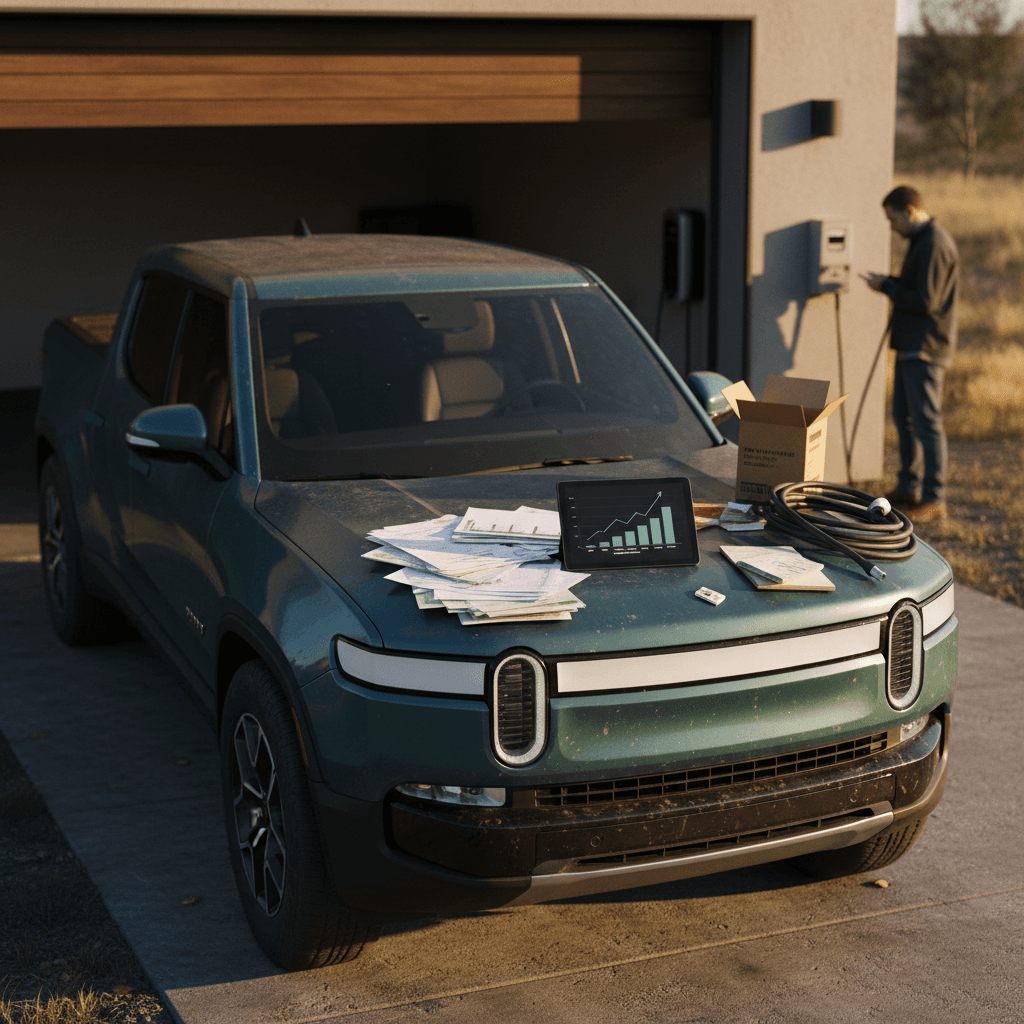
If you’re eyeing a Rivian R1T, you’re probably not just asking, “Can I afford the payment?” You want to know the true cost of ownership over 5 years, including depreciation, charging, maintenance, insurance, and incentives, so you can decide whether this electric truck really fits your budget.
What “true cost of ownership” means
Why the Rivian R1T’s 5‑Year True Cost Matters
Electric trucks like the R1T turn the usual pickup math on its head. You’re paying a premium up front for an advanced powertrain and tech, but you’re also slashing fuel and maintenance costs compared to a gas Tacoma, F‑150, or Silverado. Over a 5‑year window, the way those lines cross matters more than the sticker on day one.
Third‑party ownership-cost tools that now track the Rivian R1T peg total 5‑year out‑of‑pocket costs for a new R1T in the low‑ to mid‑$80,000s at typical U.S. mileage and insurance levels, roughly in line with premium gas trucks once you factor in fuel savings and incentives. That’s the ballpark we’ll be working in, but we’ll also talk about how buying a used R1T can cut that number dramatically.
All numbers here are estimates
Key Assumptions and What Drives R1T Ownership Costs
To keep things apples‑to‑apples, here’s the baseline scenario we’ll use for a “typical” owner. You can mentally scale the numbers up or down for your situation.
Baseline 5‑Year Ownership Scenario for Rivian R1T
Core assumptions used to estimate 5‑year true cost of ownership.
| Factor | Assumption we use | Why it matters |
|---|---|---|
| Ownership period | 5 years / 75,000 miles | Most cost‑to‑own tools use 15,000 miles per year. |
| Vehicle | Recent‑model Rivian R1T Dual Motor | Represents the volume seller in the lineup. |
| Purchase price (new) | $80,000 transaction price | Many R1Ts transact above base MSRP once options are added. |
| Purchase price (used) | $55,000 late‑model used R1T | Reflects current used‑market asking prices in many regions. |
| Annual miles | 15,000 | Higher miles magnify fuel/charging and depreciation. |
| Electricity cost | $0.19 per kWh home, $0.40 DC fast charge | Close to recent U.S. averages for residential and public fast charging. |
| Real‑world efficiency | 2.0–2.3 miles per kWh | Captures typical owner reports across seasons and wheel/tire setups. |
| Gas comparison truck | 18 mpg gasoline pickup, $3.75/gal | Useful benchmark for fuel savings math. |
Change the annual miles, electricity price, or purchase price and your results will move accordingly.
Run your own numbers
Rivian R1T: 5‑Year Cost Highlights (New Truck, Typical Driver)
Rivian R1T 5‑Year Cost Summary
To make this concrete, let’s walk through an example 5‑year ownership picture for a new Rivian R1T around $80,000 and a recent used R1T at about $55,000. These are not quotes, you should treat them as a map, not a bill, but they illustrate where the money really goes.
Illustrative 5‑Year Rivian R1T Cost of Ownership
Approximate 5‑year costs for a typical new vs used Rivian R1T at 15,000 miles per year.
| Cost category (5 years) | New R1T (~$80k) | Used R1T (~$55k) | What’s going on |
|---|---|---|---|
| Depreciation | ≈$40,000 | ≈$20,000–$25,000 | Early years hit hardest; buying used skips the steepest drop. |
| Charging (home‑heavy mix) | ≈$8,000 | ≈$8,000 | Same energy use if mileage is equal. |
| Maintenance & repairs | ≈$3,000–$4,000 | ≈$3,000–$5,000 | EVs spend less here overall, but age adds some risk for used. |
| Insurance | ≈$10,000–$12,500 | ≈$9,000–$11,000 | Higher vehicle value and comprehensive coverage drive premiums. |
| Taxes, fees, registration | ≈$6,000–$7,000 | ≈$4,000–$5,000 | Depends heavily on your state; many base it on price. |
| Financing interest (typical loan) | ≈$8,000–$10,000 | ≈$5,000–$6,000 | Financing more up front means more paid in interest. |
| Total 5‑year out‑of‑pocket (est.) | ≈$80,000–$90,000 | ≈$55,000–$65,000 | Before any federal or state EV incentives are applied. |
New trucks carry higher depreciation and finance costs; used R1Ts cut those two lines dramatically while keeping charging and maintenance similar.
Where EV ownership shines
Depreciation: What Your R1T May Be Worth in 5 Years
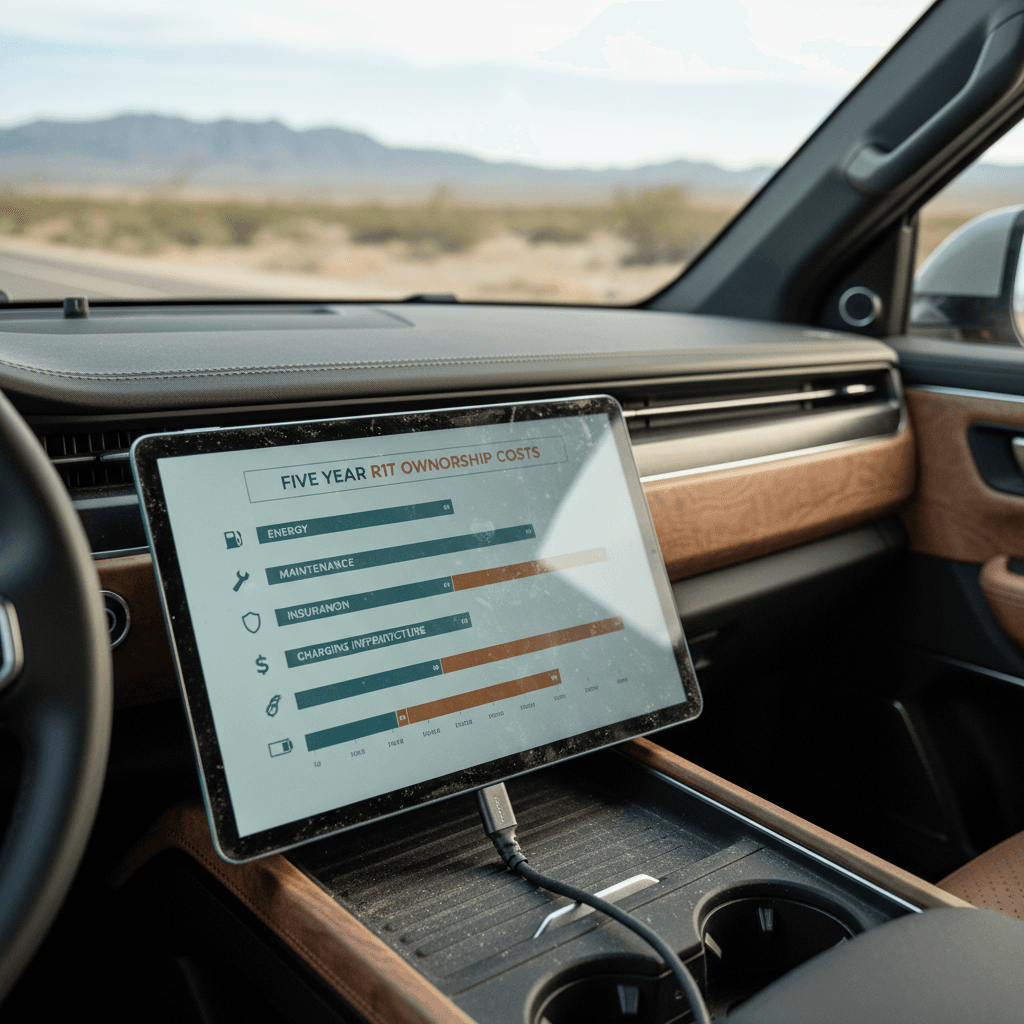
Depreciation, the difference between what you pay and what you can sell the truck for, is usually the single biggest line item in 5‑year ownership, especially for premium EVs. Current total‑cost‑of‑ownership tools that include recent model years show a new R1T shedding roughly $40,000 of value over 5 years from a high‑$70k to low‑$80k starting point.
Buying New
- Years 1–3 hurt the most. Early depreciation is steep as the market adjusts to incentives, new trims, and tech updates.
- EV tech moves quickly. New battery packs, range bumps, or price cuts on fresh models can pull used values down faster than with gas trucks.
- Upside: You get full warranty coverage from day one and the latest hardware/software.
Buying Used
- Someone else eats the steepest hit. If you buy a 2‑ or 3‑year‑old R1T at, say, $55,000 instead of $80,000 new, much of that early depreciation is already behind you.
- 5‑year window looks better. Own that used R1T for the next 5 years, and your additional depreciation might be closer to $20,000–$25,000.
- Risk: You need confidence in battery health and prior use, this is where objective battery diagnostics matter.
Use battery health to protect resale value
Charging Costs vs Gasoline Over 5 Years
Fuel is where the Rivian R1T has its cleanest shot at beating a gas truck on 5‑year total cost. Real‑world owner reports and efficiency databases put many R1Ts in the 2.0–2.3 miles per kWh window in mixed driving. Using a conservative 2.0 mi/kWh, here’s how the math looks at 75,000 miles.
Energy Cost: Rivian R1T vs Gas Truck at 75,000 Miles
Approximate 5‑year energy costs for an R1T versus a comparable gasoline pickup, assuming 15,000 miles per year.
| Item | Assumption | 5‑Year Result |
|---|---|---|
| R1T kWh used | 2.0 mi/kWh ⇒ 0.5 kWh/mi | ≈37,500 kWh over 75,000 miles |
| Home charging share | 70% at $0.19/kWh | ≈26,250 kWh ⇒ about $4,990 |
| DC fast/public share | 30% at $0.40/kWh | ≈11,250 kWh ⇒ about $4,500 |
| Total R1T energy cost | , | ≈$9,500 over 5 years |
| Gas truck mpg & fuel price | 18 mpg, $3.75/gal | ≈4,167 gallons ⇒ about $15,600 |
| Estimated savings (R1T vs gas) | , | ≈$6,000 over 5 years in this scenario |
If your electricity is cheaper than $0.19/kWh or your gas costs more than $3.75/gal, the EV advantage grows even larger.
Home charging is your lever
Maintenance and Repairs: What You’ll Actually Spend
One of the quiet advantages of EV ownership is how boring the maintenance schedule becomes. There’s no engine oil, no spark plugs, no transmission fluid, and no exhaust system to rot away. For the Rivian R1T, independent ownership‑cost tools and real‑world data suggest roughly $1,500–$1,600 in maintenance over 5 years at 15,000 miles per year for newer trucks, plus a bit more as the vehicle ages.
Typical 5‑Year R1T Maintenance Items
Most owners will deal with far fewer shop visits than they’re used to with a gas truck.
Tires
The R1T is heavy and powerful, and many trucks ride on grippier all‑terrain rubber.
- Expect at least one full set of replacements in 5 years.
- Budget: $1,200–$2,000+ depending on wheel size and tire choice.
Brake & fluid service
Regenerative braking means pads often last much longer than on gas trucks.
- Periodic brake inspections and fluid checks.
- Occasional cabin air‑filter changes.
- Budget: Low hundreds of dollars over 5 years.
Software & minor fixes
Many improvements arrive via over‑the‑air updates, but you may see:
- Warranty fixes for early‑build issues.
- Optional accessories or cosmetic work.
Most mechanical risk is covered early on by warranty.
Don’t ignore EV‑specific wear items
Insurance, Registration, and Taxes
Insurance is a meaningful slice of the 5‑year ownership pie for any premium truck, and the Rivian R1T is no exception. Because it’s heavy, powerful, and packed with expensive hardware, many owners see higher premiums than they paid for their last gas pickup, especially if they opt for robust comprehensive and collision coverage.
- A reasonable planning range for many drivers is $2,000–$2,500 per year, or $10,000–$12,500 over 5 years, but your driving record and ZIP code matter more than the badge on the tailgate.
- Registration and property tax can add another $500–$1,000 per year in states that tax based on vehicle value, especially in the early years when the truck is worth the most.
- Some states partially offset this with EV incentives or reduced registration fees, while others tack on EV‑specific road‑use fees. Always check your state’s current rules before you buy.
How to lower your R1T insurance bill
Financing: Payments and Interest Over 5 Years
Unless you’re paying cash, financing is another place where the R1T’s high sticker price shows up. With interest rates higher than they were a few years ago, the cost of borrowing deserves a line item in your 5‑year planning.
Financing an R1T: What 5 Years of Payments Really Mean
1. Understand the loan size
On an $80,000 new R1T with 10% down, you’re financing roughly $72,000 before taxes and fees. On a $55,000 used R1T with the same 10% down, you’re at about $49,500.
2. Factor in today’s rates
At mid‑single‑digit APRs over 72 months, it’s easy to spend <strong>$8,000–$10,000 in interest</strong> on a new R1T loan and <strong>$5,000–$6,000</strong> on a well‑priced used one.
3. Avoid stretching too far
Longer terms cut the monthly payment but increase lifetime interest and can leave you upside‑down if values soften faster than expected.
4. Let incentives work for you
Federal and state EV incentives can effectively lower your financed amount. Structuring those benefits into your down payment can shave both principal and interest over 5 years.
5. Consider pre‑qualification
Before you shop, getting pre‑qualified gives you a realistic payment range and makes it much easier to compare deals on specific trucks.
Where Recharged can help on financing
New vs Used R1T: Which Has Better Economics?
From a strict 5‑year cost‑of‑ownership perspective, it’s difficult for a brand‑new premium EV truck to beat a carefully chosen used one. New gives you maximum warranty and the latest hardware; used chops down depreciation and interest. Here’s how those trade‑offs usually shake out.
Arguments for Buying New
- Full factory warranty for nearly all of your 5‑year window.
- Latest tech and range, including any efficiency or charging‑speed updates.
- Ability to spec exactly what you want in terms of color, wheels, and options.
- Potential access to full federal EV tax credits or rebates, depending on current rules.
Arguments for Buying Used
- Lower entry price, often $20,000 or more below new MSRP for late‑model R1Ts.
- Slower future depreciation because the steepest curve is behind you.
- Room in your budget for upgraded tires, accessories, or home charging without blowing up the payment.
- With the right battery health documentation, you can de‑risk the biggest unknown in used EV shopping.
The 5‑year sweet spot
How Recharged Helps You Lower R1T Ownership Costs
Shopping the used market for an advanced EV like the R1T can feel risky: you’re trying to guess at battery health, prior fast‑charging habits, and whether the price really reflects fair market value. This is exactly the problem Recharged is built to solve.
Why a Used R1T From Recharged Can Change Your 5‑Year Math
Making EV ownership simpler, more transparent, and more affordable.
Verified battery health with Recharged Score
Every R1T on Recharged comes with a Recharged Score Report that includes lab‑grade battery diagnostics, so you’re not guessing about the pack that powers everything.
That helps you:
- Avoid trucks with abnormal degradation.
- Understand realistic range and resale prospects.
Fair market pricing & cost transparency
Recharged benchmarks every vehicle against the market and its battery health, so your price reflects real value, not just a VIN and odometer number.
That matters when you’re planning 5‑year depreciation and future trade‑in value.
Nationwide delivery & EV‑savvy support
Recharged’s EV‑specialist team can walk you through model‑year changes, wheel/tire choices, and charging options to match your use case, then help arrange nationwide delivery or visits to the Richmond, VA Experience Center.
Flexible ways to buy or sell
Whether you’re trading out of a gas truck or selling an R1T you already own, Recharged offers trade‑ins, instant offers, and consignment options that can lower your net cost to step into the right truck.
Ready to find your next EV?
Browse VehiclesFAQ: Rivian R1T True Cost of Ownership
Frequently Asked Questions About R1T 5‑Year Costs
Bottom Line: Is a Rivian R1T Affordable Over 5 Years?
The Rivian R1T will never be a budget beater in the way a compact hybrid is, but when you zoom out to a 5‑year true cost of ownership, it looks far more rational than its sticker might suggest. Yes, you’re paying luxury‑truck money up front, and depreciation is real, but you’re also trading gas‑station stops for lower‑cost electricity and simplifying maintenance to a level that would surprise most pickup owners.
If you’re set on the experience of an electric adventure truck, the smartest financial move for many shoppers is a late‑model used R1T with verified battery health. That’s where the lines really cross: you keep most of the capability and tech, skip the harshest depreciation, and still enjoy the EV running‑cost advantage.
When you’re ready to run numbers on a specific truck instead of a spreadsheet example, take a look at our detailed R1T vs Tacoma cost comparison, or browse used R1Ts on Recharged where every vehicle comes with a Recharged Score Report, EV‑savvy guidance, and flexible financing options. That’s how you turn a dream truck into a smart 5‑year decision.