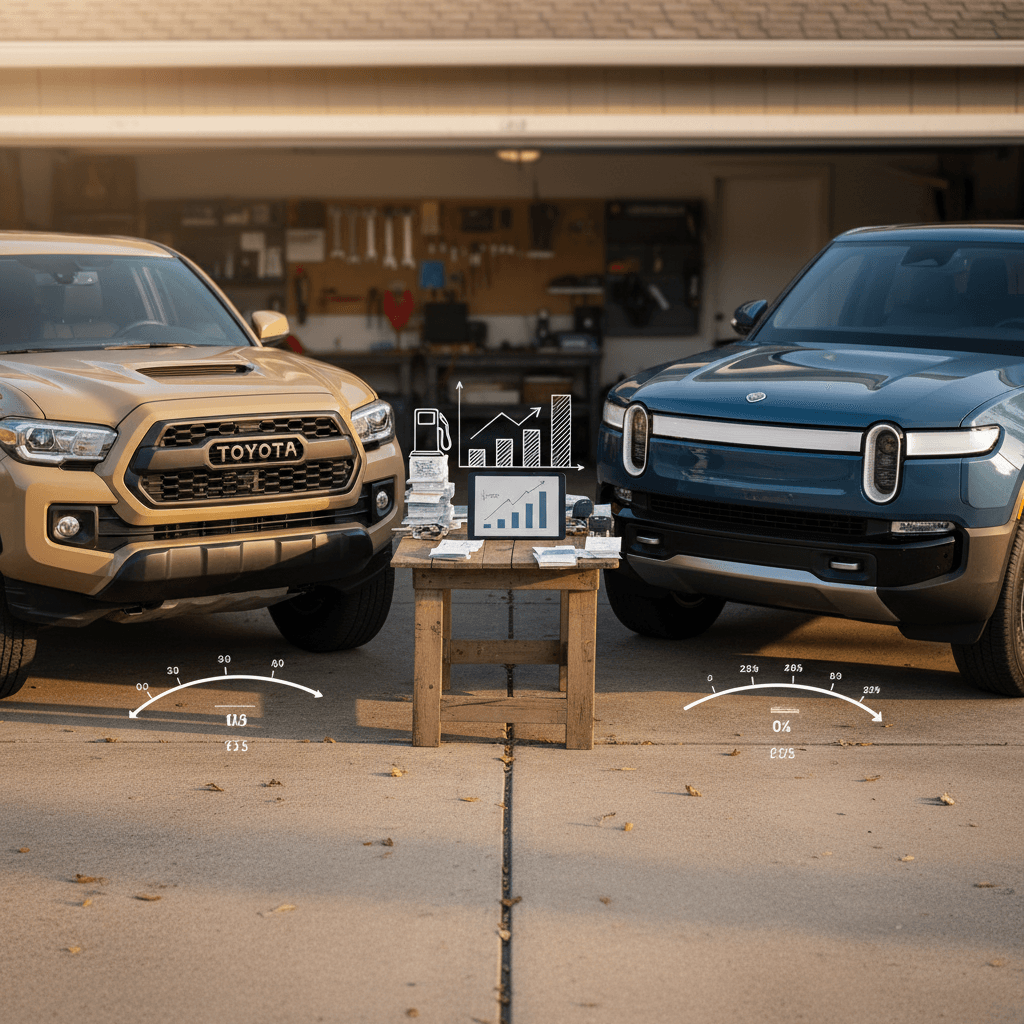
If you’re cross‑shopping a Toyota Tacoma against a Rivian R1T, you’re not just choosing between gas and electric. You’re making a long‑term money decision. The total cost of ownership, fuel or electricity, maintenance, insurance, depreciation, and taxes, can easily dwarf the sticker price over 5–10 years. This guide walks through Tacoma vs Rivian R1T total cost of ownership with realistic U.S. numbers so you can see which truck is likely to be cheaper for the way you drive.
About the numbers
Why Toyota Tacoma vs Rivian R1T Total Cost of Ownership Matters
On paper, a Rivian R1T typically costs far more to buy than a Toyota Tacoma, especially new. But once you factor in fuel, electricity, maintenance, and resale value, the story gets more complicated. Gas trucks like the Tacoma tend to be cheaper up front and simpler to insure. Electric pickups like the R1T hit you with a higher purchase price but push operating costs down, particularly if you charge mostly at home.
Who should care about this comparison?
You’ll get the most value from a TCO analysis if you fit one of these profiles.
Daily truck commuters
You drive 10,000–18,000 miles per year and care about predictable monthly costs, not just payment size.
Early EV‑curious truck owners
You’ve always driven gas pickups but are wondering if an R1T finally makes financial sense.
Used‑truck shoppers
You’re eyeing a used Tacoma or a used R1T and want to understand how depreciation and battery health affect long‑term costs.
Assumptions and How We Ran the Numbers
To compare Toyota Tacoma vs Rivian R1T total cost of ownership fairly, we need a consistent set of assumptions. Adjust these to match your own situation, but keep the framework in mind.
- Ownership horizon: 5 years (with a quick look at 10‑year outcomes later).
- Annual mileage: 12,000 miles, close to current U.S. averages for light‑duty vehicles.
- Fuel economy – Tacoma: we’ll use 21 mpg combined for a mid‑trim 4x4, which aligns with real‑world reports for modern Tacomas.
- Efficiency – R1T: 2.0 miles per kWh as a blended real‑world average, reflecting owner logs that typically fall in the 1.8–2.2 mi/kWh range depending on tires, speed, and weather.
- Energy prices: $3.75 per gallon of regular gas and $0.15 per kWh for a home‑heavy charging mix. If you rely on high‑priced DC fast charging, your electricity cost per mile will be higher.
- Purchase prices (used market baseline): think of a late‑model Tacoma in the low‑to‑mid $30,000s vs a similarly aged R1T often in the $50,000–$70,000 range, depending on pack and trim.
- Insurance and taxes: we’ll use conservative multipliers based on recent cost‑to‑own studies and what we see in the market today.
Make it your own
Fuel vs. Electricity: Cost Per Mile
Fuel and electricity are where the Rivian R1T has its most obvious shot at beating the Tacoma on total cost of ownership. We’ll start with simple cost‑per‑mile math and then translate that into 5‑year totals.
Estimated energy cost per mile
5‑year energy cost comparison
Estimated fuel vs electricity costs over 60,000 miles of driving.
| Truck | Assumed efficiency | Energy price | Cost per mile | 5‑year energy cost (60,000 mi) |
|---|---|---|---|---|
| Toyota Tacoma (gas) | 21 mpg | $3.75/gal | ≈$0.18 | ≈$10,700 |
| Rivian R1T (home‑heavy charging) | 2.0 mi/kWh | $0.15/kWh | ≈$0.075 | ≈$4,500 |
| Rivian R1T (50/50 home + expensive DC fast) | 1.9 mi/kWh blended | ≈$0.22/kWh blended | ≈$0.12–0.13 | ≈$7,200–$7,800 |
Actual totals will vary with mileage, regional prices, driving style, and charging mix.
When the Rivian loses its fuel advantage
Maintenance and Repairs: Where EVs Win and Lose
The Tacoma is legendarily durable and inexpensive to fix, but it still has all the moving parts and fluids of a traditional truck: oil changes, transmission service, exhaust components, and more. The R1T eliminates engine‑related maintenance but adds high‑cost items like large EV‑specific tires and potentially pricier body repairs.
Maintenance cost profile: Tacoma vs R1T
Toyota Tacoma (gas)
- Routine service: Regular oil changes, spark plugs, transmission fluid, coolant service, differential service.
- 5‑year estimate: Independent cost‑to‑own calculators often land in the $5,000–$6,000 range over 5 years for maintenance and repairs on a mid‑trim Tacoma driven 12,000 miles/year.
- Big unknowns: As the truck ages, suspension components, exhaust, and more complex automatic transmissions add cost.
Rivian R1T (electric)
- Routine service: No oil changes; far fewer fluids and filters. Brake wear is lighter thanks to regenerative braking.
- 5‑year estimate: Scheduled maintenance is modest, but owners often spend more on tires and potentially glass/body work. Many real‑world logs suggest total maintenance outlay similar to or slightly lower than a comparable gas truck in the first 5 years.
- Big unknowns: Out‑of‑warranty repairs on complex EV components can be expensive. Battery health matters a lot for long‑term costs and resale value.
Battery health is a cost line item
Insurance Costs and Taxes
Insurance and taxes are quieter parts of the total cost of ownership story, but over five years they add up to thousands of dollars.
Tacoma: mainstream, easier to insure
Most insurers know the Tacoma well and price policies accordingly. It’s a conventional midsize pickup built in large volumes, with predictable repair costs and a broad parts supply. Annual insurance premiums for a typical driver tend to be moderate compared with full‑size trucks or luxury EVs.
Registration fees and personal property taxes (where applicable) are also predictable. Some states charge extra for EVs, which the Tacoma avoids.
R1T: higher sticker, higher premiums
The Rivian R1T is a premium electric truck with expensive components and relatively limited repair networks. That often translates into higher insurance premiums than a Tacoma with a similar driver profile.
On the flip side, an R1T may qualify for EV‑friendly registration perks or HOV incentives in some states, but a growing number of states also tack on annual EV fees that can eat into your fuel savings.
Don’t ignore repair network coverage
Depreciation and Resale Value
Depreciation, the value your truck loses as it ages, is often the single largest cost of ownership. Here, the Tacoma and R1T follow very different paths.
How each truck tends to lose value
Tacoma depreciation profile
- Historically strong resale: The Tacoma has one of the best resale reputations in the pickup segment. Many 5‑ to 7‑year‑old Tacomas still command high prices relative to original MSRP.
- Predictable curve: Depreciation is steady rather than cliff‑like. That stability keeps long‑term cost of ownership in check, even if you drive high miles.
- Fuel economy penalty: If gas stays expensive, older, thirstier trucks may soften a bit in the used market, but the Tacoma’s brand strength is a strong counterweight.
R1T depreciation profile
- Faster early depreciation: Like many new EVs and luxury vehicles, the R1T has seen faster price declines in its first few model years as production ramps and incentives move around.
- Technology pace: Improvements in range, software, and driver‑assist tech can put early trucks at a disadvantage, weighing on used values.
- Upside for used buyers: That same depreciation can make a used R1T a relative bargain versus its original MSRP, if you’re confident in the battery and plan to keep it.
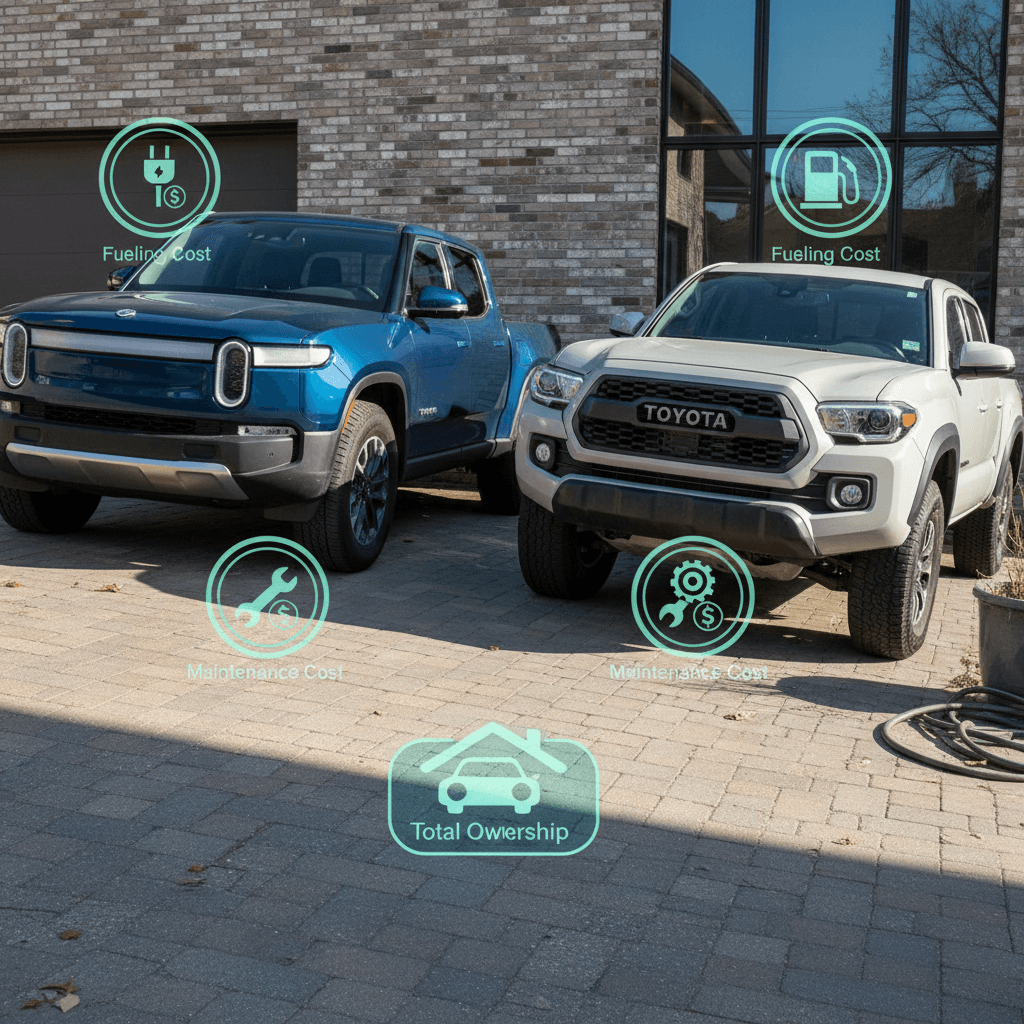
5‑Year Total Cost of Ownership: Tacoma vs R1T
Putting it all together, here’s a simplified 5‑year total cost of ownership comparison for a typical U.S. driver. Think of this as a framework, not an exact quote.
Estimated 5‑year total cost of ownership (60,000 miles)
Illustrative comparison for a mid‑trim Toyota Tacoma vs a Rivian R1T driven 12,000 miles per year in the U.S.
| Cost category (5 years) | Toyota Tacoma (gas) | Rivian R1T (electric, home‑heavy charging) |
|---|---|---|
| Depreciation | ≈$11,000–$13,000 | ≈$20,000–$30,000 |
| Fuel / electricity | ≈$10,700 | ≈$4,500–$7,800 |
| Maintenance & repairs | ≈$5,000–$6,000 | ≈$4,000–$6,000 (incl. tires) |
| Insurance | ≈$8,000–$10,000 | ≈$10,000–$13,000 |
| Taxes & fees (incl. EV fees where applicable) | ≈$3,000–$4,000 | ≈$3,000–$4,500 |
| Approximate 5‑year total | ≈$38,000–$44,000 | ≈$41,000–$61,000 |
Numbers are rounded to the nearest $100 and will vary by state, trim, incentives, and individual circumstances.
Key takeaway from the 5‑year math
10‑Year View: What Happens If You Keep It Longer?
Stretch the horizon to 10 years and 120,000 miles, and the balance starts to shift. Depreciation becomes less important, both trucks have lost most of their value, but operating costs continue to accumulate.
What changes over 10 years?
1. Energy savings compound
At 120,000 miles, even a modest 6–10 cents‑per‑mile advantage for the R1T can translate into <strong>$7,000–$12,000</strong> in lifetime fuel savings compared with a Tacoma.
2. Tacoma maintenance climbs
As the Tacoma ages, major maintenance items, timing components, suspension, exhaust, possible transmission repairs, can start to show up. Those are less likely on an R1T in the same timeframe, though not impossible.
3. Battery health becomes critical
After a decade, the R1T’s total cost of ownership depends heavily on how well its battery has aged. A healthy pack with modest range loss keeps the truck useful and valuable. A degraded or abused pack can turn into a five‑figure problem.
4. Technology gap widens
A 10‑year‑old Tacoma will feel dated but familiar; a 10‑year‑old R1T might lag current EVs on range and software. That can soften resale value and make it less appealing as a second‑owner purchase, even if operating costs stay low.
High‑mileage drivers tilt the math
Non‑Financial Factors: What Numbers Don’t Capture
Total cost of ownership is bigger than dollars. A Tacoma and an R1T deliver very different day‑to‑day experiences, and those soft factors often drive the final decision.
Everyday experience: gas vs electric truck
Driving feel
The R1T is quiet, quick, and refined in a way gas trucks simply aren’t. If you value instant torque and near‑silent highway cruising, it’s hard to go back.
Range and refueling
The Tacoma offers long highway range, near‑instant refueling, and dense gas station coverage. The R1T requires more planning on road trips and time at chargers, though the experience is improving.
Home base realities
If you have a garage and can install Level 2 charging, the R1T’s convenience is unmatched. If you street‑park or rely on shared parking with no charging, the Tacoma is far easier to live with.
“The smartest truck buyers are thinking about ownership in layers, purchase price, monthly operating cost, and what the truck will be worth when they’re done with it. Gas and electric pickups just stack those layers differently.”
So Which Truck Is Cheaper to Own?
When you line up Toyota Tacoma vs Rivian R1T total cost of ownership, there isn’t one universal winner. It comes down to how you drive, how long you keep your truck, and how you charge.
When a Tacoma usually wins
- Shorter ownership: You’ll likely keep the truck 3–6 years, then sell or trade.
- Moderate miles: You drive around 10,000–15,000 miles per year.
- Financing‑sensitive: Monthly payment and insurance are bigger concerns than energy cost.
- Limited charging access: You don’t have reliable at‑home charging or cheap public options.
In this scenario, the Tacoma’s lower purchase price, easier insurance, and slow, steady depreciation typically undercut the Rivian’s higher upfront cost and steeper early value drop.
When an R1T can make financial sense
- High mileage: You regularly clock 18,000+ miles per year and can amortize the purchase price over more miles.
- Home charging: You charge mostly at home at $0.10–$0.15/kWh, not at high‑priced fast chargers.
- Buying used: You pick up a used R1T after the steepest depreciation hit, with verified battery health.
- Long ownership: You’re comfortable keeping an EV truck 8–10 years and riding the operating‑cost advantage.
Under those conditions, the R1T’s lower energy and maintenance costs over many miles can narrow or even close the total‑cost gap to a Tacoma, especially in the used market.
How Recharged Can Help if You’re Considering a Used R1T
If you’re leaning toward a Rivian R1T but nervous about long‑term ownership costs, the used market, and the quality of the specific truck you buy, matter more than any average. That’s where a data‑driven, EV‑specific approach makes a difference.
What you get with a used R1T from Recharged
Verified battery health with the Recharged Score
Every R1T sold through Recharged includes a <strong>Recharged Score Report</strong> with third‑party battery diagnostics. That gives you a clear view of usable capacity and helps you avoid trucks with hidden degradation that could torpedo your cost of ownership later.
Transparent pricing vs fair market value
Recharged benchmarks each truck, Tacoma, R1T, or otherwise, against current market data so you can see how the price compares to similar vehicles nationwide. That’s crucial when you’re weighing whether an electric truck’s higher entry cost is justified.
Financing and payment clarity
Built‑in <strong>EV‑friendly financing</strong> tools show you how a specific R1T’s payment stacks up against the fuel savings you’re likely to see, helping you focus on all‑in monthly cost, not just sticker shock.
Trade‑in or cash offer for your current truck
If you’re coming out of a Tacoma or another gas pickup, Recharged can evaluate your vehicle for a trade‑in, instant offer, or consignment, which lets you recapture some of your existing truck’s strong resale value.
Nationwide delivery and specialist support
With a fully digital buying experience, nationwide delivery, and EV‑specialist support (plus an Experience Center in Richmond, VA), Recharged is set up for buyers who may be on their first electric truck and want guidance beyond the numbers.
FAQ: Tacoma vs Rivian R1T Ownership Costs
Common questions about Tacoma vs R1T total cost of ownership
Whether you end up in a Toyota Tacoma or a Rivian R1T, the smartest move is to think of your truck as a 5‑ to 10‑year financial product, not just a one‑time purchase. For many mainstream buyers, the Tacoma still delivers a lower and more predictable total cost of ownership. For high‑mileage drivers with good charging options, or shoppers eyeing a well‑priced used R1T with a strong battery report, the electric path can start to make sense. Run the numbers for your own driving, then choose the truck that fits both your life and your long‑term budget.