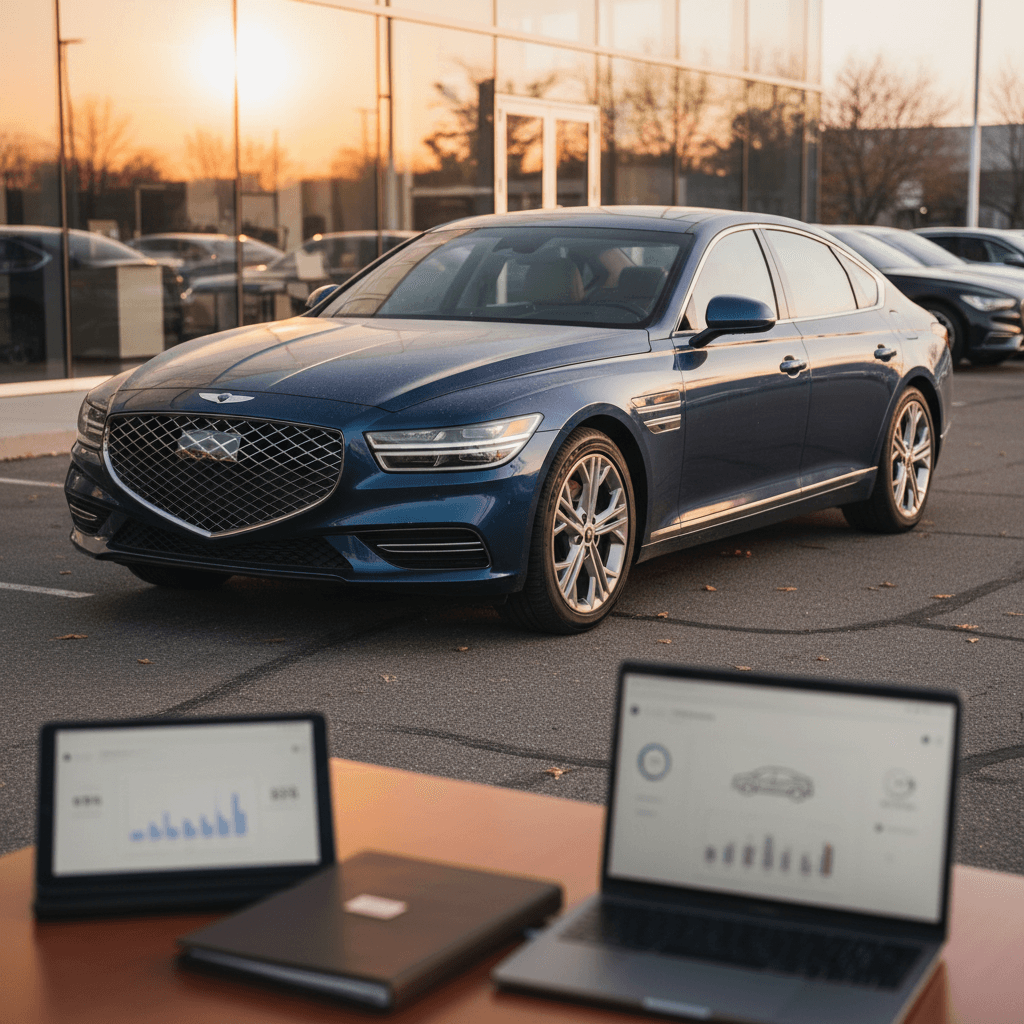
If you own a Genesis G80 Electrified and you’re thinking about selling, you’re in a very particular corner of the market. Genesis has already discontinued the model in the U.S., it sold in tiny numbers, and it’s a luxury EV sedan in a crossover‑obsessed world. That combination changes both where to sell a used Genesis G80 Electrified and how you should approach pricing and timing.
A niche luxury EV
Why Selling a Genesis G80 Electrified Is Different
Most used cars fall into huge, well‑understood buckets: mainstream crossovers, fleet sedans, popular trucks. The Electrified G80 doesn’t. It’s a low‑volume luxury EV sedan built on a gasoline platform, with excellent warranty coverage but weak U.S. sales before Genesis discontinued it. That means many buyers, and many dealers, simply don’t know what to make of it.
- Slow U.S. sales mean fewer comparable vehicles and more pricing uncertainty.
- Genesis stopped offering the Electrified G80 to U.S. buyers after the 2024 model year, which makes every used example a bit of an orphan.
- Generous 10‑year/100,000‑mile battery coverage (for original owners) is a real asset, but not every buyer understands how it transfers.
- Traditional dealers are often more comfortable discounting these aggressively than explaining why they’re special.
Discontinued doesn’t always mean worthless
Quick answer: where to sell your Electrified G80
Top 4 places to sell a Genesis G80 Electrified
Each channel trades off speed, price, and hassle. Here’s the 30‑second view before we go deep.
1. Genesis / Hyundai dealers
Best for: Convenience and trade‑ins when you’re buying another Genesis or Hyundai.
Pros: Easy paperwork, potential loyalty incentives.
Cons: Often the lowest offers on Electrified G80s; some stores simply don’t want them on the lot.
2. CarMax & similar retailers
Best for: Quick, no‑obligation cash offers.
Pros: Fast, transparent quotes and easy process.
Cons: Generic EV pricing models may undervalue a niche luxury sedan like the G80 EV.
3. Private‑party sale
Best for: Maximizing price when you can wait.
Pros: Highest potential sale price if you find the right buyer.
Cons: More time, more risk, and you have to explain EV and warranty details yourself.
4. EV‑focused marketplaces (like Recharged)
Best for: Balancing price, speed, and EV‑savvy buyers.
Pros: Battery health diagnostics, EV‑specific marketing, expert support.
Cons: Availability depends on your region and marketplace capacity.
Rule of thumb
Option 1: Genesis and Hyundai dealers
Your first instinct might be to drive your Electrified G80 back to a Genesis or Hyundai store and ask for a number. That’s not wrong, but you need to understand their incentives. For many dealerships, a discontinued, slow‑selling EV sedan with unusual equipment is exactly the kind of car they’d rather not own.
When a Genesis/Hyundai dealer makes sense
- You’re trading into another Genesis or Hyundai and want tax savings from a trade‑in credit.
- Your car is still low‑mileage and in excellent cosmetic condition, making it easier for them to certify.
- You live far from big used‑car retailers and don’t want to manage multiple offers.
Why offers can be disappointing
- Sales teams in some markets have struggled to move Electrified G80s, new or used.
- Managers may assume they’ll have to heavily discount it again to the next buyer.
- They may “price it like a sedan” rather than a well‑equipped luxury EV with a strong warranty.
Use trade‑in quotes as data points, not destiny
Option 2: Big used‑car retailers like CarMax and Carvana
Nationwide used‑car retailers, CarMax, Carvana and regional chains, have well‑oiled systems for buying cars quickly. For an Electrified G80, they’ll look at similar Genesis sedans, EV luxury competitors, and auction data to generate an offer. That gives you speed and convenience, but not always deep understanding of the car’s quirks and strengths.
What you’re trading with big retailers
Check their appetite for EVs right now
Option 3: Private‑party sale
Selling your Electrified G80 directly to another driver, through Autotrader, Cars.com, Facebook Marketplace, or local classifieds, can deliver the highest price, especially given how rare this car is. But you’re also taking on the work that dealers and marketplaces normally handle: marketing, screening, test drives, and paperwork.
- You’ll need to educate buyers about the car: what it is, why it was discontinued, and how the battery warranty works.
- Most mainstream shoppers are looking for crossovers, not big sedans, so it may take longer to find the right match.
- You’ll have to answer questions about charging speed, range, software updates, and battery health, topics many private sellers aren’t fully comfortable with.
- You carry more risk around fraud, payment issues, and post‑sale disputes.
Protect yourself in private sales
Option 4: EV‑focused marketplaces like Recharged
If there were ever a poster child for selling through an EV‑focused platform, the Genesis Electrified G80 is it. It’s a luxury EV with great warranty coverage and quietly strong engineering, but weak brand awareness and confusing messaging. Generic dealers often don’t want to explain that story; an EV specialist will.
Why an EV marketplace fits the Electrified G80
Your car needs buyers, and sales teams, who actually understand electric vehicles.
Battery health is front and center
Platforms like Recharged highlight battery health diagnostics instead of burying them. That matters with early‑generation luxury EVs, where shoppers worry about long‑term range.
Right audience, not random eyeballs
EV‑only marketplaces attract shoppers who start with an electric car in mind. You’re not competing with $20k gas crossovers for attention.
Pricing against the EV market
Specialists look at EV‑specific comps, other Genesis EVs and competing luxury EV sedans, rather than treating your car like a generic used sedan.
At Recharged, every vehicle gets a Recharged Score Report that includes verified battery health, a transparent look at fair‑market pricing, and expert‑guided support. Because we only deal with EVs, an Electrified G80 isn’t a problem to hide on the back row, it’s an opportunity to match a rare car with the right buyer.
How Recharged fits into your selling plan
Ready to find your next EV?
Browse Vehicles
How much is a used Genesis Electrified G80 worth?
Because the Electrified G80 sold in such low volumes, pricing tools don’t always agree. But a few patterns have emerged in recent data. Well‑equipped 2023–2024 cars with typical mileage have already seen heavy depreciation, which is painful if you bought new, but a potential opportunity if you’re buying or selling used.
Approximate price bands for used Electrified G80s
These are directional, national‑level ranges; your local market, mileage, options, and condition will push your car up or down.
| Model year & miles* | Realistic retail asking price | Likely dealer trade‑in range | Notes |
|---|---|---|---|
| 2022 · 20k–40k mi | Mid $30,000s–low $40,000s | High $20,000s–low $30,000s | Older build dates and more miles; value hinges heavily on warranty transfer details and battery state. |
| 2023 · 10k–30k mi | High $30,000s–high $40,000s | Low–mid $30,000s | Sweet spot for buyers: modern equipment with steep depreciation already baked in. |
| 2024 · under 15k mi | High $30,000s–high $40,000s | Low–mid $30,000s | Still relatively new; some stores may still compare to leftover new‑car pricing or incentives. |
| Fleet or corporate history | Typically 5–10% below similar private‑use cars | 5–15% below clean private‑use trade‑ins | Service history and cosmetic condition become very important; some buyers are wary of early fleet EVs. |
Use multiple valuation sources, then adjust for your actual battery health, warranty status, and regional demand.
Use multiple sources, not just one
How battery warranty and health affect your sale
With any used EV, but especially a niche luxury sedan like the Electrified G80, battery health is the main thing buyers can’t see or touch. Genesis advertises a 10‑year/100,000‑mile high‑voltage battery warranty for the original owner, and separate coverage for other EV components. How much of that protection carries to the next owner, and what your real‑world range looks like, will move your price more than a set of wheels or a paint color ever could.
1. Know what still applies
- Confirm in your warranty booklet (or with a Genesis service advisor) which portions of the EV and battery warranty transfer to the next owner.
- If you’re the original owner and still within 10 years/100,000 miles, that’s a major reassurance for buyers, advertise it clearly.
- If the car is Certified Pre‑Owned (CPO), be prepared to explain how that coverage stacks with the factory EV warranty.
2. Document real battery health
- Capture screenshots of range at 100% charge under typical driving conditions.
- Pull any available battery or high‑voltage system health reports from Genesis service visits.
- Consider a third‑party battery assessment, platforms like Recharged do this as part of the Recharged Score Report, which can materially boost buyer confidence.
Turn warranty into a selling point, not an afterthought
Checklist: prep your Electrified G80 to sell
10 steps to get your Genesis G80 Electrified ready to sell
1. Pull service and warranty records
Download or request your maintenance and warranty history from Genesis. Buyers, and EV marketplaces, will pay more for cars with clear documentation, especially on software updates and any high‑voltage system work.
2. Get a battery health snapshot
Charge to 100% and record the displayed range under normal conditions. If you can, obtain a formal battery health report or use a platform like Recharged that includes this in a Recharged Score Report.
3. Fix obvious cosmetic issues
Luxury EV buyers notice curb rash and door dings. Small reconditioning (detail, paintless dent repair, wheel touch‑up) can return more than it costs, particularly in private or marketplace sales.
4. Clear warning lights and software issues
If there are outstanding recalls or software updates, get them done before listing. A clean dashboard builds trust; warning lights scare off retail buyers and lower dealer offers.
5. Gather both keys, manuals, and charging gear
Having both keys, the mobile charge cable, and any accessories (floor mats, V2L adapters if applicable) signals a cared‑for car and can set your listing apart from sparse dealer ads.
6. Photograph it like a luxury car
Shoot in good light, with the car washed and the interior spotless. Include shots of the charging port, driver display, range at full charge, and any standout options like Nappa leather or premium audio.
7. Write an honest, EV‑savvy description
Explain range, charging habits (home vs. DC fast), and why you’re selling. Address the discontinuation candidly: buyers will Google it anyway, so you might as well get ahead of the story.
8. Decide on your minimum acceptable price
Use price guides, dealer and CarMax quotes, and EV marketplace estimates to set a walk‑away number. Knowing your floor keeps negotiations from getting emotional.
9. Choose your primary selling channel
If time matters more than every last dollar, prioritize dealers and large retailers. If net proceeds matter most, lean into EV marketplaces or a carefully managed private sale.
10. Plan the paperwork
Check your state’s rules for title transfer, payoff logistics if you still have a loan, and sales tax implications if you’re trading into another vehicle.
Common mistakes owners make when selling this car
- Assuming any Genesis dealer will love the car. Some stores actively avoid stocking slow‑turn EV sedans and will lowball accordingly.
- Hiding the discontinuation story. Buyers will find out that the Electrified G80 left the U.S. market; framing it as "rare and well‑supported by warranty" is better than pretending it didn’t happen.
- Ignoring battery health documentation. A vague “range is fine” doesn’t cut it for EV shoppers, especially on a niche model.
- Pricing only off the original MSRP. Luxury EV sedans have seen steep depreciation; your emotion about what you paid won’t sway today’s market.
- Under‑marketing the cabin and refinement. The Electrified G80’s interior, ride quality, and quietness are core selling points, show and describe them in detail.
Don’t treat it like a generic used sedan
FAQ: selling a used Genesis G80 Electrified
Frequently asked questions
Bottom line: choosing the right buyer for your G80 EV
The Genesis G80 Electrified is not just another used sedan, it’s a low‑volume luxury EV that rewards the right owner and confuses the wrong one. That’s why where you sell it matters as much as what you’re selling. Traditional dealers and big retailers buy quickly but tend to see it as inventory risk, not an opportunity. Private‑party buyers and EV‑focused marketplaces, by contrast, are more likely to appreciate its craftsmanship, quietness, and warranty‑backed battery tech.
If your priority is to be done this week, start with a couple of dealer and CarMax‑style offers to establish the floor. If you care about maximizing value, and giving the car a home with an owner who understands what it is, lean toward an EV‑centric path: a thoughtful private‑party listing or a specialist marketplace like Recharged that can back your Electrified G80 with a Recharged Score Report, expert guidance, and a nationwide pool of EV shoppers.