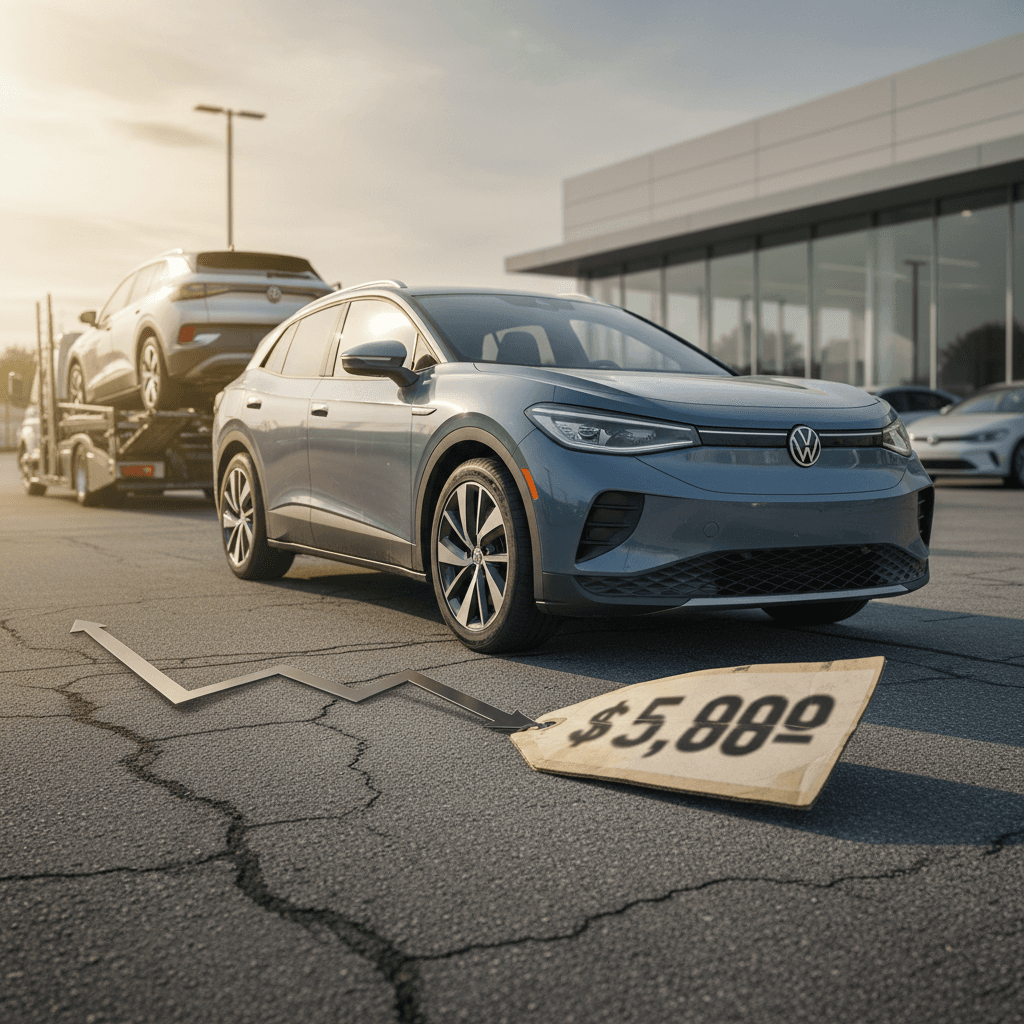
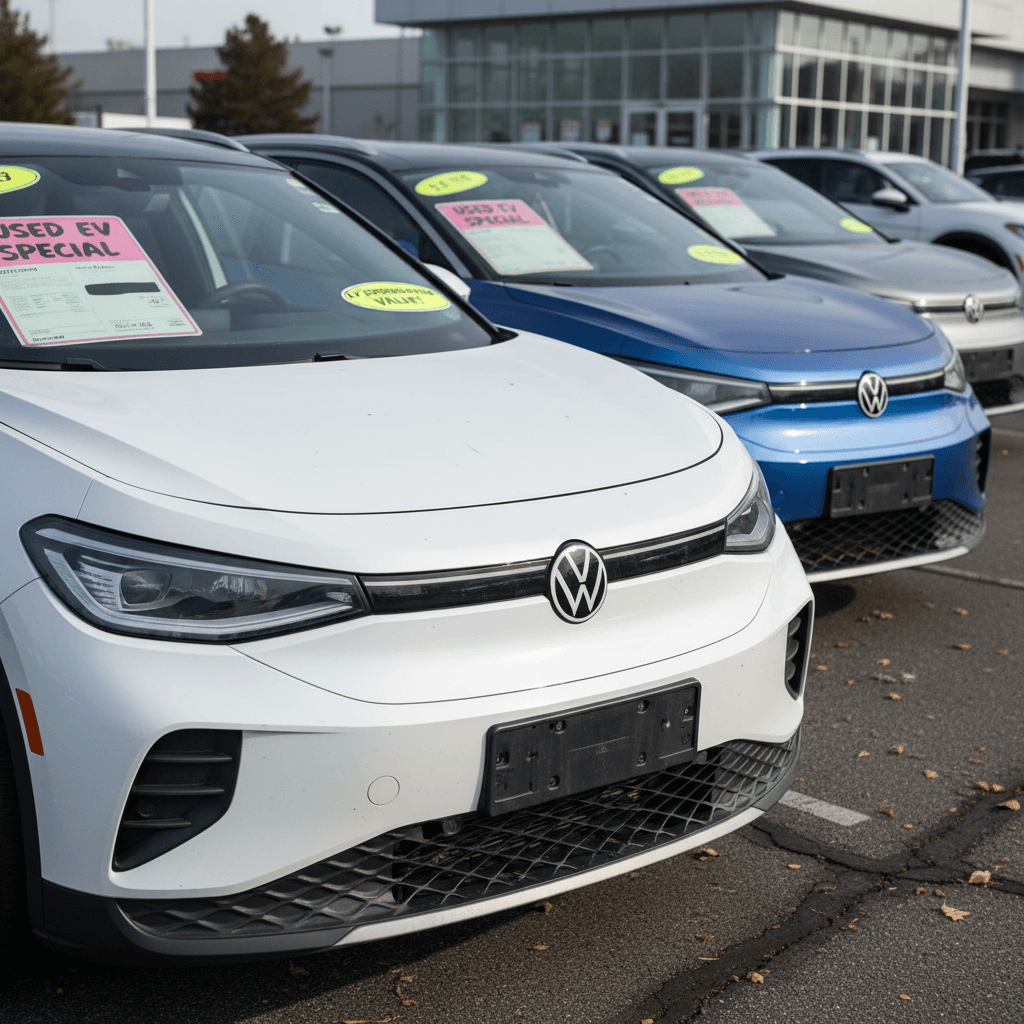
If you’re eyeing a Volkswagen ID.4, you’ve probably heard a version of the same whisper: **“EVs depreciate fast.”** The natural follow‑up is your query today, VW ID4 depreciation, how fast does it really happen? The answer is: faster than a comparable gas Tiguan, but that curve can be your friend if you’re shopping used in 2026.
Quick context: it’s not just VW
VW ID.4 depreciation at a glance
How fast a VW ID.4 typically loses value
Those are market averages and guideposts, not a guarantee on any single car. Trim, incentives, mileage, and how aggressive the dealer was on discount day one all change the curve. But it gives you a working answer to “how fast does a VW ID.4 depreciate?”, pretty quickly in the first 3–5 years, then it starts to level off.
How fast does a VW ID.4 depreciate?
Let’s put some numbers to it. Take a typical ID.4 Pro with an original sticker in the low‑to‑mid $40,000s. Here’s roughly how that value arc tends to look in the current U.S. market:
Illustrative VW ID.4 depreciation curve
Approximate retail asking price trajectory for a mainstream ID.4 Pro trim based on recent market data and EV depreciation trends.
| Vehicle age | Typical price vs. original MSRP | What you’re likely to see |
|---|---|---|
| Brand new | Paying close to MSRP, sometimes less | Heavy discounts and manufacturer incentives on new ID.4s can already push real transaction prices below sticker. |
| 1 year old | ≈15–20% below MSRP | Ex‑loaners, early lease returns, or low‑mile cars that took the “drive‑off‑the‑lot” hit. |
| 3 years old | ≈35–45% below MSRP | The sweet spot: a big chunk of depreciation is already gone, but plenty of warranty remains. |
| 5 years old | ≈55–60% below MSRP | Where EVs, including the ID.4, often bottom out relative to original price before flattening. |
Actual values vary by trim, region, incentives, and condition. Use this as a directional guide, not a quote.
Look at transaction prices, not just MSRP
Why the VW ID.4 depreciates the way it does
Four forces pushing ID.4 prices down
Some are temporary market noise; some are baked into the cake.
1. Fast‑moving EV tech
Every model year, range edges up, efficiency improves, and charging speeds inch higher. That makes early‑build ID.4s feel older, faster.
When a shopper can get a newer ID.4, or a rival EV, with more range and a quicker infotainment system, they demand a discount on last decade’s pixels.
2. Range and charging anxiety
The ID.4’s real‑world range is competitive for commuting, but U.S. buyers remain skittish about road‑trip flexibility and non‑Tesla charging reliability.
Perception matters: even if you charge mostly at home, shoppers price in the headache factor, and that shows up as lower resale.
3. Early‑run teething issues
First‑wave ID.4s arrived with some software quirks and build‑quality gripes. Most of it is fixable, but reputation lags reality.
That softens demand on the used side, particularly for 2021–2022 builds with less refined interfaces and older software.
4. EV incentives and price cuts
When new‑car prices move suddenly, factory discounts, changing tax credits, or rival EV price cuts, used values get dragged along.
The whole EV segment experienced a reset in 2024–2025 as inventories rose and incentives shifted, and ID.4s were right there in the downdraft.
Notice what’s not on that list: catastrophic battery failure. Thanks to a long high‑voltage battery warranty and conservative charging behavior by most owners, **the ID.4’s hardware is generally holding up better than its resale values suggest.** Which brings us to the gap between battery health and book value.
Battery health vs. dollar value
Volkswagen backs the ID.4’s high‑voltage battery for 8 years or 100,000 miles in the U.S., to at least 70% of original capacity. In practice, real‑world testing on similar VW battery packs has shown far less degradation than that conservative floor over the first 4–5 years.
What the warranty means for you
- Time buffer: A 3‑year‑old ID.4 still has 5 years of battery warranty left for the next owner.
- Capacity floor: If capacity drops below 70% within 8 years/100k miles, VW may repair or replace the pack.
- Peace of mind: You’re not buying a chemistry experiment, you’re buying a component with a defined safety net.
Why prices still fall so hard
- Depreciation is emotional: Shoppers price in fear of future tech obsolescence, not just actual wear.
- Market adjustment: The whole EV segment is repricing after a rapid run‑up in 2021–2022 used car values.
- Mixed press: Early stories about EV depreciation cast a long shadow, even on better‑behaved packs.
Where Recharged comes in
Ready to find your next EV?
Browse VehiclesID.4 depreciation vs. gas SUVs and other EVs
To understand whether the ID.4 is a problem child or just a kid in a rough neighborhood, you need to compare it with both a mainstream gas SUV and its EV peers.
How the ID.4’s 5‑year depreciation compares
High‑level comparison of 5‑year depreciation for a compact gas SUV, the VW ID.4, and the broader EV segment, based on recent market analyses.
| Vehicle type | Typical 5‑year depreciation | What it looks like in dollars |
|---|---|---|
| Mainstream compact gas SUV | ≈45–50% | A $35,000 gas SUV might resell for around $18,000–$19,000 after five years. |
| VW ID.4 | ≈55–60% | A $44,000 ID.4 might resell in the high‑teens to low‑20s after five years. |
| Average battery‑electric SUV | ≈55–65% | Many non‑Tesla EVs now land in this band, especially early‑generation models. |
These are ballpark segment averages, not guarantees for any individual VIN.
So the VW ID.4 is not an outlier basket case; it’s riding the same roller coaster most non‑Tesla EVs are on. The crucial thing for you as a shopper is this: **steeper depreciation punishes the first owner and often rewards the second.**
Be careful comparing to Tesla
When buying a used ID.4 makes the most sense
Who should seriously consider a used VW ID.4?
Depreciation can be your ally if you play to the ID.4’s strengths.
Suburban commuters
If you do 20–60 miles a day and can charge at home, the ID.4 makes more financial sense used than new. You let the first owner eat the big drop while you enjoy low running costs.
Battery‑value hunters
If you care more about a healthy pack than bragging rights for the newest UI skin, a 3‑year‑old ID.4 with strong battery diagnostics is a bargain relative to MSRP.
Payment‑sensitive buyers
Because depreciation is front‑loaded, used ID.4s often give you more metal, more safety tech, and more comfort for the monthly payment than a new gas compact SUV.
If you’re a serial flipper who trades out of cars every two years, buying any new EV right now is hard to justify. But **if you expect to hold a used ID.4 for 4–7 years, the worst is likely already behind it**.
How to spot a good ID.4 deal
Used VW ID.4 depreciation checklist
1. Focus on the 2–4‑year window
This is where ID.4s have shed a large chunk of value but still carry healthy new‑car feel and plenty of battery and bumper‑to‑bumper coverage. A 2022 bought in 2026, for example, often hits the sweet spot.
2. Verify battery health, don’t guess
Ask for a recent battery health report or diagnostics. On Recharged, this is baked into the Recharged Score, so you’re not buying blind on the most expensive component.
3. Read the incentive history
If the first owner got a huge rebate or tax credit, the effective price they paid was lower than sticker. That changes how “bad” their depreciation really is, and how flexible they might be on resale pricing.
4. Compare to new out‑the‑door numbers
Don’t compare a used 3‑year‑old ID.4 just to the new MSRP page. Compare it to what you’d realistically pay today after current discounts, taxes, and fees on a new one.
5. Inspect for software and recall updates
Make sure major software updates and recalls have been performed. It improves day‑to‑day experience and future resale, and it tells you the car was cared for.
6. Cross‑shop total cost of ownership
Include insurance, fuel/electricity, and maintenance. Many EVs cost more up front (or lose more value) but claw back money every month on operating costs.
Use marketplaces that specialize in EVs
Leasing vs. buying a VW ID.4
Because the ID.4 depreciates quickly on paper, leasing can look attractive, Volkswagen (and its finance arm) carry the residual‑value risk. But there are trade‑offs.
When leasing an ID.4 makes sense
- You like new tech: If you want the latest range bump, charging software, and screen layout every 3 years, lease and let VW eat the resale risk.
- Rich lease incentives: In some regions, lease cash and subsidized money factors effectively bake federal incentives into your monthly payment.
- You’re unsure about long‑term EV ownership: Leasing is a 3‑year test drive of the whole lifestyle, charging, winter range, road trips, without a long tail.
When buying used is smarter
- Depreciation has already hit: A 3‑year‑old ID.4 bought at a steep discount from MSRP can cost less per year than serial leasing.
- You’re willing to hold: If you’ll keep the car until year 7–8, you spread depreciation over more miles and more years of low running costs.
- You want equity: Owning a well‑bought used ID.4 gives you something to trade in when you’re ready for the next EV.
Financing a used ID.4
Common mistakes that hurt ID.4 resale value
- Ignoring software and recall updates, which can spook the next buyer and drag down offers.
- Skipping documented maintenance, EVs have fewer moving parts, but buyers still want service records.
- Treating fast charging like it’s free candy; constant DC fast charging can accelerate battery wear on any EV.
- Putting ultra‑aggressive tires or suspension mods on the car, which narrows your resale audience.
- Under‑optioning your car when buying new (e.g., no heat pump or driver‑assist features), which later makes it easy to skip past in used‑car search filters.
The quickest way to light money on fire
FAQ: VW ID.4 depreciation and resale
Your VW ID.4 depreciation questions, answered
Bottom line: Is a used VW ID.4 worth it?
If you’re the original owner paying close to MSRP and planning to bail in two years, the VW ID.4’s depreciation curve is unforgiving. But that’s not the whole story. For the second owner, the one shopping carefully, reading battery reports, and thinking in 5‑ to 8‑year horizons, the ID.4’s rapid early depreciation is a feature, not a bug.
You get a roomy, quiet, well‑equipped electric SUV for compact‑gas‑money, typically with years of battery warranty still in your back pocket. If you use a specialist marketplace like Recharged that verifies battery health, prices to the current EV reality, and supports EV‑specific financing and trade‑ins, you can let someone else fund the steep end of the curve while you enjoy the payoff: low running costs and a calmer relationship with the gas pump.