If you’re eyeing the all‑electric Volkswagen ID. Buzz as a family hauler, camper van, or small-business workhorse, the big question isn’t just whether it’s cool. You want to know what it costs per mile to drive, and how that compares with a gas minivan or traditional van you might already own.
At-a-glance answer
Volkswagen ID. Buzz cost per mile: quick overview
Estimated Volkswagen ID. Buzz cost per mile (electricity only)
Those numbers are estimates, not promises, your actual Volkswagen ID. Buzz cost per mile to drive will depend on electricity rates in your area, your driving style, weather, and how often you use public fast chargers. But they give you a realistic window into what living with this electric van might cost, mile after mile.
Where a used EV fits in
How we estimate Volkswagen ID. Buzz cost per mile
The U.S.‑spec ID. Buzz is still fresh, and official EPA efficiency numbers and long‑term test data are limited. To keep things honest, we’ll walk through the assumptions behind our cost‑per‑mile estimates so you can adjust them for your own situation.
- We use a combined efficiency assumption of about 2.8 miles per kWh for a loaded, real‑world ID. Buzz. That’s in line with other three‑row electric vans and large SUVs in mixed driving.
- We assume a usable battery capacity around the mid‑70 kWh range, typical for modern EV vans designed for 200+ miles of range.
- We use common U.S. electricity prices: roughly $0.13–$0.15/kWh at home, and $0.28–$0.35/kWh at public DC fast chargers.
- For gas vans, we compare to a 20–25 mpg minivan or passenger van at about $3.50 per gallon of gasoline.
Why this is still an estimate
ID. Buzz electricity use and efficiency explained
Every EV cost‑per‑mile calculation starts with one simple question: how many miles do you get from each kWh of electricity? With the Volkswagen ID. Buzz, that answer depends heavily on how you drive it.
What affects ID. Buzz miles per kWh?
Why your real cost per mile may differ from your neighbor’s
Speed
Weather
Load & Roof Gear
Using our working number of 2.8 mi/kWh, you’d consume about 0.36 kWh of electricity per mile. That’s the key figure you multiply by whatever rate you pay for electricity to find the Volkswagen ID. Buzz cost per mile to drive in your world.
Quick formula you can reuse
Home charging vs. public charging: what each mile really costs
Where you plug in your ID. Buzz matters as much as how efficient it is. Home charging is usually the hero of the story; fast charging is the road‑trip sidekick that charges more per kWh for the privilege of speed.
Volkswagen ID. Buzz electricity cost per mile by charging type
These examples assume 2.8 mi/kWh efficiency. Plug in your own rate to get a personalized number.
| Charging type | Typical U.S. rate (kWh) | Energy used per mile | Estimated cost per mile |
|---|---|---|---|
| Home Level 2 (off‑peak) | $0.13 | 0.36 kWh | ≈ $0.05 |
| Home Level 2 (standard) | $0.15 | 0.36 kWh | ≈ $0.05–$0.06 |
| Workplace charging | $0.00–$0.20 | 0.36 kWh | ≈ $0.00–$0.07 |
| DC fast charging (discounted member price) | $0.28 | 0.36 kWh | ≈ $0.10 |
| DC fast charging (walk‑up rate) | $0.35 | 0.36 kWh | ≈ $0.12–$0.13 |
Lower residential rates can drop your ID. Buzz cost per mile below four cents in some regions.
Blend your charging to lower your average
Volkswagen ID. Buzz cost per mile vs. gas vans
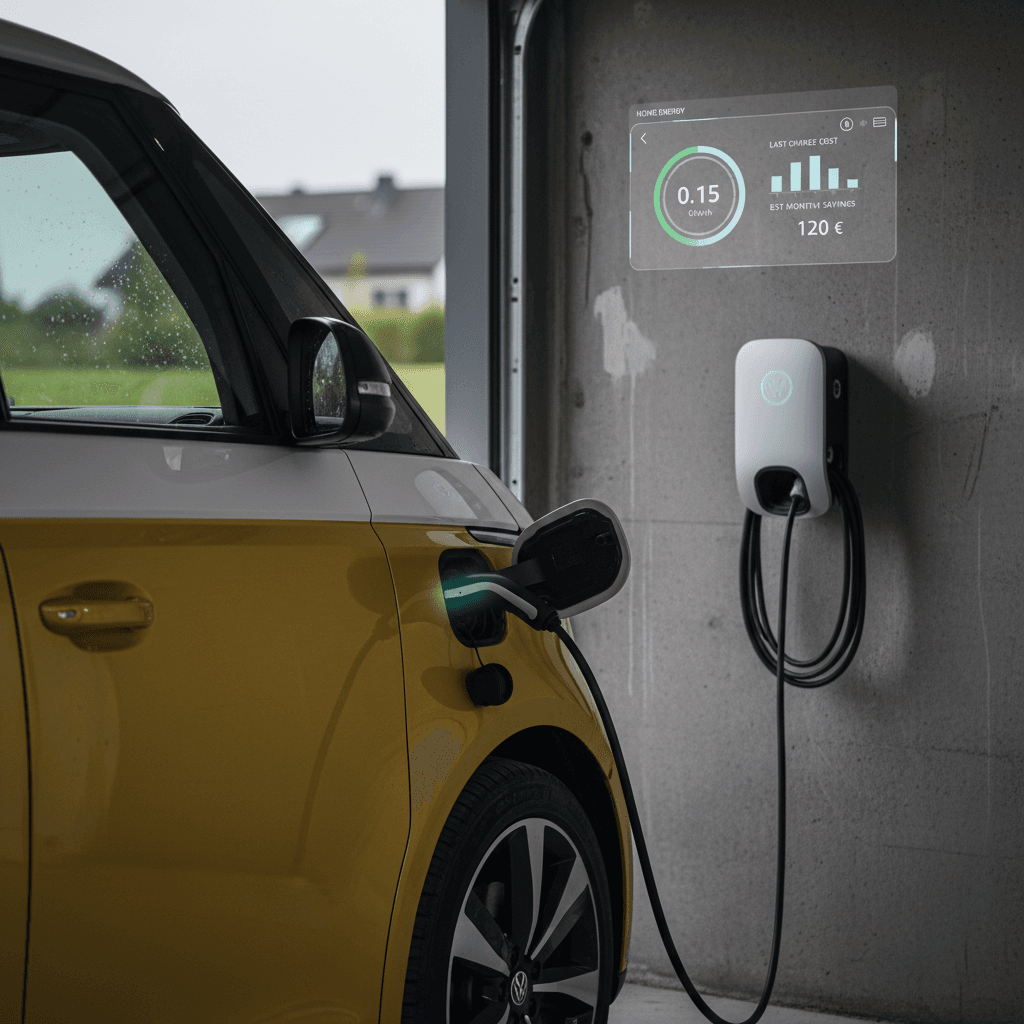
The ID. Buzz doesn’t exist in a vacuum. You’re probably cross‑shopping against a gas minivan or a three‑row SUV. So let’s put the Volkswagen ID. Buzz cost per mile to drive next to some realistic gas alternatives.
Electric: Volkswagen ID. Buzz
- Assumed efficiency: 2.8 mi/kWh
- Home rate example: $0.14/kWh
- Cost per mile (home): ≈ $0.05
- Cost per mile (mostly DC fast): ≈ $0.10–$0.12
Gas: Typical minivan or 3‑row SUV
- Real‑world mpg: 20–25 mpg
- Gas price example: $3.50/gal
- Cost per mile @ 25 mpg: ≈ $0.14
- Cost per mile @ 20 mpg: ≈ $0.18
Even without getting fancy, you can see the pattern: at normal U.S. energy prices, the Volkswagen ID. Buzz often cuts fuel cost per mile by half compared with a similar gas van. Where electricity is cheap or gas is expensive, the gap gets even wider.
Add maintenance and it gets better for the ID. Buzz
Beyond electricity: tires, maintenance, and other running costs
Electric vans don’t drink gas, but they still wear out tires and need brake fluid and cabin filters. Understanding these pieces gives you a fuller picture of ID. Buzz ownership costs per mile.
Non‑fuel costs that affect ID. Buzz cost per mile
Most are lower than a gas van, a few are higher
Tires
Maintenance
Battery health
Where Recharged’s battery data helps
Real-world Volkswagen ID. Buzz cost per mile scenarios
Let’s turn the abstract into something you can feel. Here are a few everyday ways people might use a Volkswagen ID. Buzz, and what their cost per mile to drive could look like.
Three common ID. Buzz lifestyles, and what each mile costs
1. Suburban family daily driver
You charge at home overnight on a Level 2 charger at roughly $0.14/kWh. You average 2.8 mi/kWh in mixed driving. Your electricity cost per mile lands near $0.05. Compared with a 22‑mpg gas SUV at $3.50/gal (~$0.16/mile), you’re effectively saving around $0.11 every mile you drive.
2. Road‑trip warrior
You love national parks and long highway slogs. You still top up at home, but 40–50% of your miles are on DC fast chargers at about $0.30/kWh. Your blended cost per mile ends up closer to $0.08–$0.09. Still comparable to (or better than) a very efficient gas van, with quieter, smoother miles.
3. Small business shuttle or mobile office
You run predictable local routes and can install a dedicated Level 2 at your depot and maybe negotiate a good commercial rate. Most charging happens overnight, when rates may be lower. Your cost per mile can sit deep in the $0.04–$0.06 range, and predictable energy bills make it easier to price your services.
Watch out for all‑fast‑charging habits
How a used EV (including future used ID. Buzz models) changes the math
Cost per mile isn’t just about fuel or electricity. It’s also about how much you paid for the vehicle, how fast it depreciates, and how long you keep it. That’s where used EVs can shine, especially once the ID. Buzz has been on the road long enough to appear regularly on the used market.
New ID. Buzz
- Higher upfront payment or monthly loan cost.
- Lowest fuel cost per mile, but you’re paying new‑car money for the privilege.
- Great if you want the latest tech and plan to keep it a long time.
Used EV from Recharged
- Lower purchase price and often similar efficiency to new models.
- Recharged Score shows you real battery health up front.
- Combined with cheap electricity, your total cost per mile (payment + energy + maintenance) can undercut a comparable new gas or new EV purchase.
Stretch your savings with smart financing
FAQ: Volkswagen ID. Buzz cost per mile to drive
Frequently asked questions
Bottom line: Is the Volkswagen ID. Buzz cheap to drive?
If you’ve fallen for the Volkswagen ID. Buzz’s retro‑modern charm, the good news is that the numbers mostly back up your heart. At typical U.S. electricity prices, the cost per mile to drive an ID. Buzz can be dramatically lower than a comparable gas van, especially if you lean on home Level 2 charging and treat DC fast charging as an occasional luxury, not a lifestyle.
The real magic happens when you zoom out from a single mile to thousands of them. Lower energy costs, fewer moving parts, and simplified maintenance all add up over years of school runs, road trips, or small‑business duty. And if you’re open to shopping the used market, a well‑chosen EV with a verified healthy battery, backed by a Recharged Score Report, transparent pricing, and EV‑savvy support, can make each mile even more affordable.
Whether the ID. Buzz itself or another electric van or SUV ends up in your driveway, thinking in cost per mile is the right way to cut through the hype. Do the math with your own electricity rates, then let the van that fits your life, and your long‑term budget, win.