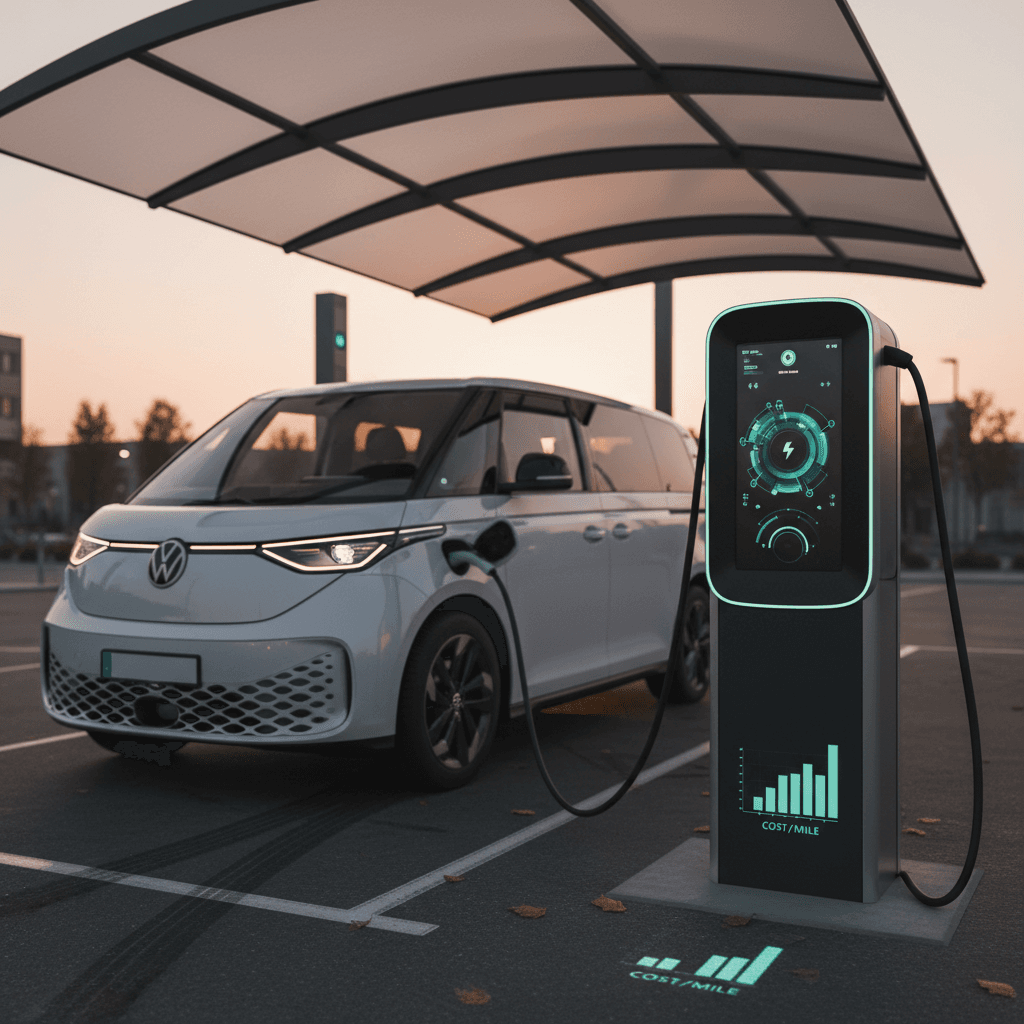
If you’re eyeing the retro‑cool Volkswagen ID. Buzz, one of your first questions is probably simple: what does it cost per mile to charge this thing? Because it’s a big, boxy electric van, its efficiency and electricity price matter more than they do on a slippery compact EV, and the difference between smart home charging and expensive DC fast charging can easily double or triple your cost per mile.
Quick answer
How much does it cost to charge an ID. Buzz per mile?
To get to a realistic ID. Buzz charging cost per mile, you need three ingredients:
- Your local electricity price (¢/kWh)
- The van’s efficiency in miles per kWh (mi/kWh) in your real driving
- How much you use home charging vs public fast charging
In the U.S., the latest Energy Information Administration data shows average residential electricity around $0.16–$0.18 per kWh in 2024–2026, with many states on either side of that number. Public DC fast charging is often $0.35–$0.60 per kWh, depending on the network, location and membership plans.
Typical ID. Buzz charging cost per mile (2026 snapshot)
Those are averages. To understand where you might land personally, it helps to look at how efficient the ID. Buzz really is and then plug in some numbers.
Volkswagen ID. Buzz efficiency: miles per kWh explained
The U.S. three‑row ID. Buzz uses a large battery (around 82–91 kWh gross depending on pack) and is EPA‑rated at about 231–234 miles of range. That works out to roughly 2.6–2.9 mi/kWh on the official combined cycle.
Real‑world testing and early owner data tend to line up with that on the highway and beat it slightly around town. On Recharged’s own long‑term testing and road trip reviews, we see these ballpark numbers:
Real‑world Volkswagen ID. Buzz efficiency
Approximate miles per kWh you can expect in different driving scenarios.
| Scenario | Typical mi/kWh | What it looks like in the real world |
|---|---|---|
| City/suburban mix | 3.0–3.4 | Errands, school runs and surface streets under ~45 mph |
| EPA‑style mixed driving | 2.7–3.1 | Blend of town and highway, light to medium load |
| Highway 65–75 mph | 2.1–2.5 | Family road trip, luggage, normal weather |
| Winter highway, loaded | 1.8–2.2 | Cold temps, heat on, passengers and cargo |
| Hyper‑efficient driver | 3.3–3.7+ | Gentle driving, mild weather, mostly under 60 mph |
Your results will vary based on load, weather, speed, wheel choice and HVAC use, but these numbers are a practical starting point.
Big box, big HVAC penalty
Home charging: ID. Buzz cost per mile
Let’s walk through what Volkswagen ID. Buzz charging cost per mile looks like for a typical U.S. owner primarily charging at home on a Level 2 charger.
- Assume residential electricity at $0.17 per kWh (roughly current U.S. average).
- Assume realistic mixed‑driving efficiency of 2.9 mi/kWh for most of the year.
- Ignore minor charging losses for now (we’ll discuss them later).
Cost per mile is simply your electricity price divided by your efficiency:
Baseline home charging example
$0.17 per kWh ÷ 2.9 mi/kWh ≈ $0.059 per mile.
Round it and you’re at roughly 6 cents per mile for everyday use if you mostly plug in at home.
Including charging losses
Level 2 home charging is usually ~90% efficient. That effectively adds about 10% to what you pay per kWh at the wall.
So 6¢/mi becomes roughly 6.5–7¢ per mile in the real world.
Save with time‑of‑use rates
Home charging cost per mile: three quick scenarios
Use these as templates and swap in your own local electricity rate.
Average U.S. home
Power price: $0.17/kWh
Efficiency: 2.9 mi/kWh
Cost/mi: ≈ $0.06–$0.07
Cheap off‑peak power
Power price: $0.12/kWh (TOU off‑peak)
Efficiency: 3.0 mi/kWh
Cost/mi: ≈ $0.04–$0.045
High‑cost state
Power price: $0.25/kWh
Efficiency: 2.8 mi/kWh
Cost/mi: ≈ $0.09–$0.10
Public DC fast charging: cost per mile on road trips
The ID. Buzz is built for family road trips, so you’re going to hit DC fast chargers. The catch is that public fast charging can cost 2–4× more per kWh than home charging, and the van is less efficient at 70–75 mph. Both push your cost per mile up.
Let’s use some realistic U.S. highway assumptions:
- DC fast charging price: $0.40 per kWh with a membership plan on a major network.
- Highway efficiency: 2.2 mi/kWh at typical freeway speeds with family and luggage.
- Charging losses and session fees roughly balance out minor optimistic assumptions.
Highway fast‑charge example
$0.40 per kWh ÷ 2.2 mi/kWh ≈ $0.18 per mile.
Add some overhead from session fees, idling penalties or higher local prices and you’re realistically in the $0.18–$0.22 per‑mile range for a trip that’s mostly DC fast charged.
Premium or pricey locations
In some urban or high‑demand corridors, published DC fast prices run closer to $0.50–$0.60 per kWh.
At $0.55 per kWh and 2.1 mi/kWh, you’re paying ≈ $0.26 per mile, well into gas‑car territory.
Don’t road‑trip on DC fast only if you care about cost
ID. Buzz charging cost per mile vs gas minivan
To understand whether an ID. Buzz makes financial sense, compare its electricity cost per mile with the fuel cost of a comparable gas minivan or three‑row SUV.
Energy cost per mile: ID. Buzz vs gas
Approximate fuel/energy cost per mile using realistic 2026 U.S. fuel and electricity prices.
| Vehicle & fueling | Assumptions | Energy cost per mile |
|---|---|---|
| VW ID. Buzz – mostly home charging | $0.17/kWh, 2.9 mi/kWh | ≈ $0.06–$0.07/mi |
| VW ID. Buzz – heavy DC fast use | $0.40/kWh, 2.2 mi/kWh | ≈ $0.18–$0.22/mi |
| Gas minivan (e.g., Pacifica, Sienna) | 24 mpg, $3.75/gal | ≈ $0.16/mi |
| Gas three‑row SUV (Pilot, Highlander) | 21 mpg, $3.75/gal | ≈ $0.18/mi |
Numbers are illustrative averages; always plug in your local gas and electricity prices for precise comparisons.
The pattern is clear:
- Home‑heavy ID. Buzz charging is significantly cheaper per mile than gasoline, even in many higher‑cost electricity states.
- Once you lean on DC fast charging, you’re playing in the same ballpark as gas for energy costs, and sometimes worse.
- Total cost of ownership still favors the Buzz in many cases once you add lower maintenance, possible EV incentives and resale, but energy savings are no longer a slam dunk if you never plug in at home.
5 factors that change your real-world cost per mile
What actually moves your ID. Buzz cost per mile up or down
Same van, radically different numbers depending on how and where you drive.
1. Your utility and rate plan
2. Your cruising speed
3. Climate and HVAC usage
4. Load and accessories
5. Charging mix
Bonus: Your driving style
How to lower your ID. Buzz charging costs
You can’t change physics, but you have a lot of control over how much you pay to move your ID. Buzz a mile. Here are practical levers that matter, especially for families watching a monthly budget.
Practical ways to cut ID. Buzz cost per mile
1. Prioritize home Level 2 charging
If you own or can influence where you park, a 240V Level 2 charger is the single biggest lever. It lets you use cheaper residential rates instead of pricey DC fast charging. If you’re shopping used, ask the seller about their home setup and utility rates.
2. Use off‑peak or EV‑specific plans
Call your utility or check its website for time‑of‑use or EV‑only plans. Many reward overnight charging with much lower rates. The ID. Buzz’s scheduled charging makes it easy to automatically charge when power is cheapest.
3. Keep highway speeds reasonable
Set cruise control closer to 65–70 mph instead of 80+ mph, especially when running loaded. The Buzz’s efficiency, and therefore cost per mile, improves noticeably with just a modest speed reduction.
4. Pre‑condition while plugged in
In hot or cold weather, use the app or in‑car settings to pre‑heat or pre‑cool the cabin while the van is still plugged in. You’re effectively running HVAC on grid power instead of your battery, which preserves range and cost per mile on the road.
5. Pack aero‑smart for long trips
Roof boxes, bike racks and cargo carriers are fantastic but hurt efficiency. If you’re chasing range or cost per mile, use rear‑mounted carriers where possible, remove racks when not in use, and keep heavy gear low and inside.
6. Keep tires properly inflated
Under‑inflated tires add rolling resistance. Check pressures regularly (especially before long trips) and use the placard values. It’s a small thing that adds up over tens of thousands of miles.
Where Recharged fits in
Ready to find your next EV?
Browse Vehicles
Used ID. Buzz buyers: what to watch for on costs
If you’re shopping for a used Volkswagen ID. Buzz, two vans with the same sticker price can have very different running costs per mile. Here’s what to look at beyond the color and trim.
- Battery health: A healthy pack preserves range and lets you use more of that cheap home charging between road‑trip fast charges. Recharged’s battery diagnostics quantify this in a way a simple test drive can’t.
- Tire condition and type: Oversized or aggressive tires look tough but usually hurt efficiency a bit. Worn tires mean an early replacement bill on top of your purchase price.
- Charging history and habits: A van that lived mostly on DC fast chargers may have slightly more battery wear, and its previous owner was probably paying close to gas‑equivalent cost per mile.
- Where you park: If you can’t install home charging (street parking, some apartments), run the numbers assuming a higher share of public charging so you’re not surprised later.
Leverage the Recharged experience
FAQ: Volkswagen ID. Buzz charging cost per mile
Frequently asked questions
Bottom line: what you should budget per mile
If you boil all the variables down, a reasonable planning number for Volkswagen ID. Buzz charging cost per mile in the U.S. is about 6–8 cents per mile for an owner who can plug in at home and uses DC fast charging mainly on road trips. If you end up relying mostly on public DC fast charging, assume something closer to 18–22 cents per mile, which looks much more like a gas van’s fuel bill.
The real strength of the ID. Buzz isn’t just cheap electrons; it’s the way a spacious, charismatic family van slots into a lower‑maintenance, lower‑complexity EV ownership experience. If you’re comparing a used Buzz to other EVs or gas people‑movers, a transparent Recharged Score battery health report, fair‑market pricing, financing, trade‑in support and nationwide delivery from Recharged make it far easier to see the full cost‑per‑mile picture before you ever sign anything.