You’ve priced the car, maybe you’ve been eyeing a Certified Pre‑Owned Tesla or another used EV on Recharged. The next question hits you on the drive home: what does Tesla Wall Charger installation cost in the real world, not the marketing brochure?
Quick answer
Tesla Wall Charger installation cost in 2025: the big picture
Tesla Wall Charger cost at a glance (2025)
Those ranges may feel wide because no two garages, breaker panels, or building departments are the same. The Tesla online store will cheerfully sell you a Wall Connector for a few hundred dollars; the rest is old‑fashioned copper, conduit, and local electrical code.
Regional sticker shock
How much does a Tesla Wall Charger itself cost?
Tesla currently sells two main home units in North America: the Gen 3 Wall Connector and the newer Universal Wall Connector with built‑in J1772 adapter. Pricing moves a little with promotions, but in 2025 you’re generally looking at:
Tesla Wall Charger hardware pricing (2025)
Typical U.S. pricing before tax and shipping.
| Product | Typical price (USD) | Notes |
|---|---|---|
| Gen 3 Wall Connector | ≈ $420–$450 | Hardwired, up to 48A, Tesla/NACS connector. |
| Universal Wall Connector | ≈ $470–$525 | Includes built‑in J1772 adapter for non‑Tesla EVs. |
| Standard Level 2 non‑Tesla charger | $300–$800 | For comparison: Emporia, ChargePoint, Wallbox, etc. |
Hardware cost is the predictable part. Installation is where things vary.
On paper the Wall Connector is the cheap date in this relationship. Even compared with popular third‑party Level 2 chargers, Tesla’s hardware is aggressively priced. That’s because the real money, as every homeowner learns, is in the installation.
Typical installation scenarios and price ranges
Most Tesla home installs fall into one of four buckets. Where you land depends on how far your panel is from the parking spot, how old your electrical service is, and whether you’re cutting through finished spaces or just stapling conduit along an exposed garage wall.
Common Tesla Wall Charger installation scenarios
These ballpark ranges bundle charger + labor + standard materials and permits.
| Scenario | Typical total cost | What it usually involves |
|---|---|---|
| Basic install (simple) | $700 – $1,200 | Panel and parking spot on the same wall; short conduit run; no drywall surgery; no panel upgrade. |
| Standard install (most common) | $1,200 – $2,000 | Charger on a different wall or across the garage; 20–40 ft of conduit; minor drilling; standard permit. |
| Complex install (long run / tricky routing) | $2,000 – $2,500 | Detached garage, attic run, exterior conduit, or 50–75 ft wiring. Still no panel upgrade. |
| Install with panel upgrade | $2,500 – $3,500+ | Older 100A service, crowded panel, or big future load (second EV, heat pump). Includes new 200A panel plus charger install. |
Real quotes will vary, but this table captures what many homeowners see in 2025.
How this compares to generic EV installs
What actually drives your Tesla Wall Charger installation cost?
The four big levers on install cost
Distance, difficulty, demand, and your panel’s age all get a vote.
1. Distance from panel
The longer the run between your main panel and charger location, the more copper wire and conduit you’re buying and the more time the electrician spends fishing it.
- Short run: 10–20 ft right across the garage = cheapest.
- Medium run: 30–50 ft with a few bends adds a few hundred dollars.
- Long run: 75+ ft, detached garage, or trenching can add $500–$1,000 by itself.
2. Wall type & access
Running conduit along an unfinished garage wall is simple. Snaking wire through finished drywall, stucco, or underground is not.
- Unfinished garage: surface‑mounted conduit, minimal patching.
- Finished interior walls: cutting and repairing drywall or stucco.
- Underground/trenching: detached garages or carports often require digging, which drives labor up fast.
3. Panel capacity and breaker size
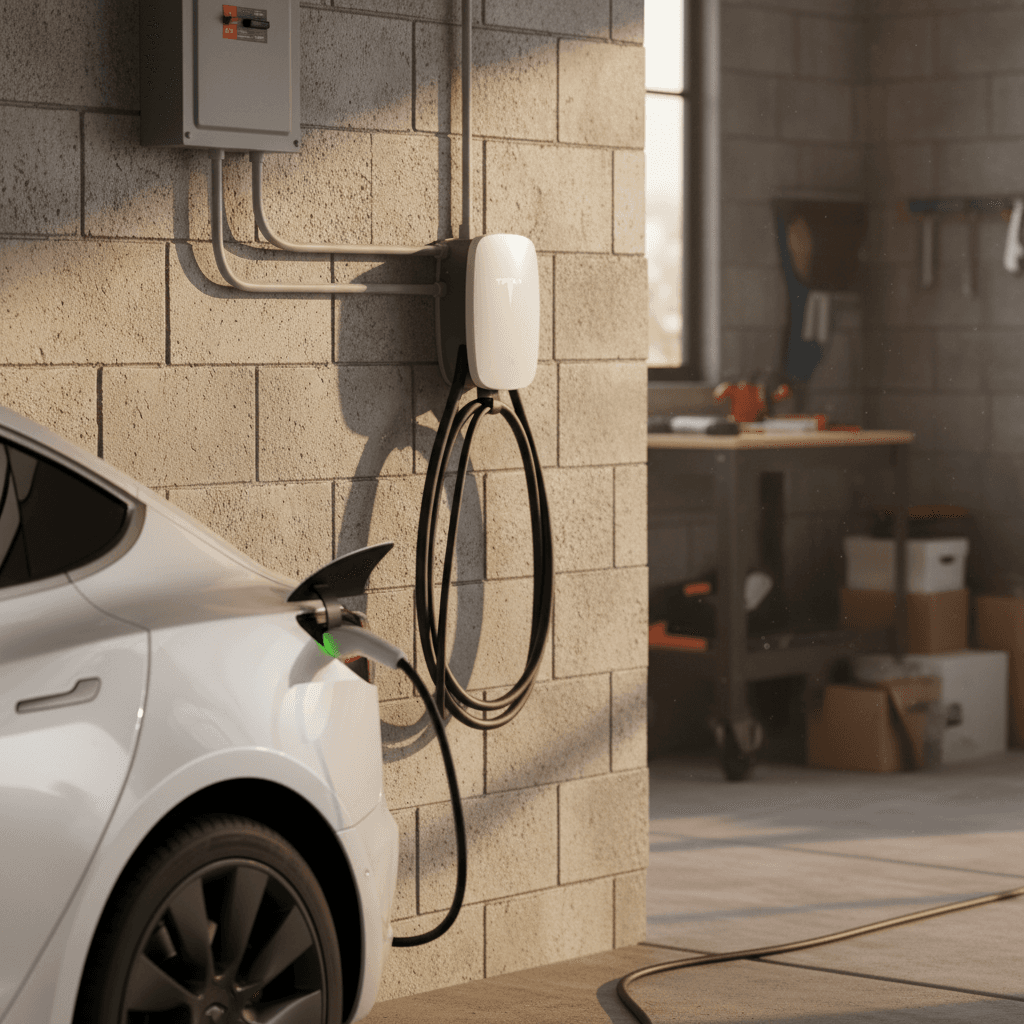
A Tesla Wall Connector wants up to a 60‑amp breaker (48A output). Your panel needs to have the spare capacity and physical space for that breaker.
- Modern 200A service: often has room for one more large circuit.
- Older 100A panels: frequently need a full upgrade, adding $1,000–$3,000.
- Load calculations: a good electrician will run the math so you don’t trip breakers when the oven and charger party at once.
4. Local labor and permitting
Electricians don’t charge the same in Omaha as they do in San Francisco. Labor typically ranges from about $300 to $1,500 for Tesla‑class installs.
- Permits: $50–$300, depending on your municipality.
- Inspection fees: sometimes bundled into the permit, sometimes separate.
- Lead times: busy markets can quote higher simply because they can.
Smart pre‑work
Is a Tesla Wall Charger more expensive than other Level 2 chargers?
Tesla has done something unusual in home charging: they’ve made the brand‑name hardware cheaper than much of the third‑party competition. Where costs can creep up is in amperage and expectations.
Tesla Wall Connector
- Hardware: often around $420–$475.
- Output: up to 48A, which can add roughly 30–45 miles of range per hour depending on the vehicle.
- Integration: native in‑car controls, Tesla app, load sharing for multiple Teslas.
- Install: usually hardwired, which electricians like for reliability.
Generic Level 2 chargers
- Hardware: typically $300–$800 for similar 40–48A units.
- Flexibility: plug‑in (NEMA 14‑50) options can be easier to replace or move.
- Smart features: Wi‑Fi, scheduling, and energy monitoring are common at this price.
- Install cost: broadly similar to Tesla if amperage and wiring length are comparable.
Good news for non‑Tesla owners
Legit ways to lower Tesla Wall Charger installation cost
Cost‑cutting moves that don’t compromise safety
1. Choose the shortest practical run
Every extra foot of 6‑gauge copper and conduit costs money. If you can park closer to the panel wall, or mount the charger on that wall, you’ll save on materials and labor.
2. Be realistic about amperage
A 48A Wall Connector is great, but many EVs can’t actually draw that much. If your car maxes out at 32A or 40A, your electrician can often size the circuit accordingly, which may avoid a panel upgrade.
3. Use an existing 240V circuit when appropriate
If you already have a lightly used 240V outlet in the right spot (say an old 30A dryer circuit), ask an electrician if it can be repurposed or if a lower‑amp charger would work. Don’t DIY this, code and load calculations matter.
4. Get at least three written quotes
Quotes for the same job can legitimately differ by hundreds of dollars. Provide the same photos and details to each electrician so you’re comparing actual apples to apples.
5. Time your install with incentives
Many utilities and some states offer limited‑time rebates for Level 2 chargers. Stack those with the federal tax credit while it’s still available to trim 20–40% off your net cost.
6. Prepare the site yourself (within reason)
Clearing garage clutter, confirming where you want the charger, and making sure the panel is accessible saves the electrician time. Don’t open walls or touch wiring yourself unless you’re qualified.
Where you should NOT save money
Tax credits, incentives, and rebates in 2025
The one bright spot in all of this copper‑and‑conduit arithmetic: in many cases you’re not paying the whole Tesla Wall Charger installation cost yourself. As of late 2025, there are three buckets of help you should look at.
- Federal tax credit (Form 8911): For home installations in eligible areas, the Alternative Fuel Refueling Property Credit can cover 30% of hardware + installation costs, up to $1,000. The program currently runs through mid‑2026, so timing matters.
- State and local programs: States like California, New York, Colorado, and Massachusetts frequently offer $300–$1,250 in rebates for home Level 2 chargers, often limited to smart chargers or specific utilities.
- Utility incentives: Many utilities offer bill credits for off‑peak charging, free or discounted chargers, or partial reimbursement of installation costs when you enroll in a managed‑charging program.
How to check incentives fast
Can you install a Tesla Wall Charger yourself?
If you’re handy, you might be tempted to watch a few videos and hang the charger yourself. After all, Tesla’s installation guide looks almost friendly. But this isn’t hanging a shelf; it’s wiring a high‑amperage 240V circuit that could cook more than dinner if you get it wrong.
DIY vs pro install: reality check
What looks like savings can evaporate under code requirements.
DIY approach
- Pros: You potentially save a few hundred dollars on labor.
- Cons: Permit issues, failed inspection, unsafe wiring, voided insurance, and Tesla refusing warranty claims related to improper installation.
- Reality: In many U.S. jurisdictions, a homeowner is not allowed to pull this permit or perform this work on their own for high‑amp circuits.
Licensed electrician
- Pros: Knows local code, pulls the permit, passes inspection, and sizes the circuit correctly for your panel and future loads.
- Cons: You pay $300–$1,500 for labor, depending on complexity.
- Reality: Required for most rebates and the easiest way to sleep at night.
Insurance fine print
Step‑by‑step: choosing an installer and reading quotes
Think of this like shopping for a used EV: the sticker price matters, but the inspection report matters more. A good installer explains what they’re doing and why; a great one hands you a quote you can actually read.
From “thinking about it” to “charging overnight”
1. Decide where you’ll park most nights
Pick the parking spot you’ll actually use, not the idealized version where the lawn tools aren’t in the way. This drives charger placement and run length.
2. Photograph your panel and garage
Take clear photos of the main panel (door open, breakers visible), the proposed charger location, and any obstructions. Include a rough measurement between panel and charger spot.
3. Gather three quotes from licensed electricians
Ask explicitly for a <strong>Tesla Wall Connector install</strong>, mention your service size (e.g., 100A vs 200A), and send the same photos to everyone. Ask each to note whether they expect a panel upgrade.
4. Compare line items, not just totals
Look for separate line items for <strong>labor</strong>, <strong>materials</strong>, <strong>permit</strong>, and any <strong>panel work</strong>. A surprisingly low quote that skips permits or inspections is a red flag, not a bargain.
5. Confirm rebate eligibility before signing
If you’re chasing incentives, make sure the electrician’s plan (charger model, smart‑charger requirement, permit timing) aligns with the fine print. Many rebates require installation by a participating or licensed contractor.
6. Schedule install and inspection
On install day, have the car at home so they can test. After the final inspection stamp, label the breaker for the charger and store your paperwork with your home records.
Where Recharged fits into your charging plan
A home charger is part of the ownership story, not an afterthought. At Recharged, every used EV we list comes with a Recharged Score Report that covers battery health, fair market pricing, and how the car will fit into your daily driving and charging habits.
If you’re shopping a Tesla, or any NACS‑equipped EV, through Recharged, our EV specialists can walk you through home charging options before you buy. That includes talking through whether a Tesla Wall Connector, a universal Level 2 charger, or even a simple 240V outlet is the smartest move for your home and budget.
Financing the whole picture
Ready to find your next EV?
Browse VehiclesFAQ: Tesla Wall Charger installation cost
Frequently asked questions
The bottom line on Tesla Wall Charger costs
When you strip away the marketing gloss, a Tesla Wall Charger is just a very capable Level 2 charger and a hungry electrical load. In 2025, the hardware itself is the easy part at roughly $420–$475. The real swing comes from your panel, your walls, and your ZIP code, which push total Tesla Wall Charger installation cost anywhere from about $700 for a slam‑dunk install to $3,500+ for older homes that need upgrades.
If you’re shopping for a used Tesla, or any EV, through Recharged, you don’t have to guess. Our specialists can help you ballpark home charging costs alongside the vehicle price, financing, and trade‑in, so you know what you’re really signing up for before the car ever hits your driveway.