If you’re trying to make sense of the Tesla Model 3 depreciation curve over 5 years, you’re asking exactly the right question. Depreciation is usually the single biggest cost of owning any car, and the Model 3 is no exception, especially now that used EV prices have cooled off from their pandemic highs. The good news: when you understand how the curve really looks, you can time your purchase or sale to keep more money in your pocket.
Depreciation in one sentence
Why Tesla Model 3 depreciation matters
For years, Teslas were the darlings of the resale world. Some early Model 3 owners could sell their cars for nearly what they paid, thanks to supply shortages and sky‑high fuel prices. That moment has passed. Through 2024–2025, used Tesla prices fell faster than the broader used‑car market, and by late 2025 the Model 3 behaved more like a premium compact sedan than a speculation asset.
Today, the Model 3 still holds value reasonably well, but it no longer defies gravity. Large price cuts on new Teslas, expiring federal EV credits, and fast‑moving battery and tech updates all pulled the used curve down. Understanding that new reality helps you decide whether to buy new, shop used, or hang on to the car you have.
Five-year Tesla Model 3 depreciation at a glance*
About the numbers
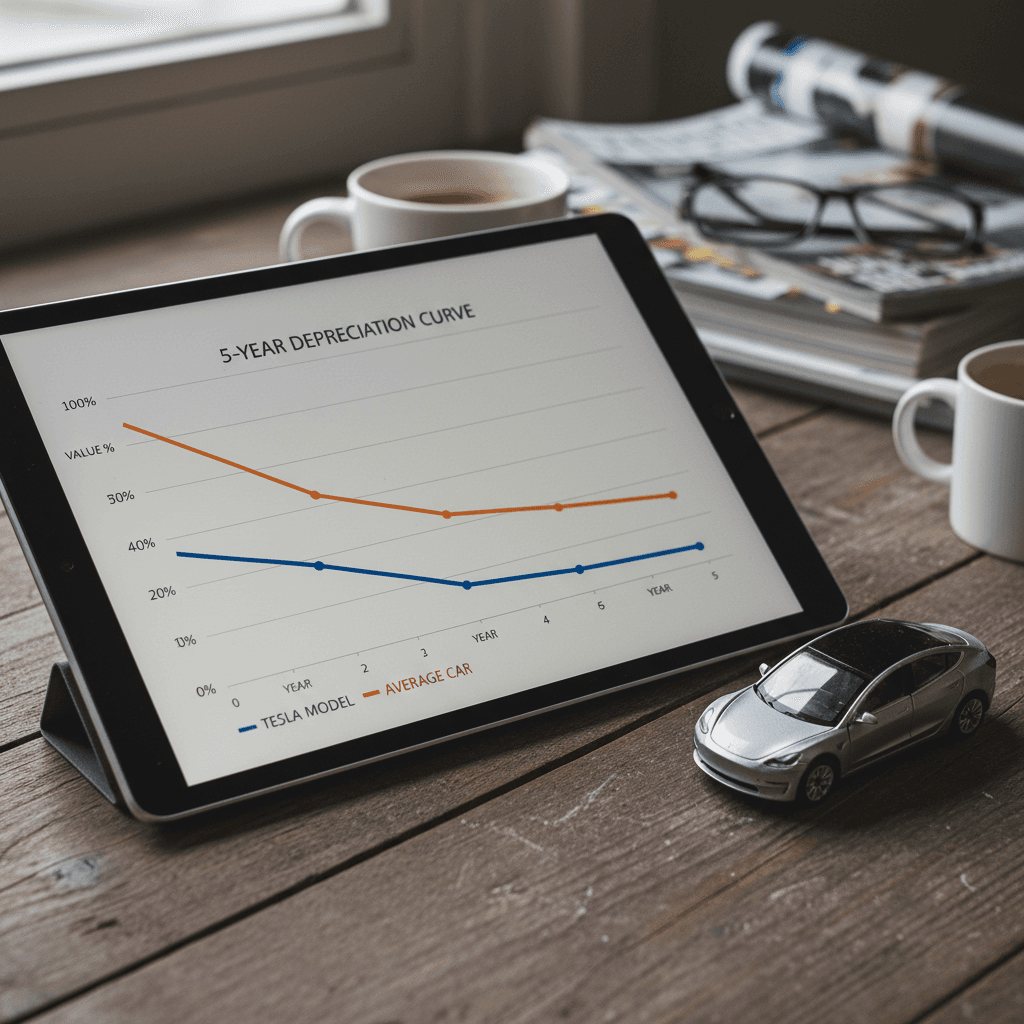
A typical 5‑year Tesla Model 3 depreciation curve
Let’s start with the basic shape of the curve for a mainstream Model 3, think a rear‑wheel‑drive or Long Range car, average mileage, no major accidents, and no unusual options. We’ll talk about Performance trims and outliers later.
- Year 1: The initial hit. Like most new cars, a Model 3 typically loses a big chunk of value right away. A 20–25% drop from the original sticker in the first year isn’t unusual in the current market, especially if Tesla has cut new prices in that time.
- Years 2–3: The steepest part of the slope. By the time the car is 3 years old, total depreciation around 30–40% is common. This is where many buyers find the sweet spot: much cheaper than new, but still relatively modern and usually under warranty.
- Years 4–5: The curve starts to flatten. By year 5, many Model 3s have lost roughly 38–45% of their original MSRP, depending on trim, miles, and market conditions. They’re still desirable, but buyers are more sensitive to battery health and upcoming maintenance costs.
- Years 6+: Slower, more traditional drop. After five years, annual depreciation often falls into a more modest 5–8%‑per‑year range, assuming mileage stays reasonable and the car remains in good mechanical and cosmetic shape.
Where the "deal zone" usually lives
Example numbers: new vs 5‑year‑old Model 3
To make this real, let’s walk through some rounded, easy‑math numbers. These are not quotes, just illustrations that match what we’re seeing in the market for typical cars and mileage.
Illustrative 5‑year depreciation curve for a Tesla Model 3
Assumes a mainstream Model 3 with an initial price around $45,000 after destination and common options, with average U.S. mileage and normal condition.
| Age | Odometer (approx.) | Illustrative Market Value | Total Depreciation | % of Original MSRP |
|---|---|---|---|---|
| Brand new | 0 miles | $45,000 | – | 100% |
| 1 year | ≈15,000 miles | $34,000–$36,000 | $9,000–$11,000 | ≈75–80% |
| 3 years | ≈45,000 miles | $27,000–$30,000 | $15,000–$18,000 | ≈67–73% |
| 5 years | ≈75,000 miles | $23,000–$28,000 | $17,000–$22,000 | ≈55–62% |
Rounded example numbers to show how a 5‑year Tesla Model 3 depreciation curve might look in today’s market.
Now compare that with some actual late‑2025 used‑price bands. A 2019–2021 Long Range Model 3 with 40,000–80,000 miles often advertises in the low‑ to upper‑$20,000s, depending on condition and options. That lines up well with the 5‑year values in the table and reinforces the idea that a well‑kept Model 3 can still keep around 60% of its original value after five years.
What about Performance and ultra‑low miles?
How the Model 3’s curve compares to other cars
So is the Model 3 still a depreciation champ? The answer now is, “it depends what you compare it to.” When the car first launched, its 5‑year retention was better than almost anything on the road. As the market normalized, it slid closer to high‑end gas sedans, and in some data sets, slightly below the best gasoline performers.
Tesla Model 3 vs typical 5‑year depreciation
Approximate 5‑year depreciation, assuming average mileage and condition.
Typical new car
≈45–50% depreciation in 5 years.
Many mainstream sedans and crossovers land in this range, losing about half their value over 60 months.
Best gas sedans
≈35–45% depreciation.
Standouts with bulletproof reliability and strong demand can do better than average, keeping more value over 5 years.
Tesla Model 3
≈38–45% depreciation.
Once an outlier, the Model 3 now behaves more like a premium compact sedan: better than many EVs, but not untouchable.
Where the Model 3 still shines
What bends the depreciation curve up or down
Depreciation averages hide the fun, and the danger. Two Model 3s built in the same month can follow very different curves depending on how they’re built, driven, and sold. Here are the levers that matter most.
Major factors that change a Model 3’s depreciation curve
Think of each factor as nudging the line up or down from the averages.
Trim, options & software
- Trim: Long Range typically holds value better than base RWD; Performance can be strong but more niche.
- Options: Bigger wheels and fancy paint rarely return dollar‑for‑dollar. Desirable interiors and driver‑assist features help.
- Software: Pre‑paid FSD can help value a bit, but buyers are increasingly skeptical about paying full freight for it used.
Mileage & usage pattern
- EV buyers are extra mileage‑sensitive because of battery wear concerns.
- High highway miles with careful charging can actually be gentler on the pack than lots of short, hot, fast‑charge sessions.
- A 5‑year‑old car with 40,000 miles will sit well above one with 100,000 miles on the curve.
Charging & battery care history
- Cars fast‑charged constantly, stored hot, or routinely run to 0% and 100% can show more battery degradation.
- Cars mostly charged at home between ~20–80% and parked in garages usually age more gracefully.
- Visible battery health data can nudge the value line significantly.
Market & policy swings
- Sharp price cuts on new Model 3s can drag used values down overnight.
- Changes in tax credits and interest rates reshape what buyers can afford.
- Local incentives, HOV lane access, and fuel‑price spikes can all move the curve.
The "software surprise" risk
Battery health’s role in 5‑year value
On a traditional gas car, most shoppers focus on mileage and service records. On a 5‑year‑old Model 3, battery health is the headline. Two cars with identical odometers can sit in completely different spots on the depreciation curve if one pack has lost significantly more usable range.
- By year 5, many Model 3 packs still deliver a large share of their original usable range, often within about 10–15% on well‑cared‑for cars.
- Hard‑driven cars with lots of DC fast‑charging or extreme climate exposure can show larger drops, which pushes their value down relative to the averages.
- Because quick‑charging and long‑range road trips are a big part of the Tesla story, buyers pay a premium for cars whose real‑world range still feels “like new.”
Where Recharged fits in
How to use the depreciation curve when buying a used Model 3
Seeing the curve on a chart is one thing. Using it when real money is on the line is another. Here’s how to turn a 5‑year depreciation curve into a buying strategy.
Practical steps for shopping the Model 3 curve
1. Decide where on the curve you’re comfortable
If you want new‑car smell and the latest hardware, accept the heavier early‑years depreciation. If value is your priority, hunt in the 2–5‑year‑old range, where someone else already paid for most of the drop.
2. Benchmark asking prices against MSRP
Look up the original MSRP and typical transaction price for the year and trim you’re considering. If a 5‑year‑old car is still priced within ~70% of that number, it should be exceptionally clean with strong battery health to justify it.
3. Normalize for mileage and condition
Use the example table as a starting point, then adjust for odometer, accident history, interior wear, and wheel or tire damage. A car that’s well above average mileage should be discounted below the “typical” curve line.
4. Treat battery health as a separate line item
If you can see a trusted battery‑health report, like the Recharged Score, mentally slide the car’s point on the curve up or down. Strong pack? It earns a place near the top of the value band. Noticeable degradation? Discount accordingly.
5. Remember options don’t all hold their value
Premium paint, 20‑inch wheels, and early‑life software add‑ons rarely retain dollar‑for‑dollar value. A loaded car is nice, but don’t pay thousands extra if those options don’t matter to you day‑to‑day.
6. Compare total ownership cost, not just price
Run the math on fuel and maintenance versus a comparable gas sedan. A slightly higher purchase price on the right used Model 3 can still win over five years once you factor in electricity and minimal service needs.
If you’re buying from a private seller
- Ask for original purchase paperwork or an itemized build sheet to verify MSRP.
- Pull a vehicle history report to check for structural damage or buyback history.
- Insist on a long test drive that includes highway speeds and some fast‑charging if possible.
- Have a plan for independent battery and mechanical inspection if anything feels off.
If you’re buying through Recharged
- Use the Recharged Score Report to see battery health, pricing vs. market, and condition at a glance.
- Lean on EV‑specialist advisors to interpret the curve for the exact car you’re considering.
- Take advantage of financing, trade‑in, and nationwide delivery to shop by value, not just ZIP code.
- Handle the whole purchase digitally or visit the Richmond, VA Experience Center if you prefer in‑person.
Selling your Model 3: timing and pricing strategies
If you already own a Model 3, the same curve works in reverse. You’re trying to pick a moment to step off the ride before a big drop, whether that’s a new round of price cuts, a major refresh, or a looming warranty milestone that makes buyers nervous.
Ways to stay on the good side of the curve as a seller
Small decisions over 5 years can easily move your car a few thousand dollars up or down the line.
Watch for warranty cliffs
Many buyers care deeply about battery and drive‑unit warranty coverage. Selling before a major warranty milestone, like the 8‑year/100k–120k‑mile markers on some packs, can keep your car higher on the curve.
Cosmetics count more than you think
Even for tech‑savvy buyers, first impressions matter. Fix curb‑rashed wheels, clean up paint, and handle obvious interior wear. A tidy car photographs better and justifies pricing near the top of the value band.
Price with the curve, not against it
Pull recent comparable sales for your trim, mileage, and region. If you want a quick sale, aim slightly below the middle of the curve. If you’re willing to wait, and your car is exceptional, price near the high side, but be ready to justify it with documentation.
Selling through a specialized marketplace
Frequently asked questions about 5‑year Model 3 depreciation
Model 3 5‑year depreciation: quick answers
Key takeaways
A Tesla Model 3 depreciation curve over 5 years isn’t magic anymore, it looks a lot like a high‑end compact sedan that happens to run on electrons instead of gasoline. You can still win big on total cost of ownership, but only if you understand where you’re stepping onto the curve and what affects your specific car’s position.
- Expect a typical Model 3 to lose roughly 38–45% of its value in the first 5 years, with the steepest drop in years 1–3.
- Battery health, mileage, trim, software, and market swings can move any individual car several thousand dollars above or below the averages.
- For buyers, 2–4‑year‑old cars often offer the best blend of price, warranty, and modern features, especially with verified battery health data.
- For sellers, timing around warranty milestones and major price cuts is crucial if you want to stay on the right side of the curve.
- Tools like Recharged’s Score Report, EV‑specialist support, and transparent pricing can turn a fuzzy, emotional decision into a clear, data‑driven one.
Whether you’re eyeing your first used Model 3 or deciding when to part with the one in your driveway, treat depreciation as something you can manage, not something that just happens to you. With the right information and a realistic view of the 5‑year curve, you can make this car’s numbers work just as well as its driving experience.