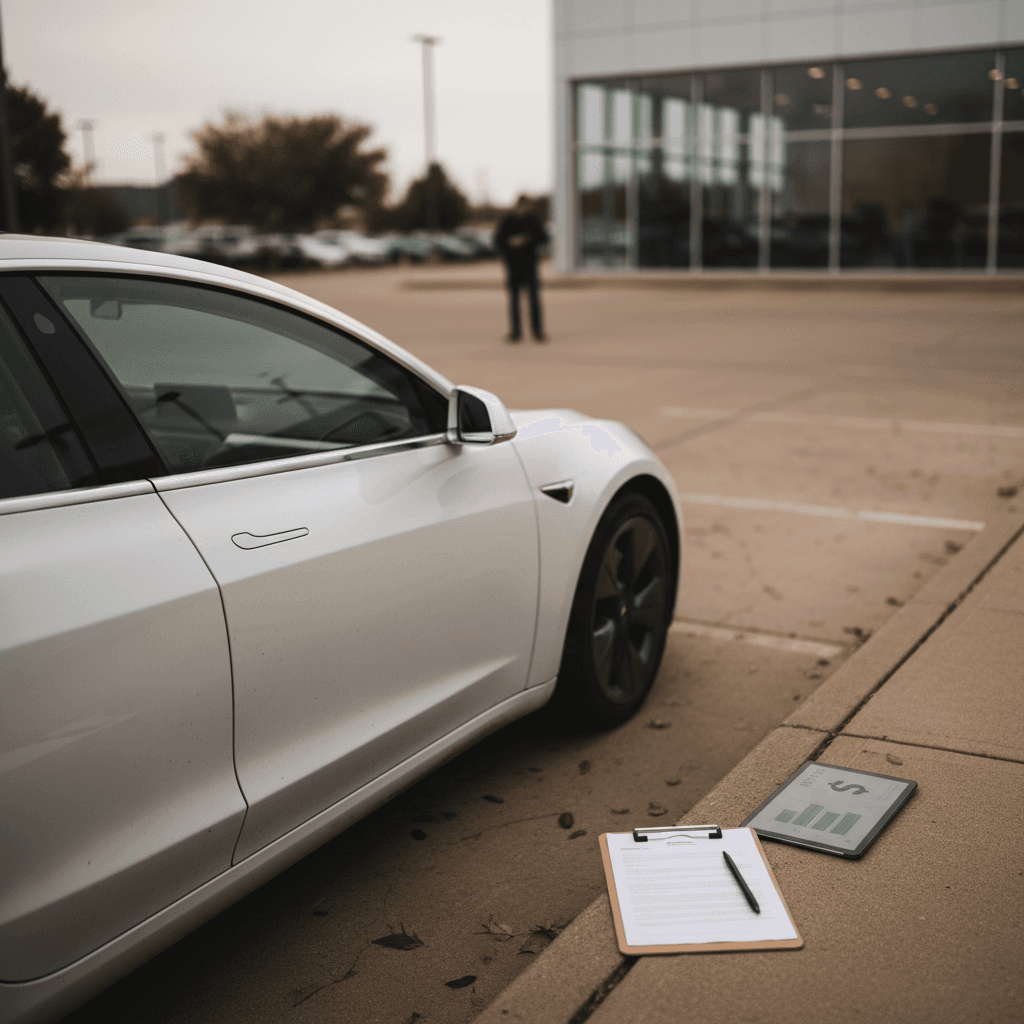
If you’re wondering what a fair Tesla Model 3 trade in value looks like in 2025–2026, you’re not alone. Between Tesla’s own price cuts, fast‑moving used EV prices, and wildly different offers from dealers and online buyers, it can be hard to know if you’re getting a good deal for your Model 3.
Quick take
Overview: Tesla Model 3 trade‑in value today
Tesla Model 3 value snapshot (2025–2026)
Tesla’s frequent new‑car price changes and software‑driven features mean the Model 3’s resale story looks different from a typical compact sedan. Values are still attractive relative to many EVs, but they’re not immune to the broader pattern: EVs depreciate faster than gas cars, especially in the first 3–5 years.
Where Recharged fits in
How much is my Tesla Model 3 worth right now?
Let’s talk ballpark numbers first. Every car is unique, but these ranges reflect what many owners in the U.S. are seeing for clean, accident‑free cars with typical mileage (around 12,000–15,000 miles per year). All figures are approximate and assume no major cosmetic or mechanical issues.
Approximate Tesla Model 3 trade‑in value ranges (U.S., 2025–2026)
These are rough wholesale/trade‑in style ranges, not private‑party retail prices. Local demand and condition can move you above or below these bands.
| Model year & trim (examples) | Typical mileage today | Rough trade‑in range | Notes |
|---|---|---|---|
| 2018–2019 Standard Range / Standard Range Plus | 60k–90k | $13,000–$18,000 | Older packs, more miles. Clean history and Autopilot help. High mileage or cosmetic issues can push you into the low‑teens. |
| 2018–2019 Long Range / Performance | 60k–90k | $15,000–$20,000 | Dual‑motor and Performance cars usually bring a bit more, especially in markets that value acceleration and AWD. |
| 2020–2021 Standard Range Plus / RWD | 35k–65k | $17,000–$24,000 | Sweet spot for many buyers: updated interior, decent range, and still under 5–6 years old. |
| 2020–2021 Long Range / Performance | 35k–65k | $20,000–$28,000 | Condition, wheels, and FSD (Full Self‑Driving) capability can move these significantly. |
| 2022–2023 RWD | 15k–40k | $22,000–$30,000 | Low miles and clean history supply is limited in some markets; strong demand can push offers higher. |
| 2022–2023 Long Range / Performance | 15k–40k | $25,000–$33,000 | Later‑model AWD cars with desirable colors/options can still command trade‑in offers in the low‑$30,000s. |
Use this as a starting point, not a quote. A detailed appraisal with VIN, options, mileage, and battery health will be more precise.
Don’t confuse trade‑in with retail
8 factors that drive Tesla Model 3 trade‑in value
What actually moves your Model 3’s number
These are the levers that matter most when an appraiser runs the numbers.
1. Model year & trim
2. Mileage and use pattern
3. Accident and repair history
4. Battery health & fast‑charging behavior
5. Software & features
6. Cosmetic condition
7. Local market demand
8. Climate & corrosion
How Recharged evaluates your Model 3
Tesla Model 3 depreciation: what the data says
To understand your trade‑in value, you need to understand depreciation. The Model 3 has generally held value better than many other EVs, but it still loses a substantial share of its MSRP over the first five years.
Five‑year Tesla Model 3 depreciation
Recent analyses of resale data show the Model 3 losing roughly 55–65% of its value over five years, depending on trim, mileage, and which dataset you use. Some studies place five‑year depreciation around 42–43%, others closer to 60–61% as EV prices have cooled.
The exact percentage matters less than the shape of the curve: big drops in the first 3 years, then a slower slide thereafter.
How that translates into dollars
Take a Model 3 that originally sold for around $50,000:
- After ~3 years, a typical resale value might be in the mid‑$20,000s to low‑$30,000s.
- After ~5 years, many examples land in the high‑teens to low‑$20,000s as trade‑ins.
- By 7–10 years, condition and battery health dominate the story more than the model year itself.
This is why a 2018 Model 3 with a well‑cared‑for battery can still be an attractive trade‑in, while a neglected 2020 may appraise surprisingly low.
Beware headline depreciation stats
Tesla trade‑in vs dealer vs online buyer vs Recharged
Once you know roughly what your Model 3 is worth, the next question is who should you sell or trade it to. Each option has its own economics and trade‑offs.
Where to sell or trade your Tesla Model 3
Convenience, price, and transparency rarely come in the same package, but you can get closer than you think.
Tesla trade‑in program
- Simple if you’re ordering another Tesla.
- Offer is usually based on auction/wholesale data.
- Historically leans conservative to protect Tesla from market swings.
- Limited flexibility if you decide not to complete the new purchase.
Franchise or independent dealer
- May be unfamiliar with EV‑specific reconditioning and battery health.
- Offers can be cautious or all over the map.
- Some will low‑ball Teslas they don’t want to retail themselves.
- Convenient if you’re trading into a non‑Tesla gas or hybrid vehicle.
Online instant‑offer buyers
- Fast quotes and easy logistics.
- Algorithms may undervalue unique options or exceptional battery health.
- Final in‑person inspections sometimes result in "adjusted" offers.
- Great for speed; not always the absolute top dollar.
Recharged (EV‑specialist marketplace)
- Built for used EVs, including Tesla Model 3.
- Includes a Recharged Score battery health report to justify pricing.
- Options for instant offer, trade‑in, or higher‑yield consignment.
- Digital experience with expert EV support and nationwide buyers.
Why EV‑specific buyers often pay more
Step‑by‑step: estimating your own Model 3 trade‑in value
DIY valuation checklist for your Tesla Model 3
1. Decode your exact trim and options
Use your Tesla account or VIN decoder to confirm whether you have Standard Range, Long Range, or Performance, plus options like FSD, premium wheels, or white interior. These can shift value meaningfully.
2. Record current mileage and tire condition
Round mileage to the nearest 1,000 and note tire life. A fresh set of tires can be a $800–$1,200 swing in your car’s effective value, especially on Performance models.
3. Check your real‑world range
Compare your typical full‑charge (or 80–90% charge) range to what the car showed when new. Significant drops can indicate battery degradation that buyers will factor into offers.
4. Pull vehicle history reports
If you’ve had any accidents or major repairs, check what shows on Carfax or AutoCheck. Appraisers will see the same data; you want to know about red flags before you start shopping offers.
5. Browse real listings, not just guides
Look at recent listings for similar Model 3s (year, trim, mileage) in your region. Expect trade‑in value to land several thousand dollars below comparable retail asking prices.
6. Get at least two real offers
Use a mix of channels, Tesla, a local dealer, and an EV‑focused buyer like Recharged, to triangulate value. If one offer is far off the others, ask why before deciding.

How to maximize what you get for your Model 3
- Fix obvious, low‑cost cosmetic issues (curb rash, missing aero caps, deep interior cleaning) before formal appraisals.
- Have both key cards/fobs, charging cable, and any adapters present during inspection, missing accessories reduce offers.
- Gather service records, especially for items like tires, brakes, and cabin filters, to demonstrate good maintenance.
- Avoid trading in during short‑term price dips driven by big new‑car discounts or incentives on brand‑new Model 3s when you can.
- If you have transferable FSD or rare options, make sure they’re called out clearly to any buyer who’s valuing your car.
Timing your sale around software and price changes
Common pitfalls with Tesla trade‑ins (and how to avoid them)
Undervaluing battery and software
Many generic appraisal tools still treat a Tesla Model 3 a bit like a gas sedan with an engine and transmission. They don’t ask how often it fast‑charged, whether FSD is active or transferable, or what the actual usable range is today.
That can hurt you twice: once in the form of a lower offer, and again when a more EV‑savvy buyer later sells the car for much more because they’ve properly documented those strengths.
Overtrusting the first instant offer
Instant offers are convenient but they’re not omniscient. If one buyer is hundreds or even thousands below what multiple others are quoting, that’s a signal, not a verdict. Take the time to compare, and don’t be afraid to walk away if the final in‑person number comes in meaningfully lower than the initial quote.
Watch for "reconditioning surprise" deductions
Tesla Model 3 trade‑in value FAQs
Frequently asked questions
Bottom line: getting a fair price for your Model 3
Your Tesla Model 3 trade in value isn’t just a number a website spits out, it’s the sum of how your specific car has been driven, charged, cared for, and documented, overlaid on a fast‑moving EV market. The owners who tend to come out ahead are the ones who understand those levers, compare multiple offers, and choose a selling path that matches their priorities around time, hassle, and dollars.
If you’re ready to explore options, consider getting an EV‑specialist opinion. At Recharged, every Model 3 we buy, sell, or accept on consignment comes with a Recharged Score Report so you can see exactly how battery health, equipment, and market data translate into your price. Whether you trade in, sell outright, or step into another used EV, that transparency is the surest way to know you’re getting a fair deal.