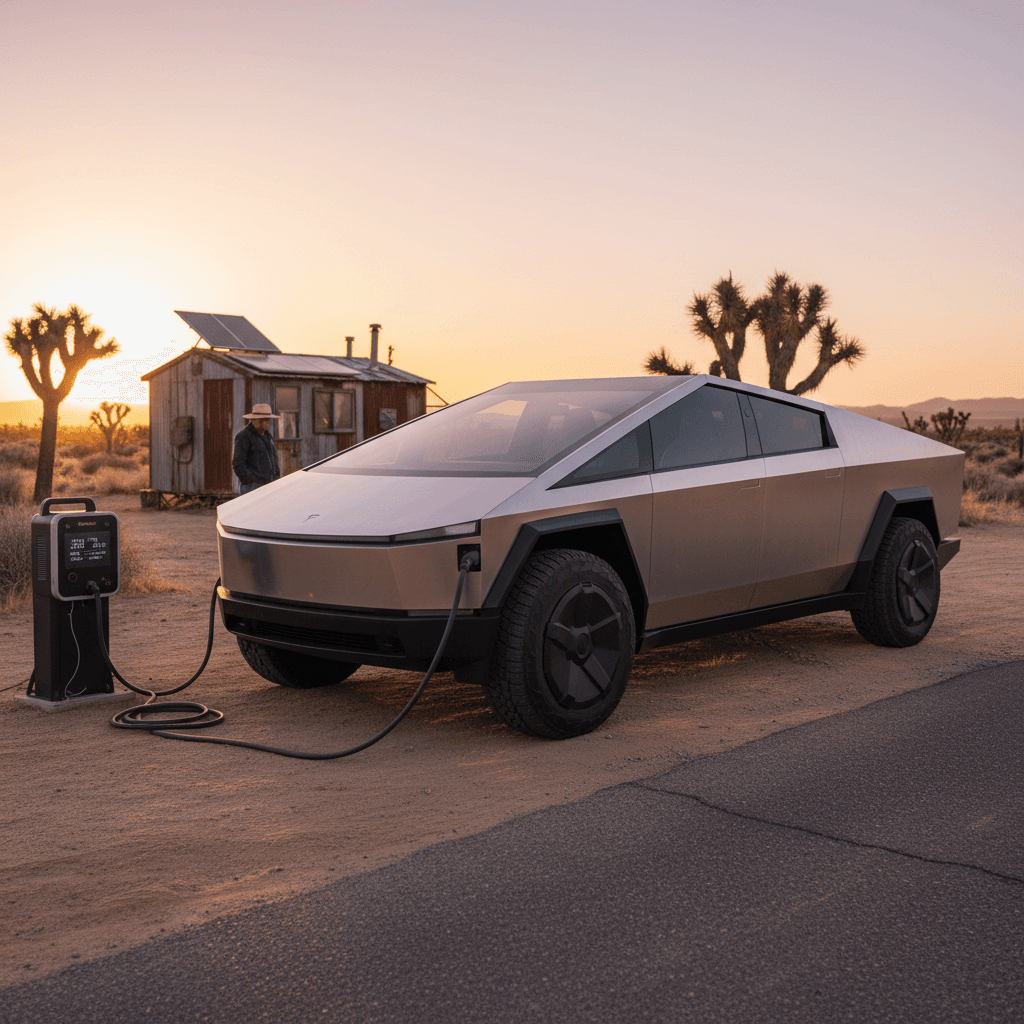
If you’re looking at a Tesla Cybertruck in 2026, whether new or used, the big question isn’t just the headline range number on Tesla’s site. It’s **real-world range**: how far you can actually go at 70–75 mph, in winter, with gear in the bed or a trailer on the hitch. This guide walks through what owners and testers are really seeing on the road so you know what to expect before you sign for a truck or plan that first long trip.
Why real-world range matters more than ever
2026 Tesla Cybertruck range: brochure vs real world
Tesla’s marketing focuses on big range numbers, but pickup trucks live at highway speeds, often loaded or towing. That’s the worst-case scenario for any EV. Independent testing of early Cybertruck All-Wheel Drive models has already shown a **noticeable gap** between EPA-style estimates and what you’ll see cruising at 70–75 mph on U.S. interstates.
Cybertruck range at a glance (2026, approximate)
Those ranges aren’t failures; they’re physics. A Cybertruck is a tall, heavy brick with performance-car power. The key is understanding **what scenario you’ll actually drive in most of the time** and planning for that, not just the best-case number on a spec sheet.
Cybertruck trims, batteries, and official range numbers
By early 2026, Tesla has simplified the Cybertruck lineup in the U.S. to two core versions: a dual‑motor All‑Wheel Drive model and the tri‑motor **Cyberbeast**. Both use a large structural battery pack of roughly 120+ kWh, with an optional range‑extender pack available on higher trims.
2026 Tesla Cybertruck trims and headline range
Approximate specs and advertised range figures for the current Cybertruck lineup. Exact numbers can vary by wheel/tire and software updates.
| Trim (2026) | Drive | Estimated Usable Battery | Tesla Claimed Range* | Notes |
|---|---|---|---|---|
| All-Wheel Drive | Dual motor AWD | ~118–123 kWh | ~320–340 mi | Core volume model; strong blend of performance and efficiency |
| Cyberbeast | Tri motor AWD | ~123 kWh+ | ~300–320 mi | Extreme performance; slightly lower efficiency |
| AWD + Range Extender | Dual motor AWD + bed pack | ~170+ kWh | ~440–470 mi | Extra pack occupies bed space; meant for long trips and work use |
| Cyberbeast + Range Extender | Tri motor + bed pack | ~170+ kWh | ~440–450 mi | Massive power and range, but payload and towing still cut range sharply |
Always check Tesla’s configurator for the latest official numbers before you buy.
Official range uses gentle test cycles
Real-world highway range at 70–75 mph
Most U.S. Cybertruck owners spend a lot of time on divided highways at 70–75 mph. That’s where the real‑world picture comes into focus, and it’s where early independent tests and owner reports have converged on a clear pattern: **expect about 75–85% of the optimistic headline number** in calm, mild‑weather conditions.
What drivers are actually seeing on the highway
Approximate real‑world results on flat ground, 70–75 mph, no trailer, 60–70°F, minimal wind.
All-Wheel Drive (dual motor)
Realistic highway range:
- About 250–270 miles from 100% to near‑empty at 70–75 mph.
- Plan around 220–240 miles if you like to keep a buffer and don’t arrive at chargers near 0%.
Those numbers line up with independent tests that drove dual‑motor trucks in mixed but highway‑heavy conditions and came in just under or slightly above Tesla’s own expectations.
Cyberbeast (tri motor)
Realistic highway range:
- Roughly 210–240 miles at 70–75 mph, depending on wheels and tires.
- Performance tires and frequent hard acceleration can pull you toward the low end of that range quickly.
You’re trading a chunk of real‑world range for the wild acceleration and higher‑speed power the Cyberbeast delivers.
Use 80% of best-case for planning
Why 75 mph hurts so much
Aerodynamic drag doesn’t rise in a straight line; it climbs with the square of your speed. A bluff truck like the Cybertruck punches a huge hole in the air. Bumping from 65 mph to 75 mph can easily cost 10–15% of your range, even in calm weather.
What this means in miles
- At 65 mph, an AWD Cybertruck might realistically see ~280 miles on a mild‑weather road trip.
- At 75 mph, that same truck can drop to ~240–250 miles under the same conditions.
If you can live in the right lane with adaptive cruise, your battery will thank you.
Towing, payload, and how fast range disappears
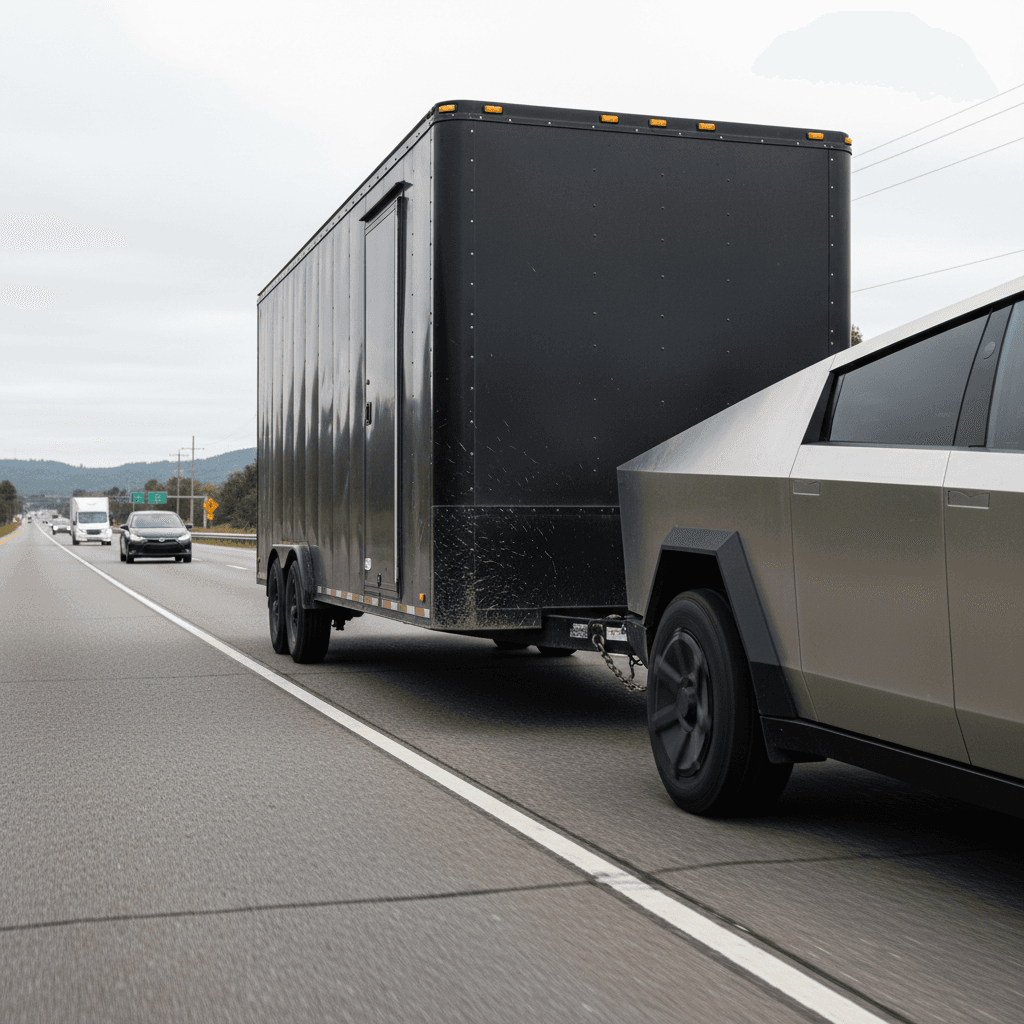
Ask any electric-truck owner, in 2026, not just Cybertruck drivers, and you’ll hear the same story: **towing is a range killer**. It’s not the weight as much as the frontal area and shape of what you’re pulling. A tall box trailer can double your aerodynamic drag at highway speed. That turns even a huge battery into something that feels small.
How towing and payload affect Cybertruck range
Approximate real‑world range impacts for an AWD or Cyberbeast Cybertruck with different loads at 65–70 mph in mild weather.
| Use case | Example setup | Range vs. no trailer | Practical highway range |
|---|---|---|---|
| Light duty work | Ladder rack, tools in bed, no trailer | 5–10% loss | ~230–255 mi (AWD) |
| Small aero-friendly trailer | Low utility trailer with ATV or bikes | 20–30% loss | ~180–210 mi (AWD) |
| Mid-size camper | Single‑axle camper, rounded front | 30–40% loss | ~150–190 mi (AWD) |
| Tall box or car hauler | Enclosed car trailer, tall front | 40–60% loss | ~110–160 mi (AWD), often less in headwinds |
| Heaviest + fast | Max tow, 70–75 mph, hills/headwinds | 50–65% loss | <120 mi (stops every 70–100 mi recommended) |
These are directional numbers, always test your own setup on a familiar route before committing to a long tow.
Don’t plan towing legs by EPA range
Payload alone (tools in the bed, stone, mulch) matters less than the shape of what you’re hauling. A full bed of bricks at 55 mph is far kinder to range than an empty bed towing a tall enclosed trailer at 70 mph. The Cybertruck’s enormous torque masks the extra weight, but the battery still has to pay the bill.
Cold weather, heat, and driving style penalties
Like any EV, the Cybertruck loses range in **cold weather** (battery chemistry and cabin heating) and **extreme heat** (A/C load and thermal management). Because the Cybertruck starts with a lot of battery, the percentage hit looks similar to smaller EVs, but the miles lost per charge can be larger.
Typical weather and driving impacts on Cybertruck range
These are broad patterns that line up with what owners of big battery EVs report by 2026.
Mild (50–75°F)
- 5–10% loss vs. EPA is common on mixed driving.
- Highway at 70–75 mph still brings you down to the 75–85% range of the headline figure.
Cold (below ~32°F)
- 15–30% loss common, more on short trips.
- Cabin heat and battery warming are big draws, especially for many short drives.
- Preconditioning while plugged in helps a lot.
Hot (90°F+)
- 10–20% loss typical in sustained heat with A/C running.
- Dark paint, long sun exposure, and repeated fast charging can push the high end of that range.
Drive smoothly, save big
What the range extender really does (and doesn’t)
Tesla’s optional **range extender** pack adds a second battery module in the bed, marketed to push total range well beyond 400 miles in ideal conditions. It’s a smart answer for work fleets and long‑distance towers who don’t mind giving up bed space, but it doesn’t magically erase the laws of physics.
- On paper, an AWD Cybertruck with the extender can approach **440–470 miles** of range in gentle, mixed driving with no trailer.
- On the highway at 70–75 mph, that same setup might land closer to **350–380 real‑world miles** in mild weather without a trailer.
- Hook up a tall camper or enclosed trailer and that highway number can still drop into the **200–260 mile** window depending on shape, speed, and terrain.
Tradeoffs of the range extender
Real trip planning examples for Cybertruck owners
To make all this more concrete, let’s walk through a few realistic 2026 scenarios. These are the kinds of trips Recharged customers talk about when they’re deciding whether a Cybertruck fits their life or when they’re trading out of a conventional truck into an EV.
Three common Cybertruck range scenarios
1. Weekend cabin run, 170 miles each way
You’ve got a dual‑motor AWD Cybertruck, no trailer, just family and luggage. At 70 mph in mild weather, you’re looking at **about 240–260 miles** of practical range. That makes a 170‑mile leg an easy one‑shot drive with 25–35% charge left when you arrive, no public charging needed if you can plug in at the cabin.
2. 130-mile tow to the track with an enclosed trailer
You’re pulling a tall enclosed trailer with a track car or side‑by‑side. At 65–70 mph, assume **about half your no‑trailer range**, say 140–170 miles of usable towing range in an AWD truck. That means your 130‑mile tow is feasible in one hop with a margin, but you’ll likely want to DC fast charge partway home unless you can refill at the track.
3. Cross‑country relocation, 400–500 miles per day
With an AWD Cybertruck and no trailer, aim for **180–220‑mile DC fast‑charge legs** at 70 mph. That typically means 2–3 charging stops a day, each 20–35 minutes, depending on how low you arrive and how busy the station is. With the range extender, you can stretch those legs, but most drivers still prefer shorter hops for faster charge curves.
Let the trip planner do the math
Thinking used? Battery health and range in 2026
Because the Cybertruck launched in late 2023, the earliest trucks are only a few years old in 2026. That means you’re unlikely to see dramatic battery degradation yet, but use, climate, and fast‑charging habits still matter. For a shopper in the used market, the difference between a pack that’s lost 2% and one that’s lost 10% of usable capacity is the difference between a truck that still feels “new” on the highway and one that needs more frequent stops.
Used Cybertruck range: what to look for
Key questions if you’re eyeing a pre‑owned Cybertruck in 2026.
1. How was it used?
- Trucks that towed heavy trailers frequently at high speed can show more wear on the battery and driveline.
- High‑mileage highway use is generally gentler on packs than short, hot‑cold city cycles, but you still want data, not just stories.
2. What does a battery health report say?
- A proper battery health scan looks at estimated remaining capacity and cell balance, not just the dash range at 100%.
- On a 2–3‑year‑old Cybertruck, a modest single‑digit percentage loss is typical. Anything beyond that warrants questions about use and charging habits.
How Recharged helps on used Cybertrucks
Because Cybertruck uses a large structural pack, you’re not shopping for “battery options” on the used market so much as **battery condition**. Focus on how the truck was used, how often it fast‑charged, and how it was stored. A garage‑kept truck that lived its life between roughly 20% and 80% state of charge will typically age much more gracefully than one that lived at 100% in the sun.
Simple ways to stretch your Cybertruck’s range
You can’t change the Cybertruck’s fundamental shape or weight, but you can absolutely influence how far it goes on a charge. The good news is that most of the biggest wins are free; they just require a little planning and a lighter right foot.
Quick wins for better Cybertruck range
1. Dial back highway speed
Dropping from 75 mph to 65–68 mph on long runs can quickly unlock **10–20% more range**, especially into a headwind. Use Autopilot or cruise control to keep speeds steady instead of yo‑yoing with traffic.
2. Precondition while plugged in
In both hot and cold weather, use the Tesla app to pre‑heat or pre‑cool the cabin while the truck is still on shore power. That way, the pack is warmed or cooled and the cabin is comfortable before you start eating into your on‑road range.
3. Choose tires carefully
Big, aggressive off‑road tires and heavy aftermarket wheels look great, but they carry a heavy efficiency penalty. If most of your driving is highway, stick with **more efficient all‑season or highway‑terrain tires**, or accept that you’re trading range for style and traction.
4. Pack smarter, tow smarter
If you can choose between a low, rounded trailer and a tall, blunt one, always pick the slipperier shape. Load heavy items low and forward, strap things down, and avoid tall roof loads that add drag for no good reason.
5. Use range mode and navigation
Let the truck’s nav and energy prediction tools guide you. Enter your destination, enable any efficiency‑oriented drive modes, and watch the projected arrival state of charge. If the estimate drops too fast, slow down a few mph, small changes add up.
Don’t run to zero
FAQ: Tesla Cybertruck real-world range in 2026
Frequently asked questions
The bottom line for 2026 is simple: the Tesla Cybertruck offers **impressive real‑world range for such a big, fast pickup**, but it still lives under the same physics as every other EV truck. Unloaded at reasonable speeds, it’s a relaxed long‑distance partner; loaded or towing fast, it becomes a truck that works best with thoughtful route planning and realistic expectations. If you’re shopping new or used and want help matching real‑world range to your actual life, a transparent battery‑health view, like the Recharged Score Report, and an EV‑savvy advisor go a long way toward making sure the Cybertruck you buy is the truck you’ll be happy to live with.