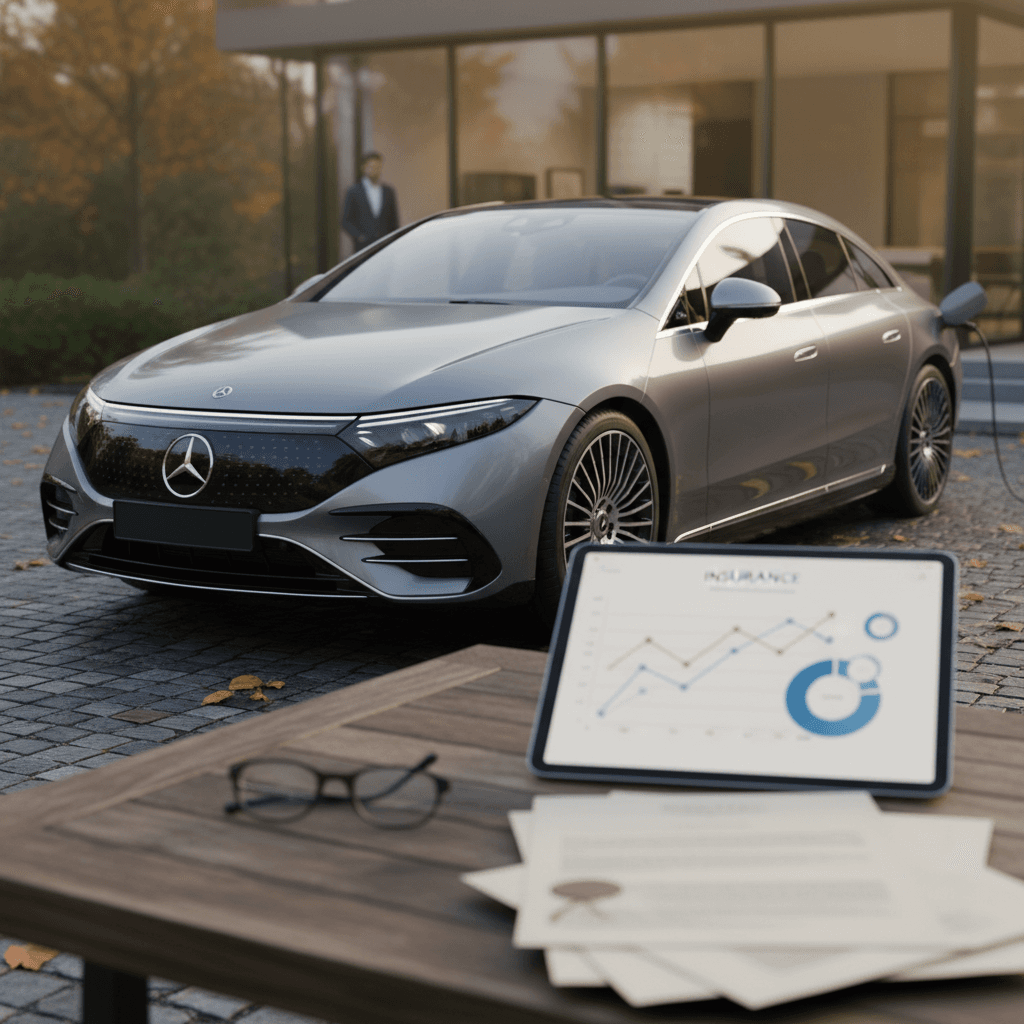
If you’re shopping for a Mercedes EQE, whether the sleek sedan or the roomy EQE SUV, it pays to understand Mercedes EQE insurance costs before you sign anything. Luxury EVs often cost more to insure than gas models, but the story is more nuanced than “EVs are expensive.” Your trim, driving history, where you live, and even whether you buy new or used can swing your premium by hundreds of dollars a year.
Quick EQE insurance snapshot
Mercedes EQE insurance costs at a glance
Typical Mercedes EQE insurance snapshots (U.S., 2025)
Exact numbers will depend heavily on your ZIP code, driving history, and how you configure your EQE. But as a working range, many owners with solid records see full‑coverage EQE premiums around $160–$215 per month. Very high‑risk drivers, urban locations, or AMG performance trims can push that higher.
How much does it cost to insure a Mercedes EQE?
Let’s put some clearer bookends around typical Mercedes EQE insurance cost scenarios in the U.S. for 2025. These are directional examples, not quotes, but they’ll help you sanity‑check the numbers you’re seeing from insurers.
Sample Mercedes EQE annual insurance estimates
Illustrative full‑coverage premiums for a Mercedes EQE in the U.S. assuming 12,000 miles/year. Your actual rate will vary.
| Driver profile | Vehicle | Location type | Typical annual premium | Monthly equivalent |
|---|---|---|---|---|
| Clean record, age 40 | 2023 EQE 350+ sedan (used) | Suburban | $1,700–$2,000 | $140–$165 |
| Clean record, age 35 | 2024 EQE 350 4MATIC SUV (new) | Suburban | $1,900–$2,300 | $160–$190 |
| Clean record, age 30 | 2024 EQE 500 4MATIC SUV (new) | Urban | $2,200–$2,700 | $185–$225 |
| One at‑fault accident, age 28 | 2023 EQE 350+ sedan (used) | Urban | $2,600–$3,300 | $215–$275 |
| Young driver, age 22 | 2024 AMG EQE SUV (new) | Urban | $3,400+ | $285+ |
Use these scenarios as a comparison tool when you collect real quotes.
Don’t anchor on a single quote
Why Mercedes EQE insurance can be higher than average
If you’re coming out of a mainstream crossover or sedan, your first EQE quote might trigger a little sticker shock. There are several structural reasons why the EQE tends to sit in the upper band for insurance costs:
- High vehicle value. A well‑equipped new Mercedes EQE SUV can climb into the $80,000+ range, which simply costs more to repair or replace after a major loss.
- Complex technology. Air suspension, advanced driver‑assist systems, multi‑screen dashboards, and high‑end lighting all raise repair bills when damaged.
- Battery and EV‑specific components. Even if the high‑voltage battery isn’t replaced after a crash, specialized labor and diagnostic time push up claim costs.
- Luxury‑brand parts pricing. Daimler parts and authorized‑shop labor rates are usually higher than mainstream brands.
The good news for EQE owners
7 key factors that shape your EQE insurance cost
You can’t change the fact that the EQE is a high‑value luxury EV, but you have more control than you might think over the rest of the equation. Here are the levers that matter most.
What insurers look at for Mercedes EQE rates
Understanding these factors helps you decide where to focus if you want to save.
1. EQE trim & body style
Insuring an EQE 350+ sedan usually costs less than an EQE SUV, and both cost less than an AMG EQE. Higher power, more expensive wheels, and performance components all add risk in the insurer’s eyes.
2. Where you live & park
Urban ZIP codes with higher crash and theft rates drive premiums up. Parking in a locked garage and living in a lower‑risk suburb can cut your EQE insurance cost substantially.
3. Annual mileage & usage
Driving 20,000 miles per year exposes your EQE to more risk than a 7,500‑mile commuter. Lower stated mileage and avoiding business‑use classification usually help bring costs down.
4. Driving record & age
Clean record drivers in their 30s–50s get the best EQE insurance rates. Recent at‑fault accidents, DUIs, or multiple tickets will add hundreds of dollars a year, or more.
5. Coverage limits & deductibles
Higher liability limits protect your assets but cost more. You can offset part of that by choosing a higher collision and comprehensive deductible if you have savings to cover it.
6. Bundling & household policies
Insuring your home and multiple vehicles with one company often yields multi‑policy and multi‑car discounts, which can really matter on a higher‑premium vehicle like the EQE.
Ask about EV‑specific discounts
EQE trims compared: sedan vs SUV, 350 vs AMG
The way you spec your Mercedes EQE can nudge your insurance bill up or down, even before you factor in your personal driving profile. Here’s how insurers typically view the main variants:
EQE sedan models
- EQE 350+ (RWD): Often the most affordable EQE to insure thanks to lower power output, rear‑wheel drive, and more sedan‑like usage patterns.
- EQE 350 4MATIC: All‑wheel drive adds capability but also some repair complexity and cost.
- AMG EQE sedan: More performance, larger wheels, and pricier brakes/tires typically push premiums higher.
Insurers often treat EQE sedans like a blend of an E‑Class sedan and a high‑value EV: premium, but not exotic.
EQE SUV models
- EQE 350+ SUV: Higher center of gravity, more family‑duty use, and a larger body shell can mean slightly higher claim costs than the sedan.
- EQE 500 4MATIC SUV: More power and more equipment mean a more expensive vehicle to repair or replace.
- AMG EQE SUV: The priciest to insure in the EQE family, with performance parts and high‑dollar wheels/tires.
Think of EQE SUV insurance as comparable to a fully‑loaded GLE or GLS with similar sticker prices.
How used vs. new changes EQE insurance cost
One of the under‑appreciated benefits of buying a used Mercedes EQE is that insurance often gets less expensive as the vehicle depreciates. The replacement cost the insurer puts on the line is lower, and that’s a huge piece of your premium.
New vs. used Mercedes EQE: insurance differences
Why many EQE owners see lower premiums when they step into a pre‑owned vehicle.
New Mercedes EQE
- Higher replacement value, so collision and comprehensive cost more.
- Lenders usually require lower deductibles and full coverage.
- GAP or lease protection is often recommended on heavily financed new EQEs.
Used Mercedes EQE
- Depreciation lowers the payout risk for the insurer.
- You have more flexibility to raise deductibles or drop some optional coverages if your risk tolerance allows.
- Great fit if you want EQE luxury with more manageable ownership costs.
How Recharged fits in
Ready to find your next EV?
Browse Vehicles9 smart ways to lower your Mercedes EQE insurance bill
You may not be able to turn an EQE into an economy‑car insurance bargain, but you absolutely can avoid overpaying. Here are practical tactics that work in the real world.
Action checklist: cutting your EQE insurance cost
1. Get at least three comparable quotes
Use the same driver info, same EQE VIN or trim, and the same coverage limits when you compare companies. Small discrepancies, like one quote using 25/50 liability and another using 100/300, can mislead you about who’s actually cheaper.
2. Right‑size your coverage limits
Don’t under‑insure a $70,000–$80,000 luxury EV. Aim for strong liability limits (such as $250k/$500k) but consider higher deductibles to keep premiums reasonable if you have cash reserves.
3. Explore usage‑based or telematics programs
If you’re a smooth, low‑mileage driver, telematics programs that monitor hard braking, nighttime driving, and mileage can unlock meaningful discounts on an EQE.
4. Ask about EV, safety, and anti‑theft discounts
Point out the EQE’s safety tech, garage parking, and any extra anti‑theft measures you use. Some carriers won’t surface these discounts unless you ask.
5. Adjust comprehensive vs. collision deductibles
If replacing cosmetic damage isn’t mission‑critical for you, consider a higher collision deductible on a used EQE while keeping comprehensive more modest for weather and theft losses.
6. Bundle your policies
Putting your home, renters, or umbrella coverage with the same company as your EQE can shave a healthy percentage off already‑high premiums.
7. Clean up your record where possible
If you’re close to a ticket falling off your record, ask your agent when your rate might improve and whether it’s worth adjusting your policy term to line up with that date.
8. Limit young drivers on the policy
If you have a teen driver, consider keeping them on a separate vehicle with a lower insurance symbol rather than giving them regular access to the EQE in your insurance paperwork.
9. Re‑shop at renewal, not just at purchase
EQE repair‑cost assumptions evolve as more data comes in. Re‑quoting at each renewal keeps you from sticking with an insurer that hasn’t recalibrated its EV pricing.
Don’t chase savings by under‑insuring
Insurance tips when you’re buying a used EQE
If you’re shopping used, insurance should sit right alongside battery health and price in your decision matrix. Here’s how to keep the process smooth and predictable.
- Get quotes on specific VINs. Small differences in equipment, like wheel size or driver‑assist packages, can nudge premiums. Quoting on the actual EQE you’re buying avoids surprises.
- Factor insurance into your total monthly budget. When you compare a used EQE at Recharged with other EVs or gas SUVs, look at payment + insurance + charging, not just the sticker price.
- Leverage condition reports. The Recharged Score Report shows verified battery health and overall condition. Sharing that with your agent can support better underwriting than a generic "high‑risk EV" assumption.
- Ask your lender about required coverages. If you’re financing, your bank or credit union may require certain deductibles or GAP coverage. Clarify those expectations before you finalize your policy.
Use “what if” scenarios
Is GAP or lease protection worth it on an EQE?
Like most modern luxury EVs, a new EQE depreciates quickly in the first few years. If you’re financing heavily or leasing, that makes GAP coverage or lease‑end protection an important conversation.
When GAP or lease protection makes sense
- You’re putting little or no money down and financing 60–72 months or longer.
- You drive higher‑than‑average miles and could accumulate wear and tear quickly.
- You’d struggle to pay off a loan balance if your EQE were totaled in the first few years.
In these situations, the small added monthly cost of GAP coverage can protect you from writing a five‑figure check after a total loss.
When you may be able to skip it
- You’re buying a used EQE that has already taken much of its initial depreciation hit.
- You’re putting a strong down payment on a new EQE and keeping the loan term short.
- You have the savings to cover the difference between actual cash value and payoff if the worst happens.
If your equity position is strong, you might choose to put that GAP budget toward higher liability limits instead.
Frequently asked questions about Mercedes EQE insurance
Mercedes EQE insurance: your questions answered
Bottom line: what to expect with EQE insurance
Owning a Mercedes EQE means enjoying a quiet, refined electric drive with classic Mercedes comfort, and insuring it will cost more than covering a mainstream crossover. But “luxury EV” doesn’t have to mean “budget‑busting insurance.” If you understand how EQE trims, new vs. used status, and your personal profile drive premiums, you can make smart decisions that keep costs in check.
If you’re leaning toward a used EQE, buying from a transparent, EV‑focused marketplace like Recharged helps you see the full picture. With verified battery health, clear pricing, and expert support, you can weigh insurance, charging, and maintenance alongside the purchase price, and choose the EQE that fits your life and your budget today and down the road.