If you’re looking at a Volkswagen ID.4, you’re probably wondering not just **“What’s the price?”** but **“How much does it cost to own a Volkswagen ID.4 per year?”** The short answer: for a typical U.S. driver, expect roughly **$6,000–$9,000 per year** all‑in, depending on whether you buy new or used, how much you drive, and your local electricity and insurance rates. Let’s unpack where that money actually goes, and where an electric SUV like the ID.4 can save you real cash versus gas.
What this guide covers
VW ID.4 annual cost overview
Typical VW ID.4 yearly costs at a glance
Those are broad ranges; your own number might land below or above them. To make this concrete, we’ll use a **“typical commuter” scenario**, about **12,000 miles per year**, and then show how things change if you drive more, pay high electricity rates, or buy used instead of new.
Key assumptions: mileage and electricity rates
You can’t talk about **how much it costs to own a Volkswagen ID.4 per year** without setting a few ground rules. Here’s what we’ll assume for most of the math in this guide:
- Annual mileage: 12,000 miles (close to the U.S. average; Edmunds and other TCO models often use 12,000–15,000).
- Energy use: about 31 kWh per 100 miles in mixed driving for the big‑battery ID.4, which lines up with real‑world highway data and EPA figures.
- Home electricity price: $0.16 per kWh (around the current U.S. residential average; many regions are lower, some coastal states are higher).
- Public fast charging: used occasionally for road trips, say 15–20% of your miles, at roughly $0.35–$0.45 per kWh.
- Ownership: we’ll compare new vs. 3‑year‑old used, both financed, but the annual running‑cost math is similar either way.
Customize these numbers for your life
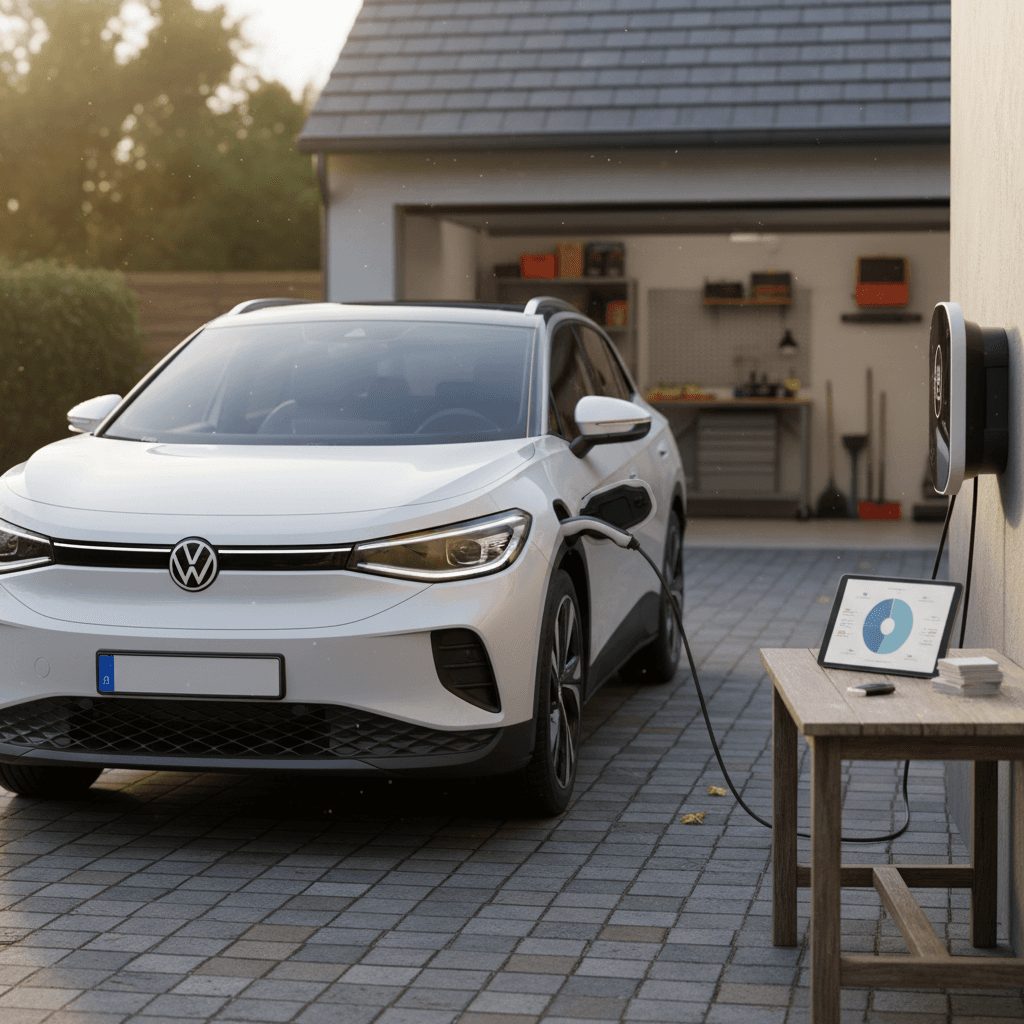
What you’ll pay to charge a Volkswagen ID.4 per year
Volkswagen’s big‑battery ID.4 models tend to land around **29–34 kWh per 100 miles** in real‑world U.S. driving, depending on weather, speed, and wheel size. That’s mid‑pack for compact electric SUVs, neither a miser nor a glutton.
Annual VW ID.4 charging cost examples
Estimated yearly electricity cost for a big‑battery VW ID.4 at different electricity prices and mileages.
| Miles per year | kWh/100 miles (realistic) | Home rate ($/kWh) | Annual electricity cost |
|---|---|---|---|
| 10,000 | 31 | $0.13 | ≈ $403 |
| 12,000 | 31 | $0.16 | ≈ $595 |
| 15,000 | 31 | $0.16 | ≈ $744 |
| 12,000 | 31 | $0.22 | ≈ $818 |
Use your own kWh rate and mileage to refine these estimates.
To sanity‑check that: at 31 kWh/100 miles and 12,000 miles per year, you’ll use about **3,720 kWh** annually. At $0.16/kWh, that’s **$595**. Bump your rate to a pricey $0.22/kWh and you’re still around **$820 per year**, which is low compared with a similar gas SUV that might burn $1,800–$2,400 in fuel at today’s prices.
Public fast charging can double your energy cost

Volkswagen ID.4 insurance costs per year
Insurance is where the friendly little electric crossover quietly turns into a German luxury product. Multiple sources put **average VW ID.4 insurance** somewhere between about **$1,700 and $2,700 per year** for full coverage in the U.S., depending on whose data set you use and how recent it is.
- MoneyGeek’s model pegs the ID.4 around $1,679 per year on average, with cheaper carriers near $1,300 and expensive carriers north of $2,400 for a 40‑year‑old driver.
- Other aggregators that slice the data differently show some drivers paying closer to $2,700 per year on average.
- Young drivers, urban drivers, and high‑claim ZIP codes can see premiums well over $3,000–$4,000 per year.
Why is the ID.4 pricey to insure?
Realistic VW ID.4 insurance bands
Where you might land based on driver profile
Low range: $1,300–$1,700/yr
Clean record, 30s–50s, suburban or smaller‑city ZIP code, good credit, higher deductibles.
Typical: $1,700–$2,300/yr
Average risk profile in a mixed urban/suburban area with standard deductibles and strong coverage.
High: $2,300–$3,500+/yr
Young or high‑risk drivers, dense metro areas, prior claims, or very low deductibles.
Two easy ways to cut ID.4 insurance costs
VW ID.4 maintenance and repair costs
One bright spot: **routine maintenance on a VW ID.4 is cheap** compared with a gas SUV. You’ve lost oil changes, timing belts, spark plugs, and most of the usual rotating‑metal headaches. What’s left is largely inspections, filters, coolant and brake‑fluid intervals, and the occasional software update.
- Volkswagen’s Carefree Maintenance typically covers scheduled maintenance for the first 2 years or 20,000 miles on new ID.4s, which takes some sting out of the first visits.
- After that, owners report dealer service visits in the $250–$600 range, depending on what’s due (simple inspections vs. brake‑fluid service and additional checks).
- Independent EV‑savvy shops can sometimes do the same work for less, once your warranty comfort level allows it.
Typical maintenance budget
Where the ID.4 saves you money
- No oil changes or engine tune‑ups.
- Regenerative braking means slower brake wear in normal driving.
- Fewer moving parts, so fewer fluids and filters overall.
- Remote software updates can fix issues without a shop visit.
Where costs can surprise you
- Out‑of‑warranty electronics or infotainment glitches can be pricey.
- High‑voltage components are rare failures, but complex and expensive.
- Dealer‑only procedures sometimes carry luxury‑car labor rates.
- Some service departments are still learning EVs; shop around.
Tires and other wear items
Like most EV crossovers, the ID.4 is heavy, torquey, and often shod with big wheels. That’s a hostile work environment for tires. Owners with 19–21‑inch wheels often see **tire life in the 20,000–30,000 mile range**, depending on driving style and alignment.
Annualized tire and wear‑item costs for ID.4
Approximate costs spread out over time, assuming average usage.
| Item | Replacement interval | Per‑event cost (approx.) | Annualized cost |
|---|---|---|---|
| Tires (set of four) | 25,000 miles | $900–$1,200 | $430–$575 (at 12,000 mi/yr, ~every 2 yrs) |
| Wiper blades | 1–2 years | $40–$80 | $20–$40 |
| Cabin air filter | 2 years | $80–$150 (dealer), less DIY | $40–$75 |
| Brake pads/rotors | Often 60,000+ miles | $600–$1,000 | $100–$160 (averaged over long term) |
Your actual costs depend heavily on wheel size, road quality, and how you drive.
EV tire reality check
Taxes, fees, and registration
This part is highly state‑dependent, but a quick sketch is still useful when you’re asking how much it costs to own a Volkswagen ID.4 per year.
- Many states have EV registration surcharges (often $100–$250 per year) to make up for lost gas‑tax revenue.
- Standard registration, inspections, and plate fees can easily add another $100–$200 per year.
- If you’re financing or leasing, some states attach property or excise taxes to the vehicle’s value, which fall gradually as it depreciates.
Planning number for most owners
Depreciation, and why buying used changes everything
Now for the elephant in the room, and the reason so many smart EV shoppers go used. **Depreciation** is almost always the biggest single cost of owning a modern electric vehicle, and the VW ID.4 is no exception.
Early U.S. ID.4s saw brisk discounts on the used market as new EV supply improved, federal credits changed, and lease deals got aggressive. That’s bad news if you paid MSRP in year one, and fantastic news if you’re shopping those same cars three years later.
Depreciation on new vs. 3‑year‑old used ID.4
Illustrative examples, not predictions
New Volkswagen ID.4
Say you buy a new ID.4 for $45,000 out the door and keep it five years.
- Resale after 5 years might be roughly $18,000–$24,000, depending on mileage and market.
- That’s around $4,200–$5,400 per year in depreciation alone.
3‑year‑old used ID.4
You buy a 3‑year‑old ID.4 for $26,000 and keep it five more years.
- Resale after 8 years might land in the $10,000–$14,000 range.
- That’s closer to $2,400–$3,200 per year in depreciation.
Why used ID.4s are in a sweet spot
Putting it together: total annual cost examples
Let’s roll all the categories together so you can see a full‑year picture. These are ballpark numbers for a typical U.S. driver at 12,000 miles per year; your real costs can be lower or higher.
Estimated yearly VW ID.4 ownership costs
Comparing new vs. used ID.4 ownership over a multi‑year horizon.
| Category | New ID.4 (est.) | 3‑yr‑old used ID.4 (est.) |
|---|---|---|
| Electricity (mostly home) | $600–$800 | $600–$800 |
| Insurance | $1,700–$2,300 | $1,500–$2,100 |
| Maintenance & minor repairs | $250–$500 | $300–$600 |
| Tires & wear items | $400–$700 | $400–$700 |
| Taxes & registration | $200–$400 | $200–$400 |
| Depreciation | $4,200–$5,400 | $2,400–$3,200 |
| Approx. total per year | $7,300–$10,100 | $5,400–$7,800 |
Financing cost is not shown; that depends on your rate, down payment, and term.
Quick takeaway
How buying a used ID.4 with Recharged can lower your costs
If depreciation is the budget killer, **buying the right used ID.4** is the antidote. This is where a platform built specifically for used EVs, like Recharged, quietly rewrites the math.
- Every vehicle on Recharged comes with a Recharged Score Report, which includes verified battery health. That helps you avoid cars with abused packs that could cost you later.
- Recharged’s pricing tools benchmark each ID.4 against the market so you’re paying a fair price, not a dealer’s guess at the EV zeitgeist.
- If you’re selling or trading in a current vehicle, Recharged can provide an instant offer or consignment to soften the upgrade cost.
- Financing and nationwide delivery turn the whole process into a mostly digital transaction, so you can shop the best‑value ID.4s, not just the ones in your ZIP code.
Stack the deck in your favor
FAQ: VW ID.4 ownership costs
Frequently asked questions about VW ID.4 yearly costs
Viewed in isolation, the Volkswagen ID.4’s yearly costs can sound hefty: four‑figure insurance, EV‑sized tires, and depreciation that hits like gravity. But line those numbers up against a similarly sized gas crossover and the picture sharpens. Electricity is markedly cheaper than fuel, routine maintenance is almost quaintly simple, and buying a well‑priced used ID.4 can cut your biggest expense, depreciation, nearly in half. If you run the math with your own mileage and utility rates, then pair it with a battery‑verified, fairly priced used example from Recharged, the ID.4 stops being an experiment and starts looking like exactly what it is: a thoroughly modern daily driver with long‑term costs you can actually plan for.