If you’re wondering whether you should wait for a 2027-model EV or buy a used electric car now, you’re not alone. EV technology is moving fast, headlines are full of “next big thing” battery breakthroughs, and used EV prices have swung wildly over the last few years. The good news is you don’t need a crystal ball, you just need a clear view of what’s actually coming, what’s already good enough, and how that lines up with your life and budget.
Context: Where We Are Today
Why This Decision Is Tricky in 2026
On paper, waiting for a shiny 2027 EV sounds safe: more range, newer tech, maybe cheaper batteries. In reality, you’re trading real-world savings and utility today for the promise of better future products whose pricing and timing are not locked in. Automakers have delayed or reshuffled multiple “affordable EV” launches already, and some 2026–2027 concepts may never arrive in exactly the form or price point that’s being teased right now.
- Technology headlines make 2027 sound like a hard reset for EVs (solid‑state batteries, ultra‑cheap compacts, etc.).
- But most real 2026–2027 product plans are evolutionary, more range, lower cost per kWh, wider NACS adoption, rather than revolutionary overnight shifts.
- Meanwhile, used EVs have quietly become dramatically more affordable and easier to finance, especially for non‑Tesla models.
Don’t Plan Around Press Releases
What 2027 EVs Are Likely to Change, and What They’re Not
What’s Actually Coming by 2027
Think “better and cheaper,” not “sci‑fi overnight”
Incremental Range Gains
Lower Battery Costs
Charging Standard Convergence
Where expectations get out over their skis is around radical battery tech and ultra‑cheap EVs. Solid‑state batteries, for example, are being piloted by companies like BYD with small‑batch deployments targeted for 2027 high‑end models, not $30,000 crossovers in U.S. showrooms. And some of the most hyped “sub‑$30k EVs” have already seen timelines pushed back or re‑scoped as the economics of incentives, materials, and demand have shifted.
What probably won’t be different by 2027
- Mass‑market solid‑state batteries in affordable trims.
- 3–5 minute DC fast charging as a universal norm.
- 40–50% cheaper EVs across the board.
- Unlimited public charging that’s always cheap and empty.
What will quietly improve
- More efficient powertrains (slightly better real‑world range).
- Better software and driver‑assist tuning from lessons learned.
- More NACS‑native models and fewer adapter headaches.
- More competition in compact SUVs and crossovers, especially from Korean and Chinese brands globally.
How to Read 2027 Product News
How the Used EV Market Is Changing Right Now
Key Used EV Market Signals
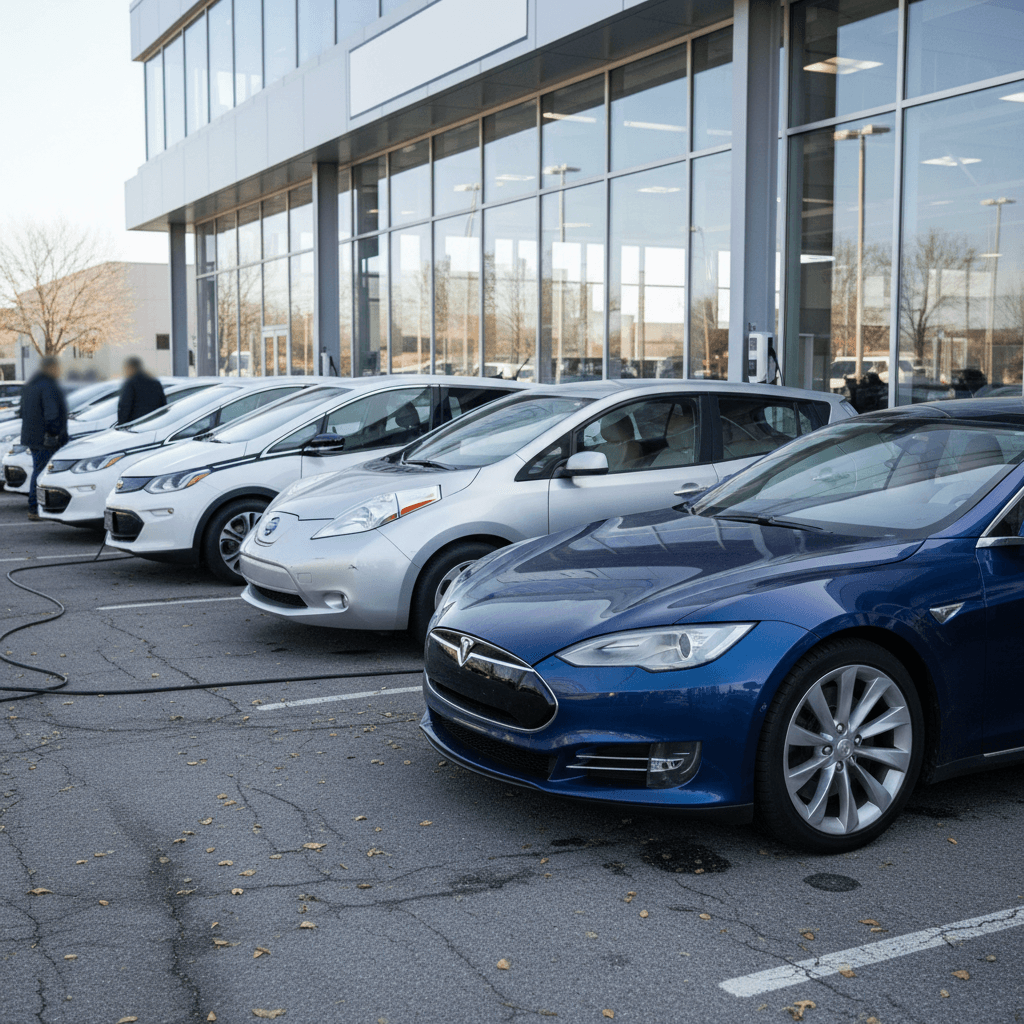
In practical terms, this means that if you’re shopping in 2026 you’re walking into a market where non‑Tesla used EVs are often dramatically cheaper than they were a couple of years ago, and many still have a sizable chunk of battery warranty left. Tesla pricing has bounced around more sharply, but even there, used Model 3s routinely land in the mid‑$20k range rather than the $40k+ price tags they carried when new.
Where Used EVs Are a Sweet Spot
Technology FOMO: Solid-State Batteries, NACS & More
A lot of the anxiety behind “should I wait for a 2027 EV or buy used?” comes from fear of buying just before a big leap in technology. Let’s unpack the main things people worry about: batteries, charging, and software.
Will Today’s Tech Feel Obsolete by 2027?
How key EV technologies likely age over the next 2–3 years.
| Tech Area | Today’s Reality (2026) | By 2027 | Impact on a Used EV Bought Now |
|---|---|---|---|
| Batteries | Mostly lithium‑ion packs with 220–320 mile range in mainstream models | Some high‑end pilots of solid‑state; modest range bumps elsewhere | Your 230–280 mile EV is still perfectly usable; resale may soften slightly but not collapse. |
| Charging Port | Mix of CCS and NACS; many brands shipping or promising NACS in 2025–2026 | Most new U.S. EVs NACS‑native or with factory adapter | Used CCS cars with good NACS adapters remain practical; not a reason alone to delay. |
| Fast Charging | 150–250 kW peak on many road‑trip‑worthy EVs; networks uneven but improving | More high‑power sites, better reliability in major corridors | Well‑specced 2020–2024 EVs remain road‑trip capable; charging curve matters more than year. |
| Software & OTA | Some brands excellent (Tesla, Hyundai/Kia), others hit‑or‑miss; ADAS varies widely | Incremental ADAS and UI upgrades; more consistency with lessons learned | You might miss the latest interface polish, but core driving and charging experience remains solid. |
Most current EV tech remains fully viable through the late 2020s, especially for typical daily use.
What *Is* Risky: Under‑Ranged, Orphaned Models
Cost Comparison: Waiting vs Buying Used Today
To make this concrete, imagine you’re cross‑shopping a used 2022–2023 EV versus a hypothetical 2027 new model. We can’t know exact future prices, but we can outline the tradeoffs you’re likely to see.
Scenario A: Buy Used in 2026
- Vehicle: 2022 compact crossover EV, ~65–75 kWh battery, ~250 miles EPA range.
- Price: Mid‑$20k to low‑$30k depending on brand, trim, and mileage.
- Financing: Competitive used rates; some lenders offer EV‑specific products.
- Incentives: You may qualify for used EV tax credits depending on income, price cap, and vehicle eligibility.
- Operating costs: Immediate fuel and maintenance savings versus your current gas car.
Scenario B: Wait for a 2027 New EV
- Vehicle: 2027 compact EV on newer platform, possibly with slightly higher range and NACS port standard.
- Price: High‑$30k to $40k+ list price before incentives for mainstream crossovers, unless a true budget model appears and you can actually get one.
- Financing: New‑car interest rates that may or may not be lower than 2026 levels; possible captive‑finance incentives.
- Incentives: New EV tax credits depend on future policy and domestic‑content rules, these can change between now and 2027.
- Operating costs: You keep paying for your current vehicle (including any big repairs) until 2027, then switch to EV savings.
Do the “Total Cost of Waiting” Math
Lifestyle Check: How Much EV Do You Actually Need?
The right answer to “wait or buy used?” depends heavily on how you actually drive, where you live, and how much you care about bleeding‑edge tech versus cost and simplicity.
Quick Lifestyle Audit Before You Decide
1. Daily Miles vs. Range Needs
If you drive under 60–80 miles on a typical day, almost any modern used EV with 200+ miles of remaining range will feel liberating. You only need 300+ miles of range if long, spontaneous road trips are a big part of your life.
2. Home vs. Public Charging
If you can install Level 2 charging at home or already have it, a used EV becomes dramatically more convenient. If you’re 100% reliant on public charging and live in a sparse region, waiting for better local infrastructure may make more sense.
3. Climate & Parking
Cold climates and lots of highway driving hit range hardest. Parking in a garage and pre‑conditioning the car on the charger can offset much of that. If you don’t have dedicated parking, factor in how often you’re okay plugging in at public stations.
4. Tech & Safety Priorities
If you absolutely want the latest driver‑assist suite or a specific infotainment platform, that’s a point toward waiting or buying newer. If you mainly care about low running costs and quiet, smooth commuting, a 3–5‑year‑old EV is usually plenty.
5. Life Changes on the Horizon
Expecting a longer commute, a move to a rural area, or regular towing/road‑tripping within the next 2–3 years? That might justify waiting for a bigger‑battery or more capable EV rather than buying a short‑range city car now.
Decision Framework: Should You Wait or Buy Used?
Here’s a simple way to turn all of this into a decision. Pick the profile that sounds most like you, then fine‑tune from there.
Buyer Profiles and Recommended Paths
The Burning‑Cash Commuter
You drive a lot, gas is painful, and your current car needs work.
You have (or can add) home Level 2 charging.
You don’t care if the UI looks like a 2023 or 2027 tablet.
<strong>Recommendation:</strong> Don’t wait. A well‑chosen used EV will likely save more over the next 3 years than any tech gains you’d get in a 2027 model. Focus on battery health and remaining warranty.
The Tech‑Obsessed Early Adopter
You keep phones for two years and always want the latest features.
You’re curious about solid‑state, ultra‑fast charging, and advanced driver‑assist.
You can afford a higher purchase price and aren’t stretched to keep your current car going.
<strong>Recommendation:</strong> Waiting may make sense, especially if you’re eyeing premium or halo models that are explicitly targeted for 2027+. Just don’t anchor on pre‑production pricing.
The Range‑Anxious Road‑Tripper
You do frequent long‑distance drives and prefer fewer charging stops.
You care a lot about NACS access and robust DC fast‑charging curves.
Your current gas car is fine for another couple of years.
<strong>Recommendation:</strong> Consider a newer used EV with strong fast‑charging now, or wait for 2027 if you’re targeting a specific upcoming long‑range model. Either way, prioritize charging speed and network access over pure headline range.
The Budget‑Constrained Upgrader
You need to minimize monthly payment and total cost of ownership.
You’re okay with previous‑generation styling and screens.
You mainly drive locally and can charge at home or work.
<strong>Recommendation:</strong> Strong lean toward used. Target 3–6‑year‑old mainstream EVs where depreciation has already done its work, and use tools like the Recharged Score to validate battery health so you’re not buying someone else’s problem.
Rule of Thumb
How Recharged Helps You De‑Risk a Used EV
The biggest rational fear about buying a used EV is simple: “Am I about to get stuck with a worn‑out battery or an overpriced car?” That’s exactly the problem Recharged was built to solve.
Buying Used Doesn’t Have to Feel Like a Gamble
How Recharged makes the used‑EV path safer and simpler
Verified Battery Health
Transparent, Fair Pricing
EV‑Specialist Support
Nationwide Delivery
Trade‑In & Selling Options
Financing Built for EVs
Try This: Reality‑Check a Used EV
Frequently Asked Questions
Should I Wait for a 2027 EV or Buy Used Now?
Bottom Line: Who Should Wait for 2027, and Who Shouldn’t
If your current car is paid off, reliable, and cheap to run, and you’re genuinely excited about a specific upcoming 2027 EV or high‑end tech like early solid‑state batteries, then waiting can be a rational, even enjoyable choice. You’re effectively buying an option on the future with relatively low carrying costs today.
But if you’re asking “should I wait for a 2027 EV or buy used?” while pouring money into fuel and repairs, or feeling boxed‑in by an aging gas car, the answer tilts strongly toward buying a well‑vetted used EV now. The technology in 3–6‑year‑old EVs is already mature enough for most drivers, and today’s used prices plus tools like the Recharged Score let you capture much of the EV benefit curve without waiting on uncertain future products.
Ultimately, the smart move isn’t to time the market perfectly, it’s to match the EV you buy to the life you’re living, at a total cost that makes sense. If you’re ready to run that calculation with real cars and real numbers, Recharged can help you compare used options, understand battery health, explore financing, and decide whether the future you’re waiting for is actually already sitting on a used‑EV lot today.