The 2017 Chevy Bolt EV was a landmark: the first mass-market electric car in the U.S. to pair **200+ miles of EPA range** with a relatively attainable price. Nearly a decade later, the question for most shoppers isn’t “Was it important?” but “Is a **2017 Chevy Bolt EV** still a smart used buy today?” This review focuses on exactly that: real-world range, recall history, battery health, and the ownership experience you can expect now.
2017 Bolt EV in one sentence
Why the 2017 Bolt EV Still Matters
If you’re shopping used, the 2017 Bolt EV sits in a sweet spot between older short-range EVs and today’s pricey long-range models. It delivers **EPA-rated 238 miles of range**, seats five adults, and drives more like a peppy hot hatch than an eco-appliance. On today’s market, you can often buy a 2017 Bolt for **roughly one-quarter of its original MSRP**, making it one of the cheapest ways to get meaningful EV range without burning gasoline.
2017 Chevy Bolt EV: quick pros and cons
The high-level tradeoffs before you dive into the details
What the 2017 Bolt gets right
- Long range for the price – 238‑mile EPA rating still beats many newer budget EVs.
- Efficient and peppy – instant torque, strong regen, and ~4 mi/kWh is realistic for many drivers.
- Spacious hatchback packaging – more useful interior than its subcompact footprint suggests.
- Depreciation already “baked in” – steep early drop means strong value used.
Where the 2017 Bolt falls short
- Battery fire recall history – absolutely critical to verify replacement status.
- Slow DC fast charging – ~55 kW peak and aggressive taper, not ideal for frequent road trips.
- Early‑GM infotainment feel – functional but dated compared with 2024+ EVs.
- No modern driver‑assist suite – no Super Cruise and only basic active safety tech.
2017 Chevy Bolt EV key specs at a glance
Core 2017 Bolt EV specs
2017 Chevy Bolt EV trim comparison
Only two trims were offered in 2017: LT and Premier. Many key EV features are shared, but convenience and safety options differ.
| Feature | LT | Premier | |
|---|---|---|---|
| Seat material | Cloth | Leather-appointed | |
| DC fast charging (CCS) | Optional package | Optional package | |
| Advanced safety (lane keep, fwd collision alert) | Optional Driver Confidence packages | Optional Driver Confidence packages | |
| Surround vision camera | Not available | Standard | |
| Rear parking sensors | Optional | Standard | |
| Wheels | 17" alloy | 17" alloy with different finish |
DC fast charging (CCS) was optional on both trims in 2017, don’t assume every used Bolt has it.
Range and efficiency: how far a 2017 Bolt really goes
On paper, the 2017 Chevrolet Bolt EV delivers **238 miles of EPA-rated range** from its roughly **60 kWh usable battery**. In real life, that translates into about **180–260 miles** on a full charge, depending on speed, temperature, and how gently you drive. Many owners report efficiency in the **3.5–4.5 mi/kWh** range in mixed driving, which keeps real‑world range surprisingly close to the original EPA number even years later.
Range rule of thumb
- City driving: The Bolt’s single‑speed drivetrain and strong regen make it extremely efficient around town. Stop‑and‑go commutes can easily beat the EPA range.
- Highway driving: At 70–75 mph, expect range to drop more noticeably. Think **170–200 miles** in many U.S. highway conditions.
- Cold weather: Like most EVs, the 2017 Bolt can lose 20–40% of its range in winter, especially on short trips where cabin heating dominates energy use.
- Hot weather: A/C is less punishing than heat, but high speeds plus A/C can still trim 10–15% off ideal range.
Watch winter highway range
Charging experience: home, public, and road trips
The 2017 Bolt EV charges with a standard **J1772 inlet for Level 1 and Level 2 AC** charging, and many cars were optioned with **CCS DC fast charging**. That makes it compatible with most non‑Tesla public infrastructure in the U.S. While charging speeds aren’t cutting‑edge anymore, they’re adequate for overnight home charging and occasional road trips if you plan ahead.
Charging options for a 2017 Chevy Bolt EV
How each charging level fits into daily life
Level 1 (120V wall outlet)
- ~1.2–1.4 kW, roughly 3–5 miles of range per hour.
- Good for ~30–40 miles of daily driving if you can plug in every night.
- Too slow to refill a full battery from empty in a day.
Level 2 (240V home or public)
- Up to ~7.2 kW on 2017 models.
- Roughly 25–30 miles of range per hour of charge.
- 0–100% in about 8–10 hours, perfect for overnight charging.
DC fast charging (CCS)
- Peaks around 55 kW under ideal conditions.
- Roughly 90–150 miles added in ~30–45 minutes from low SOC.
- Best used to 70–80%; charging slows significantly above that.
Does every 2017 Bolt have DC fast charging?
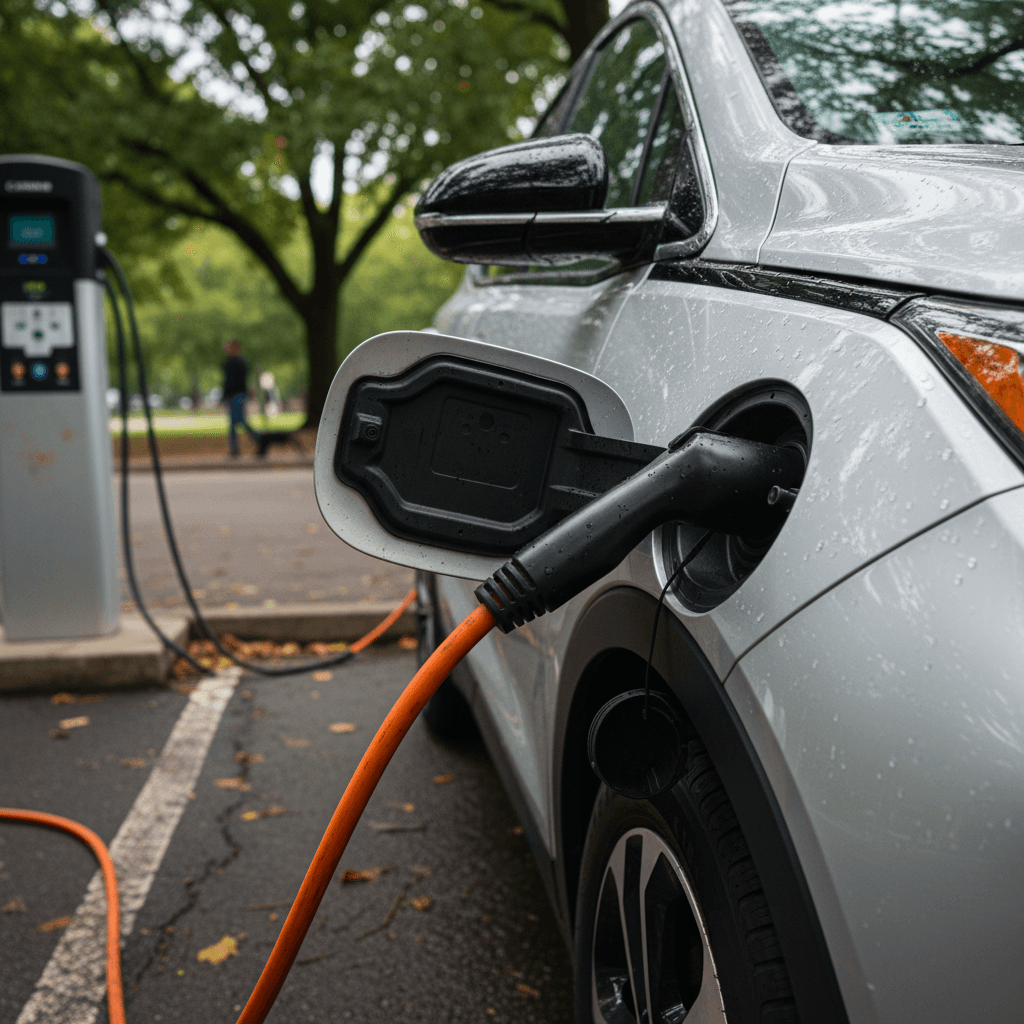
Road‑tripping in a 2017 Bolt
The Bolt can road‑trip, but it’s not built around DC fast‑charging the way newer 800‑volt EVs are. You’ll see ~55 kW max at low state of charge, with a fairly aggressive power taper as the battery fills. On a long drive, that means more frequent, shorter charging stops rather than one big splash of energy.
Daily charging pattern
Where the 2017 Bolt shines is as a daily commuter. Plug into a 240V Level 2 charger at home and you’ll wake up each morning with a full “tank,” without ever visiting a gas station or public charger. For many U.S. households driving 30–60 miles per day, the charging experience is almost invisible.
Driving experience, comfort, and interior tech
Behind the wheel, a 2017 Bolt EV feels more like a lively compact hatchback than an eco‑science project. With **200 hp and 266 lb‑ft of torque to the front wheels**, it jumps off the line, merges confidently, and excels in urban traffic. One‑pedal driving with strong regenerative braking quickly becomes second nature, making stop‑and‑go traffic less fatiguing.
- Ride and handling: The tall body and relatively short wheelbase mean you’ll feel sharp bumps more than in a larger sedan, but body control is good and the low battery pack keeps it stable in corners.
- Noise: Cabin noise is acceptable for the class, though you’ll notice more wind and road noise at 70+ mph than in a modern luxury EV.
- Interior space: Despite its small footprint, the Bolt offers legit adult room in both rows and flexible hatchback cargo space, especially with the rear seats folded.
- Infotainment: A large central touchscreen, Apple CarPlay/Android Auto, and clear energy‑use displays make it easy to understand and optimize your driving efficiency. The UI feels older today but remains very usable.
Packaging win
Reliability, recalls, and battery replacements
You can’t talk about any early Chevy Bolt EV, including the 2017, without addressing its **high‑profile battery recall**. Certain LG‑supplied battery modules used in 2017–2019 cars had a manufacturing defect that could, in rare cases, lead to thermal runaway and fires. U.S. safety regulators ultimately urged owners to park outside and avoid charging unattended until a permanent fix was available.
Battery recall is non‑negotiable
- GM’s final remedy for many affected Bolts was a **full pack replacement** with revised LG cells.
- Recalled cars typically received a slightly higher‑capacity pack, bringing usable energy closer to **64–65 kWh** in practice, which can even increase real‑world range for some owners.
- Once the recall is properly completed and documented, most insurers, lenders, and used‑car retailers (including Recharged) consider these cars safe to operate.
Outside the battery saga, the 2017 Bolt EV has generally proven **mechanically robust**. With no engine, transmission, or exhaust system to maintain, there are fewer complex wear items than in a gas car. Owners most commonly report minor issues like infotainment glitches, the occasional sensor fault, or normal EV wear items such as tires and 12‑volt batteries.
How Recharged handles Bolt recalls
Battery health and degradation on older Bolts
Battery degradation, the slow loss of usable capacity over time, is central to any **2017 Chevy Bolt EV review**. Age, mileage, climate, and fast‑charging habits all play a role. The recall complicates the picture: many 2017s now have **newer replacement packs**, often installed between 2021 and 2023, which effectively “reset the clock” on degradation for those cars.
Original packs
On early, non‑replaced packs, anecdotal reports from high‑mileage drivers suggested single‑digit to low‑teens percent loss after 100,000 miles in normal use. The recall means relatively few 2017s still run their original packs today, but if you find one, treat that as a red flag and dig deeply into recall status.
Replacement packs
Owners of replacement packs commonly see capacity readings in the ~62–65 kWh range shortly after install, with modest declines (for example, low‑single‑digit % loss) over the first tens of thousands of miles when driven and charged reasonably.
Habits that help Bolt battery health
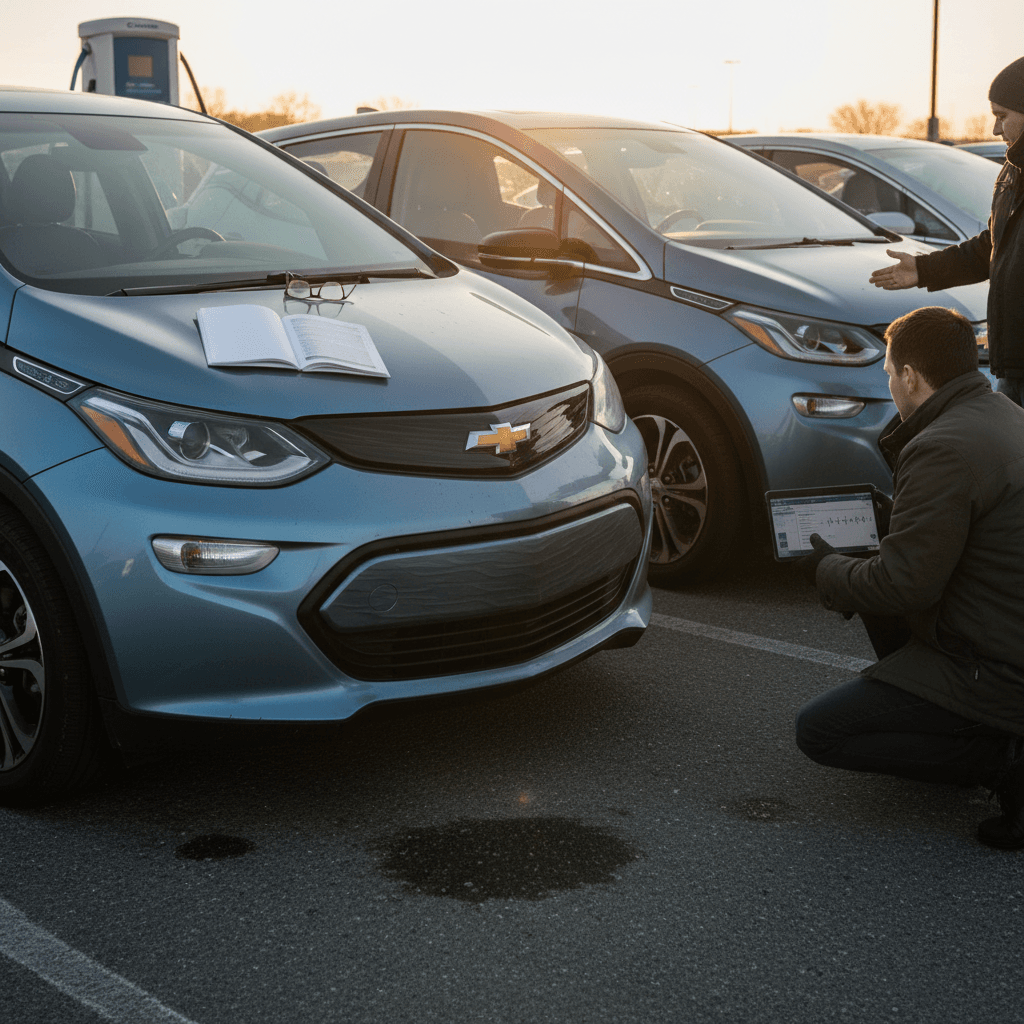
Battery health checks for a used 2017 Bolt EV
1. Confirm recall completion
Request documentation of the battery recall repair, including the date and odometer reading at which the pack was replaced or the final remedy applied.
2. Compare range to EPA rating
Ask the seller what range they see from 100% to low state of charge in their typical driving. Large gaps versus the 238‑mile EPA figure can signal abnormal degradation, or just a lot of high‑speed highway use.
3. Scan with an OBD app (optional)
If you’re comfortable, a Bluetooth OBD dongle and third‑party app can estimate usable kWh. Don’t obsess over precise numbers, but look for large outliers versus what’s typical for the car’s age and mileage.
4. Test drive from low to mid SOC
Drive the car from, say, 40% to 20% and watch how the state of charge and estimated range drop. You’re looking for smooth, consistent behavior rather than sudden swings.
Ownership costs and used pricing in today’s market
When new, a 2017 Chevy Bolt EV LT started around the mid‑$30,000s before incentives, with Premier trims a few thousand higher. Today, heavy depreciation plus the age of the platform mean **used values have fallen dramatically**. National pricing guides show typical 2017 Bolt EVs trading in the **low‑five‑figure range** depending on mileage, condition, and battery status, versus original MSRPs in the high‑$30,000s.
Cost snapshot for a 2017 Bolt EV (U.S.)
Insurance costs vary by region, but the Bolt’s strong crash‑test performance and compact‑car footprint help. And because electricity is generally cheaper per mile than gasoline, especially if you can charge at home on an off‑peak rate, **total cost of ownership can be very compelling** compared with a similar‑size gas car, even before you factor in lower maintenance.
How Recharged evaluates used Bolts
What to check before you buy a 2017 Bolt EV
If you treat the 2017 Bolt EV like any other compact used car, you’ll miss the EV‑specific risks and opportunities that really define its value. Use the checklist below as a framework whether you’re shopping privately, at a dealer, or on a marketplace like Recharged.
Pre‑purchase checklist for a 2017 Chevy Bolt EV
1. Verify VIN for recalls
Run the VIN through the official recall lookup and confirm all Bolt‑specific campaigns, especially the battery recall, have been completed.
2. Confirm DC fast‑charge capability
Physically inspect the charge port door: look for the two larger DC pins below the J1772 opening, or verify the fast‑charge option code on the build sheet.
3. Inspect tires and brakes
Like many EVs, the Bolt is heavy and torquey. Uneven tire wear or tired shocks can appear sooner than on a comparable gas hatchback. Regenerative braking reduces pad wear, but have a shop check anyway.
4. Test all infotainment and cameras
Cycle through the touchscreen, backup camera, Bluetooth, and (on Premier) surround‑view cameras and heated seats. Infotainment gremlins are annoying and can be costly to chase.
5. Drive at highway speed
Get the car up to at least 65–70 mph. Listen for unusual wind or drivetrain noise and note how stable it feels in crosswinds and over expansion joints.
6. Evaluate charging behavior
If possible, plug into a Level 2 charger during your inspection. Confirm that the car starts charging promptly and that there are no error messages on the dash or charging station.
Who the 2017 Bolt EV is (and isn’t) right for
Great fit
- Suburban commuters driving 20–80 miles per day, with reliable access to home or workplace charging.
- Two‑car households that can use the Bolt as the primary commuter and keep a gas or newer‑EV road‑trip car around.
- Value seekers who want long EV range at a used‑car price, and are comfortable doing a bit of homework on recalls and battery health.
Probably not ideal
- Drivers who routinely need fast, back‑to‑back DC fast charges on long highway trips.
- Shoppers who want the latest driver assistance features, active‑safety suites, or Tesla‑grade DC charging performance.
- Owners without any reliable home or workplace charging, who would be depending on public Level 2 for nearly all their energy.
2017 Chevy Bolt EV FAQ
Frequently asked questions about the 2017 Bolt EV
Bottom line: is a 2017 Chevy Bolt EV a good buy?
If you go in with eyes open, a well‑sorted 2017 Chevy Bolt EV remains one of the **best values in the used EV market**. You’re getting real long‑distance electric range, practical hatchback utility, and very low running costs for the price of a typical used compact gas car. The tradeoffs, slower fast‑charging, a dated interior, and a complicated recall history, are real but manageable if you do your homework.
The key is to treat the battery pack like the engine and transmission combined: verify its history, understand its health, and price the car accordingly. If that sounds like a lot to shoulder alone, platforms like Recharged are designed to do this technical due diligence for you, with a **Recharged Score Report**, verified battery health data, fair‑market pricing, and expert EV guidance from first click to delivery.
For commuters, first‑time EV buyers, and value‑focused households who mostly charge at home, a clean, recall‑completed 2017 Bolt EV can still be a smart, future‑proof way into electric ownership, without the new‑car sticker shock.