You’re not alone in wondering, “Should I get an EV?” In 2025, electric vehicles are cheaper to run than gas cars, but not always cheaper to own. Incentives are shifting, interest rates are high, and headlines about slowing EV demand can make the choice feel riskier than it is. This guide walks through the real trade‑offs so you can decide if an EV fits your budget, driving habits, and charging situation right now, especially if you’re considering a used EV.
EV adoption is growing, but more slowly
How to use this guide
- If you want the short answer, jump to Quick answer: should you get an EV?.
- If you’re comparing long‑term costs, read EV vs gas costs in 2025.
- If you’re worried about charging or range, focus on Charging and Range & driving habits.
- If you’re shopping used, don’t skip New vs used EVs and battery health and How Recharged helps.
Quick answer: should you get an EV?
At a glance: who an EV fits best in 2025
Use these as starting points, not hard rules.
An EV is likely a good move if…
- You can charge at home or at work most days.
- You drive 10,000–15,000 miles a year or more.
- You live in an area with decent public charging and mild to moderate winters.
- You plan to keep the vehicle 5+ years and care about lower maintenance and emissions.
- You can afford a slightly higher purchase price (or are buying a fairly priced used EV).
You may want to wait or choose hybrid/gas if…
- You can’t install home charging and rely on scarce or expensive public chargers.
- You drive mainly short trips (under 6,000 miles/year), so fuel savings are limited.
- You often tow or drive long rural routes with few fast chargers.
- You live somewhere with very high electricity rates and low gas prices.
- You need the absolute lowest upfront price and can’t stretch your budget.
The short version
EV vs gas costs in 2025
EVs are still typically more expensive to buy than gas cars, but they’re cheaper to operate. The question behind “should I get an EV?” is really “does the total cost of ownership make sense for me?” Let’s break down the key pieces: purchase price, fuel/energy, maintenance, and depreciation.
Key cost numbers to keep in mind
1. Purchase price
New EVs today often cost several thousand dollars more than comparable gas models. With the federal tax credit now largely scaled back and more restrictive, the gap depends heavily on state incentives, dealer discounts, and whether you buy new or used.
Used EVs, however, can be priced very aggressively because of higher depreciation. That’s where many shoppers are finding the sweet spot, if they can verify battery health and understand real‑world range.
2. Operating costs
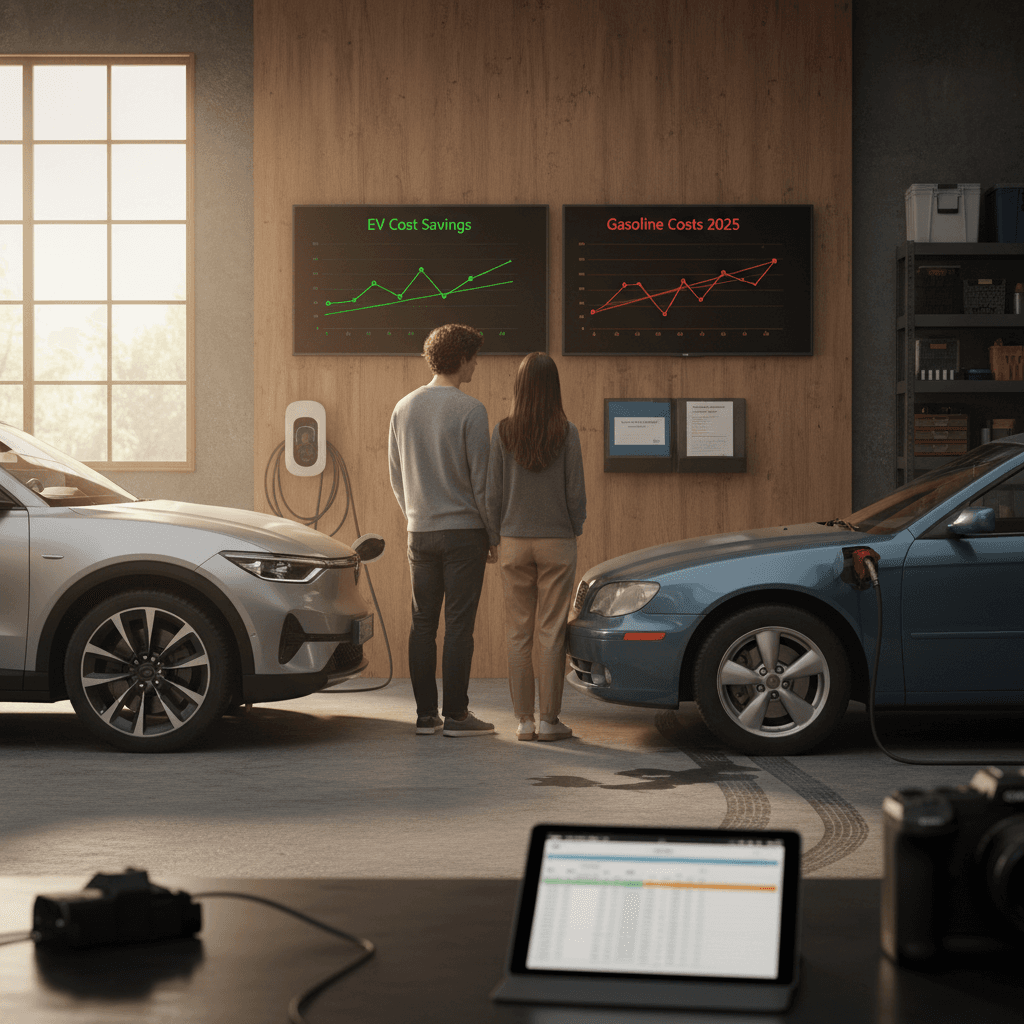
On energy alone, EVs usually win. At average U.S. prices, a typical EV might cost 3–5 cents per mile to charge at home versus roughly 10–15 cents per mile for gasoline. Over five years, that can mean several thousand dollars in fuel savings for a normal commuter.
Maintenance and repairs also tend to be lower for EVs: no oil changes, fewer fluids, less brake wear. Over a five‑year span, many analyses show $2,000+ in maintenance savings compared with gas cars, depending on how and where you drive.
Don’t ignore depreciation
Put together, most mainstream EVs and comparable gas cars are now surprisingly close in five‑year cost for an average driver, often within a few hundred dollars. If you drive more than average, charge at home, or buy a strong‑value used EV, the numbers often tilt in your favor. If you drive very little, rely on expensive public fast charging, or pay very high electricity rates, gas can still be cheaper overall.
Charging: do your home and routine actually fit an EV?
Charging is where many shoppers get stuck. The reality in 2025: if you can charge where you park most nights, an EV is usually easy to live with. If you can’t, you need to look much harder at your local infrastructure and costs before deciding to get an EV.
Home charging (ideal case)
- Level 1 (120V): Standard outlet, adds roughly 3–5 miles of range per hour. Works for very short commutes or second cars.
- Level 2 (240V): Dedicated circuit (like for a dryer), typically 25–40 miles of range per hour. This is the sweet spot for most owners.
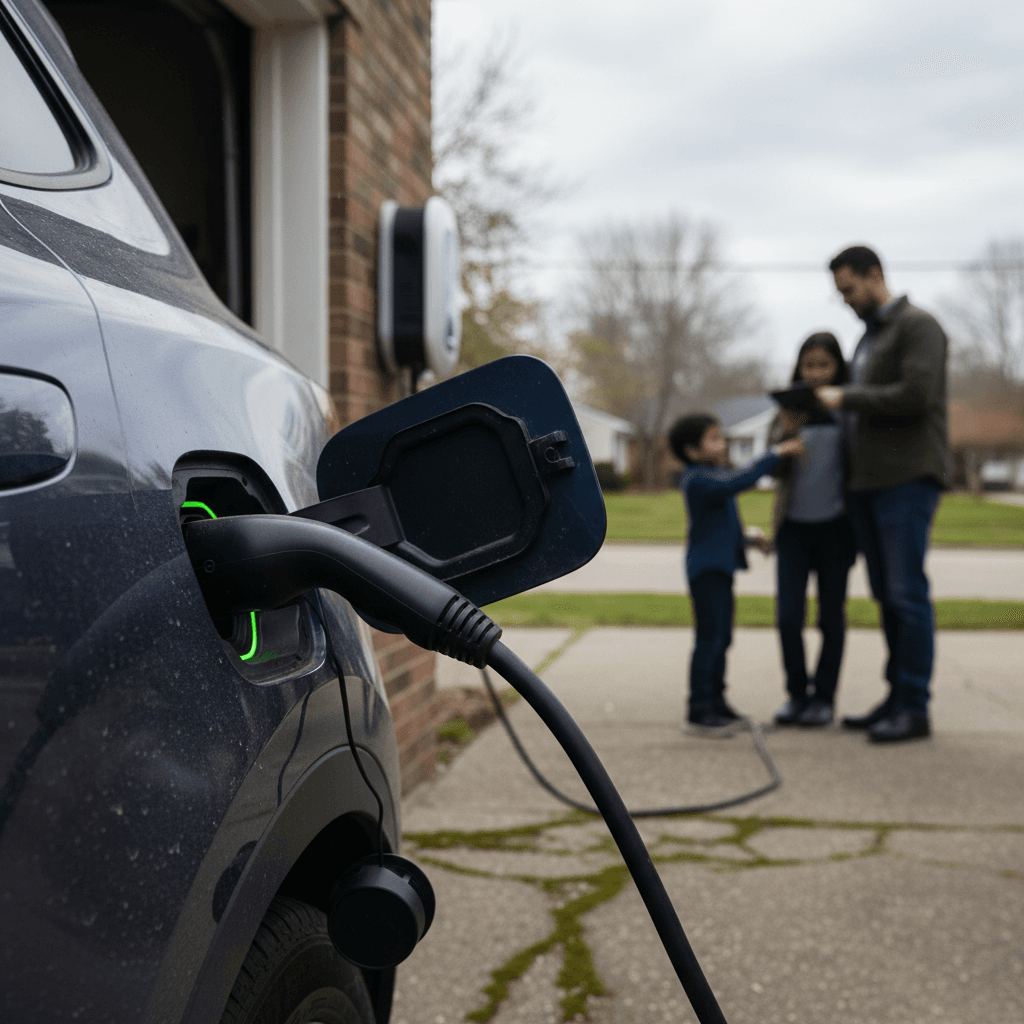
If you own your home and can install a 240V outlet or wallbox, day‑to‑day EV ownership is usually straightforward. You plug in at night, wake up with a “full tank,” and rarely think about public charging.
Public charging (okay to mixed)
- Workplace charging: Great if available, especially combined with some home charging.
- DC fast charging: Essential for road trips, but not ideal as your primary fueling method, costs are higher and sessions take time.
- Apartment or urban living: Can work if you have reliable chargers in your garage or neighborhood, but it’s highly location‑dependent.
If most of your charging would be at public stations, factor in higher per‑kWh prices, potential wait times, and reliability. In some markets, fast‑charging regularly can erase much of the EV’s cost advantage.
Fast way to sanity‑check charging
Range, climate and your driving habits
Today’s EVs span everything from compact hatchbacks with under 150 miles of real‑world range to crossovers and trucks that comfortably clear 250–300 miles. Whether that works for you depends less on the EPA sticker and more on your actual usage and weather.
Three questions that reveal if EV range fits your life
1. What’s your real daily use?
Add up your typical weekday driving: commute, school runs, errands. Many U.S. drivers log under 40 miles per day. For them, even a modest‑range EV can work well with home charging.
2. How harsh are your winters?
Cold weather can temporarily cut range by 20–40% because the battery and cabin heating both draw energy. If you live in a cold climate, build in a buffer and consider models with stronger winter performance.
3. How often do you road‑trip?
Occasional road trips are fine, just plan around fast chargers. Constant long‑distance driving, especially in rural areas with few chargers, is where gas or a plug‑in hybrid may still be more practical.
Think in weekly miles, not just road trips
New vs used EVs and why battery health matters
One of the biggest EV questions in 2025 is whether to buy new or used. New EVs come with full warranties and the latest tech but carry higher prices and bigger depreciation risk. Used EVs can be tremendous value plays, if you understand battery health, remaining warranty, and how the car was used.
Buying new
- Pros: Full factory warranty, latest range and tech, known history, simpler financing.
- Cons: Higher purchase price, biggest depreciation hit in the first few years, incentives are changing and may be more limited than a few years ago.
New can make sense if you want maximum range, plan to keep the car a long time, and can comfortably afford the upfront cost.
Buying used
- Pros: Lower purchase price, prior owner already absorbed early depreciation, many off‑lease EVs with low mileage.
- Cons: Battery health varies, range may be lower than when new, and older models may not fast‑charge as quickly or have the newest safety tech.
This is where independent battery health data becomes critical. Two identical EVs on paper can have very different real‑world range depending on how they were driven and charged.
Battery health is the make‑or‑break on a used EV
When an EV is usually a great fit
Profiles of drivers who tend to love their first EV
Suburban commuter with driveway
You have a driveway or garage, can install Level 2 charging, and commute 20–50 miles a day. Fuel and maintenance savings add up quickly, and public charging is mostly for the occasional trip.
High‑mileage professional
You put 15,000–25,000 miles a year on your car and mostly drive predictable routes. Lower “fuel” and service costs can offset a higher purchase price over just a few years.
Environment‑first household
You’re willing to invest a bit more upfront for lower lifetime emissions and smoother driving. Pairing one EV with one gas or hybrid vehicle in the household often offers a great balance.
Used EV + home charging: often the sweet spot
When you might want to wait on an EV
There’s no shame in deciding that 2025 isn’t your EV year. In some situations, a hybrid or efficient gas car still makes more sense. Here are the most common cases where waiting, or choosing a different powertrain, can be the smarter move.
- You rent and your landlord won’t allow outlet or charger installation, and nearby public chargers are scarce or always busy.
- Your state has high electricity rates and relatively cheap gas, so the running‑cost advantage is much smaller.
- You drive mostly very short distances, under 5,000–6,000 miles per year, so fuel savings won’t offset higher purchase or charging costs.
- You frequently tow heavy loads or drive long distances in remote areas where fast charging is limited or non‑existent.
- You need to keep your monthly payment as low as possible and can find deeply discounted gas or hybrid models that undercut comparable EVs.
An EV is the wrong tool if it creates constant anxiety
Step-by-step EV readiness checklist
Walk through these steps before you sign anything
1. Map your miles
Look at the last few months of driving. Roughly how many miles do you drive per week, and what’s your longest typical day? If it’s under 50–70 miles most days, a wide range of EVs will work comfortably.
2. Confirm your charging plan
Can you install a 240V outlet or wallbox where you park? If you rent, talk to your landlord early. If not, evaluate nearby public chargers for availability, pricing, and safety.
3. Compare true 5‑year costs
Don’t just shop monthly payments. Compare a realistic five‑year cost of ownership: purchase price (or lease), fuel or electricity, maintenance, insurance, and expected resale value. Many calculators now let you plug in local electricity and gas prices.
4. Decide on new vs used
If you’re leaning used, focus on models with solid reliability and widespread charging compatibility. Plan to review independent battery health data, not just the odometer reading.
5. Test‑drive both EV and gas (or hybrid)
Back‑to‑back drives reveal a lot: cabin noise, ride quality, driver‑assist tech, and charging or fueling experience near the dealership. The smoother, quieter EV drive is a big part of the appeal.
6. Plan your exit strategy
Think about how long you plan to keep the car. If you might sell in 2–3 years, consider models with historically stronger resale or look at leasing to offload depreciation risk.
How Recharged makes used EV ownership simpler
If you decide an EV fits but want to avoid paying new‑car prices, the used market is where the real opportunity is, and also where the most questions pop up. That’s exactly the problem Recharged was built to solve.
What Recharged adds to the used EV equation
Making it easier to say “yes” to the right electric car, not just any electric car.
Verified battery health
Every vehicle comes with a Recharged Score Report that includes battery diagnostics, so you see how much capacity remains and what that means for real‑world range, not just a generic “good” or “bad” label.
Fair market pricing
Recharged benchmarks vehicles against nationwide EV sales data to help ensure fair pricing, factoring in battery health, trim, mileage, and equipment. You’re not guessing whether the EV premium is justified.
EV-specialist support & logistics
From financing and trade‑ins to nationwide delivery and an Experience Center in Richmond, VA, Recharged pairs a fully digital buying experience with experts who understand EVs, not just generic used cars.
Ready to find your next EV?
Browse VehiclesLower the barrier with smarter financing
EV decision FAQ
Frequently asked questions about whether you should get an EV
Bottom line: should you get an EV?
In 2025, the honest answer to “Should I get an EV?” is: it depends less on the headlines and more on your specific situation. If you can charge where you live or work, drive a normal or high annual mileage, and are open to a used EV with verified battery health, an electric car can match or beat a comparable gas vehicle on cost while being quieter, smoother, and easier to live with day to day. If you lack reliable charging, drive very little, or need absolute rock‑bottom upfront pricing, a hybrid or efficient gas car can still be the right move, for now.
If you’re EV‑curious but cautious, start by mapping your miles, checking your charging options, and comparing a few real vehicles side by side. Then, if a used EV looks like a fit, explore options from providers that specialize in electric vehicles. With tools like the Recharged Score Report, EV‑savvy financing, and nationwide delivery, you can step into EV ownership with far fewer unknowns, and with a car that actually matches the way you drive.