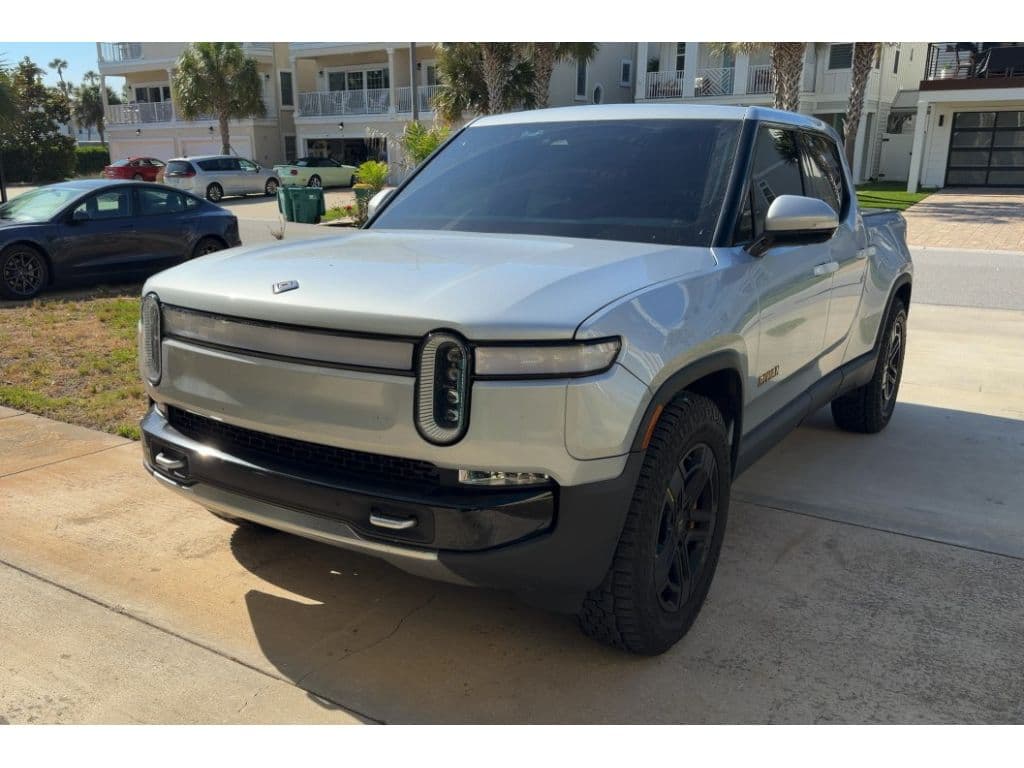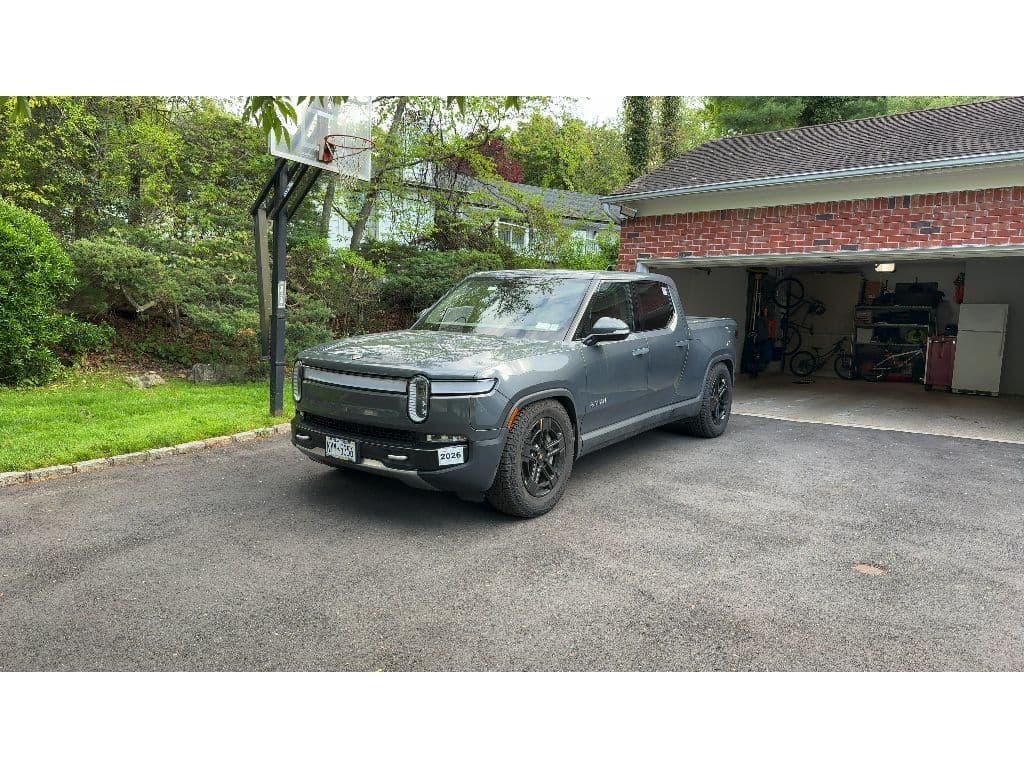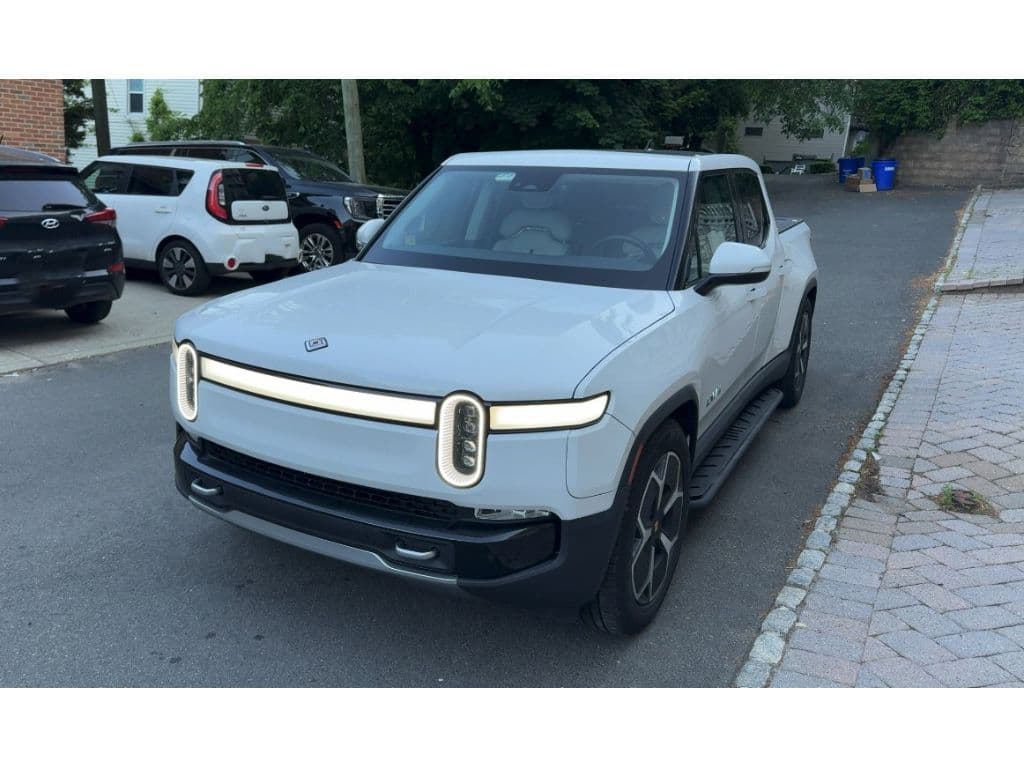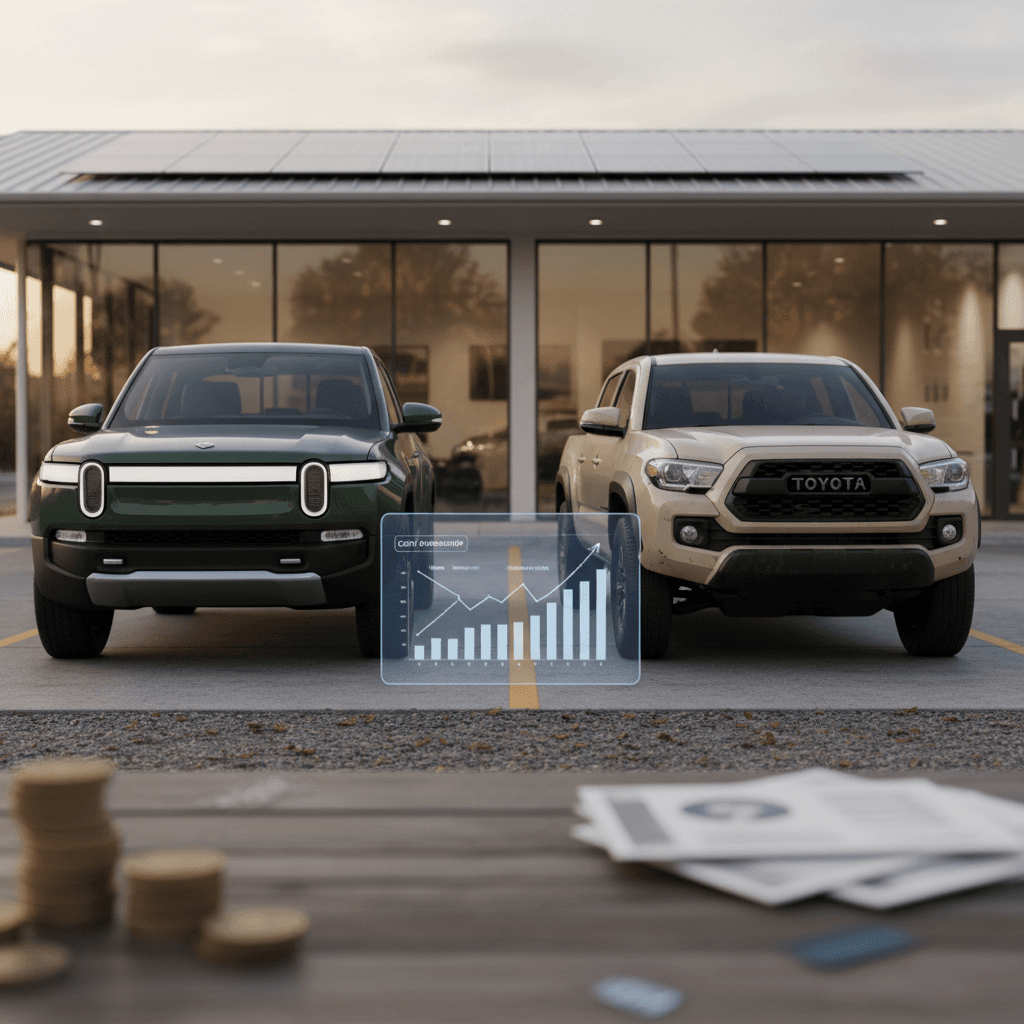
If you’re cross‑shopping a Rivian R1T and a Toyota Tacoma in 2026, you’re really asking two questions: how much truck do I want, and what will it actually cost me to own? This 2026‑focused Rivian R1T vs Toyota Tacoma cost comparison breaks down sticker price, fuel vs electricity, maintenance, insurance, incentives and 5‑year total cost of ownership so you can see where an electric truck pencils out, and where a gas Tacoma still wins.
A fair fight?
R1T vs Tacoma: Who this 2026 cost comparison is for
- Shoppers debating a 2025–2026 Rivian R1T versus a 2025–2026 Toyota Tacoma.
- Drivers trying to understand how electricity vs gasoline will change their monthly budget.
- Owners thinking about trading a Tacoma for a used R1T (or vice versa).
- Buyers who care about 5‑year cost to own, not just monthly payments.
Numbers below use recent 2025–2026 pricing data plus mainstream cost‑to‑own studies for midsize trucks and EVs. Where hard data doesn’t exist yet, for example, long‑term Rivian repair history, we’ll use conservative, clearly labeled estimates instead of guesses.
Headline price: 2026 MSRP and real‑world transaction prices
Let’s start with the part you can’t ignore: what it costs to get either truck in your driveway in 2026.
Typical 2025–2026 pricing: Rivian R1T vs Toyota Tacoma
Approximate starting prices for popular trims before incentives, taxes and fees, based on early‑2026 market data.
| Model (2025–2026) | Example trim | Approx. MSRP | Typical out‑the‑door* |
|---|---|---|---|
| Rivian R1T | Dual Motor, Large battery | $74,000 | $80,000+ |
| Rivian R1T | Used 2022–2024 Adventure (large pack) | $55,000–$70,000 | $58,000–$73,000 |
| Toyota Tacoma | 2025–2026 SR Double Cab 4x4 | $36,000 | $40,000–$42,000 |
| Toyota Tacoma | 2025–2026 TRD Off‑Road Double Cab | $42,000 | $46,000–$48,000 |
Actual prices vary by configuration, region and incentives. Always confirm current pricing before you buy.
New vs used changes the math
Price gap at a glance (new trucks)
Fuel vs electricity costs: how much it really costs to drive
Ongoing energy cost is where EV trucks usually claw back some of their higher purchase price. To keep things apples‑to‑apples, we’ll assume 12,000 miles a year and U.S. average prices in early 2026.
Key 2026 energy assumptions
You can adjust these later for your own rates and driving style.
Gasoline – Tacoma
Fuel economy: ~22 mpg combined for a 4x4 Tacoma in mixed use.
Gas price: We’ll use $3.75/gal as a 2026 national average placeholder.
Electricity – Rivian R1T
Efficiency: roughly 2.1–2.4 miles/kWh depending on tires and driving.
Home electricity: $0.15/kWh (approximate national residential average).
Charging mix
We’ll assume 80% home Level 2 and 20% public fast charging for the R1T, with public charging costing 2–3x more per kWh than home.
Estimated annual energy cost at 12,000 miles/year
Rounded estimates using the assumptions above. Your actual costs will vary with local fuel and electricity prices.
| Truck | Energy use assumption | Energy price assumption | Annual energy cost |
|---|---|---|---|
| Toyota Tacoma (gas) | 22 mpg | $3.75/gal | ≈ $2,050 |
| Rivian R1T (mostly home charging) | 2.2 mi/kWh | $0.15/kWh home + limited fast charging | ≈ $900–$1,200 |
| Rivian R1T (heavy fast charging) | 2.2 mi/kWh | Effective ~$0.35/kWh | ≈ $1,900 |
Public fast charging can narrow the gap, but in most regions electricity still undercuts gasoline over 5 years.
Home charging is the lever
Maintenance and repairs: where EVs usually win
Here the electric truck’s simplicity shows up. No oil changes, spark plugs, or exhaust; fewer fluids; way fewer moving parts in the drivetrain. Tires and brakes are still very real costs, and early R1T owners do report heavy tire wear, but the overall maintenance burden is still lower than a gas truck.
Typical annual maintenance/repair costs
Based on mainstream cost‑to‑own tools for Tacomas plus early EV truck data and owner reports for the R1T.
| Truck | What’s included | Estimated annual maintenance & repairs |
|---|---|---|
| Toyota Tacoma | Oil changes, filters, routine services, minor repairs | ≈ $700–$1,100 |
| Rivian R1T | Tire rotations, cabin filters, brake fluid, occasional service visits | ≈ $400–$800 (plus potentially faster tire wear) |
These are averages; individual experiences vary widely with use and region.
Don’t forget tires
Insurance and taxes: what you’ll pay to keep them legal
Insurance is one of the least discussed but most important levers in a Rivian R1T vs Toyota Tacoma cost comparison. New EVs with expensive battery packs often cost more to insure than simpler, cheaper gas trucks, though the gap is closing as mainstream carriers get more Rivian data.
Toyota Tacoma insurance
- Recent breakdowns for a 2025 Tacoma put annual insurance around $2,000–$2,200 for a typical driver, with modest variation by trim.
- Midsize trucks like the Tacoma tend to sit in the middle of the pack: more than a compact sedan, but often less than a full‑size half‑ton.
- Property taxes and registration are tied to value; a ~$40K truck keeps those costs moderate.
Rivian R1T insurance
- Independent analyses in 2025–2026 peg R1T insurance roughly 30–50% higher than a comparable gas truck with a similar sticker price, largely due to repair complexity and parts cost.
- Owners report anything from about $1,800/year on the low side with mainstream insurers to well over $3,000/year in high‑cost metro areas.
- Because the R1T costs far more than a Tacoma, expect higher registration and property tax in states that assess value‑based fees.
Shop your insurance before you order
Depreciation and resale value: 2026 outlook
Toyotas, and Tacomas in particular, have built a reputation on rock‑solid resale. Rivian is newer, and the electric‑truck market is still finding its pricing floor. That doesn’t mean the R1T is a depreciation disaster, but it does mean more uncertainty than a Tacoma.
How these trucks typically lose value
5‑year depreciation snapshots for 2025–2026 models.
Toyota Tacoma depreciation
- Cost‑to‑own tools show a 5‑year depreciation hit around $12K–$15K on a mid‑range 2025 Tacoma, leaving strong residual value.
- That’s roughly 30–35% of original MSRP, excellent for a mass‑market truck.
- High demand for used Tacomas in many regions props up prices.
Rivian R1T depreciation
- Early R1Ts saw steeper drops as Rivian adjusted pricing and more inventory hit the used market.
- Current used‑market data suggests 5‑year depreciation closer to 40–50% of original price, with wide variation by battery pack and options.
- If Rivian stabilizes pricing and volumes, depreciation could improve, but it won’t likely match Tacoma’s track record soon.
Buying used can flip the script
Five‑year total cost of ownership: Rivian R1T vs Tacoma
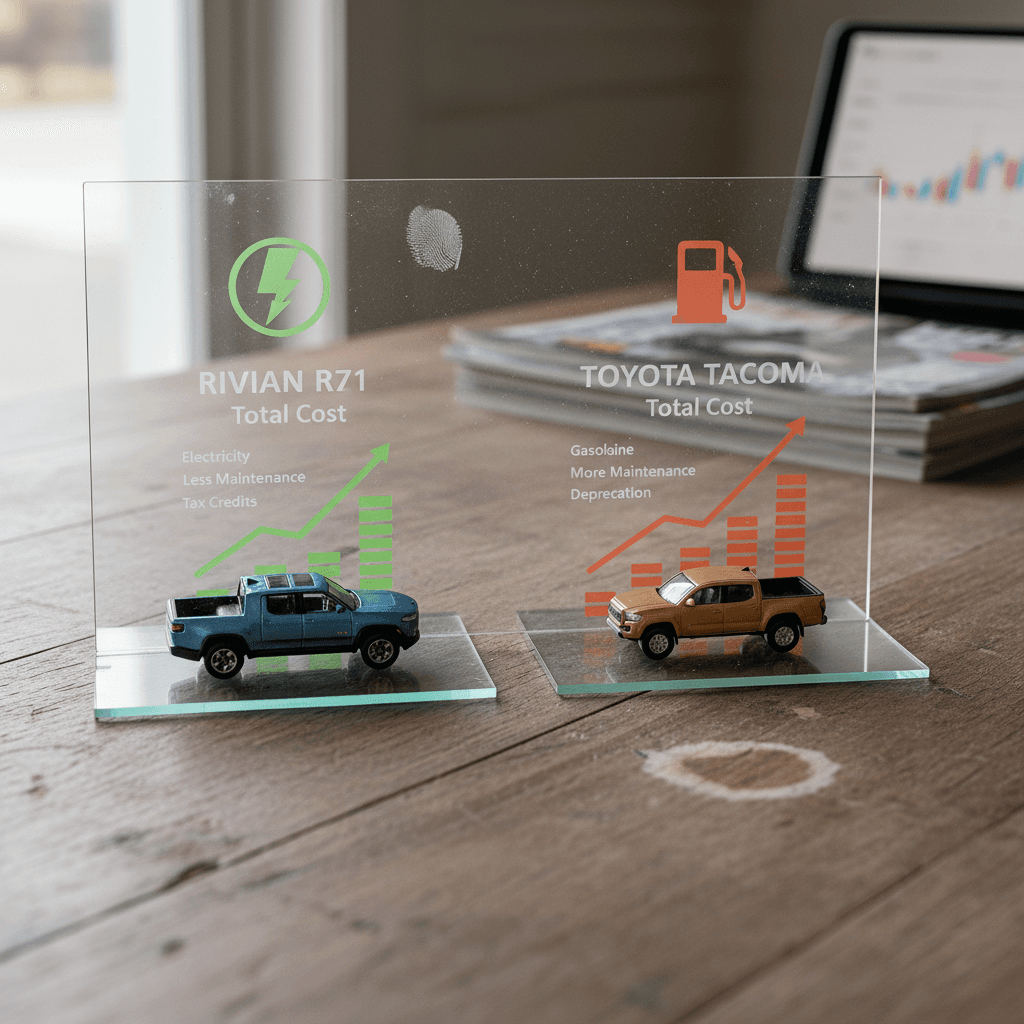
Put it all together and you get the metric that really matters: what it costs to buy the truck, run it, insure it and eventually sell it, over a 5‑year horizon. Think of these numbers as directional rather than precise, your local fuel prices, electricity rates and insurance profile will shift the outcome.
Estimated 5‑year total cost of ownership (2026 purchase)
Illustrative 5‑year cost breakdowns for a new R1T vs a new Tacoma, assuming 12,000 miles/year and typical 2026 U.S. costs.
| Cost component (5 years) | Rivian R1T – new | Toyota Tacoma – new |
|---|---|---|
| Purchase price (incl. fees) | $80,000 | $45,000 |
| Estimated incentives (federal + state, if eligible) | - $7,500 to - $10,000 | Usually $0 (most Tacomas don’t qualify) |
| Fuel / electricity | $5,000 | $10,250 |
| Maintenance & repairs | $3,000–$4,000 | $5,500–$6,000 |
| Insurance | $11,000–$15,000 | $9,500–$11,000 |
| Taxes & registration | Higher (value‑based) | Moderate |
| Estimated resale value after 5 years | $40,000–$48,000 | $28,000–$32,000 |
| Approx. 5‑yr net cost to own | ≈ $45K–$55K | ≈ $35K–$42K |
All figures rounded; taxes and fees will vary by state. “Net cost” subtracts an estimated resale value after 5 years.
Where the R1T catches up, and where it doesn’t
Financing, incentives and tax credits in 2026
How you pay for the truck and which incentives you qualify for can move thousands of dollars between the Rivian R1T and Toyota Tacoma columns.
Key 2026 money‑lever questions
1. Do you qualify for federal EV incentives?
Many Rivian R1T configurations have been eligible for some form of federal EV tax credit or point‑of‑sale rebate when leased. The Tacoma generally does not qualify for EV‑related federal credits. Confirm current rules and income caps before you buy.
2. Are there state or utility rebates?
Several states and utilities offer <strong>EV or charger rebates</strong> that effectively lower the R1T’s cost of ownership but do nothing for a gas Tacoma. Check for home charger installation credits and discounted EV rates, too.
3. What APR can you actually get?
Rivian has periodically advertised <strong>sub‑2% APR</strong> deals on new R1T builds, while mainstream banks might quote higher rates on trucks in general. A one‑point APR difference on $70K+ is real money over 60–72 months.
4. Lease vs buy?
Leasing can unlock tax credits on high‑MSRP EVs that might not qualify for a purchase credit, and some lessees have saved thousands by buying out leases early. Tacomas usually lease well because of strong residuals.
Stack incentives with smart financing
Which truck makes sense for you? Buyer scenarios
R1T vs Tacoma: best‑fit buyer profiles
High‑mileage commuter or contractor
Drives 15,000–20,000 miles per year, mostly highway.
Has a garage or dedicated parking where Level 2 charging is feasible.
Wants to cut fuel cost and is open to planning charging stops on longer routes.
<strong>Math outcome:</strong> The more you drive on cheap home electricity, the more the R1T’s higher sticker can be justified, especially if you buy used.
Urban or suburban weekend adventurer
Short weekday commute, with occasional road trips and off‑road weekends.
Lives where public fast charging is available but not always cheap or convenient.
Values tech, performance and quiet driving as much as cost.
<strong>Math outcome:</strong> A Tacoma will almost always be cheaper to buy and insure, but an R1T can be worth the premium if you value the EV experience and can charge at home.
Budget‑focused buyer
Prioritizes low monthly payment and predictable costs over performance.
May not have access to home charging or lives in a rental.
Plans to keep the truck for at least 5 years and maybe more.
<strong>Math outcome:</strong> A Tacoma, especially used, remains the safer play financially. Simpler to insure, easier to service and with bulletproof resale if you need out.
Used‑truck hunter
Shopping in the $35K–$55K range for a capable truck.
Considering a 3–4‑year‑old R1T versus a similar‑age Tacoma TRD Off‑Road or Pro.
Wants to avoid biggest depreciation hit but still buy something relatively modern.
<strong>Math outcome:</strong> This is where a vetted used R1T can go toe‑to‑toe with a Tacoma. Battery health and pricing discipline are everything.
Used Rivian R1T vs used Tacoma: how Recharged can help
Most of the real‑world cross‑shopping between Rivian R1T and Toyota Tacoma is already happening in the used market. That’s where the R1T’s early‑life depreciation can make it much more competitive on total cost of ownership, if you know exactly what you’re buying.
Why battery health matters more than miles
With any used EV truck, the battery pack is the single most expensive component. Two R1Ts with the same odometer reading can have very different battery health depending on charging habits, climate and use.
Every EV Recharged sells comes with a Recharged Score Report that includes verified battery diagnostics, so you’re not guessing about the most critical part of the truck.
Simplifying the EV side of the equation
Recharged’s EV‑specialist team can walk you through home charging options, expected electricity cost in your utility area, and how your driving pattern affects range and operating expense.
If you’re trading out of a Tacoma (or any gas truck), Recharged can provide a trade‑in offer or consignment option and help you compare a used R1T’s total cost against sticking with another gas pickup.
End‑to‑end help for used EV trucks
Ready to find your next EV?
Browse VehiclesFAQ: Rivian R1T vs Toyota Tacoma cost questions
Common 2026 cost questions about R1T vs Tacoma
Bottom line: 2026 R1T vs Tacoma cost verdict
If your only goal is to minimize 5‑year cost, a Toyota Tacoma, especially bought used, still wins the Rivian R1T vs Toyota Tacoma cost comparison in 2026. It’s cheaper to buy, cheaper to insure, and backed by decades of strong resale performance. But that’s not the whole story. A Rivian R1T offers a radically different ownership experience: far lower fuel cost when you can charge at home, reduced routine maintenance, instant torque and a quiet cabin that makes every mile feel premium. For high‑mileage drivers who can leverage home charging and incentives, or for shoppers targeting a well‑priced used R1T with a healthy battery, the total‑cost gap can narrow enough that the EV truck’s benefits justify the extra outlay.
The smart move is to run your own numbers, real insurance quotes, your utility’s EV rate, your mileage, and your time horizon, rather than relying on averages. If you’re considering a used R1T, Recharged can supply the missing data: battery health, market‑correct pricing, and expert EV guidance so you know exactly what that Rivian will cost you to own compared with the Tacoma you already know.