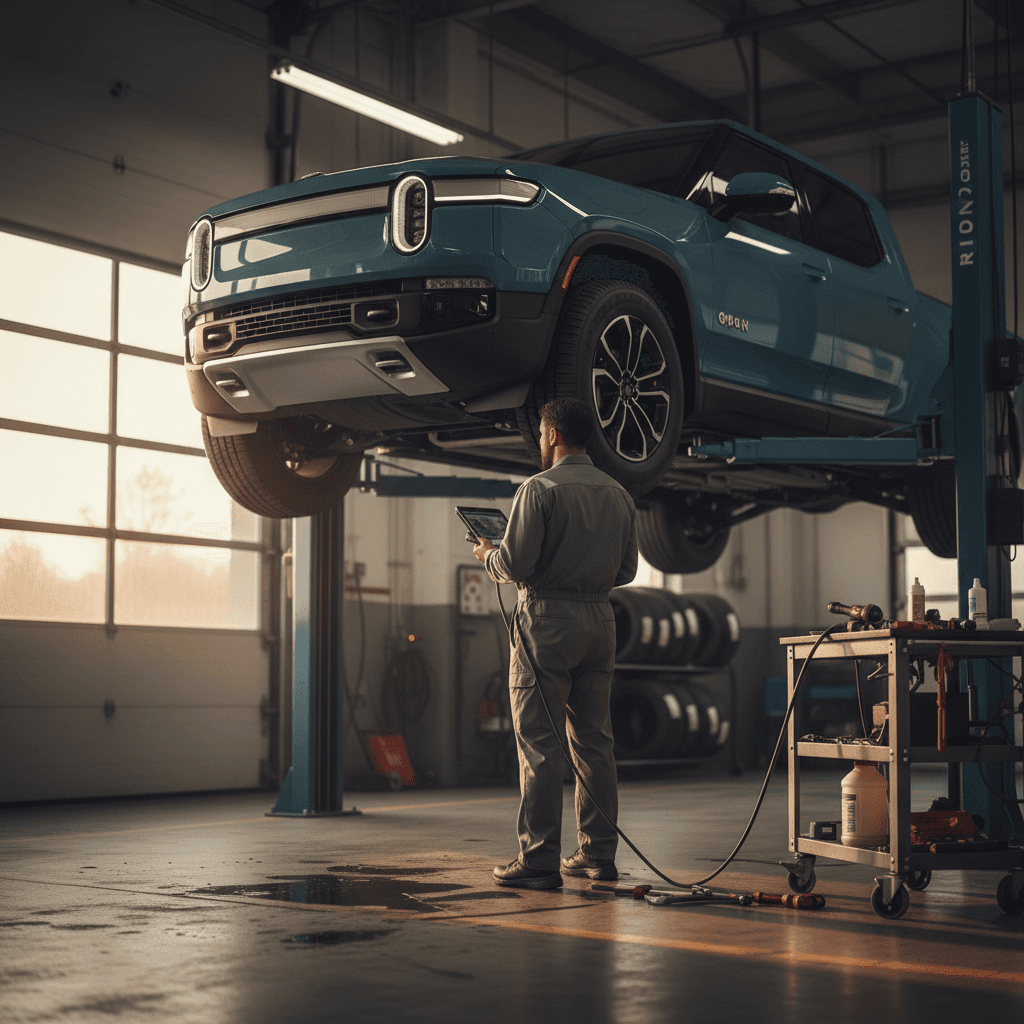
If you’re driving, or shopping for, a Rivian R1T, you’ve probably heard that electric trucks need far less maintenance than gas pickups. That’s true, but “less” doesn’t mean “none.” Understanding the Rivian R1T maintenance schedule will help you plan costs, protect your warranty, and avoid surprises, especially if you’re buying used.
Good news for R1T owners
Rivian R1T maintenance schedule at a glance
Key Rivian R1T maintenance milestones
Rivian publishes one core maintenance schedule for both R1T and R1S, and it’s almost entirely driven by mileage and time, not model year. That’s helpful if you’re considering a used R1T: a 2022 truck and a 2024 truck follow essentially the same checklist; the only question is where that truck currently falls on the timeline.
Official Rivian R1T maintenance intervals
Here’s a simplified version of the factory-style Rivian R1T maintenance schedule that most owners will see in the first 100,000+ miles. Exact recommendations can vary slightly as Rivian updates its support docs, so always double-check in your app or owner’s manual, but this is the current baseline many owners and service centers are using:
Rivian R1T core maintenance schedule
Typical service items and intervals for Rivian R1T trucks in normal driving conditions. Severe off-road use or heavy towing may justify more frequent inspections.
| Service item | Recommended interval | Notes |
|---|---|---|
| Tire rotation + multi-point inspection | Every 7,500 miles (12,000 km) | Can often be handled by Rivian mobile service or a partnered tire shop. |
| Comprehensive inspection | 22,500 miles (36,000 km) | Deeper look at suspension, steering, underbody, seals, and general wear. |
| Brake fluid flush | Every 36 months (3 years) | Time-based; moisture contamination is the main concern, not mileage. |
| Coolant change (battery & thermal system) | 112,500 miles (180,000 km) | Long-life coolant; schedule may arrive sooner for high-mileage drivers. |
| Drive unit fluid change (Quad-Motor only) | 112,500 miles (180,000 km) | Applies to Quad-Motor R1T; Dual-Motor versions may have different guidance. |
| Alignment check | Roughly every 6,000–12,000 miles or as needed | More often if you off-road, hit potholes, or see uneven tire wear. |
| Cabin air filter | Around 20,000–30,000 miles or 2–3 years | Frequency depends on climate, dust, and how sensitive you are to odors. |
| Wiper blades | Every 12–24 months | Replace sooner in harsh climates or if streaking starts. |
| High-voltage battery and drive system check | At scheduled inspections or if alerts appear | Monitored continuously via software; faults trigger warnings in the app. |
Intervals are approximate; always confirm with the Rivian app or your service advisor.
Watch for schedule changes
What actually gets serviced on a Rivian R1T
What your R1T doesn’t need
- No engine oil or oil filter changes
- No spark plugs, timing belts, or fuel filters
- No exhaust system repairs or emissions tests
- No transmission fluid services in the traditional sense
Compared with a gas pickup, those skipped services alone can save you thousands of dollars over a typical ownership window.
What your R1T still needs
- Tires, alignments, and wheel balancing
- Brake fluid flushes and occasional brake service
- Suspension, steering, and underbody inspections
- Coolant and (for some trucks) drive-unit fluid changes
- Cabin air filters, wiper blades, and basic hardware checks
And like any vehicle, unexpected repairs, door hardware, glass, electronics, can still pop up outside the normal schedule.
Use the Rivian app as your service brain
Maintenance timeline for the first 10 years
To make the Rivian R1T maintenance schedule feel more concrete, it helps to think in rough ownership stages. Here’s how your service needs typically ramp up if you drive about 12,000 miles per year.
Rivian R1T maintenance by ownership stage
What to expect in your first decade with an R1T
Years 1–3 (0–36,000 miles)
- Tire rotation & inspection every ~7,500 miles
- First comprehensive inspection around 22,500 miles
- First brake fluid flush at 3 years
- Cabin filter and wipers as needed
Years 4–6 (36,000–72,000 miles)
- Ongoing tire rotations and alignments
- Second brake fluid flush (~6 years)
- Watch for suspension wear if you off-road or tow a lot
- Out-of-warranty repairs start to matter more at resale
Years 7–10 (72,000–120,000+ miles)
- Third brake fluid flush (~9 years)
- Coolant service and drive-unit fluid (Quad-Motor) approaching ~112,500 miles
- Second or third full set of tires
- More frequent inspections as components age
How this compares to a gas truck
Tires, rotations, and alignments on the R1T
If there’s one part of the Rivian R1T maintenance schedule you don’t want to ignore, it’s tires. The truck is heavy, powerful, and often wears aggressive all-terrain rubber. That combination can chew through tread quickly if you skip rotations or drive hard.
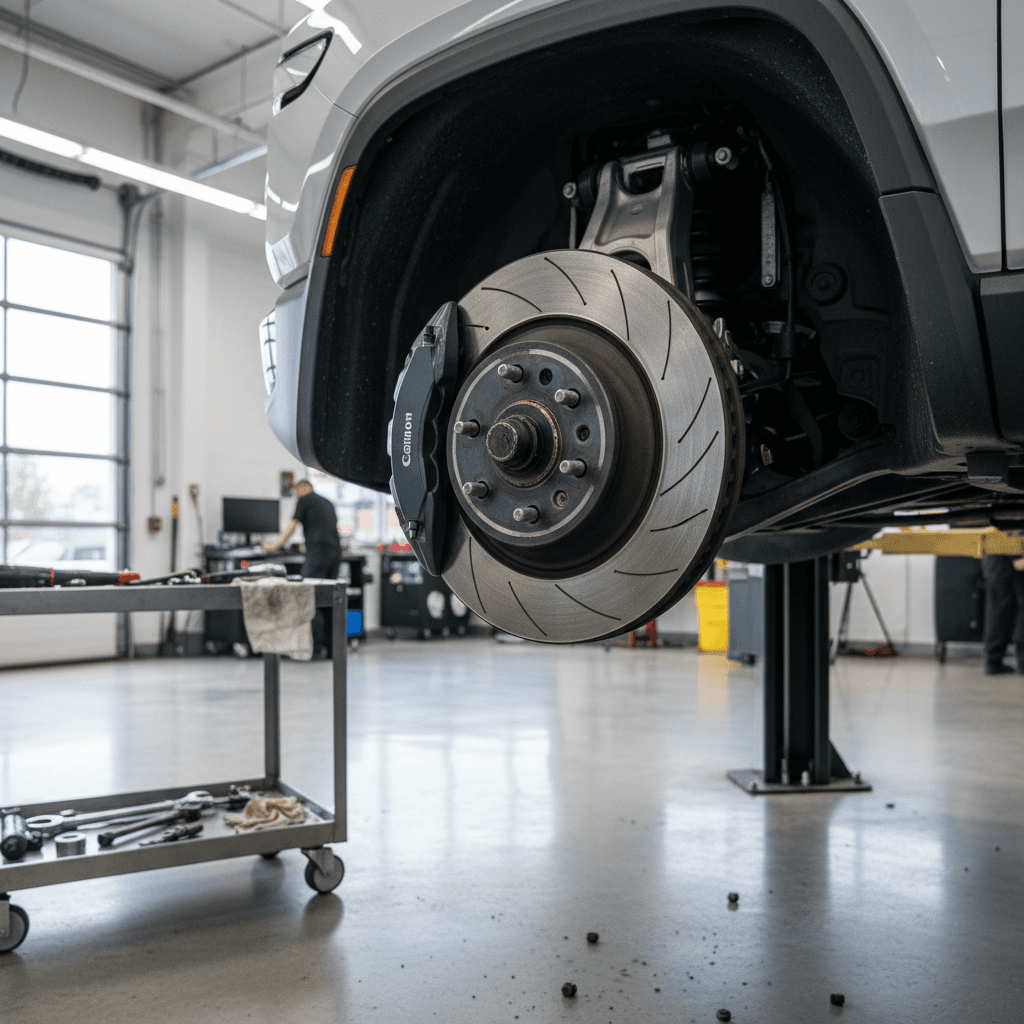
- Rotate every ~7,500 miles: This matches Rivian’s interval and aligns with what most service centers recommend. Some owners who tow or off-road rotate a bit sooner (5,000–6,000 miles).
- Watch for uneven wear: Feathering, cupping, or inside-edge wear can signal alignment issues or worn suspension components that need attention.
- Alignments aren’t one-and-done: Because the R1T is heavy and many owners use it on rough roads, a wheel alignment every 6,000–12,000 miles, or after a hard hit or lift change, isn’t overkill.
- Use Rivian’s tire partners when convenient: Rivian now works with major tire retailers like Discount Tire, America’s Tire, and Tire Rack for rotations, replacement, and TPMS work, which gives owners more options beyond Rivian service centers.
- EV tires can wear faster: Instant torque and extra weight mean you may see 25,000–40,000 miles from a set of tires depending on your driving style and tire choice.
Don’t ignore load index and speed rating
Brakes, regenerative braking, and real-world wear
Like most EVs, the R1T leans heavily on regenerative braking to slow the truck and recapture energy. That means your physical brake pads and rotors can last far longer than on a comparable gas truck, if they’re used and maintained correctly.
What lasts longer
- Brake pads & rotors: Many EV owners see well over 60,000 miles on original pads, and some go much higher in gentle driving.
- Rotor wear: With regen doing most of the work, rotors often wear more from corrosion than from friction.
What still needs regular service
- Brake fluid: It absorbs moisture over time, which reduces performance. That’s why Rivian recommends a flush roughly every 3 years, even with low miles.
- Slide pins and parking brake mechanisms: These need to move freely. Long periods of disuse or salty climates can cause sticking, which shows up as uneven pad wear or noise.
Use your friction brakes occasionally
Battery, coolant, and drive-unit fluid service
One of the most reassuring parts of the Rivian R1T maintenance schedule is how little hands-on work the high-voltage components require. The traction battery, inverters, and motors are sealed systems monitored by software. Your job is mostly to keep the truck within reasonable operating conditions and let the thermal system do its thing.
Long-interval fluid services on the R1T
These are measured in years and tens of thousands of miles, not oil-change intervals.
Battery coolant
The R1T uses a dedicated thermal management system to keep the battery and power electronics in a healthy temperature range. The coolant is typically replaced around 112,500 miles. For most owners, that’s 7–10 years into ownership.
Drive-unit fluid (Quad-Motor)
On Quad-Motor trucks, Rivian calls for a drive-unit fluid service at roughly the same 112,500-mile mark. Dual-Motor trucks have different hardware; your specific recommendation will be listed in your app or owner’s documentation.
What about battery degradation?
Software updates, recalls, and remote checkups
Unlike a traditional truck, a big slice of R1T “maintenance” happens over the air. Rivian constantly pushes software updates that tweak range estimates, add features, or even change how mechanical systems behave.
- Over-the-air updates: Many improvements, drive modes, charging behavior, UI refinements, arrive without a service visit. Plan time for updates to install when the truck is parked and has enough charge.
- Self-service features: Newer software allows owners to perform tasks like wheel-size changes and recalibration from the touchscreen after swapping wheels, reducing trips to the service center.
- Remote diagnostics: If a warning light or error pops up, Rivian can often read logs remotely and decide whether you need mobile service, a service center visit, or just a software fix.
- Recalls and campaigns: As a newer brand, Rivian has issued several service campaigns and recalls, including suspension-related repairs on some R1 trucks. These are typically performed free of charge but may require a service-center appointment.
Take recall notices seriously
Used Rivian R1T buyers: maintenance questions to ask
Shopping for a used R1T is different from shopping for a used gas truck. You’re less worried about oil-change history and more focused on battery health, tire and brake wear, and whether critical maintenance has kept pace with mileage and time.
Maintenance questions to ask before you buy a used R1T
1. Has the tire rotation & inspection schedule been followed?
Ask for invoices or app screenshots showing rotations about every 7,500 miles. Uneven tire wear or mismatched tires can be a clue that maintenance was skipped, or that the truck has seen hard use.
2. When was the last brake fluid flush?
Brake fluid should be changed about every 3 years. On an early R1T (2022–2023), the first flush may already be due or completed. Verify with documentation rather than taking a seller’s word for it.
3. Any outstanding recalls or service campaigns?
Make sure all open campaigns have been performed, especially those involving the suspension, steering, or high-voltage components. A seller should be ready to show service records or app notes.
4. How many tire sets has the truck worn through?
Multiple full sets of tires at relatively low mileage can be a red flag for aggressive driving or repeated alignment issues. It’s not always a deal-breaker, but it’s something to price into your decision.
5. Has the truck done heavy towing or off-roading?
There’s nothing wrong with using an R1T for what it was built to do. Just know that frequent towing or serious off-roading increases the importance of alignment checks, suspension inspections, and underbody exams.
6. Has coolant or drive-unit fluid service been done on high-mileage trucks?
If the R1T is closing in on, or has passed, 112,500 miles, ask whether the long-interval coolant and drive-unit (Quad-Motor) fluid services have been completed and documented.
7. Can you see objective battery-health data?
Dash range estimates are only part of the picture. At Recharged, we run independent battery diagnostics and roll the results into our <strong>Recharged Score</strong>, so you can compare used EVs on true battery condition, not just odometer readings.
How Recharged helps with used R1Ts
Ready to find your next EV?
Browse VehiclesRivian R1T maintenance FAQ
Frequently asked questions about Rivian R1T maintenance
The bottom line on Rivian R1T maintenance
The Rivian R1T maintenance schedule is refreshingly light compared with gas pickups: rotate tires and inspect regularly, flush brake fluid every few years, and address long-interval coolant and drive‑unit services as the miles add up. The real determinants of your costs are how hard the truck has been used, towing, off‑roading, wheel changes, and how faithfully basic items like rotations and alignments have been handled.
If you already own an R1T, let the Rivian app guide you on timing, and stay ahead of issues with regular inspections. If you’re shopping for a used R1T, pay close attention to maintenance records and battery health, not just the odometer. At Recharged, we combine a verified Recharged Score Report with EV-specialist support, financing options, trade‑ins, and nationwide delivery, so you can step into R1T ownership with a clear view of future maintenance, not guesswork.