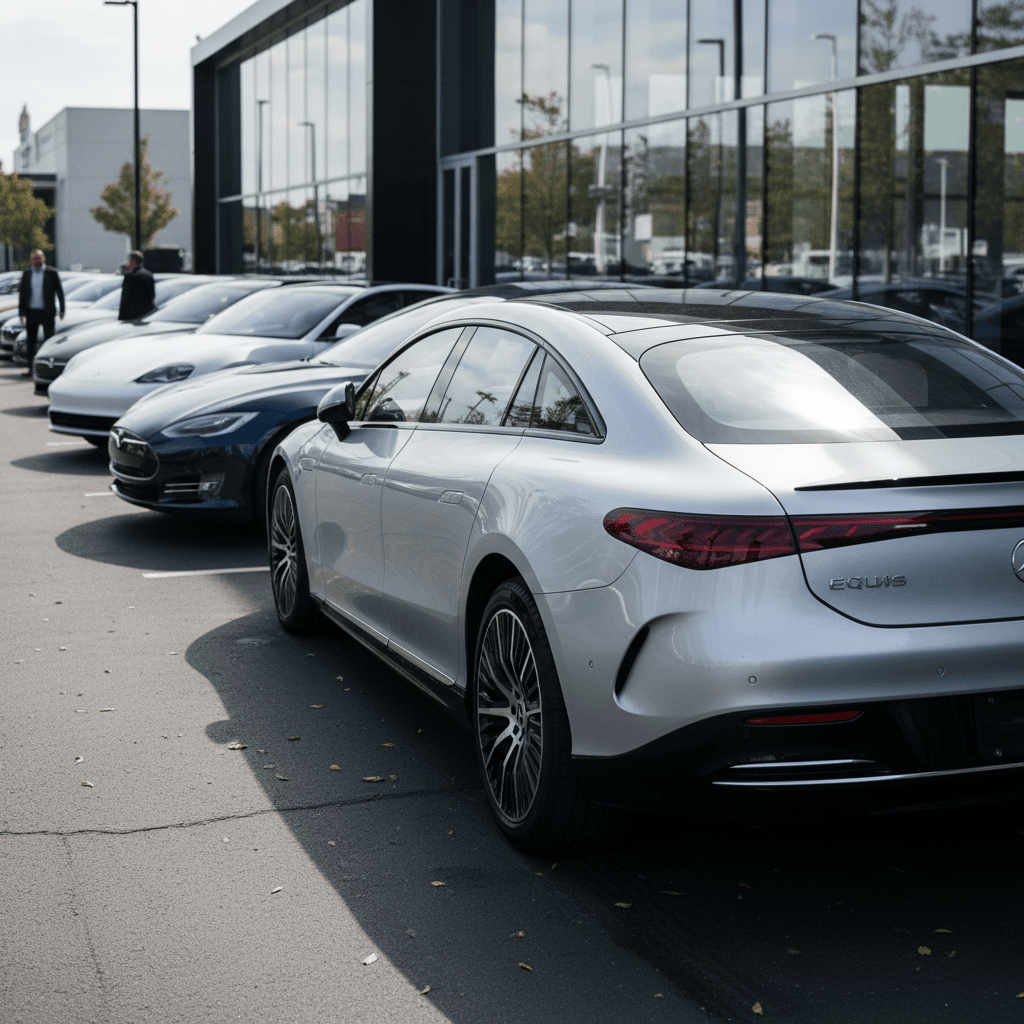
If there’s a poster child for luxury EV depreciation, it’s the Mercedes‑Benz EQS. We’re talking eye‑watering drops in value, often well over half of the original sticker in just a few years. For the first owner, that hurts. For you, as a used buyer, it can be an opportunity. The key is knowing when Mercedes EQS depreciation turns this flagship EV into a genuine used bargain, and when it’s a money pit with ambient lighting.
Quick Take
Why the Mercedes EQS Depreciates So Fast
To understand why the EQS is showing up as a used bargain, you have to look at how quickly it sheds value. Several data sets put the EQS among the worst luxury cars for depreciation. One recent market analysis found the Mercedes EQS losing roughly 60% of its value over five years, dropping from an original MSRP just over $100,000 into the low‑$40,000 range. Another study that blended sedan, SUV, and AMG variants showed an average 48–50% loss after just one year, over $65,000 evaporating almost instantly.
- High starting prices: Many early EQS sedans rang the bell at $110,000–$130,000 with options. When the market cooled on luxury EVs, there was simply more air to come out of the balloon.
- Fast‑changing tech: Flagship EVs age like smartphones. Newer software, bigger batteries, and better driver‑assist systems make a three‑year‑old car feel older than its years.
- Luxury‑EV fatigue: The broader luxury EV segment has hit a reality check. EQS sales have stumbled, and Mercedes has already announced pricing cuts and even pauses in U.S. orders for some EQ models as demand softens.
- Brand‑new segment: A lot of early EQS buyers were tech‑forward, lease‑heavy customers. Those cars are now washing back into the market all at once, pushing prices down.
Luxury EVs Depreciate Faster Than the Average Car
Mercedes EQS Depreciation at a Glance
How Far Values Have Fallen: Real‑World Examples
You don’t have to squint at spreadsheets to see Mercedes EQS depreciation in the wild, just scan used listings. It’s not unusual to find 2022 EQS 450+ sedans, which carried MSRPs around $105,000–$110,000 when new, advertised in the mid‑$30,000s to low‑$40,000s today. Similarly, EQS 580 sedans and SUVs that once topped $125,000 are now frequently listed in the $40,000–$60,000 range, depending on mileage and options.
Sample Used Mercedes EQS Pricing vs. Original MSRP
Approximate asking prices seen in the U.S. used market compared to launch‑era MSRPs. Individual vehicles will vary by condition, location, and equipment.
| Model / Year | Original MSRP (approx.) | Typical 2025 Asking Price | Value Lost |
|---|---|---|---|
| 2022 EQS 450+ Sedan | $105,000 | $35,000–$40,000 | About 60–65% |
| 2022 EQS 580 4MATIC Sedan | $125,000 | $42,000–$50,000 | About 60% |
| 2023 EQS 450+ SUV | $110,000 | $40,000–$55,000 | About 50–60% |
| AMG EQS Sedan | $150,000+ | $50,000–$60,000 | Around 60–70% |
These aren’t offers from Recharged, but they illustrate how aggressively the EQS drops into used‑bargain territory.
Where Recharged Fits In
When Big Depreciation Turns Into a Used Bargain
A car isn’t a bargain just because it’s cheaper than it used to be. The math has to work for you going forward. For the EQS, the sweet spot is when most of that brutal front‑loaded depreciation has already happened, but you still have plenty of battery life and warranty coverage left.
The EQS Sweet Spot for Used Buyers
Look for cars where someone else paid for the painful early depreciation, but you still get years of coverage and modern tech.
3–5 Years Old
By years 3–5, the EQS’s biggest value drop is usually behind it. You’re shopping at a fraction of original MSRP, but the car still feels thoroughly modern inside.
30k–60k Miles
Enough miles that the price has softened, but not so many that you’re staring down heavy wear or an expired battery warranty.
Strong Warranty Left
Mercedes’ battery warranty in the U.S. is typically 8 years/100,000 miles. A well‑chosen used EQS can give you years inside that window.
What “Used Bargain” Really Means Here
Battery Health and Warranty: What Really Matters
Depreciation headlines are one thing; battery health is another. The EQS uses a large lithium‑ion pack, and like any EV, its value depends heavily on how that pack has aged. Mercedes backs the battery for roughly 8 years or 100,000 miles in the U.S., which covers defects and excessive degradation, but that doesn’t mean every used example is equal.
Battery & Charging Checklist for a Used EQS
1. Get a Real Battery‑Health Report
Don’t settle for a vague “it drives fine.” Ask for a quantified battery‑health or state‑of‑health report. With Recharged, this is baked into the Recharged Score, so you can see how much usable capacity remains versus new.
2. Review Fast‑Charging History
Frequent DC fast charging isn’t a deal‑breaker, but heavy use at ultra‑fast stations can accelerate wear. Ask how the previous owner charged, mostly at home Level 2, mostly fast‑charged, or a mix.
3. Check Remaining Battery Warranty
Confirm the in‑service date and mileage so you know exactly how much time is left on the Mercedes high‑voltage battery warranty. That’s real money if something goes wrong.
4. Test Real‑World Range
On a test drive, reset the trip computer and watch projected range. Compare it to the original EPA number. A healthy EQS should still deliver a comfortable majority of its rated range in mild weather.
5. Inspect Charging Hardware
Visually check the charge port, cables, and any included home‑charging equipment. Damage here can be expensive and annoying, even if the battery is fine.
Don’t Buy Blind on Battery Health
EQS vs. Tesla Model S and Other Rivals on Resale
If you’re cross‑shopping, you’ve probably noticed something interesting: the EQS usually undercuts a comparable Tesla Model S on the used market, even though it often carried a higher MSRP when new. One analysis that compared five‑year depreciation found the EQS losing about 73% of its value, while a Tesla Model S lost closer to 65% over the same horizon. In other words, the Model S holds onto several more percentage points of value, which is why you see higher used prices for similar‑year cars.
Where the EQS Loses
- Resale value: The EQS simply falls harder, which is bad for first owners but good for you.
- Charging network perception: Tesla’s Supercharger network is still the benchmark, even as more EVs gain NACS access.
- Brand momentum: The EQS has faced criticism for styling and some quality gripes, which drags on demand.
Where the EQS Wins for Used Buyers
- Purchase price: You typically pay less for an EQS than a similar‑year, similar‑mileage Model S.
- Cabin experience: The quiet, cosseting interior and available Hyperscreen feel every bit like a flagship.
- Comfort focus: If you want a luxury lounge on wheels more than a track toy, the EQS makes sense.
Don’t Chase Resale You’ve Already Avoided
Ownership Costs Beyond the Sticker Price
Low used prices are only half the story. The Mercedes EQS is still a six‑figure German flagship at heart, and some costs reflect that. Kelley Blue Book pegs the five‑year cost to own a new 2025 EQS at just under $120,000, with depreciation alone accounting for nearly $60,000 of that and maintenance and repairs adding another $10,000‑plus over the period. When you buy used, you’re thankfully skipping the steepest depreciation, but you’re not escaping premium‑brand ownership entirely.
Where EQS Ownership Dollars Go
Understanding these buckets helps you decide whether a used EQS fits your budget long‑term.
Maintenance & Repairs
Routine service is less intense than a gas S‑Class (no oil changes), but high‑end features, air suspension, complex lighting, massive screens, can be pricey if they fail out of warranty.
Insurance & Taxes
High original MSRP and expensive parts can mean above‑average insurance premiums and higher registration fees in some states, even if you bought it used at a discount.
Energy & Charging
Electricity is usually cheaper than premium fuel, especially if you can charge at home. Public fast‑charging can add up, but many EQS owners do most of their charging overnight in the garage.
Budget for the Quirks
How to Shop a Used Mercedes EQS Like a Pro
A used EQS isn’t the kind of car you buy on a whim because it looks good under the showroom lights. You need to be methodical, about the car, the numbers, and the seller. Here’s a roadmap that mirrors how we think about EQS inventory at Recharged.
Step‑by‑Step: Evaluating a Used EQS
1. Start With the Battery & Recharged Score
Ask for objective battery‑health data and market‑correct pricing. On Recharged, that’s all pulled together in the Recharged Score Report, so you can see state of health, projected range, and how the asking price compares to similar EQS listings nationwide.
2. Confirm Software & Feature Updates
Mercedes has pushed software updates and tweaks since launch. Verify that the car has current firmware, and that all major features (driver assist, infotainment, Hyperscreen if equipped) work smoothly.
3. Inspect for Luxury‑Car Wear
Look for seat bolster wear, pixel issues in big screens, squeaks or rattles from the panoramic roof, and any warning lights. A quiet, solid feel matters as much in a used EQS as it did when new.
4. Take a Mixed Driving Test
Don’t just crawl around the block. Combine highway, rough pavement, and a few tight turns. Listen for suspension noises and pay attention to brake feel, regenerative and friction braking should blend seamlessly.
5. Run the Numbers Honestly
Compare the total cost of a used EQS (payment, insurance, energy, a repair cushion) to what the same money buys in something newer but less fancy. It should still pencil out as a win for you, not just a bargain in theory.
6. Consider Trade‑In and Financing
If you’re coming out of another car, gas or EV, see what your trade‑in is worth and what your payment looks like with used‑EV financing. Recharged can help with both, along with nationwide delivery if you find “the one” a few states away.
“When a six‑figure flagship quietly slides into the price range of a suburban family crossover, that’s when you stop talking about depreciation as a tragedy and start calling it an opportunity, if you know what you’re looking at.”
Common Questions About Mercedes EQS Depreciation
Mercedes EQS Depreciation & Used‑Buyer FAQ
Is a Used Mercedes EQS a Good Bargain for You?
The Mercedes EQS is a case study in modern EV economics. As a new‑car proposition, the depreciation curve is brutal. As a used‑car opportunity, it’s compelling: you can buy a whisper‑quiet, tech‑heavy, long‑range luxury flagship for the price of a new family crossover, if you’re thoughtful about which car you choose and how long you plan to keep it.
If you love the idea of a cocoon‑quiet cabin, futuristic lighting, and that unmistakable three‑pointed star, a used EQS deserves a serious look. Just make battery health, warranty coverage, and total ownership costs part of your decision, not an afterthought. Shopping with tools like the Recharged Score, EV‑savvy financing, transparent pricing, and the option for nationwide delivery or trade‑in can turn EQS depreciation from somebody else’s nightmare into your everyday luxury.