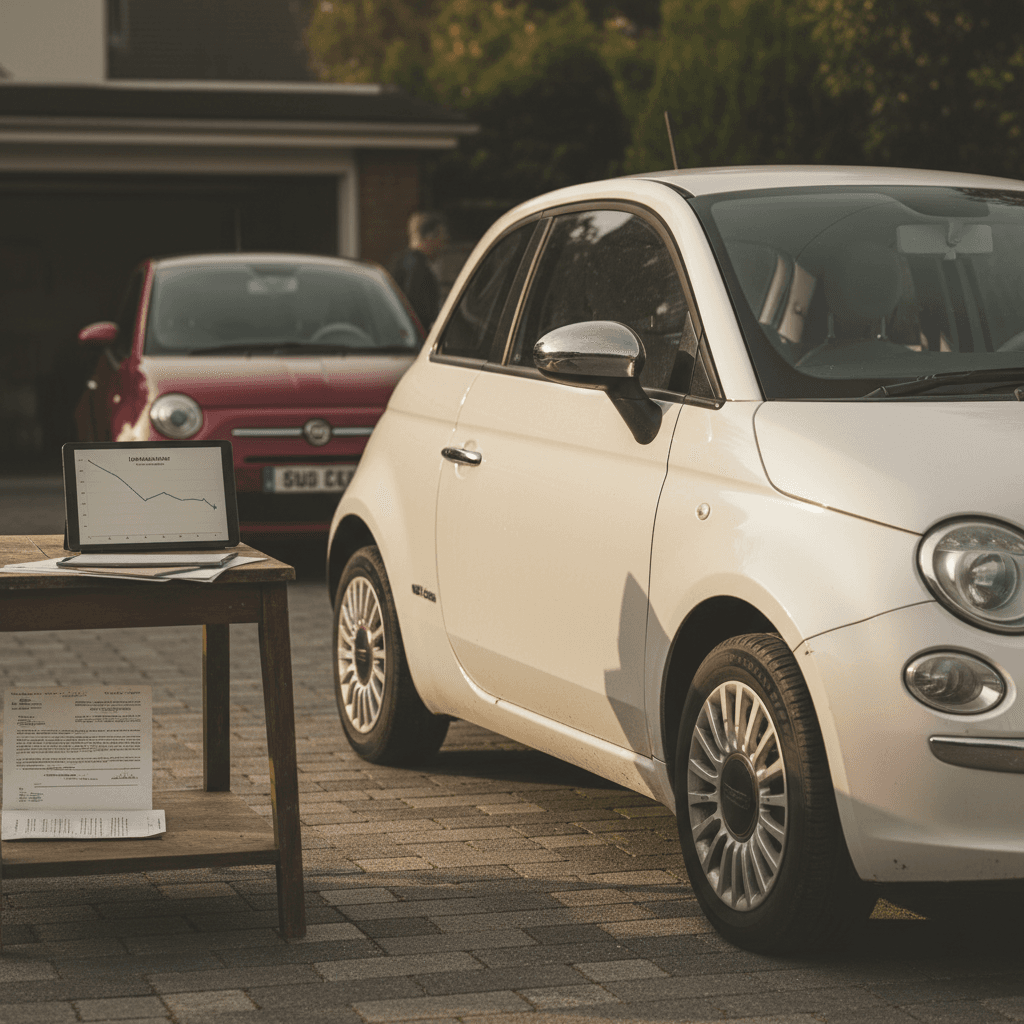
If you’re looking at a quirky city EV on a budget, it’s only a matter of time before a used Fiat 500e pops up in your search. Understanding Fiat 500e value after 5 years is critical, because this is a car that’s been both a bargain and a depreciation horror story, depending on when and how you buy it.
Two different 500e stories
Why Fiat 500e value after 5 years matters
Unlike a Tesla Model 3 or a Chevy Bolt, the Fiat 500e is unapologetically niche: tiny, stylish, and range‑limited. That combination makes depreciation steeper than average, but it also creates opportunities. If you time it right, you can let the first owner (or the leasing bank) eat the bulk of the loss and enjoy a low‑cost, low‑mileage city EV. If you time it wrong, you’re the one holding the bag when it’s time to sell.
Five years is a sweet spot because most EVs have done their biggest drop by then, yet they’re still inside or just beyond the factory 8‑year / 100,000‑mile battery warranty in the U.S. For a Fiat 500e, that means you’re balancing three questions: 1. How much of the original MSRP is left? 2. How healthy is the battery and how much range does it still deliver? 3. Will you be able to resell it again in 3–5 years without losing everything you saved?
Fiat 500e 5‑year value snapshot (2026 outlook)
How much value does a Fiat 500e lose in 5 years?
If you strip away the noise and look just at the numbers, most data sources cluster around the same answer: a Fiat 500e loses roughly 48–52% of its value over five years.
Illustrative Fiat 500e 5‑year depreciation curve
Modeled example based on a new Fiat 500e with an inflation‑adjusted MSRP of about $33,000.
| Age | Estimated value kept | Approx. resale value | Notes |
|---|---|---|---|
| 1 year | ~71% | $23,000 | Steep first‑year drop is typical of EVs and small niche cars. |
| 3 years | ~61% | $19,500 | Depreciation slows but is still faster than many gas subcompacts. |
| 5 years | ~52% | $16,500–$17,000 | About half the original value remains on an average‑mileage, healthy‑battery car. |
| 8 years | ~30% | $9,500–$10,000 | Near end of battery warranty; condition and service history dominate value. |
Real‑world deals will move these numbers up or down, especially if the car was heavily discounted or leased at a subsidized rate when new.
UK vs. U.S. numbers can look wildly different
Real‑world used Fiat 500e prices in 2026
By April 2026, most of the 500e inventory you’ll see on used‑car sites in the U.S. falls into two buckets: - **Older compliance cars**: 2013–2019 models, often with 40–70k miles and 80–90 mile original EPA range. - **Early second‑generation cars**: 2024+ models are just trickling into the used market; their 5‑year story won’t be visible until 2029–2031.
2015–2019 Fiat 500e (first gen)
- Dealer retail: commonly in the $9,000–$14,000 range depending on miles and condition.
- Private party: often $1,000–$2,000 less than dealer pricing.
- Tax history: many were originally leased, so the federal EV tax credit was baked into subsidized lease payments, not into today’s resale price.
In expensive coastal markets, low‑mile, well‑kept cars can still push into the mid‑teens. In lower‑demand regions, prices can dip into high‑single‑digit thousands.
2024+ Fiat 500e (second gen)
- New MSRPs are generally in the low‑$30Ks before destination.
- Lightly used 1‑ to 2‑year‑old examples are starting to appear with mid‑$20K asking prices.
- Because this car is so new, its true 5‑year value curve is still speculative, but early signs suggest depreciation will again be steeper than mainstream EVs.
If you’re thinking ahead to 2030–2031 resale value, assume that a 2024 500e will likely be a mid‑teens car by its 6th or 7th birthday, depending on mileage and battery health.
How Recharged benchmarks value
What actually drives Fiat 500e value after 5 years
Key factors that move 5‑year Fiat 500e value up or down
Think of these as the levers that explain why two similar‑looking cars can be several thousand dollars apart.
Battery health & range
On a short‑range EV, every mile of usable range matters. A 500e that still delivers 80+ miles on a full charge is worth far more than one down in the 60s.
This is often the single most important value driver on a 5‑ to 8‑year‑old 500e.
Mileage & usage pattern
A 5‑year‑old 500e with 25k mostly city miles will usually beat a 60k‑mile commuter that’s done daily highway duty.
High mileage doesn’t automatically kill value, but it raises questions about battery wear and upcoming maintenance.
Market & region
Demand is strongest in dense, EV‑friendly cities where 80–100 miles of range is plenty and parking is tight.
In rural or cold‑weather regions, buyers worry more about limited range, so prices can be softer.
Warranty timeline
Being inside the 8‑year / 100k‑mile battery warranty adds confidence and resale value. Once you’re beyond that, every battery quirk weighs heavier on price.
Service history & support
Documented software updates, recall work, and regular maintenance help. Spotty dealer support for older 500e in some areas can push values down.
Charging & use case fit
The 500e is happiest as a second car or short‑range commuter. Buyers who understand that are willing to pay more than shoppers hoping to road‑trip it.
Battery health, warranty and their impact on value
Battery performance isn’t just an engineering question; it’s a financial one. On any five‑year‑old EV, but especially a short‑range city car like the 500e, capacity loss directly hits value because it limits how you can use the car.
- A healthy 5‑year‑old Fiat 500e pack might still deliver roughly 85–90% of its original usable capacity in a mild climate with moderate mileage.
- Aggressive fast‑charging, frequent 100% charges, extreme heat, or very high mileage can accelerate degradation and knock thousands off resale value.
- Because MSRP is relatively low, a worst‑case battery replacement bill can approach or exceed the entire value of a 7‑ to 10‑year‑old 500e, which is why many owners simply walk away when packs fail outside warranty.
Battery warranty fine print matters
Battery checks before you buy a 5‑year‑old Fiat 500e
1. Pull a proper battery‑health report
Don’t settle for a generic OBD screenshot. Use a structured report, like the <strong>Recharged Score</strong>, that quantifies estimated remaining capacity, tracks error codes, and flags thermal‑management issues.
2. Verify fast‑charge behavior
If possible, observe a DC fast‑charge session. Unstable charging, repeated charge faults, or very slow speeds can indicate underlying pack or BMS issues that will hurt future value.
3. Compare range to real‑world expectations
Take a long test drive on your usual route, reset the trip computer, and see how many miles per 10% of battery you actually get. That tells you far more than the dashboard’s theoretical range estimate.
4. Check warranty start date and mileage
Get the in‑service date from service records or a dealer. A car first sold in late 2021 may have warranty to late 2029 even if the model year is 2020.
5. Look for software and recall history
Battery‑management updates and recall work can improve reliability and protect value. Lack of any EV‑specific service over five years is a red flag.
Five‑year cost of ownership: how the 500e stacks up
Depreciation is just one side of the ledger. To decide whether a 5‑year‑old 500e is a good value, you need to look at total cost of ownership: purchase price, energy, maintenance, and eventual resale.
Where the 500e saves you money
- Low purchase price: By the time it’s five years old, a 500e often undercuts comparable gas city cars and mainstream EVs.
- Energy costs: For typical urban driving, electricity is usually far cheaper per mile than gasoline, especially if you can charge overnight at home.
- Simple maintenance: No oil changes, fewer moving parts, and modest tire sizes keep routine costs down.
Where the 500e can cost you
- Rapid early‑life depreciation: If you buy new and sell at year five, you’re likely eating a roughly 50% value loss.
- Out‑of‑warranty risk: Past the 8‑year battery warranty, a major pack issue can total the car financially.
- Limited versatility: If your life changes (longer commute, frequent road trips), you may need to sell at a discount because of the short range.
Where the 500e shines on value
How to shop smart for a ~5‑year‑old Fiat 500e
Your goal in the used 500e market is simple: capture the upside of heavy depreciation without inheriting someone else’s battery or support headaches. That comes down to process.
Step‑by‑step: Buying a 5‑year‑old Fiat 500e without regrets
1. Decide if the use case really fits
Be brutally honest: will an 80–100‑mile EV cover 95% of your driving? If you routinely do long commutes or winter highway trips, a different EV may deliver better long‑term value.
2. Target the right age and mileage
For first‑gen cars, a “sweet spot” is often 4–7 years old with 25k–60k miles, new enough to be inside battery warranty, old enough that depreciation has slowed.
3. Prioritize battery‑health transparency
Favor cars with a professional battery‑health report, like a <strong>Recharged Score</strong>. If a seller can’t or won’t provide one, price that uncertainty into your offer, or walk.
4. Check for EV‑savvy support nearby
Before you buy, confirm which local dealers or independent shops are actually certified and equipped to work on 500e. Weak support in your area suppresses both convenience and resale value.
5. Compare total cost, not just price
Look at energy costs, insurance, and realistic resale in 3–5 years. On Recharged, every 500e listing includes a <strong>total cost of ownership view</strong>, not just a sticker price.
6. Consider buying from an EV‑focused marketplace
Platforms built for EVs, like Recharged, screen vehicles for battery health, price fairness, and title status, which helps you avoid surprises that traditional used‑car lots sometimes miss.
When a 5‑year‑old Fiat 500e is a good (or bad) deal
Reading the deal: green flags vs. red flags
Use these cues to judge whether the value proposition makes sense for you.
When the value case is strong
- Price sits comfortably in the mid‑teens for a 4–6‑year‑old car with low–moderate miles.
- Independent battery‑health report shows good remaining capacity and clean error history.
- You live in a city or suburb where its range is more than enough most days.
- There’s at least one EV‑trained Fiat or Stellantis service point within a reasonable distance.
- You plan to keep it 3–5 years and squeeze maximum value from the low running costs.
When the value case is shaky
- Asking price is close to or above 50% of the original MSRP despite high mileage or questionable battery health.
- The car is at or beyond the 8‑year battery‑warranty window with no documented pack history.
- No nearby service network is willing or able to work on a 500e.
- You expect it to double as a long‑distance road‑trip car.
- The seller can’t explain recent recalls, software updates, or charging behavior.
Leasing the new 500e vs. buying used
FAQ: Fiat 500e value after 5 years
Frequently asked questions about Fiat 500e 5‑year value
Key takeaways on Fiat 500e value after 5 years
The Fiat 500e is a textbook case of how depreciation can punish first owners and reward savvy second ones. After five years, a typical 500e has shed roughly half its original value, but that doesn’t make it a bad car, it just shifts the value equation in favor of buyers who understand its limitations and how to evaluate battery health.
If your driving is mostly urban, you have reliable charging at home or work, and you go in with eyes open about range and service support, a carefully chosen 4–7‑year‑old Fiat 500e can deliver remarkably low cost per mile. The key is to anchor your offer to real‑world depreciation data, insist on transparent battery‑health information, and buy at a price that already bakes in the car’s quirks.
Recharged was built to make that process easier. Every used EV on the platform, including the Fiat 500e, comes with a Recharged Score battery‑health report, fair‑market pricing, and EV‑savvy guidance from search to delivery. If you decide a 5‑year‑old 500e is the right move, you shouldn’t have to guess whether you’re getting a bargain city car, or a future depreciation story of your own.