Search interest in the phrase “lithium battery for electric car” usually comes from the same place: you’re either thinking about buying an EV, or you’re wondering how long the battery in your current car will last before it empties your savings. The good news is that modern lithium EV batteries are far tougher, safer, and longer‑lived than most people think.
Big picture
Why lithium batteries dominate electric cars
If you drive a modern EV, it almost certainly runs on a lithium‑ion battery pack. As of 2023–2024, lithium chemistries like NMC (nickel‑manganese‑cobalt), NCA (nickel‑cobalt‑aluminum) and LFP (lithium iron phosphate) account for the overwhelming majority of battery electric vehicle production worldwide. That’s because lithium cells offer high energy density, good power delivery, and long cycle life, all in a relatively compact and lightweight package.
Lithium batteries and the EV market
Why this matters for you
Lithium battery basics: what’s inside your EV pack
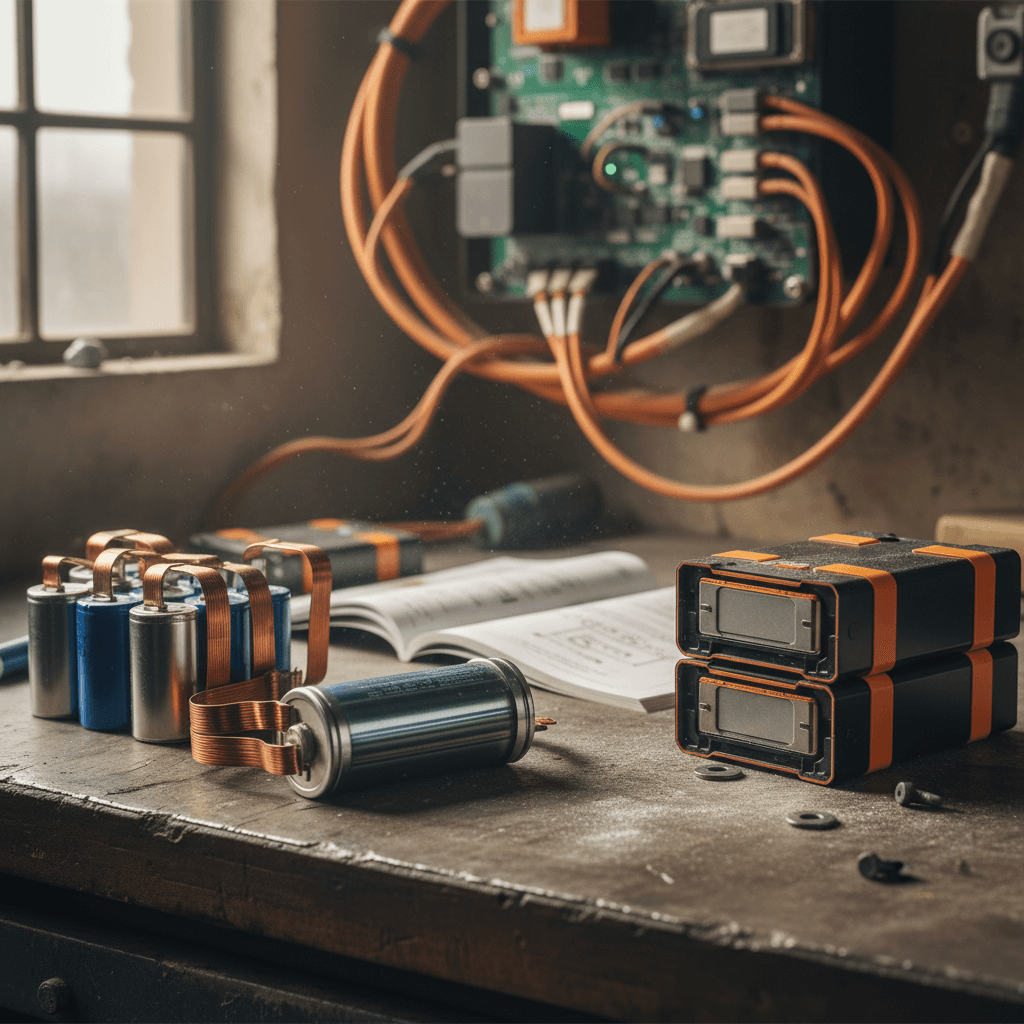
Think of the lithium battery in an electric car as a giant, rugged version of the one in your laptop, only with far more safety engineering and cooling. Instead of a single brick, your EV battery pack is a carefully managed ecosystem:
- Cells – Hundreds to thousands of individual lithium‑ion cells (cylindrical, prismatic, or pouch).
- Modules – Groups of cells wired together and packaged for serviceability and cooling.
- Pack – All modules plus cooling channels, high‑voltage connections, and crash structure, typically mounted in the floor.
- BMS (Battery Management System) – The electronic brain that monitors temperature, voltage, and current to keep the pack safe and extend its life.
High voltage, high respect
NMC vs LFP vs other lithium EV chemistries
“Lithium battery” sounds singular, but you’re really choosing among families of chemistries. The two you’ll hear most about on window stickers and spec sheets are NMC and LFP. Each has a personality.
Common lithium chemistries for electric cars
How today’s main EV battery types differ in feel, cost, and ownership experience.
| Chemistry | Typical Use | Key Strengths | Drawbacks | Best If You… |
|---|---|---|---|---|
| NMC / NCA | Many long‑range & performance EVs | High energy density, strong performance, good fast‑charge capability | Higher cost, uses nickel & cobalt, somewhat more sensitive to heat | Want max range and strong acceleration, often drive long highway trips |
| LFP (LiFePO4) | Value‑oriented and fleet EVs; some newer crossovers | Lower cost, very long cycle life, excellent safety, can sit at high state of charge more comfortably | Slightly lower energy density, a bit heavier for same range, colder‑climate efficiency hit | Mostly charge at home, prioritize longevity & cost over absolute range |
| LMR / “manganese‑rich” | Next‑gen cells announced for trucks & SUVs | Lower cost than nickel‑rich packs, good range, fewer modules needed | Still pre‑mass‑market; details vary by automaker | Plan to keep your truck long‑term and want solid range without a six‑figure price tag |
| Solid‑state (prototype) | Future premium EVs | Very high potential energy density, improved safety, very fast charging (in theory) | Not commercially available in mainstream EVs yet, cost unknown | Are planning your next‑next car, not the one you’re buying today |
NMC and LFP dominate electric cars today; other chemistries are emerging but not yet mainstream in retail EVs.
NMC vs LFP in one sentence
How long does a lithium EV battery really last?
Strip away the myths and the picture is surprisingly boring, in the best way. Modern lithium batteries for electric cars are engineered to last at least as long as the vehicle, and often longer.
What actually determines EV battery life
It’s less about calendar years and more about how and where you drive.
Charge patterns
Frequent DC fast charging and constant 0–100% cycles are harder on the pack.
Moderate charging, say 10–80% most of the time, tends to preserve capacity.
Climate
Extreme heat is the enemy of any lithium battery.
Cars with active liquid cooling and garage parking age more gracefully than those baking in the sun.
Mileage & use
High annual mileage adds cycles, but EV packs are designed with a buffer.
Many real‑world tests show well over 90% capacity after 100,000 miles when managed properly.
Warranty safety net
Real‑world data backs this up. Long‑term tests of popular EVs driven over 100,000 miles commonly show capacity in the low‑90% range, even with some fast‑charging in the mix. And industry studies suggest only a small fraction of EVs, on the order of a few percent, ever need a full battery replacement, usually under warranty.
Battery replacement costs in 2025
This is usually the scary part of any article about a lithium battery for an electric car, so let’s deal with it head‑on. If you ever had to replace the entire high‑voltage pack out of warranty, it wouldn’t be cheap, but it’s also not the routine event social media horror stories make it out to be.
Typical out‑of‑warranty replacement ranges (2025, U.S.)
Don’t let worst‑case costs scare you off
For context, running an ICE car for 12–15 years often means thousands spent on fuel, oil changes, transmission service, and major engine repairs. With an EV, a healthy lithium battery plus low routine maintenance can make total ownership costs very competitive, especially if you charge mostly at home.
How to care for a lithium battery in daily driving
You don’t need to baby a modern EV, but a few simple habits will keep your lithium battery happier for longer, especially if you plan to keep the car past the warranty or you care about resale value.
Everyday habits that extend EV battery life
1. Live in the middle of the battery
For daily use, try to stay between roughly 10% and 80% state of charge. Save consistent 100% charges for road trips where you’ll drive off immediately.
2. Favor AC charging at home
Level 2 charging in your driveway or garage is gentler than frequent DC fast charging. Occasional fast charges are fine; using them as your only charging source accelerates wear.
3. Avoid parking at 0% or 100% for long periods
Letting the car sit dead or fully topped up for days, especially in heat, is hard on lithium chemistry. If you’re parking for a while, aim for around 40–60% state of charge.
4. Keep it cool when you can
Garage parking or shade is a quiet gift to your battery. High ambient temperatures force the cooling system to work harder and can accelerate long‑term degradation.
5. Use scheduled charging
Most EVs let you schedule charging so it finishes near your departure time. That keeps the pack from sitting at a high state of charge longer than necessary and can lower your electric bill if you have time‑of‑use rates.
6. Stay current on software updates
Automakers continually refine battery management software. Updates can improve range prediction, charging behavior, and even long‑term durability.
Buying a used EV? Battery health checklist
If you’re shopping the used market, the single most important component you’re buying is the lithium battery pack. A high‑mileage battery in good health is no problem; a neglected one can turn a cheap EV into an expensive science project. Here’s how to separate the keepers from the question marks.
Used EV battery check: what to look for
1. Ask for a battery health report
Many modern EVs can display state of health, and some brands provide official reports. At Recharged, every vehicle includes a <strong>Recharged Score</strong> report with verified battery diagnostics, so you’re not guessing.
2. Review fast‑charging history
Heavy, daily DC fast‑charging isn’t an automatic deal‑breaker, but it’s useful context. A car that’s mostly home‑charged with occasional road‑trip fast charges is ideal.
3. Compare indicated range to original specs
On a full or near‑full charge, compare the displayed range to the EPA rating from new. A modest drop, say, 5–10%, is normal. Much more than that deserves a closer look.
4. Check warranty status
Confirm how many years and miles of high‑voltage battery warranty remain. A car with several years of coverage left significantly reduces your risk.
5. Look for warning lights or charging issues
Any battery or charging system warnings, unexplained cut‑offs at fast chargers, or refusal to accept a charge are red flags that call for professional diagnostics.
6. Consider how you’ll use the car
A battery that’s down to 80–85% of original capacity might be perfectly fine if you mostly commute 30 miles a day but frustrating if you road‑trip every weekend.
Where Recharged fits in
How Recharged evaluates lithium EV batteries
Traditional used‑car shopping leans on seat‑of‑the‑pants impressions: Does it feel quick? Any odd noises? With EVs, you still want the test drive, but the heart of the car is the lithium battery, and that requires data.
Inside a Recharged Score battery report
Turning invisible battery data into simple, transparent insights.
Verified state of health
We use dedicated diagnostics tools and OEM data where available to estimate how much usable capacity remains compared with when the car was new.
Charging behavior & history
We review charging patterns, including DC fast‑charging usage and any logged faults, to understand how the lithium battery has been treated.
Fair value pricing
Battery health flows directly into pricing. A car with an exceptionally strong pack is priced accordingly; a weaker pack is discounted or doesn’t make the cut.
Ready to find your next EV?
Browse VehiclesShop from your couch
Future trends: solid-state and next-gen chemistries
The lithium battery for electric cars is in the middle innings of its story, not the end. While today’s EVs mostly use NMC, NCA, and LFP packs, automakers and cell suppliers are pouring billions into next‑generation chemistries aimed at more range, lower cost, and even better safety.
Short-term: cheaper, tougher lithium
- Manganese‑rich cells promise lower cost than nickel‑heavy packs while still delivering 350–400 miles of range in larger vehicles.
- Refined LFP designs, like blade and “short blade” cells, focus on improved cooling, packaging efficiency, and very high cycle life.
- U.S. and European plants are scaling up lithium cell production rapidly, aiming to localize supply chains and push costs down further.
Longer term: solid-state & sodium‑ion
- Solid‑state batteries could offer higher energy density and faster charging with improved safety, but they’re still working their way out of the lab and into early production.
- Sodium‑ion packs are beginning to appear in more affordable vehicles overseas. Energy density is edging close to LFP, with the promise of abundant raw materials and very low cost.
- For a buyer in 2025, these are trends to watch rather than features to wait for, current lithium EVs are already very good.
Frequently asked questions about lithium EV batteries
Lithium battery for electric car: FAQ
The bottom line on lithium batteries for electric cars
Under the floor of every good electric car is a lithium battery pack doing the unglamorous work: storing energy, shrugging off heat and cold, and quietly outlasting the fears swirling around it. The important question isn’t whether a lithium battery for an electric car is “reliable enough”, the data says it is, but which chemistry, range, and warranty profile best fit how you actually drive.
If you’re looking at the used market, that’s where transparency matters. A clean EV with a tired pack is like a sports car with low oil pressure, pretty, but problematic. By combining verified battery diagnostics, fair market pricing, financing, trade‑in options, and nationwide delivery, Recharged is designed to make sure your next electric car has the kind of lithium battery you don’t have to think about at all, except when you’re enjoying the way it drives.