If your Kia EV9 suddenly refuses to “wake up,” throws a battery discharge warning, or won’t shift into Drive even with plenty of range left, the culprit is often the humble 12‑volt battery. This guide walks you through Kia EV9 12V battery replacement basics: how the system works, warning signs, costs, and when you should call a dealer instead of reaching for a wrench.
High‑voltage vs 12‑volt: two different batteries
Why the Kia EV9 12V battery matters
In a gasoline car, the 12‑volt battery cranks the engine. In a Kia EV9, it does something just as critical: it wakes the car up and powers all the low‑voltage electronics that let the high‑voltage battery join the party. Door locks, computers, contactors, brake boosters, shifters, if the 12V battery is weak or dead, your EV9 can’t go into Ready mode, no matter how full the big battery is.
- Unlocking and locking doors and the tailgate
- Booting the infotainment, instrument cluster, and control modules
- Operating power steering and brake systems at start‑up
- Closing high‑voltage contactors so the main traction battery can power the car
- Running alarms, telematics, and background systems when parked
Why a weak 12V can feel worse in an EV
How the Kia EV9 12V system works
Like other E‑GMP‑platform vehicles, the Kia EV9 uses a 12‑volt auxiliary battery plus a DC‑DC converter that steps down power from the high‑voltage pack. Once the vehicle is in Ready mode, that DC‑DC converter effectively acts like an alternator, keeping the 12V system charged while you drive.
Kia EV9 low‑voltage system at a glance
What’s happening behind the scenes when you press the EV start button
12V auxiliary battery
A conventional 12‑volt battery that powers control units, locks, lights and safety systems. If it’s flat, the EV9 won’t boot up, even if the main pack is full.
High‑voltage pack
The big battery under the floor stores the energy that actually moves the vehicle. It feeds the motors and, via a converter, keeps the 12V system alive while driving.
DC‑DC converter
Replaces an alternator in an EV. It takes high‑voltage energy and converts it to ~12V to charge the auxiliary battery and run accessories.
About that “12V Battery Reset” button
Common Kia EV9 12V battery symptoms
When the EV9’s 12V battery starts to go, it rarely fails gracefully. Here are the patterns owners report most often when a Kia EV9 12V battery replacement is due:
Warning signs your EV9 12V battery is unhappy
Random “Battery Discharge” warnings
You see <strong>Battery Discharge Warning</strong> or similar messages after the car sits parked, especially overnight or at the airport.
Car won’t go into Ready or Drive
You press the EV start button and the screens flicker or reboot, but the EV9 refuses to shift into gear, or it asks you to move the key fob but never fully wakes up.
Multiple warning lights at once
A Christmas tree of ABS, steering, and brake warnings appears with no clear pattern. Low 12V voltage can confuse multiple modules at the same time.
The car “dies” after accessory use
Listening to music or using climate while parked for a while leaves the car unresponsive, even though the traction battery still has plenty of charge.
Need for frequent jump‑starts or resets
If you’re using jumper cables, a jump pack, or the vehicle’s reset function regularly, the 12V battery is probably due for testing or replacement.
If your EV9 won’t start, don’t keep cycling power
Before you replace the 12V battery, try this
Not every warning light means the 12V battery needs to be swapped immediately. A few smart checks can save you time and money before you schedule a Kia EV9 12V battery replacement.
- Check that the high‑voltage battery has a reasonable state of charge (ideally 20% or more). Extremely low main pack charge can limit what the DC‑DC converter can do.
- Turn everything off, lights, HVAC, heated seats, and then press the EV start button once with your foot on the brake. Give the car 30–60 seconds to fully boot.
- If equipped, follow the owner’s‑manual procedure for a 12V battery reset or jump function from the main pack. If the EV9 then starts normally and stays happy, you may just have caught a one‑off low‑voltage event.
- Use a quality digital multimeter or 12V tester across the battery posts under the hood. Under about 12.2V after resting, or below 11.8V under light load, is a strong sign the battery is weak.
- If you have any doubt, or the car still won’t start, call roadside assistance or your Kia dealer rather than forcing it. They can test the 12V, check for service campaigns, and safely clear any resulting error codes.
Follow Kia’s jump‑starting instructions to the letter
Kia EV9 12V battery specs and type
Kia publishes the 12V auxiliary battery capacity for the EV9 at around 60 Ah, similar to what you’d find in a midsize SUV. The battery itself is a standard automotive 12‑volt design in a compact case size used across many modern vehicles.
Typical Kia EV9 12V battery details
Always confirm exact fitment for your model year and region, but these are the specs most owners will see.
| Attribute | Typical spec / notes |
|---|---|
| Battery type | 12‑volt automotive auxiliary battery |
| Chemistry | Lead‑acid or AGM (Absorbent Glass Mat), region‑dependent |
| Approx. capacity | ~60 Ah |
| Common group size | H5 / Group 47 style case (verify fitment) |
| Nominal voltage | 12V |
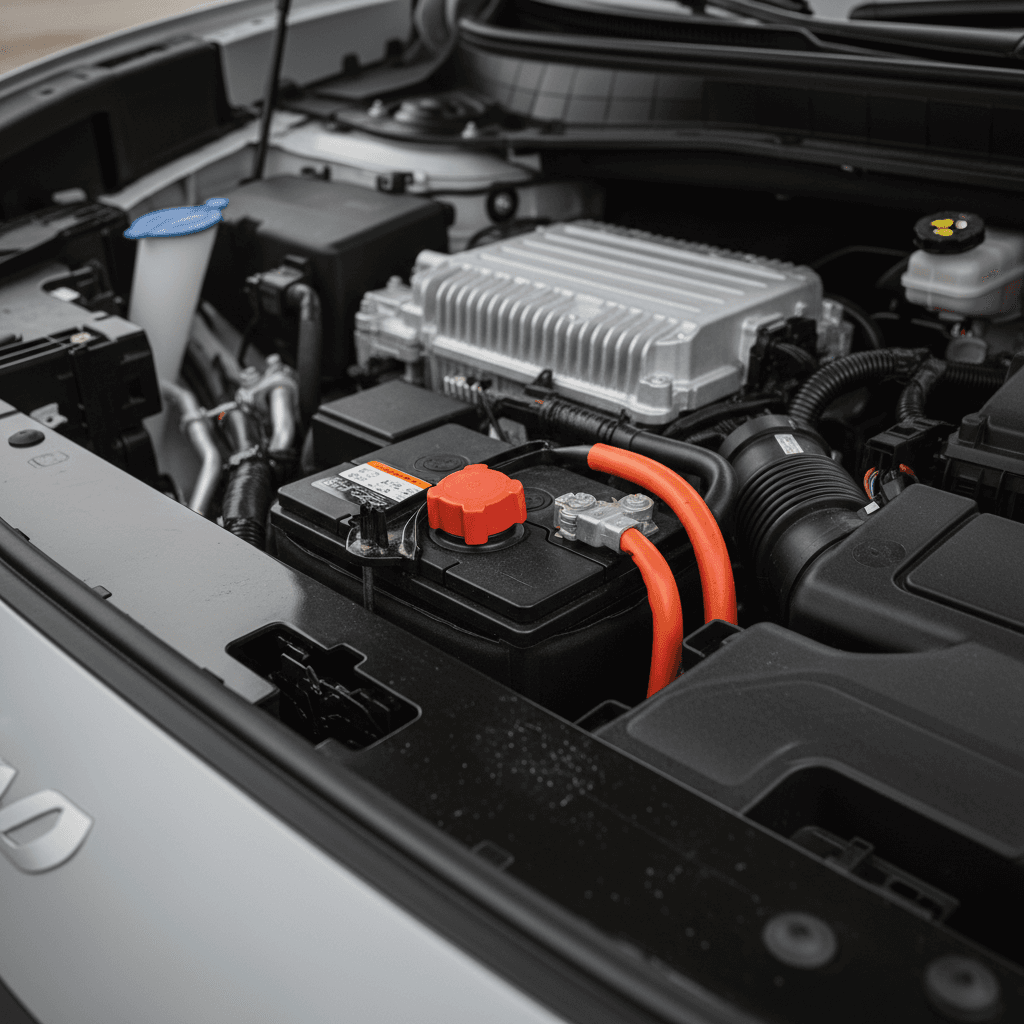
| Location | Under hood, near right‑hand side under trim/cover |
| Replacement style | Drop‑in, with venting and hold‑down bracket |
Use this as a starting point, your under‑hood label and owner’s manual are the final word.
AGM vs flooded lead‑acid in the EV9
Kia EV9 12V battery replacement steps (owner-level overview)
On paper, swapping the EV9’s 12V battery isn’t wildly different from changing one in a gas SUV. The high‑voltage pack remains isolated as long as you follow Kia’s safety instructions and never poke anything orange. Here’s the high‑level process so you know what’s involved, even if you ultimately let a shop do the work.
Owner‑level overview of Kia EV9 12V replacement
1. Park safely and power down
Park on a flat surface, set the parking brake, switch the EV9 fully off, and remove the key fob from the vehicle. Allow electronics to go to sleep for several minutes.
2. Open the hood and locate the 12V battery
Release the hood and secure it. Remove any plastic covers to expose the battery and the clearly labeled positive and negative terminals or jump studs.
3. Protect memory if needed
If you care about radio presets or window indexing, some shops use a memory saver pack. On a modern EV like the EV9, expect a few warning lights after replacement until modules relearn, even when using a saver.
4. Disconnect the negative terminal first
Always loosen and remove the <strong>negative (–)</strong> cable first, then the positive (+). This reduces the chance of shorting a tool to ground.
5. Remove hold‑downs and lift out battery
Undo any brackets or clamps securing the 12V battery. Lift it straight up and out, keeping it upright to avoid spills if it’s not sealed.
6. Clean terminals and tray
Inspect cables for corrosion and clean the tray. Corroded or loose connections can mimic a bad battery, so this is worth doing while it’s apart.
7. Install the new battery
Set the new battery in place with the correct orientation. Reinstall hold‑downs so the battery can’t move under braking. Connect the positive (+) cable first, then the negative (–).
8. Verify operation and clear any warnings
Close up covers, then press the EV start button with your foot on the brake. Expect a few lights on first start; many will clear after a short drive. If warning messages persist, the car should be scanned with a diagnostic tool or checked by a Kia dealer.
When NOT to touch the battery yourself
Cost of a Kia EV9 12V battery replacement
Compared with the big traction pack, a Kia EV9 12V battery replacement is a relatively small maintenance bill, but prices can still surprise you if you walk into the parts counter blind.
Typical Kia EV9 12V replacement cost ranges
If your EV9 is still under its basic warranty and the 12V battery fails unusually early, Kia may cover testing and replacement, especially if there are known 12V issues on your build. That’s why it’s smart to log early symptoms and get them documented at a dealer, even if the car revives after a jump.
Ask for a printout of the 12V battery test
Kia EV9: dealer replacement vs DIY
When a Kia dealer makes sense
- You’re still within the bumper‑to‑bumper warranty window.
- You’ve seen repeated 12V issues, warning cascades, or no‑start events.
- You want any related software updates or recalls checked at the same visit.
- You’re not comfortable working around batteries and high‑voltage hardware.
Dealers can also verify that the root cause really is the 12V battery, and not a DC‑DC converter, parasitic draw, or wiring fault.
When DIY is reasonable
- You’re comfortable with basic hand tools and battery safety.
- The EV9 is out of warranty and symptoms align with a classic weak 12V.
- You’ve verified the battery is underspec on a proper tester.
- You can fully match the original battery’s size, polarity, and chemistry.
If you DIY, keep receipts and note the mileage for your records. That paper trail matters if you ever sell, or if unrelated electrical issues crop up later.
Aftermarket 12V batteries: choose wisely
How to make your EV9 12V battery last longer
The best 12V battery is the one you never have to think about. A few small adjustments to how you use and store your Kia EV9 can stretch that battery’s life and reduce the chances you’ll wake up to a dead dash.
Simple habits that protect your Kia EV9’s 12V battery
Drive it, don’t just let it sit
Short, infrequent trips and long idle periods are hard on 12V batteries. Aim for regular drives long enough for the DC‑DC converter to top everything off.
Avoid extended accessory use while off
Running HVAC, audio, and accessories in Accessory mode for long stretches leans on the 12V system. If you need climate or music for a while, keep the car in Ready with adequate main battery charge.
Keep software updated
Kia updates can improve how the car manages low‑voltage systems at rest. Keeping your EV9’s software current can reduce phantom drain that stresses the 12V.
Watch for parasitic drains
If you add dash cams or accessories, wire them correctly and follow best practices for parking mode so they don’t quietly pull your 12V battery down overnight.
Store with a healthy state of charge
If you’ll park for weeks, store the EV9 with decent traction‑battery charge and, if the manual allows, consider periodic wake‑ups so the DC‑DC can maintain the 12V.
Periodic 12V checkups are cheap peace of mind
Used Kia EV9 buyers: what to check about the 12V battery
If you’re shopping a used Kia EV9, the 12V battery is a small part with outsized influence on how “sorted” the vehicle feels. You don’t want to fall in love with a three‑row EV only to discover it has an electrical gremlin that’s really just a tired auxiliary battery.
12V battery checks before you buy a used EV9
Whether you’re buying from a private seller, a dealer, or a digital marketplace like Recharged, these questions matter.
Service and warranty history
Ask for records of any 12V battery replacements, electrical complaints, or jump‑start calls. Multiple no‑start events may point to a deeper issue than just an old battery.
Current battery health test
Request a fresh 12V test report as part of the inspection. Voltage alone doesn’t tell the whole story; capacity and internal resistance matter too.
Overall electrical behavior
Does the EV9 boot cleanly from cold? Any lingering warnings after a short test drive? Smooth, repeatable starts are what you’re looking for.
At Recharged, every used EV we list, including vehicles like the Kia EV9, gets a Recharged Score battery health report that focuses on the big traction pack. But our EV specialists also look at low‑voltage performance, real‑world behavior, and early‑life failure patterns so you’re not inheriting someone else’s 12V headache.
Kia EV9 12V battery replacement FAQ
Frequently asked questions about Kia EV9 12V batteries
Key takeaways for Kia EV9 owners
The Kia EV9’s 12‑volt battery is small, but it’s the gatekeeper for everything else the vehicle can do. When it gets weak, you may see strange warnings, failed start attempts, and a lot of frustration that has nothing to do with the big drive battery under the floor.
- Learn the basic warning signs of a failing 12V battery so you can act before you’re stranded.
- Follow Kia’s jump‑starting and reset procedures exactly; don’t improvise around high‑voltage components.
- Use the right replacement battery, correct size, chemistry, and capacity, whether you DIY or go to a shop.
- Treat the 12V battery as consumable maintenance, just like tires or cabin filters, especially as the EV9 ages.
- If you’re buying used, make 12V performance part of your inspection, alongside high‑voltage battery health reports like the Recharged Score.
If you’re moving into a used Kia EV9, or any used EV, working with a specialist retailer like Recharged can simplify the whole picture. You get transparent battery‑health data, expert guidance on ownership costs, financing and trade‑in options, and a team that thinks about little things like 12‑volt batteries so you don’t have to. That way, the only time you’re thinking about the EV9’s low‑voltage system is when you’re reading an article like this one, not when you’re stuck in the driveway.