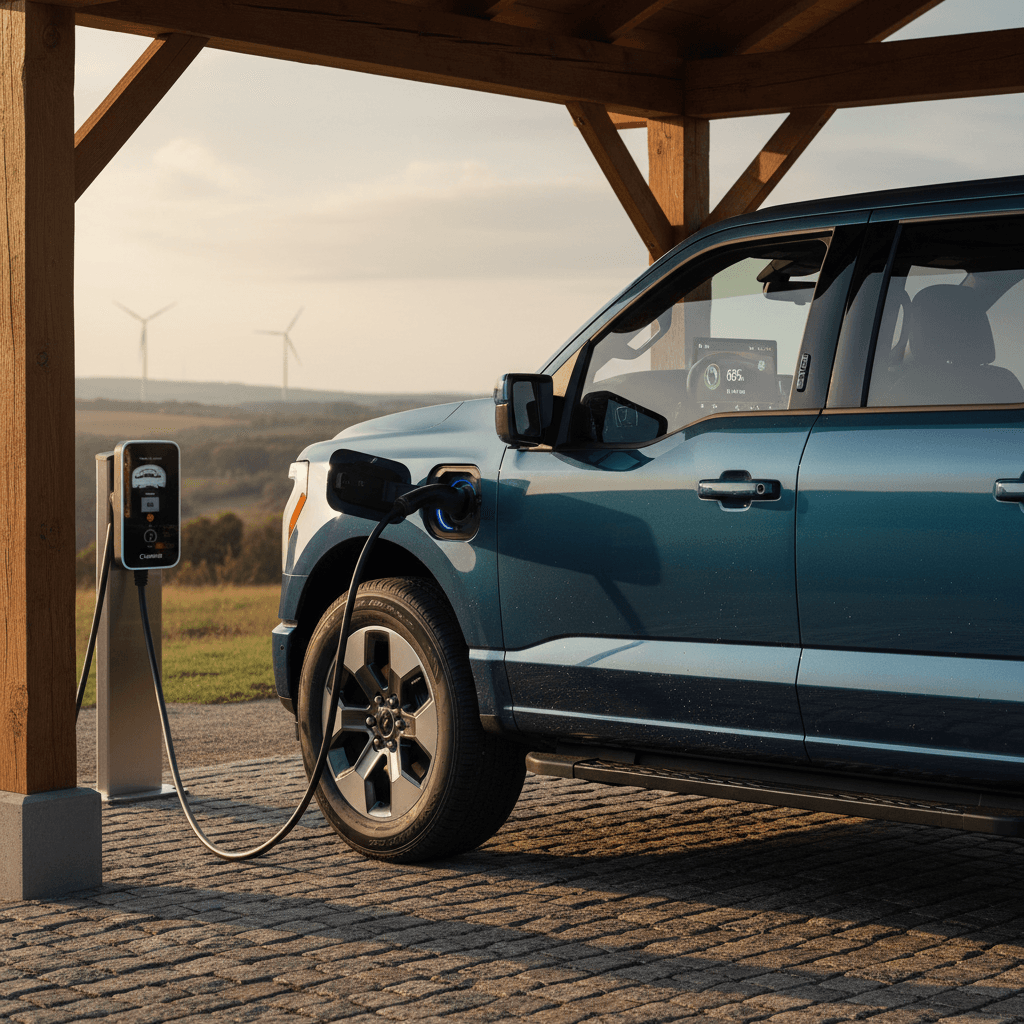
You bought a Ford F-150 Lightning, or you’re eyeing a used one, and the first practical question hits: how long does it take to charge a Ford F-150 Lightning? The honest answer is: it depends. On where you plug in, which battery you have, how low you let it run, even the weather. This guide breaks it all down into real-world numbers so you can plan your day, your commute, and your road trips without guesswork.
Quick answer
Ford F-150 Lightning charging time at a glance
Typical Ford F-150 Lightning charging times
If you only remember one thing, let it be this: EV charging time is mostly about how many kilowatt-hours you need to add, and how many kilowatts the charger can deliver consistently. The F-150 Lightning combines a very large battery with a very large, very aerodynamic… brick. It’s a work truck first, a rolling battery second. That makes picking the right charging setup even more important than it is for a compact EV.
Battery sizes and what they mean for charging time
The Ford F-150 Lightning has come with two main battery configurations. Exact usable capacity can vary slightly by model year and software, but as a working rule of thumb:
- Standard Range: roughly mid-90s kWh usable (often quoted around 98 kWh gross).
- Extended Range: roughly low 120s kWh usable (around 131 kWh gross).
For comparison, many mainstream EVs live around 60–80 kWh. The Lightning is lugging around almost double that, which is why its charging times sound big on paper. The flip side is that you also get truck-size range and the ability to power tools, campsites, even a house in an outage with the right setup.
Rule of thumb
Home charging: how long it really takes
Most Lightning owners do the bulk of their charging at home, overnight. That’s where the truck feels civilized rather than like a 6,000-pound device you forgot to plug in.
Level 1 (120V) charging time
Level 1 is the included mobile charge cord plugged into a standard household outlet. The truck will usually pull around 12 amps at 120 volts, about 1.4 kW of power.
- Realistic rate: roughly 2–3 miles of range per hour.
- Time from 15% to 100% on Standard Range: 40+ hours.
- Time from 15% to 100% on Extended Range: well over 50 hours.
Level 1 is last-resort charging
Level 2 (240V) home charging time
Level 2 is where the F-150 Lightning becomes livable. This means a 240V circuit, either with Ford’s Charge Station Pro or a third-party 40–48A wall unit. The Lightning’s onboard AC charger accepts up to 19.2 kW on certain Extended Range trims with the right hardware, but most home setups land between 9.6 and 11.5 kW.
Approximate Ford F-150 Lightning home charging times (15% → 100%)
Realistic overnight charging times assuming average efficiency and normal temps. Actual times vary with exact usable capacity, losses, and settings.
| Setup | Power (approx) | Standard Range (≈98 kWh gross) | Extended Range (≈131 kWh gross) |
|---|---|---|---|
| 120V Level 1 (12A) | 1.4 kW | 40+ hours | 50+ hours |
| 240V Level 2, 32A | 7.7 kW | ~13–15 hours | ~18–20 hours |
| 240V Level 2, 40A | 9.6 kW | ~11–13 hours | ~15–17 hours |
| 240V Level 2, 48A | 11.5 kW | ~8–10 hours | ~10–12 hours |
| High-power AC (up to 19.2 kW)* | Up to 19.2 kW | ~5–7 hours | ~7–8 hours |
Assumes the battery isn’t freezing cold and you’re not towing a yacht the moment you unplug.
About that 19.2 kW figure
In everyday life, the key point is this: on a properly sized Level 2 charger, you’re filling a Lightning essentially from empty to full overnight. For most owners who arrive home with 30–50% left, you’re talking about 4–6 hours of charge time, quietly happening while you sleep.
DC fast charging: road-trip reality vs brochure numbers
Ford quotes attractive DC fast-charging times for the Lightning, but like every modern EV, the charging curve matters more than a single headline number. Power ramps up, plateaus, then tapers as the battery fills.
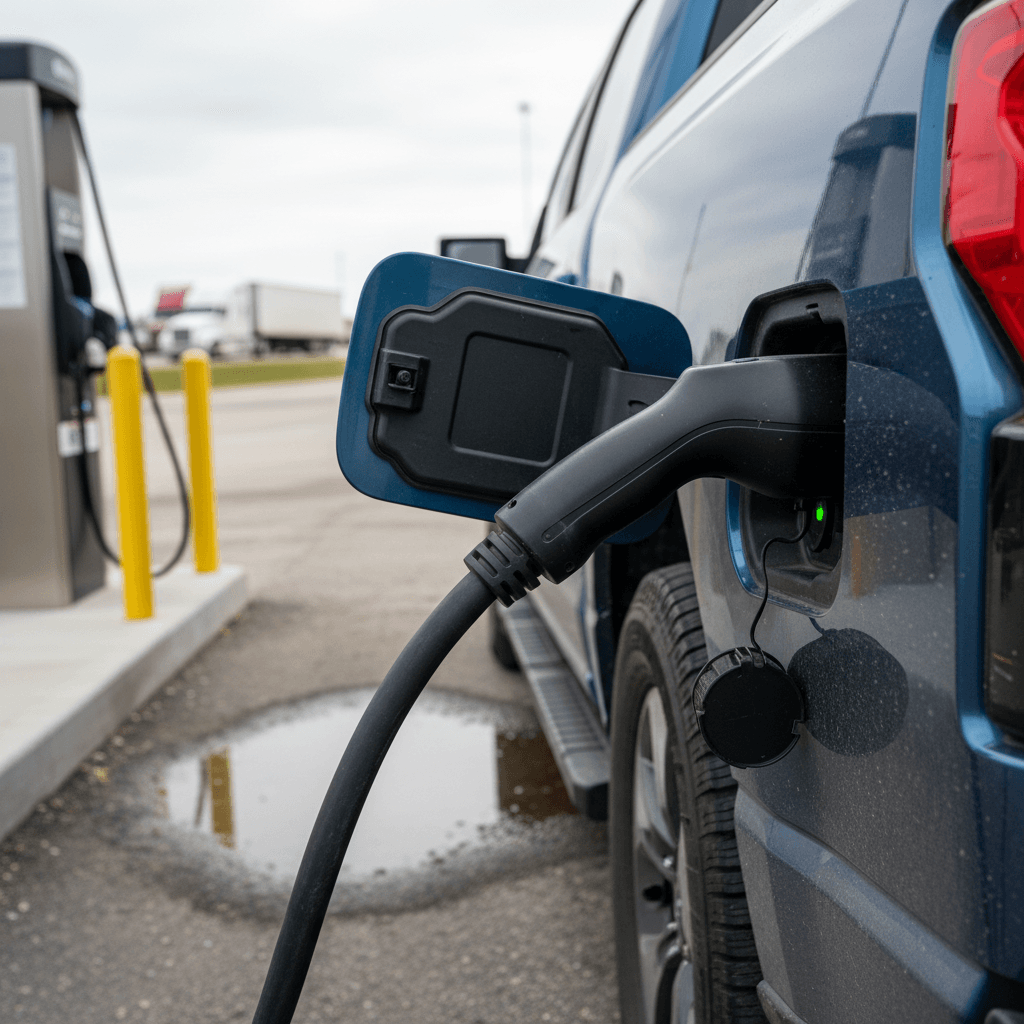
Approximate Ford F-150 Lightning DC fast charging times (good 150+ kW charger)
Times assume a healthy battery, mild temperatures, and a DC fast charger that can supply at least 150 kW.
| Battery | State of Charge | Estimated Time | Notes |
|---|---|---|---|
| Standard Range | 15% → 80% | ~36–45 min | Peak power around 120–150 kW, then tapers. |
| Extended Range | 15% → 80% | ~40–50 min | Bigger pack; usually similar peak power, more energy to add. |
| Either pack | 80% → 100% | +25–40 min | Best avoided unless you must stretch to the next charger. |
Think in 15–80% chunks on road trips; the last 20% always slows down.
Real-world owners often find that in cool or very hot weather, or at crowded stations throttled by demand, those 15–80% sessions creep closer to the high end of those ranges. Still, compared to filling 130 kWh at home, adding 50–60% of the battery at a highway charger in under an hour is a minor miracle of electrons.
Road-trip strategy
Ford F-150 Lightning charging time table
Ford F-150 Lightning charging times by scenario
High-level overview so you can quickly see how long typical charging scenarios take.
| Scenario | Charger Type | Power | Time (Standard Range) | Time (Extended Range) |
|---|---|---|---|---|
| Overnight from low charge | Level 2, 48A home | ≈11.5 kW | ~8–10 hours | ~10–12 hours |
| Workday top-up | Level 2 public, 32–40A | 7–9.6 kW | ~5–7 hours (30% → 90%) | ~6–8 hours (30% → 90%) |
| Emergency at home | Level 1, 120V | 1.4 kW | ~8–10 hours for ~20–25% | Similar; extremely slow |
| Highway stop | DC fast, ≥150 kW | 100–150+ kW peak | ~36–45 min (15% → 80%) | ~40–50 min (15% → 80%) |
| Stretching range | DC fast, 80% → 100% | Tapering down | +25–40 min | +25–40 min |
All times are ballpark figures meant for planning, not lab-certified guarantees.
5 big factors that change your charging time
What really changes your Ford Lightning charging time
Same truck, very different outcomes depending on how, and where, you plug in.
1. Temperature
2. Starting & target %
3. Charger power & sharing
4. Electrical limits at home
5. Load & accessories
Bonus: battery health
Safety note
How to choose the right home charger for your Lightning
Because the F-150 Lightning’s battery is so large, your home setup is the single biggest predictor of how painless ownership will feel. Get this wrong and the truck feels like it’s always thirsty; get it right and it simply wakes up full every morning.
Key decisions when choosing a home charger for your F-150 Lightning
1. Decide your realistic daily mileage
If you drive 20–40 miles per day, a 32A Level 2 unit may be enough. If you routinely chew through 80+ miles, especially with towing or heavy loads, aim for 40–48A so the truck reliably refills overnight.
2. Check your electrical panel capacity
A 48A charger typically needs a 60A breaker; high-power AC like Ford’s 80A Charge Station Pro needs a 100A circuit. Have a licensed electrician confirm whether your panel and service can handle it.
3. Pick the right amperage, not just a fancy box
A flashy 48A charger on a 40A circuit is just a 40A charger in denial. Make sure the unit is set (or hardwired) to the maximum your wiring safely supports, and that your Lightning is configured correctly in the settings.
4. Think about where the truck actually parks
Lightning is big. Buy enough cable length to comfortably reach the charge port without stretching across walkways. A 23–25 foot cable is often a good starting point for a full-size pickup.
5. Consider smart features and TOU rates
If your utility offers cheaper off-peak electricity, a smart charger or Ford’s app can schedule charging automatically. That doesn’t change charge time, but it can cut your cost per kWh dramatically.
6. Plan for future EVs or a second Lightning
If you’re already pulling permits, think ahead. Adding capacity now can be much cheaper than tearing things open again when EV number two shows up in the driveway.
Where Recharged fits in
Ready to find your next EV?
Browse VehiclesBattery health, fast charging, and used F-150 Lightnings
Because the Lightning’s pack is so big and DC fast charging is part of the appeal, it’s natural to worry that you’re “hurting” the battery every time you plug into a high-power station. The reality is more nuanced.
Fast charging vs battery wear
Ford, like every major automaker, manages charging with conservative software limits. Yes, heavy DC fast charging over many years can contribute to slightly faster degradation, but for most owners the bigger factors are:
- Frequently parking at 100% for long stretches.
- Regularly running the pack very low.
- Extreme heat with no shade or ventilation.
What to watch on a used Lightning
When you’re evaluating a used truck, ask two questions:
- How does indicated range compare to new? Significant drop can hint at heavy use or age.
- How was it charged? A mix of home Level 2 and occasional fast charging is ideal.
A data-backed battery health report, like the Recharged Score, goes much deeper than a test drive guess.
Why battery health reporting matters
Checklist: get the fastest, cheapest charging for your lifestyle
Make your Ford F-150 Lightning easy to live with
Confirm your main parking & outlet situation
Apartment, townhouse, or single-family home all change what’s realistic. Before you fall in love with a Lightning, make sure you can at least add a 240V circuit where you normally park.
Size your charger to your real driving, not your fantasies
If your weekly reality is school runs and Home Depot trips, a solid 40A Level 2 unit is often plenty. If you tow heavy or road-trip often, invest in 48A or higher-power AC where feasible.
Use scheduled charging to hit off-peak windows
Many utilities now offer lower rates late at night. Set your Lightning or wallbox to start charging when electricity is cheapest. Time stays the same; your bill doesn’t.
Plan DC fast charging stops around 10–70% SOC
On trips, avoid arriving at chargers with a nearly empty battery if you can, and don’t linger past ~70–80% unless the next charger is far away. It’s the sweet spot for speed.
Protect the battery from extreme heat when parked
Whenever possible, park in a garage or shade in hot climates. Heat is the long-term enemy of lithium packs and can subtly affect both range and charging behavior over time.
Use data, not vibes, when buying used
For a used Lightning, lean on battery health reports, service history, and real test drives. A truck that lives on DC fast chargers every day will age differently than one that mostly sips Level 2 at home.
Ford F-150 Lightning charging FAQ
Frequently asked questions about F-150 Lightning charging time
Bottom line: how long to charge a Ford F-150 Lightning?
Living with a Ford F-150 Lightning is less about memorizing exact charging times and more about matching your truck, your charger, and your lifestyle. With a solid Level 2 setup at home, the honest answer for most owners is: the truck charges while you sleep, and you barely think about it. On the road, you’ll spend 30–45 minutes at a good DC fast charger every few hours, enough time to stretch, eat, and get back in the saddle.
If you’re shopping for a used Lightning, or trying to figure out whether your home can realistically support one, Recharged is built for exactly that kind of decision. Every truck on our marketplace includes a Recharged Score battery health report, fair-market pricing, and experts who live and breathe EVs, trucks included. Get the charging story right up front, and the F-150 Lightning stops being a question mark and starts being just what it looks like: a very modern truck that quietly fills up in your driveway.