If you own a Ford Mustang Mach‑E, or you’re thinking about buying one, the question isn’t just “Is it good?” It’s “How fast does the Ford Mustang Mach‑E depreciate, and what does that do to my wallet?” In 2026, the Mach‑E sits in a weird spot: a genuinely good EV saddled with an oversupplied used‑EV market, nervous shoppers, and fast‑moving tech that dates early models in a hurry.
The short version
Ford Mustang Mach‑E depreciation at a glance
Mustang Mach‑E depreciation snapshot (2026 market)
How fast does the Mustang Mach‑E depreciate?
Let’s put hard numbers to “how fast.” Based on recent resale and auction data through early 2026, plus third‑party depreciation studies, here’s a realistic view of Mustang Mach‑E depreciation in the U.S. market:
Estimated Ford Mustang Mach‑E depreciation timeline
Approximate value retention for a typical Mach‑E Premium or California Route 1 with average mileage in a normal market, before major accidents or unusual wear.
| Age of vehicle | Typical miles | Estimated value vs. original MSRP | What that usually means in dollars* |
|---|---|---|---|
| 1 year | 10,000–15,000 | 75–80% | A $55,000 Mach‑E might still fetch $41,000–$44,000 |
| 3 years | 30,000–40,000 | 45–55% | Same $55,000 Mach‑E often trades around $25,000–$30,000 |
| 5 years | 60,000–70,000 | 35–40% | Value may land near $19,000–$22,000 |
| 7 years | 80,000–90,000 | 25–30% | Often high‑teens, especially as warranty end approaches |
These ranges are directional, not guarantees. Local demand, incentives, and condition can move your Mach‑E above or below these bands.
Why these are ranges, not promises
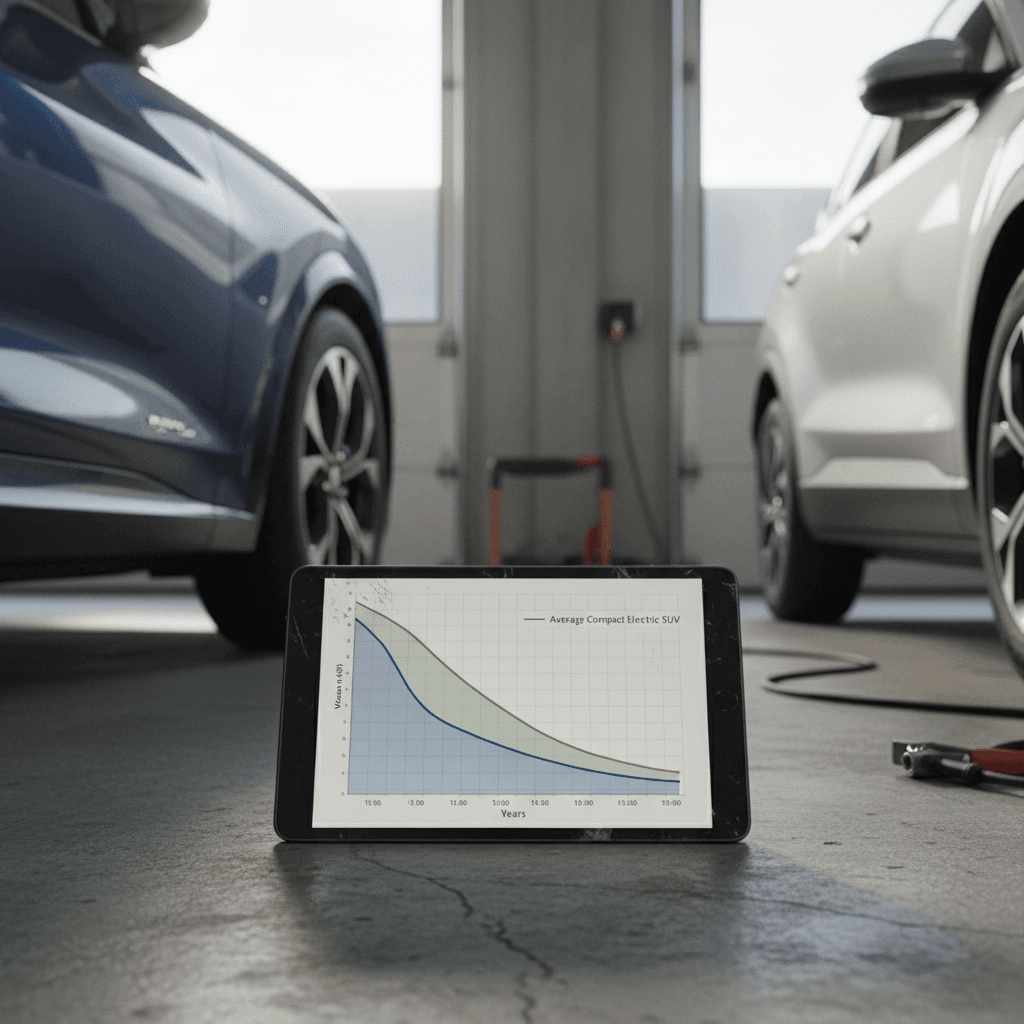
One widely cited market study of 5‑year‑old EVs pegs the Ford Mustang Mach‑E at roughly 65% depreciation after five years, while the average compact electric SUV sits closer to 59–60%. In plain English: the Mach‑E is losing value a bit faster than its classmates, but it’s not falling off a cliff uniquely by itself.
Why is the Mach‑E depreciating so fast?
Four forces pushing Mach‑E values down
None of them are about whether the car is fun to drive.
1. Rapid EV tech leapfrogging
2. Shifting tax credits & incentives
3. A wave of off‑lease EVs
4. General EV anxiety
It’s not just Ford
Mach‑E vs other EVs and gas SUVs
Mach‑E vs other electric crossovers
- Mach‑E: Around 65% depreciation at 5 years in recent studies, slightly worse than segment average.
- Typical compact electric SUV: Roughly 59–60% depreciation at 5 years.
- Standouts: Some Teslas and newer long‑range crossovers can hold value better if they keep getting software and charging‑network advantages.
The Mach‑E ranks in the bottom half of EV value retention tables, not a disaster, but not a star either.
Mach‑E vs gas compact SUVs
- Gas crossovers: Many mainstream compact SUVs lose about 45–50% over 5 years.
- Translation: A gas RAV4 or CR‑V often keeps more of its sticker price than a Mach‑E in the same time frame.
- But: The Mach‑E claws some of that back with far lower fuel and maintenance costs over those same 5 years.
If you only look at resale, gas wins. If you include fuel and service, the math gets murkier, and often more favorable to the EV.
Think total cost, not just resale
What hurts Mustang Mach‑E resale value the most?
- Shorter‑range early trims: First‑wave Mach‑Es with smaller batteries and slower DC fast‑charging tend to be punished more in the used market.
- High mileage for age: A 3‑year‑old Mach‑E with 60,000 miles looks like a rideshare car to used‑car shoppers. The discount is steep.
- Out‑of‑warranty anxiety: As the 8‑year/100k‑mile battery warranty horizon comes into view, buyers worry about theoretical $10k+ pack replacements, even though most packs are fine.
- Spotty fast‑charging access: In areas with weak non‑Tesla DC fast‑charging, the Mach‑E feels less practical to second owners. That shows up in bids at auction.
- Brand and software perception: Ford has improved Mach‑E software over time, but early glitches left a reputation hangover that still colors how some used shoppers view the car.
Accidents and title issues hit EVs harder
How to slow down your Mach‑E’s depreciation
Practical ways to protect your Mustang Mach‑E’s value
1. Keep the battery happy
Avoid living at 100% or 0% state of charge. Use scheduled charging to sit near 40–80% for daily use, and save full charges for road trips. Healthy batteries appraise better, and battery health is a core part of the <strong>Recharged Score</strong> on every car we list.
2. Stay on top of software updates
Ford continues to ship over‑the‑air updates for driveability, range prediction, and infotainment. A fully up‑to‑date Mach‑E feels and functions newer than its build date suggests, which helps resale.
3. Document maintenance and any repairs
Even though EVs need less service than gas cars, keep receipts for tire rotations, brake work, recalls, and any high‑voltage system checks. A clean, documented history reassures the next owner.
4. Watch your miles
If you can keep miles near or below 12,000 per year, your Mach‑E will price closer to the top of its model‑year range. High‑miles EVs are still a hard sell for many shoppers.
5. Fix cosmetic issues promptly
Curb‑rashed wheels, cracked glass, and interior stains are silent value killers. These are relatively cheap to fix now but create outsized discounts at trade‑in time if ignored.
6. Time your exit strategically
Values wobble around policy changes, new model launches, and major price cuts. Selling just before a big new‑model refresh, or just before your battery warranty window starts to feel “short”, often nets you more.
How Recharged helps lock in more value
Ready to find your next EV?
Browse VehiclesBest time to sell or trade in a Mustang Mach‑E
There’s no magic odometer reading when your Mach‑E turns into a pumpkin, but there are windows where the market tends to treat you more kindly.
Timing windows that usually work in your favor
Depreciation is a curve, but you can choose where you jump off it.
Before 3 years / 36k–40k miles
Around 4–5 years / 50k–70k miles
Before big market shocks
If you’re unsure where your specific Mach‑E sits on the curve, you can request a no‑obligation instant offer or consignment valuation from Recharged. We look at your actual VIN, mileage, options, and battery health, not just a generic pricing model, and help you find the right time to move.
Real‑world Mach‑E depreciation scenarios
Scenario 1: Enthusiast owner, low miles
Car: 2022 Mustang Mach‑E Premium AWD, 12,000 miles, one‑owner, clean history.
Original MSRP: about $58,000.
In early 2026, a car like this commonly trades in the low‑ to mid‑$30,000s through dealers, call it about 40–45% depreciation in four years. On the private market or a curated marketplace like Recharged, with great photos and a strong battery‑health report, it might do a bit better.
Scenario 2: High‑miles commuter, early build
Car: 2021 Mach‑E Select RWD, 70,000 miles, mixed fast‑charging history.
Original MSRP: around $45,000.
By early 2026 this car is well into the steeper section of the curve. It’s not unusual to see examples like this offered in the high‑teens to low‑$20,000s, roughly 55–60% depreciation in about five years, aggravated by mileage and being an earlier, shorter‑range configuration.
Why your offer may differ from the classifieds
Should you buy a used Mustang Mach‑E now?
If you’re shopping, the very same depreciation that stings current owners can be your best friend. The Mach‑E has already done the awkward early‑EV price drop; you get the car that reviewers like without the original owner’s five‑figure haircut.
Pros and cons of buying a used Mach‑E in 2026
Depreciation makes the math interesting.
Upsides for used buyers
- Big discounts vs. new: It’s common to see 3‑year‑old Mach‑Es listed $20,000+ below original sticker.
- Warranty runway: Many still have years left on the 8‑year/100k battery warranty.
- Mature software: Early bugs are largely patched; you’re stepping into a more sorted product.
Things to watch closely
- Battery health: Two Mach‑Es with identical miles can have very different degradation, depending on fast‑charge habits and climate.
- Charging fit for your life: If you can’t install home Level 2 charging, run the numbers carefully.
- Policy risk: Future changes in EV fees, incentives, or charging subsidies can nudge resale again.
Use data, not vibes, on a used Mach‑E
Ford Mustang Mach‑E depreciation FAQ
Frequently asked questions about Mach‑E depreciation
Key takeaways on Mach‑E depreciation
The Ford Mustang Mach‑E is depreciating faster than Ford would like and faster than many gas crossovers, roughly half its value gone in three years, and around two‑thirds over five for typical examples. That’s the cost of being an early‑cycle EV in a whiplash market.
But depreciation cuts both ways. For existing owners, smart charging habits, meticulous maintenance, and strategic timing can soften the blow, especially if you sell through a marketplace that highlights your car’s battery health and condition instead of hiding it. For shoppers, that same steep curve turns the Mach‑E into one of the more compelling used EV values on the road.
If you’re wondering what your Mach‑E is really worth, or whether a used one you’re eyeing is priced fairly, Recharged can help. Every car we list comes with a Recharged Score Report, verified battery diagnostics, fair‑market pricing, and hands‑on EV specialists to guide you from first click to delivery. In a market where values move fast, good data is the one thing that doesn’t depreciate.