If you’re shopping for a used electric vehicle, you’ll quickly run into one big question: what is a good battery health percentage for a used EV? Unlike gas cars, where mileage and maintenance tell most of the story, an EV’s value and day‑to‑day usability live and die with the battery pack. The good news: most modern packs age more slowly than early fears suggested, but you still need to know what’s normal, what’s excellent, and what to walk away from.
Key term: State of Health (SoH)
Why battery health matters on a used EV
Battery health isn’t just a nerdy number, it directly affects range, performance, and resale value. A car that left the factory with an EPA‑rated 250‑mile range but now has 75% battery health will feel more like a 185‑mile EV in real life. That might be fine for a short commute, but frustrating if you road‑trip or have long winter drives. Battery condition also drives how the market prices used EVs: two cars with the same mileage can have very different values if one pack tests at 94% and the other at 78%.
What real‑world data says about EV battery health
What “battery health percentage” really means
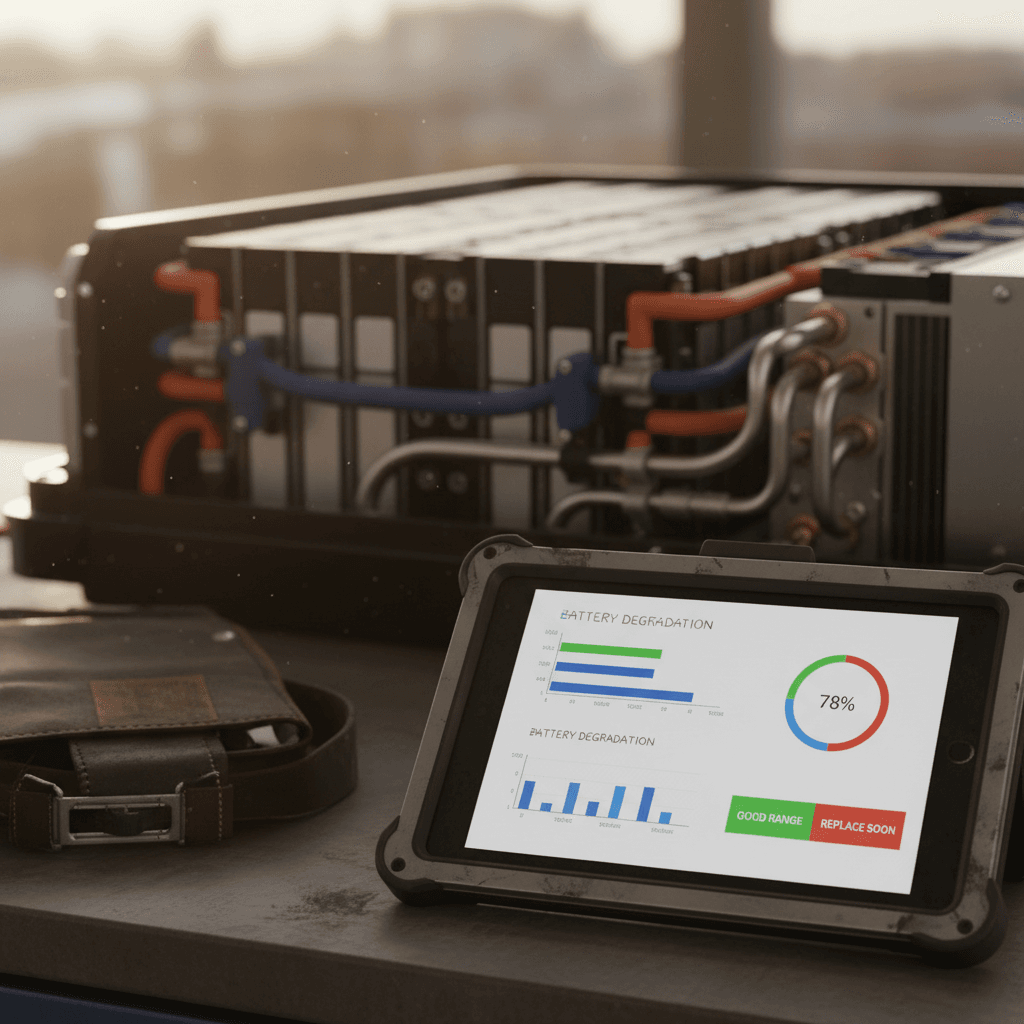
In most reports, battery health percentage is a measure of capacity, not day‑to‑day state of charge. You’ll see it labeled as SoH or “usable capacity.” A reading of 88% SoH means the pack can store 88% of the energy it could new, so all else equal, you’ll see about 12% less range from a full charge.
State of Health (SoH)
- Long‑term measure of battery aging.
- Expressed as a percentage of original capacity.
- Changes slowly over months and years.
- Used for valuation, warranty, and resale decisions.
State of Charge (SoC)
- Short‑term measure of how full the battery is today.
- Displayed on the dash as your charge level.
- Changes every time you drive or plug in.
- Does not tell you how much the battery has aged.
Don’t confuse SoH with range guess apps
Quick answer: what is a good battery health percentage?
Context matters, age, mileage, climate, and model all play a role, but these are solid working benchmarks for most modern EVs with liquid‑cooled packs:
Good battery health percentage benchmarks for used EVs
Approximate SoH thresholds that are generally considered healthy, average, or concerning, regardless of brand.
| Battery SoH | How to interpret it | Typical buyer takeaway |
|---|---|---|
| 95–100% | Exceptional, like‑new capacity for its age | Great find, expect near‑factory range |
| 90–94% | Strong health, very normal for 2–5 years old | Considered "good" for almost all buyers |
| 85–89% | Still healthy, especially on 5–8 year old EVs | Usually acceptable unless you need max range |
| 80–84% | Noticeably reduced range but usable for many | Value the car accordingly; fine for shorter commutes |
| 70–79% | Approaching warranty floor on many models | Only consider at a steep discount and with clear use case |
| <70% | Below normal; often considered end‑of‑life for pack | Generally avoid unless you’re comfortable with a future battery replacement |
These are market‑oriented guidelines for shoppers, not OEM warranty thresholds.
Rule of thumb for most shoppers
What’s normal battery degradation by year?
Modern EV batteries don’t fall off a cliff. They usually lose a small chunk of capacity early in life, then settle into a slow, steady decline. Large‑scale studies across thousands of vehicles put average degradation around 1.5–2.3% capacity loss per year in typical use. That means a well‑cared‑for EV can easily stay in the 80s or 90s for a decade.
- Year 1–2: It’s common to see the first 3–5% loss here as the pack “settles in.”
- Years 3–7: Degradation usually slows to roughly 1–2% per year in moderate climates.
- Years 8–12: Rates can creep up again, especially if the car lives in high heat or has seen heavy DC fast charging.
Don’t obsess over every single percent
Good vs “uh‑oh” battery health by vehicle age
Instead of asking, “Is 88% good?” in isolation, judge battery health against the car’s age and usage. Here’s a shopper‑friendly way to read SoH numbers by age band.
Battery health benchmarks by vehicle age
Use these as directional guides, not strict pass/fail rules.
0–3 years old
- Excellent: 95–100% SoH
- Normal/Good: 92–94%
- Watch closely: 88–91%
- Red flag: ≤87% unless very high mileage or heavily fast‑charged fleet use
4–7 years old
- Excellent: 92%+ SoH
- Good/Normal: 86–91%
- Use‑case dependent: 80–85%
- Red flag: <80% on a car still under battery warranty
8–12 years old
- Excellent: 88%+ (often rare, but possible on pampered cars)
- Normal: low‑ to mid‑80s
- Use‑case dependent: mid‑70s to ~80%
- Red flag: <75% unless it’s deeply discounted and still meets your range needs
Climate and charging history matter
Why “good” battery health varies by model and chemistry
Not all EV batteries age the same way. Early air‑cooled packs (like first‑generation Nissan Leafs) tend to degrade faster, especially in hot climates. Most newer EVs use liquid‑cooled lithium‑ion packs that control temperature much better and degrade more slowly. Some newer models also use LFP chemistry, which tolerates frequent 100% charges better but may have slightly less energy density.
Liquid‑cooled NMC/NCA packs
- Common in Tesla, Hyundai/Kia, Ford, VW and many others.
- Generally see ~1.5–2.5% per year in real‑world studies.
- High‑80s SoH after 6–8 years is entirely normal.
Air‑cooled or early designs
- Found in some older Leafs and a few early EVs.
- More sensitive to heat and frequent fast charging.
- A 10‑year‑old car in the 70s SoH might still be expected.
Check model‑specific norms
How to actually check battery health on a used EV
Battery health should never be a mystery or a guess. Here are the main ways to get a reliable number before you buy.
Steps to verify used EV battery health
1. Ask for an official battery health report
Many automakers and dealers can run an <strong>OEM diagnostic</strong> that reports State of Health. This is the gold standard when you can get it.
2. Use a third‑party battery test
Tools such as telematics‑based diagnostics or direct pack testing can measure SoH even when the OEM doesn’t display it. Every vehicle on Recharged includes a <strong>Recharged Score Report</strong> with independent battery health data.
3. Don’t rely on dash range alone
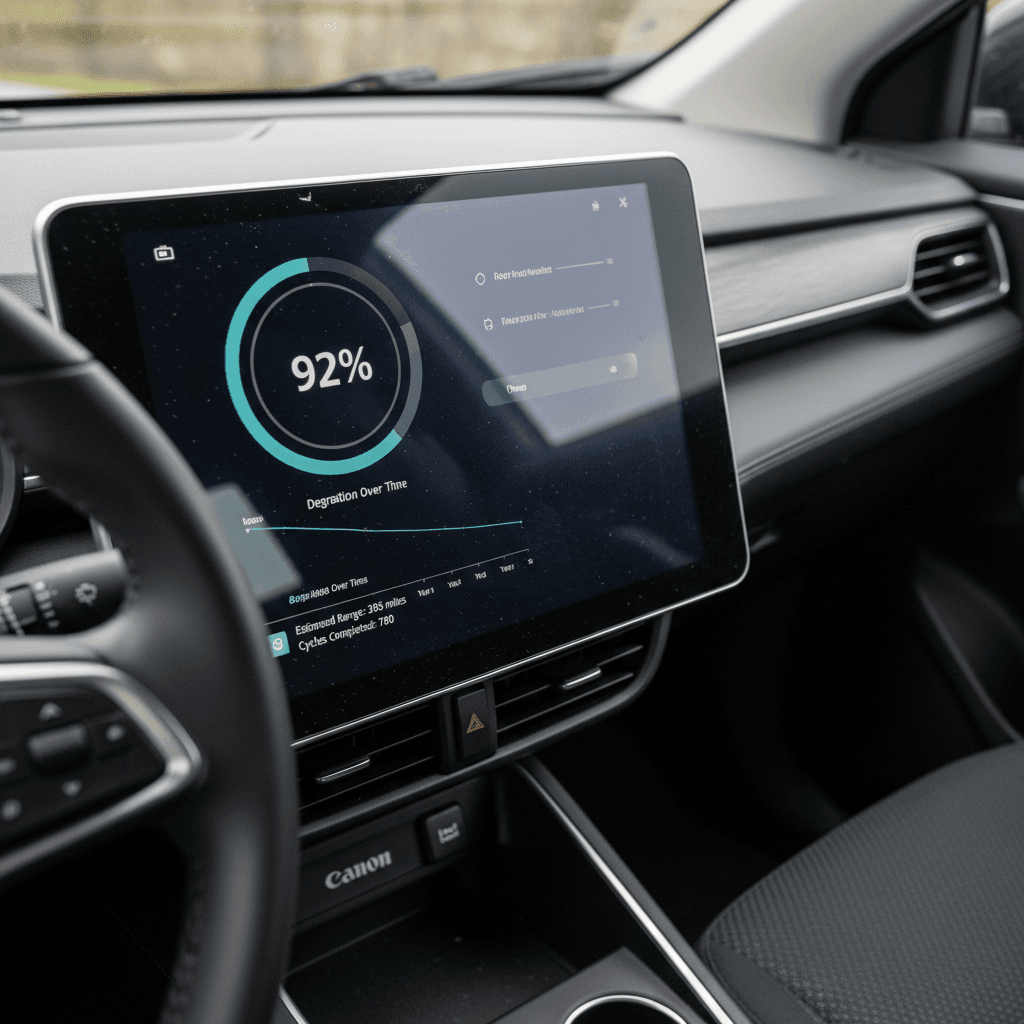
An estimated range at 100% can be misleading. Software updates, driving style, climate, and recent trips all skew the reading. Treat it as a sanity check, not your only data point.
4. Verify the car is fully updated and calibrated
For some models, running the pack from high to low once and letting it sleep can improve BMS calibration. Make sure any recent battery test followed OEM or tool instructions.
5. Cross‑check with warranty status
Look up the <strong>battery warranty terms</strong> by VIN and model year. If SoH is already near the warranty floor, factor that into both price and risk tolerance.
6. Document everything
If you move forward, keep copies of all battery health reports with the purchase paperwork. They help with resale later and protect you if an issue surfaces under warranty.
Range translation: what battery health means in miles
Most buyers don’t wake up thinking in percentages, they think in miles. Here’s how common SoH levels translate into usable range on a car that was rated for 250 miles new.
From battery health percentage to estimated range
Approximate real‑world range at different SoH levels for a 250‑mile‑new EV, assuming similar driving and conditions.
| Battery SoH | Approx. usable range now | Who this usually works for |
|---|---|---|
| 95–100% | 235–250 miles | Almost any driver; feels like a new EV |
| 90% | ~225 miles | Most commuters and road‑trippers |
| 85% | ~210 miles | Daily drivers who take occasional trips |
| 80% | ~200 miles | Short‑to‑moderate commuters; some trip planning needed |
| 75% | ~185 miles | Urban or suburban use; frequent top‑ups on trips |
| 70% | ~175 miles | Best for city driving or as a second car |
These are ballpark estimates; weather, speed, and driving style still matter.
Match SoH to your real use case
Red flags to watch for when shopping used
Most used EVs on the market today have healthy batteries, but there are patterns that should make you slow down or renegotiate.
- Seller refuses to provide any battery health report or claims they “can’t access that information.”
- Reported SoH is far below model‑typical averages for its age and mileage.
- Battery SoH is near or below the OEM warranty threshold but the warranty has already expired.
- History of extreme heat usage (e.g., prior life in very hot climates) combined with heavy DC fast‑charging.
- Multiple rapid drops in displayed range over a short ownership window, suggesting an underlying issue.
Walk‑away scenario
How Recharged evaluates battery health on used EVs
Because battery condition is the single biggest variable in used‑EV value, Recharged bakes it into the buying process instead of treating it as an afterthought. Every vehicle listed on Recharged comes with a Recharged Score Report that includes independent battery health diagnostics, fair‑market pricing, and context on how that specific pack compares with typical degradation for its age and model.
What you get with a Recharged Score
Battery transparency, priced into the deal.
Verified battery SoH
Fair market pricing
Support from EV specialists
Ready to find your next EV?
Browse VehiclesFAQ: battery health on used EVs
Frequently asked questions about used EV battery health
Bottom line: what’s “good enough” battery health?
If you remember one thing, make it this: on a typical modern used EV, anything in the high‑80s or above is solid battery health, especially once the car is more than a few years old. Mid‑80s can still be a smart buy if the price and your driving pattern line up. Once you drop into the 70s, you’re trading away flexibility and resale value and should either negotiate hard or keep looking.
Instead of chasing a perfect percentage, focus on fit and transparency: does the car’s battery health, age, and range match how you actually drive, and can the seller prove it with a credible report? With tools like the Recharged Score Report, expert EV‑specialist support, and options for financing, trade‑in, and nationwide delivery, you can shop the used EV market knowing the most important component, the battery, isn’t a question mark.