If you’re considering a VW ID Buzz, or eyeing a used one, the big question isn’t just how charming it looks. You want to know how fast it actually charges on a road trip, and what living with it is like day to day. In this VW ID Buzz charging speed test guide, we’ll translate the marketing claims into real-world charge times, costs, and strategies you can actually use.
Why charging speed matters more on a van
VW ID Buzz charging basics: battery, ports, and power
VW ID Buzz key charging specs (North America & EU)
Under the floor, the ID Buzz uses the familiar MEB battery pack. Early European ID. Buzz Pro vans shipped with a 77 kWh usable / 82 kWh gross pack and a maximum DC rating around 170–175 kW. Later North American and Canadian materials quote a larger ~91 kWh pack and a 200 kW DC acceptance rate, but on the ground you’ll still see very similar **10–80% times in the high‑20‑minute range** when everything is going right.
On AC, every ID Buzz currently supports **11 kW Level 2 charging**. In practical terms, that’s a full recharge in about 7.5–9 hours from empty to full, depending on pack size and real‑world efficiency. At American home voltages, **a 40–48 A Level 2 wallbox is all you’ll ever need** for overnight charging.
Where the charge port is
Lab specs vs. real-world VW ID Buzz charging speed tests
Carmakers talk about peak kW because it sounds impressive. What you actually feel on the road is the **whole charging session**: how long it takes to go from your arrival state of charge (SoC) to the target SoC you need to keep moving. Let’s unpack what we know from both official specs and independent VW ID Buzz charging speed tests.
Factory claims vs independent charging tests
How the ID Buzz behaves on a real DC fast charger
What Volkswagen claims
- Early ID. Buzz Pro: up to 170–175 kW DC fast charging and about 30 minutes from 5–80% under ideal conditions.
- 2025 ID. Buzz marketing in North America: up to 200 kW DC and 10–80% in roughly 26 minutes when using a high‑power DC fast charger.
- 11 kW AC home charging for an overnight 0–100% refill.
What real tests are seeing
- Independent charging-curve analysis reports a **peak of around 130–135 kW** on some European ID. Buzz Pro models, with an **average of ~109 kW from 10–80%** and about **30 minutes** for that window.
- North American tests of 2025 vans have seen the van **jump quickly to ~150–200 kW** on a compatible DC station, adding roughly **10–80% in the mid‑20‑minute range** when the battery is warm and preconditioned.
If you average the data instead of chasing the highest kW number, the story is straightforward: **plan on about 25–30 minutes for a fast, comfortable 10–80% charging stop** on a high‑power DC fast charger when conditions are in your favor. That’s in line with other large, three‑row EVs, and quicker than older CCS vans that top out around 100–125 kW.
Cold batteries charge slower
DC fast charging curve: where the ID Buzz is quickest
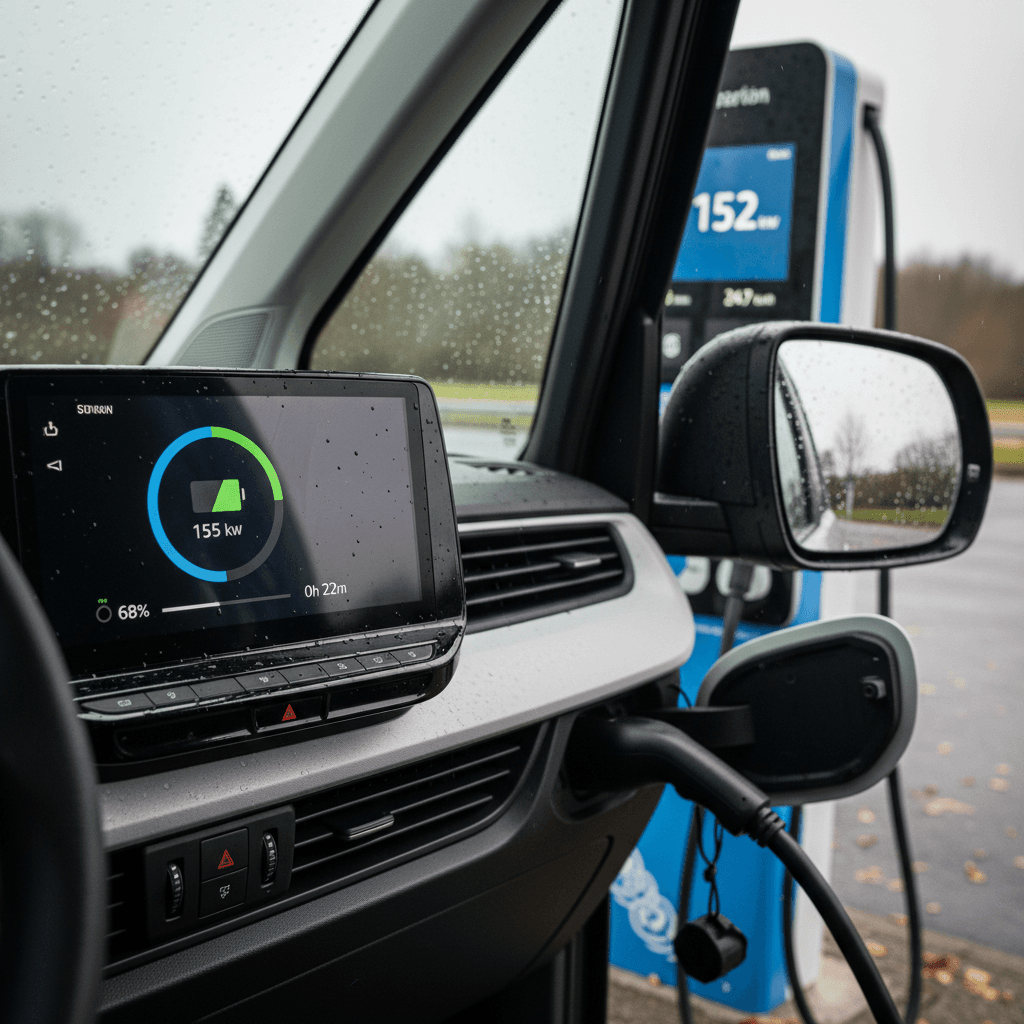
Like every modern EV, the VW ID Buzz follows a charging curve: power ramps up at low state of charge, holds a plateau for as long as the battery can accept it, and then gradually tapers down as SoC rises. Understanding that shape is the key to faster road trips.
Simplified VW ID Buzz DC fast charging behavior
Approximate real‑world DC fast charging curve for a warm battery on a high‑power charger.
| State of charge (SoC) | Typical power | What you should do |
|---|---|---|
| 5–10% | Ramp up from ~80 kW toward peak | Arrive in this window on long trips for the fastest average speed. |
| 10–40% | Near peak: roughly 130–200 kW depending on charger and trim | This is the sweet spot: you’re adding range very quickly per minute spent stopped. |
| 40–60% | Taper begins: roughly 120–160 kW | Still efficient. Fine to keep charging if the next stop is far away. |
| 60–80% | Taper continues: roughly 80–130 kW | Good time to unplug once you have the range you need; beyond ~70–75% you’re paying more time for fewer miles. |
| 80–100% | Steep taper: often below 60–70 kW and dropping | Avoid DC charging this high unless you absolutely need the range or can’t charge at your destination. |
These figures are generalized from published charging-curve data and road tests; exact numbers vary by charger, temperature, and model year.
Practical rule of thumb
- On a 200 kW DC charger, a well‑conditioned ID Buzz battery can go from roughly 10–60% in about 15–18 minutes.
- Going from 10–80% usually lands in the **26–30 minute** range when the pack and charger are cooperating.
- Pushing beyond 80% can easily add another 15–20 minutes for the last 20%, often not worth it unless the next charger is truly far away.
Building a road-trip charging strategy for the ID Buzz
A three‑row electric van invites road trips. But it’s also shaped like one, and that extra frontal area shows up as higher consumption at highway speeds. The good news is that the ID Buzz’s charging performance is strong enough to make long drives workable if you plan around the charging curve.
VW ID Buzz DC fast charging game plan
1. Target 100–150 miles between stops
At U.S. highway speeds, an ID Buzz loaded with people and luggage often lands around 2.3–3.0 mi/kWh. With an 80% usable window, that makes 100–150 miles a comfortable distance between 10–60% or 10–70% stops.
2. Arrive low, leave before 80%
Plan legs so you arrive near 10–20% and depart around 60–75%. That keeps you in the fastest part of the charging curve and avoids the steep slowdown above 80%.
3. Use built-in route planning with preconditioning
Newer software adds **battery preconditioning** when you set a DC fast charger as the destination in the native navigation. That warms the pack before you arrive, improving initial charge speed and shaving a few minutes off winter stops.
4. Stack stops with meals and errands
You’ll hit that 25–30 minute 10–80% window easily just by using the restroom, grabbing food, and stretching. Treat DC charging as a built‑in break and it becomes much less disruptive.
5. Prefer high-power sites with multiple stalls
A big van takes up space and uses a lot of power. When you can, pick **150+ kW sites with 4+ stalls**, which tend to have better reliability and less chance of someone else’s car throttling your session.
6. Have a backup charger in the plan
Especially on less‑traveled routes, always have a second station within range. Networks still have hiccups; your range buffer is your insurance.
Pro move: think in minutes, not miles
Home charging times and hardware options
DC fast charging gets all the headlines, but **home charging is where you’ll put most of your energy into the pack**. The ID Buzz is straightforward here: an 11 kW onboard charger and a battery in the high‑70s to low‑90s kWh range.
Approximate VW ID Buzz home charging times
How long it takes to recharge an ID Buzz at home from a low state of charge under typical conditions.
| Charging level | Typical power | Approx. 10–80% time | Use case |
|---|---|---|---|
| Level 1 (120 V, 12 A) | ~1.3 kW | 30–40 hours | Emergency or very light use only; fine if you drive just a few miles per day. |
| Level 2 (240 V, 32 A) | ~7.7 kW | 8–10 hours | Good baseline for many homes, especially if your daily driving is under 80–100 miles. |
| Level 2 (240 V, 40–48 A) | 9.6–11.5 kW | 6–8 hours | Best experience for an ID Buzz; essentially recovers a full day of driving overnight. |
Times are rounded estimates; real results depend on pack size, efficiency, and how low you run the battery before plugging in.
Don’t DIY a high-amp circuit
If you buy a used ID Buzz through Recharged, our team can walk you through **matching a home charger to your panel capacity and daily driving needs**, and connect you with installers who understand high‑draw EV loads. The goal is simple: plug in at night, wake up to a full van every morning with zero drama.
Charging costs: ID Buzz vs. a gas minivan
Speed is one axis; cost is another. To put the ID Buzz’s charging performance into context, it’s worth looking at how much you’re actually paying per mile compared with a traditional family van.
Home charging: the sweet spot
At U.S. residential electricity rates around $0.13–$0.18 per kWh, an ID Buzz averaging roughly 2.5–3.0 mi/kWh costs on the order of $0.05–$0.07 per mile.
That’s similar to driving a 30+ mpg hybrid on ~$3 gas, and noticeably cheaper than a typical gas minivan in the low‑20‑mpg range.
DC fast charging on the road
DC fast charging is more expensive, but you’re paying for speed and infrastructure. On big networks, per‑kWh pricing often lands in the $0.35–$0.55 per kWh range.
Even at $0.40/kWh and 2.7 mi/kWh, the Buzz comes in around $0.15 per mile, roughly comparable to a 20 mpg minivan on $3 gas, except you’re also avoiding oil changes and many ICE maintenance costs.
Included charging plans help
Does fast charging hurt ID Buzz battery health?
Every EV owner eventually asks the same question: “If I keep using DC fast charging, am I cooking the battery?” With the ID Buzz, the answer is nuanced: **occasional fast charging is built into the design**, but your habits still matter.
- The pack is liquid‑cooled and managed by software that guards cell temperatures and taper behavior automatically.
- VW’s own documentation warns that *frequent, consecutive* DC fast charges can accelerate long‑term capacity loss, this is true for every modern EV.
- Light commercial users (rideshare, delivery, fleet) who hammer DC fast chargers every day will see more degradation than a family using DC mostly for road trips.
Battery‑friendly charging habits
If you’re considering a **used ID Buzz**, the biggest unknown is how the previous owner treated the battery. That’s exactly why Recharged includes a **Recharged Score battery health report** with every vehicle, using diagnostics to estimate real usable capacity and highlight any abnormal wear before you buy.
Using Electrify America and Tesla Superchargers with the ID Buzz
In the U.S., your ID Buzz will mostly sip DC electrons from **Electrify America** and other CCS networks. But thanks to the ongoing shift toward the North American Charging Standard (NACS), Volkswagen owners are also gaining access to Tesla’s Supercharger network with an adapter.
Where you’ll fast charge a VW ID Buzz in North America
CCS today, NACS adapter access rolling out
Electrify America
The default road‑trip partner for new ID Buzz owners. Many trims include a **charging plan with EA credits** and a discounted Pass+ membership, which can shave roughly a quarter off normal posted pricing for several years.
Other CCS networks
ChargePoint, EVgo, FLO, and regional networks all support CCS. The ID Buzz works with these like any other CCS EV; just make sure you have the right app or RFID card set up before a big trip.
Tesla Superchargers (with adapter)
Volkswagen has committed to giving ID Buzz owners **Supercharger access via a NACS adapter**. For many 2025‑era models, the adapter is a paid accessory, and some vehicles need a software update for full support. Over time, new VWs will move to a native NACS port.
Check adapter and software requirements
VW ID Buzz charging speed test: FAQ
Frequently asked questions about VW ID Buzz charging
Key takeaways for used ID Buzz shoppers
When you strip away the marketing numbers and look at real VW ID Buzz charging speed tests, the pattern is clear: this is a **solid, road‑trip‑capable electric van** with DC fast charging that comfortably matches its mission. You’re looking at roughly 25–30 minutes for a 10–80% charge on a good station, with home charging easily covering daily driving if you invest in a sensible Level 2 setup.
If you’re evaluating a **used ID Buzz**, focus on three things: how the previous owner charged it, how much real‑world range it still delivers, and how its charging habits fit your lifestyle. That’s exactly what a Recharged Score battery health report is built to surface, paired with transparent pricing, financing options, and trade‑in support so you can upgrade out of your gas van without guesswork. A charming EV is great; a charming EV that charges the way you expect on day 1 and day 1,001 is even better.