If you’re looking at a luxury EV like the Genesis GV60, you’re probably wondering one simple thing: how much does it cost per mile to drive? The sticker price is obvious; the day‑to‑day electricity cost is not. In this guide we’ll translate efficiency ratings and electricity prices into clear cents‑per‑mile numbers you can actually budget around.
Quick context
Genesis GV60 cost per mile: the short answer
Typical Genesis GV60 cost per mile (2026)
For most U.S. drivers in 2026, a Genesis GV60 costs roughly 5–7 cents per mile to drive when you charge primarily at home, and around 9–14 cents per mile when you rely heavily on public DC fast chargers. That’s the high‑level answer. Next, we’ll show you exactly how we get there so you can plug in your own electricity rate, or your own efficiency numbers from the car’s trip computer, and get a personalized figure.
How efficient is the Genesis GV60?
Every U.S.‑market Genesis GV60 uses a 77.4‑kWh battery pack on Hyundai Motor Group’s E‑GMP platform. Depending on trim and wheels, EPA‑rated range falls in the 235–294‑mile window, with most dual‑motor models clustered in the mid‑200s. In practical terms, that means you’re generally looking at about 3.0–3.5 miles per kWh in normal mixed driving, with careful drivers in mild weather sometimes doing a bit better and winter highway trips doing a bit worse.
- Standard/Advanced dual‑motor trims typically see around 3.2–3.5 mi/kWh in moderate weather.
- Performance‑oriented trims and constant high‑speed driving tend to land closer to 2.7–3.1 mi/kWh.
- Owners in online forums routinely report summer efficiency above 4.0 mi/kWh on gentle suburban routes, and closer to 2.5–3.0 mi/kWh in cold‑weather highway use.
How to find YOUR GV60 efficiency
What electricity price should you use?
Electricity rates vary dramatically by state and even by utility, but we need a working number. Federal data through late 2024 and early 2025 show U.S. average residential electricity around 16–17¢/kWh, with many states already higher in 2026. For easy math, and to reflect continued increases, we’ll use 18¢/kWh as a reasonable 2026 national average home rate. If yours is different, just swap it into the formulas below.
Sample residential electricity prices (2026)
These ballpark figures show why your GV60 cost per mile might be lower in some regions and higher in others.
| Location example | Approx. rate (¢/kWh) | Impact on GV60 cost per mile |
|---|---|---|
| Low‑cost states (parts of Midwest/South) | 12–14 | Excellent: many drivers land near 4–5¢/mile. |
| Average‑cost states (large parts of U.S.) | 16–18 | Typical: expect 5–7¢/mile at home. |
| High‑cost states (e.g., CA, Northeast) | 22–28+ | Higher: common to see 7–10¢/mile at home. |
Always check your own bill; even neighbors can pay different rates.
Don’t forget fees and taxes
GV60 cost per mile in real‑world scenarios
Let’s turn those efficiency and electricity numbers into real cost‑per‑mile estimates. We’ll walk through three common scenarios using simple math you can tweak yourself.
Three common cost‑per‑mile scenarios for a Genesis GV60
Adjust the electricity rate and efficiency to mirror your own driving.
1. Typical U.S. home charging
Assumptions
- Home electricity: 18¢/kWh
- Real‑world efficiency: 3.2 mi/kWh (mixed driving)
Math
Cost per mile = 18¢ ÷ 3.2 ≈ 5.6¢/mile
2. Efficient driver, good weather
Assumptions
- Home electricity: 18¢/kWh
- Real‑world efficiency: 3.8 mi/kWh (careful driving, mild temps)
Math
Cost per mile = 18¢ ÷ 3.8 ≈ 4.7¢/mile
3. Winter highway & fast charging
Assumptions
- Public DC fast charging: 40–45¢/kWh (common range today)
- Real‑world efficiency: 2.7 mi/kWh (cold temps, 70–75 mph)
Math
Cost per mile ≈ 15–17¢/mile on road trips heavy on fast charging.
If you split your time between home charging and occasional DC fast charging on trips, it’s realistic to assume an overall average around 6–8¢ per mile for a typical GV60 owner in 2026. That’s the number many shoppers find useful when they compare against their current gas vehicle.
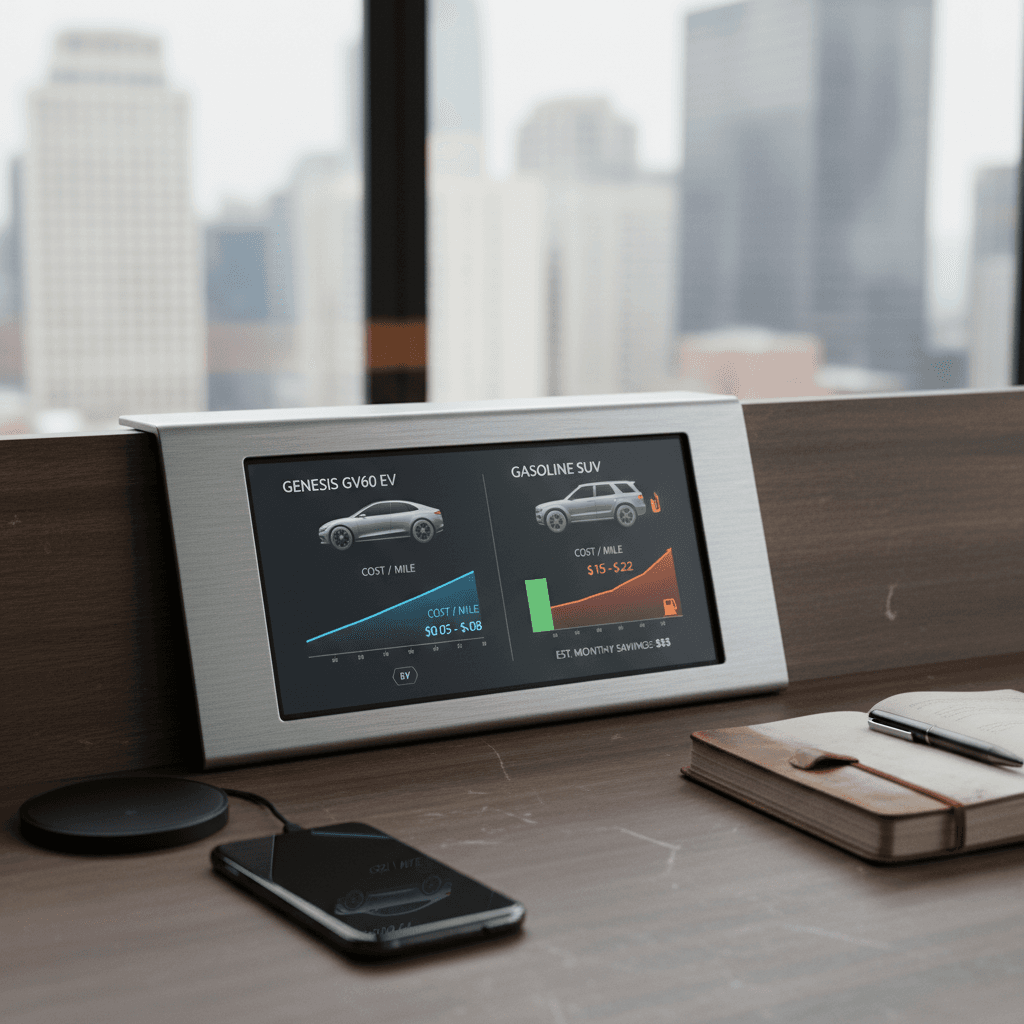
Genesis GV60 vs. gas SUV: cost per mile comparison
To understand whether the Genesis GV60 is “expensive” to drive, you have to compare it with the luxury crossovers many shoppers also consider. Think BMW X3, Mercedes‑Benz GLC, Audi Q5, or even Genesis’s own gas‑powered GV70.
Genesis GV60 vs. comparable gas SUV: fuel cost per mile
Illustrative comparison using realistic 2026 fuel and electricity prices. Your local numbers may differ, but the pattern is similar.
| Vehicle | Assumed efficiency | Energy price | Energy used per mile | Approx. cost per mile |
|---|---|---|---|---|
| Genesis GV60 (home charging, typical) | 3.2 mi/kWh | 18¢/kWh | 0.31 kWh | ≈ 5.6¢/mile |
| Genesis GV60 (fast charging heavy use) | 2.7 mi/kWh | 43¢/kWh | 0.37 kWh | ≈ 16¢/mile |
| Gas luxury SUV (premium fuel) | 24 mpg combined | $4.25/gal | 0.042 gal | ≈ 17.7¢/mile |
| Gas luxury SUV (city heavy driving) | 19 mpg city | $4.25/gal | 0.053 gal | ≈ 22.4¢/mile |
Gas SUVs still can’t touch a well‑driven EV on per‑mile energy cost, especially if you charge at home.
What this means for you
Six factors that change your GV60 cost per mile
What really moves the needle on GV60 cost per mile
Some factors you can’t control. Others you absolutely can.
1. Climate & HVAC use
2. Speed & driving style
3. Home vs. public charging
4. Time‑of‑use (TOU) plans
5. Battery & tire condition
6. Trip mix: city vs. highway
Hidden budget killer: habitually fast charging
How to lower your Genesis GV60 cost per mile
Practical ways to keep your GV60 cheap to drive
1. Enroll in a cheaper overnight rate, if available
Call or log into your utility account and look for time‑of‑use or EV‑specific plans. If you can drop from 24¢ to 14¢/kWh overnight, your cost per mile could fall from roughly 7.5¢ to 4.3¢ with the same driving habits.
2. Schedule charging for off‑peak hours
Use the GV60’s built‑in charge scheduling or your home charger’s app to start charging late at night. That way you automatically take advantage of lower rates without having to remember to plug in at specific times.
3. Drive smoothly and use regen wisely
In an EV, every unnecessary burst of acceleration is energy you’ll never get back. Stick to Eco or Normal mode for commuting, keep freeway speeds reasonable, and lean on strong regen settings in stop‑and‑go traffic.
4. Keep tires inflated and EV‑appropriate
Check tire pressures monthly and consider low‑rolling‑resistance tires when it’s time to replace the originals. Under‑inflated or aggressive tires can easily cost you 0.2–0.3 mi/kWh, which adds up over thousands of miles.
5. Pre‑condition while plugged in
On hot or cold days, pre‑heat or pre‑cool the cabin while the GV60 is still connected to the charger. That energy comes from the grid instead of the battery, leaving more usable range, and better efficiency, once you start driving.
6. Plan trips around reliable charging
On road trips, use EV‑specific route planners to chain together efficient, reasonably priced fast chargers. Stopping at the most expensive stations out of desperation is a quick way to raise your cost per mile.
Where used GV60s fit in, and how Recharged helps
The per‑mile electricity cost of a 2‑year‑old Genesis GV60 is essentially the same as a new one, what matters more is battery health and how previous owners treated the car. That’s where a transparent used‑EV process matters just as much as knowing your local electricity rate.
Why battery health matters for cost per mile
As an EV ages, usable battery capacity can decline slightly. That doesn’t usually change your efficiency in mi/kWh, but it does change how often you have to charge and how much buffer you have on road trips. A pack that’s been fast‑charged hard its whole life may be less convenient, and potentially less efficient in extreme conditions, than one that’s been pampered with mostly home charging.
How Recharged supports GV60 shoppers
Every EV listed on Recharged includes a Recharged Score Report with verified battery diagnostics, fair‑market pricing, and expert guidance. If you’re comparing a used GV60 to other luxury EVs, that report helps you understand not just today’s range, but how confident you can be in its long‑term running costs.
From instant offers and trade‑ins to EV‑savvy financing and nationwide delivery, Recharged is built to make used EV ownership, GV60 included, as simple and transparent as possible.
Genesis GV60 cost per mile: FAQ
Frequently asked questions about GV60 cost per mile
Bottom line: what you should budget per mile
When you cut through the alphabet soup of kWh, MPGe, and utility tariffs, the story is straightforward: a Genesis GV60 is usually a very inexpensive vehicle to drive per mile, especially if you can charge at home on a competitive electricity rate. Plan on roughly 5–7¢/mile in typical mixed driving with mostly home charging, and 7–10¢/mile if you lean more on public fast chargers.
The key levers are the ones you control, where you charge, when you charge, how you drive, and the condition of the car you buy. Get those right, and a GV60 can undercut a comparable gas SUV’s fuel cost by 40–60% mile after mile. If you’re exploring used GV60s or other EVs, a transparent battery‑health report and fair pricing, like you’ll find with the Recharged Score, turn those cents‑per‑mile estimates into real‑world savings you can count on.