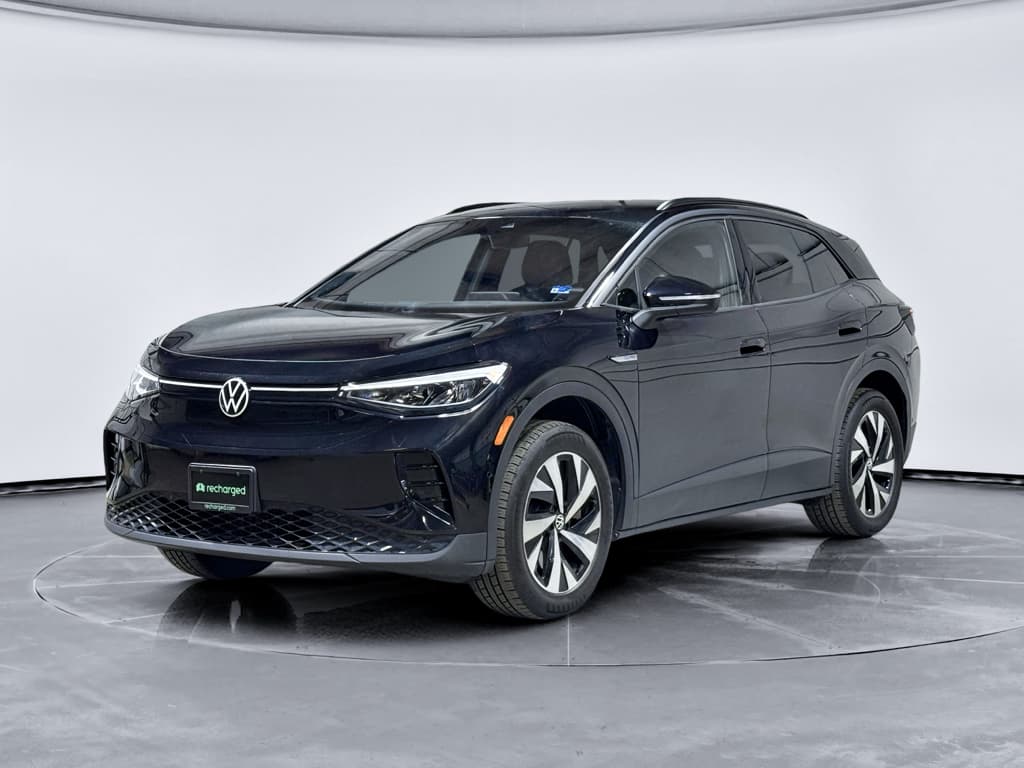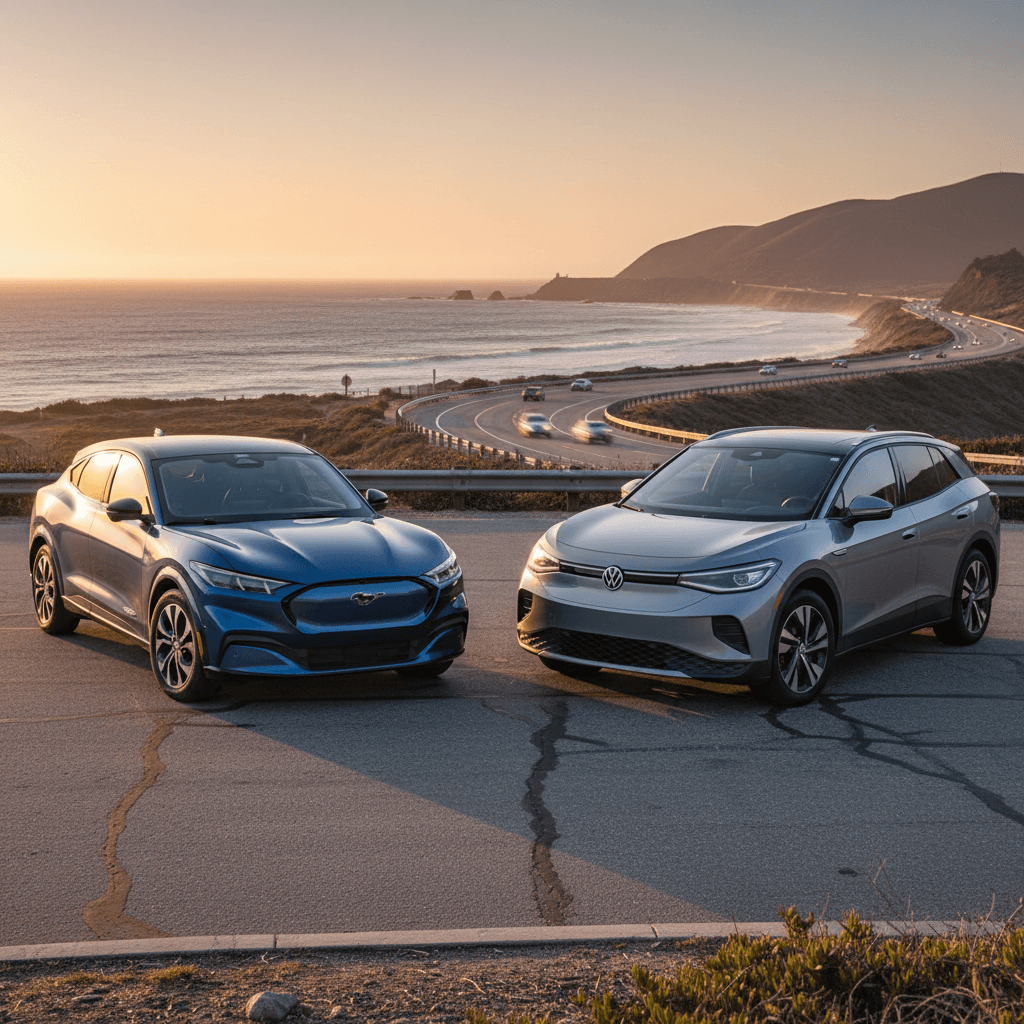
You could hardly script two more different takes on the electric family SUV. The Ford Mustang Mach‑E shows up in skinny jeans and a leather jacket, all fastback attitude and instant torque. The Volkswagen ID.4 arrives in a sensible sweater with reusable grocery bags in the back. If you’re torn between the two, this Ford Mustang Mach‑E vs VW ID.4 guide will walk you through how they really compare in the U.S. market, especially if you’re shopping used.
Model years this comparison focuses on
Ford Mustang Mach-E vs VW ID.4: quick take
Ford Mustang Mach‑E: the extrovert
- Stronger performance: even lower trims feel punchy; GT models are genuinely quick.
- Sharpened handling: firmer, more engaging drive than most compact SUVs.
- Range: up to around 320 miles in newer extended‑range RWD versions.
- Interior: Airy, modern cabin with big center screen; some cheaper-feeling plastics.
- Best for: Drivers who care about acceleration and style as much as practicality.
Volkswagen ID.4: the rational choice
- Comfort first: soft ride, relaxed steering, easygoing demeanor.
- Usability: big cargo hold, roomy back seat, straightforward crossover shape.
- Range: up to the mid‑200s of miles for 82 kWh battery trims; efficiency is solid.
- Interior: Calmer design, but early infotainment and touch controls can frustrate.
- Best for: Families and commuters who want a quiet, practical EV that fades into the background.
Short answer
Ready to find your next EV?
Browse VehiclesKey specs: Mustang Mach-E vs ID.4
Core specs comparison (typical U.S. trims)
Representative specifications for popular 2023–2025 trims. Exact numbers vary by model year and configuration, but this gives you the lay of the land.
| Mustang Mach‑E (RWD extended-range) | Mustang Mach‑E GT (AWD) | VW ID.4 Pro (RWD, 82 kWh) | VW ID.4 AWD Pro | |
|---|---|---|---|---|
| Estimated horsepower | ~290–310 hp | Up to ~480 hp | ~280 hp (82 kWh) | ~335 hp |
| 0–60 mph (approx.) | Mid‑5 to ~6.0 seconds | Low‑3s to mid‑3s | ~6–7 seconds | High‑5s |
| Battery (usable) | ~91 kWh (extended) | ~91 kWh | ~77–79 kWh (82 kWh pack) | ~77–79 kWh |
| EPA range (best trims) | Up to ~320 miles RWD | ~260–280 miles | Up to ~291 miles RWD | ~260–270 miles |
| DC fast‑charge peak | Up to ~150 kW | Up to ~150 kW | Up to ~175 kW (82 kWh) | Up to ~175 kW (82 kWh) |
| Onboard AC charger | Up to 11 kW | Up to 11 kW | 11 kW | 11 kW |
| Seats | 5 | 5 | 5 | 5 |
| Max cargo (rear seats down) | Around high‑50 cu ft | Around high‑50 cu ft | Low‑to‑mid‑60 cu ft | Low‑to‑mid‑60 cu ft |
For shopping, focus less on tiny spec differences and more on range, charging speed, and how the car fits your life.
How to read these specs
Performance & driving feel
The philosophical split is obvious the first time you lean into the accelerator. The Mustang Mach‑E, even in its more sensible Select or Premium trims, feels eager. There’s a coiled‑spring quality to the power delivery, instant thrust, taut body control, a bit of that Mustang swagger translated into crossover form. GT and Rally versions simply add ferocity; these are legitimately fast cars by any historic Mustang standard.
The Volkswagen ID.4, by contrast, is tuned for serenity. Steering is lighter, body motions are softer, and the whole car seems to exhale and tell you to relax. Acceleration in the 62 kWh and 82 kWh RWD trims is perfectly adequate for merging and passing, but there’s none of the drama you get in the Mach‑E. AWD Pro trims add useful shove, yet the ID.4 still feels more like an electric Tiguan than a hot hatch.
How they feel from behind the wheel
Same segment, very different personalities.
Mustang Mach‑E
- Throttle response: Immediate and strong, especially in Unbridled/ sportier modes.
- Ride & handling: Firmer, more controlled; some road harshness on larger wheels.
- Noise: Quiet overall, with a bit more road and wind noise than the VW on some surfaces.
- Fun factor: High. Feels like a performance‑oriented crossover, even in mid trims.
Volkswagen ID.4
- Throttle response: Smooth and progressive, less neck‑snapping off the line.
- Ride & handling: Softer and more compliant; soaks up bad pavement better.
- Noise: Very hushed at city speeds; highway wind noise is modest and unobtrusive.
- Fun factor: Low‑key. Relaxing to drive, but not something you’ll take the long way home to enjoy.
Performance verdict
Range, battery & real-world efficiency
On paper, the Ford and the Volkswagen trade punches. Extended‑range Mach‑E RWD trims reach up to about 320 miles of EPA‑rated range. The ID.4 Pro with the larger 82 kWh pack tops out around the high‑200s to just under 300 miles, depending on wheels and drive layout. In AWD form, both drop into roughly the 250–270‑mile band.
Range & efficiency snapshot
In the real world, the ID.4 tends to be a bit more relaxed at highway speeds, which helps efficiency. The Mach‑E, with its performance bias and often stickier tires, can encourage you to drive in ways that are… let’s say, not EPA‑cycle‑friendly. But if you drive both reasonably, you’ll find the usable range band surprisingly similar. For most U.S. families, either will cover a week of commuting on a single charge and handle road‑trip legs with one well‑placed DC fast‑charge stop.
Used EV reality check
Charging experience & road-tripping
On hardware, these two are close. Recent Mach‑E models support DC fast charging up to around 150 kW; the ID.4 with the 82 kWh pack can peak closer to 170–175 kW. In practice, both tend to do the 10–80% dance in roughly 30 minutes when the pack is warm and the charger is delivering what it promises.
Home charging vs public charging
Think about where you’ll really plug in most of the time.
At home
- Both support 11 kW Level 2 AC charging when wired to a 240V circuit.
- Expect ~25–35 miles of added range per hour, depending on trim and conditions.
- If you own your home, a dedicated Level 2 charger is the best quality‑of‑life upgrade you can buy.
If you’re not sure what you need, start with an EV home charging explainer and talk to a qualified electrician.
On the road
- Both use CCS fast charging on today’s public networks.
- Look for 150 kW+ stations for the best road‑trip experience.
- Ford and VW have both begun integrating access to Tesla’s Supercharger network via adapters and software updates; support will improve through 2026.
Plan ahead with apps like PlugShare, A Better Routeplanner, and the built‑in nav systems.
Road-trip rule of thumb
Space, comfort & practicality
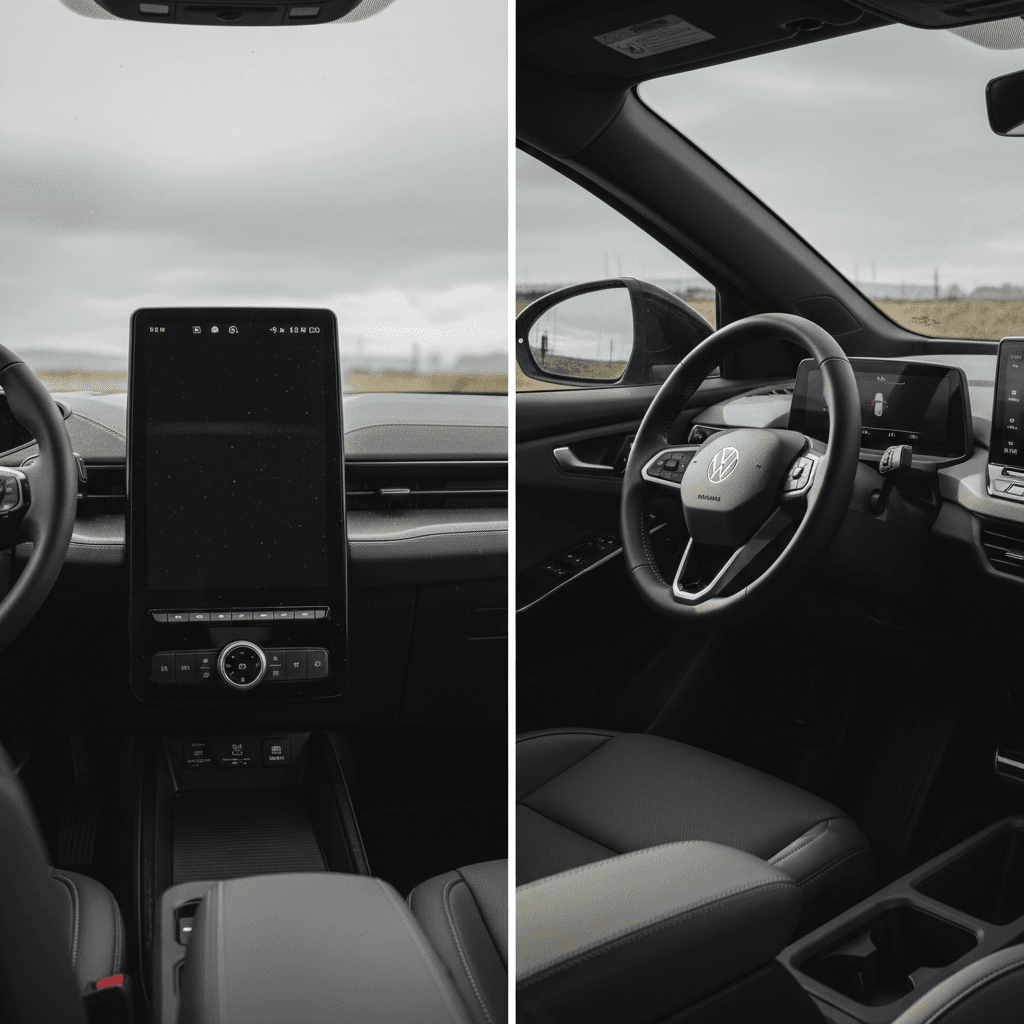
The VW ID.4 is the more straightforward family tool. With its conventional SUV roofline, generous rear legroom, and a cargo area stretching into the low‑to‑mid‑60‑cubic‑foot range with seats folded, it’s simply easier to live with if you haul strollers, dogs, or the week’s Costco spoils. The back doors open wide, and the flat floor makes it easy for kids to clamber in and out.
The Mustang Mach‑E isn’t cramped, but it does prioritize style. The sloping roof and sporty stance nibble away at rear headroom and cargo flexibility. You still get a useful hatch and a handy front trunk, but if you regularly treat your EV like a rolling minivan, the Ford makes you work a bit harder at Tetris. In compensation, you get a more dramatic cabin design and a driving position that feels less like a crossover and more like a tall car.
Family-friendliness checklist
Car seats & kids
ID.4 has slightly easier access and more rear headroom for bulky child seats. Both offer ISOFIX/LATCH anchors and reasonably flat rear benches.
Cargo flexibility
ID.4’s boxier shape and larger cargo volume win if you routinely carry bikes, big strollers, or camping gear. Mach‑E’s frunk is handy for dirty or wet items.
Ride comfort
ID.4’s soft suspension makes potholes vanish, especially on smaller wheels. Mach‑E rides more firmly, fine for adults, but notice it if your roads are rough.
Parking & visibility
Both have good outward visibility and standard driver‑assist tech. The Mach‑E’s long hood and thick rear pillars make cameras more important in tight spaces.
In-car tech & safety recalls
Both SUVs are rolling software platforms as much as they are vehicles. That’s good, over‑the‑air updates can add range, features, or fixes, but it also means living with each brand’s idea of user interface design.
Mustang Mach‑E tech
- Dominated by a large portrait‑style center touchscreen running Ford’s SYNC software.
- Physical volume knob, but most climate and drive‑mode functions live in the screen.
- BlueCruise hands‑free highway driving is available on many trims, genuinely helpful on long trips.
- Graphics and responsiveness are generally good; learning curve is moderate.
Volkswagen ID.4 tech
- Landscape touchscreen, capacitive sliders for climate and volume on many trims.
- Early software versions were slow and occasionally buggy; later updates improved things but some owners still dislike the touch controls.
- Travel Assist offers lane‑centering and adaptive cruise but feels a bit more conservative than Ford’s setup.
- Interior lighting and ambient effects give a calm, lounge‑like atmosphere.
Recent safety recalls you should know about
Ownership costs & used-market value
Depreciation is the ghost at the EV banquet, and both of these crossovers have already done a lot of their falling by the time they show up in the used listings. That’s good news for you. Early‑build Mach‑E and ID.4 models that once stickered in the $45,000–$60,000 range are often thousands less on the used market, especially as newer competitors arrive.
Cost factors to compare
Beyond the sticker price, here’s what really matters.
Purchase price
Incentives & financing
Maintenance & repairs
Insurance costs tend to be similar when you normalize for value, though performance‑oriented Mach‑E GT and Rally trims can be pricier to insure. Both brands have large dealer networks, so warranty work and parts availability are better than for some newer EV startups. Where things diverge is long‑term confidence: Ford has been more aggressive with performance updates, while VW has focused on software polish and incremental usability tweaks.
Who should buy which?
Pick your electric SUV persona
You love driving
You care about 0–60 times and lane‑change feel more than how many grocery bags fit in the back.
You want something that doesn’t feel like every other crossover in the school pickup lane.
You’re okay with a slightly firmer ride and busier styling in exchange for character.
→ <strong>Recommendation:</strong> Focus on Mustang Mach‑E Premium and GT trims with the extended‑range battery.
You just need a calm, practical EV
Your priority list is comfort, range, and a normal SUV shape that swallows family detritus.
You don’t mind if the cabin feels a bit anonymous as long as it’s quiet and usable.
You prefer a softer ride and don’t care whether the badge says Mustang.
→ <strong>Recommendation:</strong> Look at ID.4 Pro and AWD Pro trims with the 82 kWh pack.
You’re a budget-conscious commuter
Most of your driving is local, with the occasional weekend trip under 200 miles.
You want the best value in a used EV, not the flashiest spec sheet.
You’re willing to accept a smaller battery or fewer options for the right price.
→ <strong>Recommendation:</strong> Consider standard‑range Mach‑E and ID.4 62 kWh models, but be extra careful about real‑world range and battery health. This is where the Recharged Score pays off.
You’re planning regular long road trips
You’ll be driving 300–500‑mile days several times a year.
Charging‑network reliability, route planning, and fast‑charge speeds matter a lot.
You’d like driver‑assist systems that genuinely reduce fatigue.
→ <strong>Recommendation:</strong> Extended‑range Mach‑E with BlueCruise, or ID.4 82 kWh trims paired with good CCS and (increasingly) Tesla Supercharger access.
Used Mach-E vs ID.4: buyer checklist
Pre-purchase checklist for either EV
1. Verify battery health & range
Ask for a recent battery‑health report and compare it with the original EPA range. On Recharged, every vehicle comes with a <strong>Recharged Score</strong> so you know how much usable range you’re actually buying.
2. Check DC fast-charging history
Heavy fast‑charging isn’t automatically bad, but repeated high‑power sessions in hot climates can age packs faster. Look for signs of reduced fast‑charge speeds in owner reports or during a test drive.
3. Confirm software & recall updates
For both Mach‑E and ID.4, make sure major recalls and software campaigns have been completed. Your seller or a franchised dealer can confirm this by VIN; Recharged surfaces open recalls in our listings.
4. Inspect tires and brakes
EVs are heavy and torquey. Uneven tire wear or premature brake wear can hint at alignment issues or a hard‑driven past life, especially on Mach‑E GTs.
5. Test all driver-assistance features
Engage adaptive cruise, lane‑centering, parking aids, and cameras. Glitches here can indicate software problems or sensor damage that’s annoying and sometimes expensive to sort out.
6. Live with the infotainment for 10 minutes
Sit in a parking spot and adjust climate, nav, and audio. If the control layout or response time makes you grit your teeth (looking at you, early ID.4 sliders), better to discover that before you buy.
Ford Mustang Mach-E vs VW ID.4: FAQ
Frequently asked questions
Bottom line: which EV SUV is better?
If you buy with your heart, the Ford Mustang Mach‑E is the obvious choice. It’s quicker, more expressive, and more fun to drive than the Volkswagen, especially in its extended‑range and GT flavors. It feels like a statement: "Yes, I bought the electric one, and it’s still a Mustang."
If you buy with your head, the Volkswagen ID.4 makes a quietly compelling case. It’s roomy, comfortable, and unpretentious. It does everything a compact family SUV should do while just happening to run on electrons instead of gasoline. For a lot of households, that’s exactly the point.
The good news is that on the used market, you don’t have to overpay to get either. Whether you lean toward the Mach‑E’s personality or the ID.4’s pragmatism, focus on finding a car with strong battery health, up‑to‑date software, and no outstanding safety recalls. That’s precisely what the Recharged Score and our expert team are built to surface, so you can pick the EV that fits your life, not just the spec sheet.