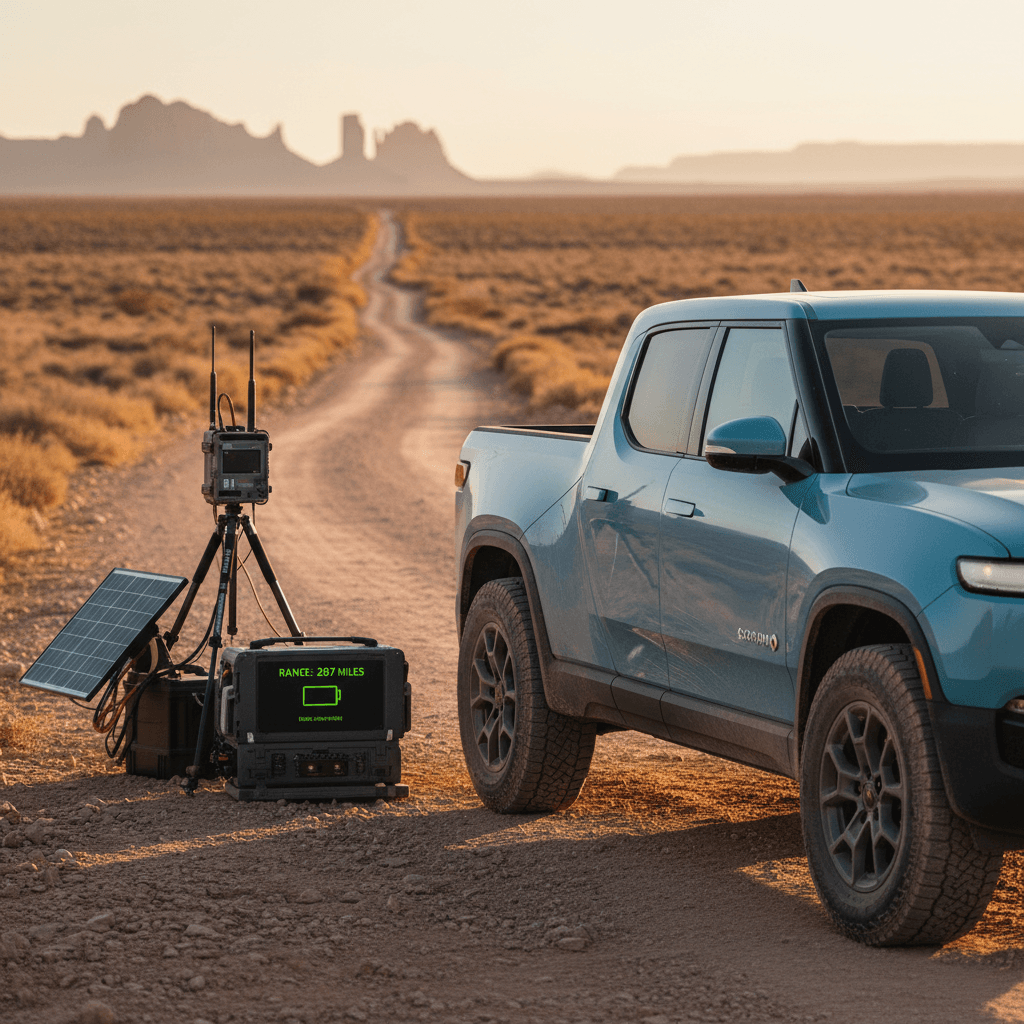
If you’re shopping a Rivian R1T in 2026, you’ve probably memorized the EPA numbers: up to **420 miles** on paper with the latest Max pack, and well under that for off‑road tires or earlier trucks. That’s the brochure story. This guide is about the **Rivian R1T real‑world range in 2026**, what owners actually see on the road, how much towing really hurts, and what changes if you buy used instead of new.
Quick takeaway
Why real-world range matters more than EPA numbers
EPA ratings are useful, but they’re a laboratory snapshot. They assume gentle acceleration, relatively low average speeds, and no bikes on the roof or trailer on the hitch. The Rivian R1T is a **tall, heavy, very quick** truck; the moment you drive it like a truck, 75 mph on I‑70, mountain passes, camping gear, maybe a trailer, the gap between EPA and real‑world range shows up fast.
- EPA numbers are based on a mixed-driving test cycle with modest average speeds.
- Real drivers in 2026 routinely cruise at 70–80 mph, especially in the western U.S.
- Accessories like roof racks, all‑terrain tires, and lift kits all eat into efficiency.
- Cold or very hot weather can easily cost you 15–30% of range before you even floor it.
Highway reality check
Rivian R1T range basics for 2023–2026 trucks
By 2026, most R1Ts on the road fall into three main battery flavors, Standard, Large, and Max, paired mostly with the Dual‑Motor or Performance Dual‑Motor drive unit. Quad‑Motor trucks are still out there, especially in earlier model years, but Rivian has leaned hard into its more efficient in‑house dual‑motor setup.
Approximate EPA-estimated ranges for Rivian R1T (U.S., through 2025)
Broad EPA-estimated range bands for common Rivian R1T configurations. Exact figures vary slightly by model year and wheel/tire choice.
| Pack & drive unit | Typical EPA rating (best-case wheels) | Notes |
|---|---|---|
| Standard pack Dual-Motor | ~270 miles | Later trucks use LFP cells; good daily driver pack with less cost. |
| Large pack Dual-Motor | ~330–352 miles | The sweet spot for many owners; often chosen for road trips. |
| Large pack Quad-Motor | ~314–328 miles | More power, a bit less efficiency than dual motor in most cases. |
| Max pack Dual/Performance Dual | ~400–410 miles (up to ~420 mi on latest trucks) | Headline range numbers with 21" efficient wheels. |
| Off-road / All-terrain setups | 10–15% less than above | 20" all‑terrain tires and lift increase drag and rolling resistance. |
Use these as a reference point, your 2026 real-world range will usually be lower, especially at higher speeds.
About 2025–2026 R1T updates
Real-world Rivian R1T range by pack, motors, and wheels
Let’s translate the alphabet soup of packs, motors, and wheels into **usable miles in 2026**, what you can reasonably expect on a dry day, moderate temps, and typical U.S. highway speeds around 70–75 mph without towing.
Typical Rivian R1T real-world highway range (2026, no towing)
How to sanity‑check your own range
City vs. highway vs. mixed driving: what you’ll actually see
Like most EVs, the Rivian R1T is **happiest in slower, smoother driving**. Regenerative braking gets a workout in town, and aero drag is lower below freeway speeds. That means you can sometimes beat the EPA number in gentle suburban use, and miss it by a mile or ten blasting across Kansas.
How the R1T behaves in different driving scenarios
Assuming a healthy battery and moderate weather in 2026
City / suburban
Best-case efficiency. Lots of stop‑and‑go lets regen work for you.
- Likely to meet or beat EPA numbers on Standard and Large packs.
- Max pack trucks can feel like they run forever in town.
- Short trips in winter can still hurt if the pack never warms fully.
Mixed commute
Closest to EPA tests. Some city, some highway.
- Expect roughly 75–95% of EPA in 50–60 mph mixed driving.
- Roof racks and big tires shave another 5–10% off.
Pure highway
Where expectations break. Drag and elevation changes add up fast.
- 70–80 mph freeway often lands at 60–80% of EPA.
- Headwinds, rain, and grades can pull you even lower.
When the R1T beats its sticker
Towing and hauling: how fast range really drops
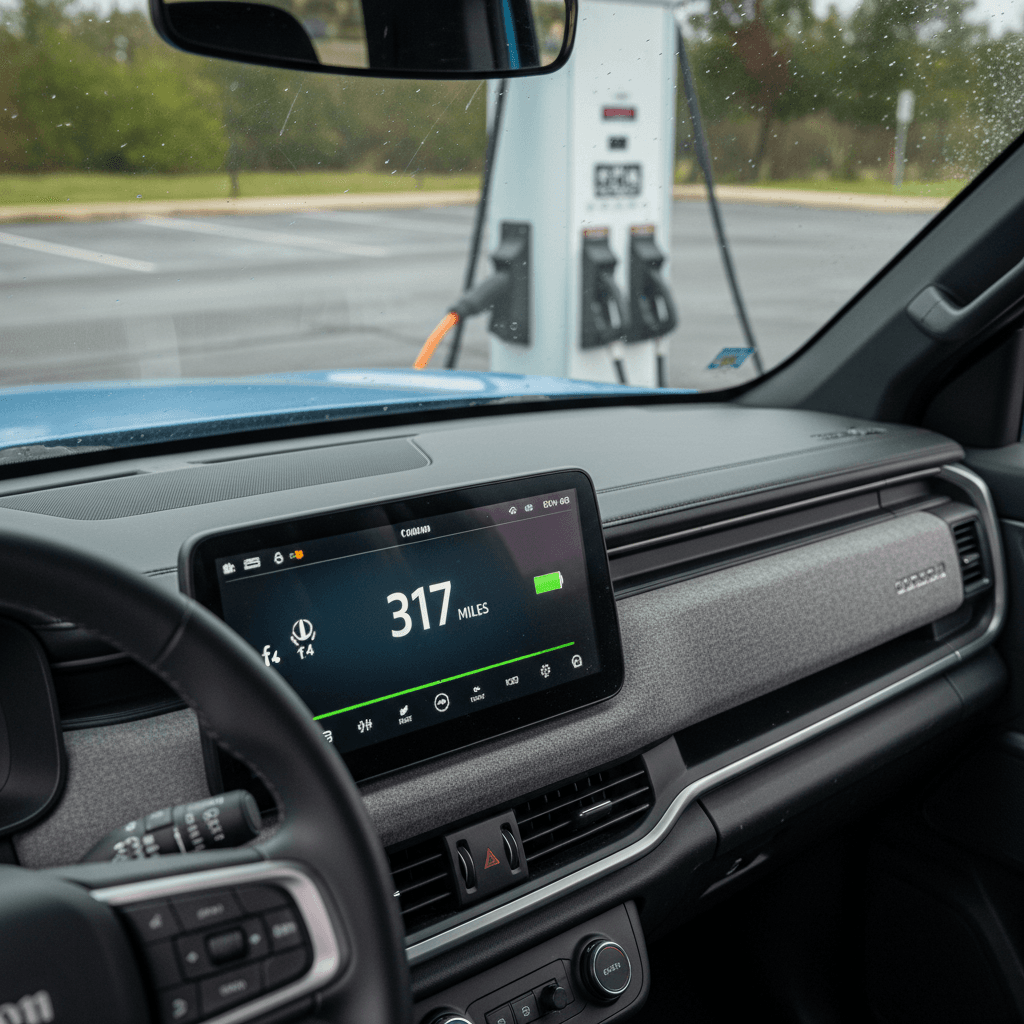
The R1T is rated to tow up to **11,000 pounds**, but the laws of physics don’t care what the spec sheet says. Add a big, boxy trailer and you’re effectively pushing a second wall of air down the highway. That’s why owners, and our own testing at Recharged, see **40–60% range loss** when towing near the truck’s potential.
Approximate Rivian R1T towing range in real-world use
Ballpark planning numbers for towing at 60–70 mph with healthy batteries and proper loading. Always leave extra margin for weather, grades, and headwinds.
| Configuration | Typical tow weight & trailer type | Highway range window | How to plan |
|---|---|---|---|
| Large pack Dual, 21" road tires | 3,000–4,000 lb small travel trailer or toys | ~110–150 miles | Plan 70–110‑mile legs between DC fast chargers. |
| Max pack Dual/Perf Dual, 21" wheels | 5,000–7,000 lb mid-size camper or car hauler | ~140–190 miles | Comfortable 90–130‑mile legs with decent buffer. |
| Quad-Motor, all‑terrain tires | Similar trailer, more aggressive tires | ~90–140 miles | Shorter legs; watch elevation and wind closely. |
| Light utility trailer, bikes, gear | 1,000–2,000 lb open trailer, low profile | ~60–75% of your normal highway range | Plan around your usual non‑towing range, then cut it by a third. |
Think in terms of legs between fast chargers, not just pack size, when planning trips with a trailer.
Don’t chase the GVWR
Weather, speed, and terrain: the biggest range killers
When R1T owners compare notes in 2026, three themes always come up: **cold**, **speed**, and **climbing**. You can’t control the weather or the Rockies, but understanding how each factor hits your range helps you plan realistic legs.
Top 5 Rivian R1T range killers in 2026
1. Winter cold (below ~32°F)
The battery needs to warm up, and cabin heat comes from electricity, not waste engine heat. Expect **15–30% less range** in steady sub‑freezing temps, more if your trips are short and the pack never fully warms.
2. High sustained speeds (75–80+ mph)
Above ~65 mph, aero drag grows fast. On a tall truck like the R1T, jumping from 65 to 80 mph can turn a comfortable 240‑mile Max pack leg into a white‑knuckle 190‑mile leg.
3. Big elevation gains
Climbing long grades eats energy; you regain some on the way down via regen, but not all. Mountain passes can shrink your effective range by 10–25%, especially when you start a climb with a cold pack.
4. Aggressive throttle use
Instant torque is addictive. Lots of full‑throttle launches and late braking can easily cost you another 5–10% over a long day, even without towing.
5. Roof boxes, bike racks, and off‑road tires
Each of these adds drag or rolling resistance. A cargo box plus beefy all‑terrains can combine for a **10–20% hit** compared with a stock R1T on 21" road tires.
Watch the wind, not just the weather
Real-world examples: three R1T trip profiles
Let’s turn the numbers into something you can picture. These are realistic 2026 scenarios pulled from owner logs, media testing, and our own experience helping customers shop used R1Ts.
Suburban commuter, Large pack Dual
Profile: 30‑mile round trip, 60% city, 40% highway at 65 mph, mild climate.
- Sees roughly 2.5–2.8 mi/kWh.
- Real‑world range: ~260–290 miles on a full charge.
- Charges to 70–80% most days, rarely needs DC fast charging.
Road‑tripper, Max pack Dual
Profile: 400‑mile highway days at 70–75 mph, occasional mountains, summer temps.
- Sees roughly 2.1–2.3 mi/kWh.
- Real‑world legs: ~230–270 miles between fast charges.
- Keeps SOC between ~10–80% to optimize charging speed.
Weekend tower, Large pack Quad
Profile: 5,000‑lb camper, 65 mph target, mix of flats and modest grades.
- Sees roughly 1.1–1.5 mi/kWh when towing.
- Real‑world legs: ~110–150 miles between chargers.
- Plans on 90–120‑mile hops for comfort and charging choices.
Used Rivian R1T battery health and degradation
By 2026, the earliest R1Ts are approaching five years old. That makes **battery health** a core part of any used‑truck range conversation. The good news: early owner data suggests Rivian packs are holding up well, with modest degradation for trucks that aren’t abused. But you still want real numbers, not assumptions.
- Most well‑cared‑for R1Ts we see show **roughly 5–10% capacity loss** after several years, depending on mileage and charging habits.
- High annual mileage and constant DC fast charging can push that higher, while gentle AC charging and moderate climates help preserve capacity.
- Degradation doesn’t hit evenly: the first few percent can disappear quickly, then the loss often slows.
- Software updates can slightly change the displayed range or usable buffer, which is why an **independent battery health check** is so valuable on a used truck.
How this changes real-world range
Stretching your R1T’s range: practical tips
Whether you’re in a brand‑new 2026 R1T or a 2022 truck you just bought used, the basics of maximizing range are the same. You don’t have to hypermile, just be intentional about how you drive and charge.
9 simple ways to get more real-world range
1. Slow down a little on the freeway
Even dropping from 78 mph to 70 mph can add **20–40 miles of usable range** on Max pack trucks over a full charge. On a Standard pack, the difference between stressful and easy can be just 5 mph.
2. Use preconditioning
In winter, pre‑heat the cabin and battery while plugged in so more stored energy goes to driving, not bringing a frozen pack up to temperature.
3. Run Eco or Conserve modes on long highway legs
These modes dial back power delivery and, in some setups, power fewer motors, shaving a noticeable chunk off your consumption at speed.
4. Keep tires properly inflated
Under‑inflated tires are silent range killers. Check pressures regularly, especially before trips, and follow the door‑jamb label for your setup.
5. Remove racks and boxes when you can
If you’re not using your cargo box or bike rack every day, take it off. The aero drag penalty adds up over thousands of miles a year.
6. Plan chargers around 10–80% for trips
The R1T charges fastest in the middle of the pack. Shorter, more frequent DC fast‑charge stops can get you down the road quicker than a single deep charge to 100%.
7. Use live consumption instead of guessing
Watch your kWh/100 miles or mi/kWh and adjust your speed and following distance in real time. Think of it as a live miles‑per‑gallon gauge for electrons.
8. Warm up before towing
If possible, drive the truck for a bit before you hook up and hit a long grade in winter. A warm battery tows more efficiently than a cold one.
9. Keep software up to date
Rivian continues to tweak efficiency, preconditioning, and driver‑assist behavior via OTA updates. Staying current can put a few bonus miles back in your pocket.
How Recharged evaluates R1T range on used trucks
If you’re looking at a used Rivian R1T in 2026, you don’t just want a generic “EPA: 314 miles” number, you want to know **how this specific truck’s battery and configuration will behave** on your commute or your favorite camping route. That’s exactly what we built the Recharged Score to answer.
What goes into a Rivian R1T’s range picture at Recharged
Every R1T listing includes a Recharged Score Report so you know what you’re really buying.
Verified battery health
We don’t stop at odometer readings. Recharged uses battery diagnostics and historical data to estimate usable capacity, so you can see how much of the original pack the truck still has.
That feeds directly into realistic range estimates for that VIN, not just the model line.
Configuration & use-case modeling
We factor in pack size, motors, wheels/tires, and accessories to show how far that truck is likely to go:
- On your daily commute.
- On 70–75 mph highway legs.
- While towing within a given weight range.
If you tell our EV specialists how you drive, they’ll help you interpret the numbers.
Ready to find your next EV?
Browse VehiclesWhy this matters when you’re shopping used
Rivian R1T real-world range FAQ (2026)
Frequently asked questions about Rivian R1T real-world range
Bottom line: Is the Rivian R1T a good range bet?
If you strip away the marketing and look at how people actually drive in 2026, the Rivian R1T is **one of the strongest real‑world range performers** among electric pickups, especially in Dual‑Motor and Max pack configurations. You won’t see 400‑plus miles at 75 mph into a headwind with a camper behind you, but you will see consistent, repeatable legs once you learn how your truck responds to speed, weather, and load.
For daily commuting and weekend trips, even a used Large pack R1T offers generous real‑world range and fast charging that makes most road trips straightforward with a bit of planning. If you’re staring at multiple used R1Ts and wondering which one will go the farthest for your life, not just on the window sticker, browsing trucks with a Recharged Score Report is an easy way to start. You’ll see transparent battery health, realistic range expectations, and expert help if you want to talk through how a specific R1T will fit your routes before you ever hit “buy.”