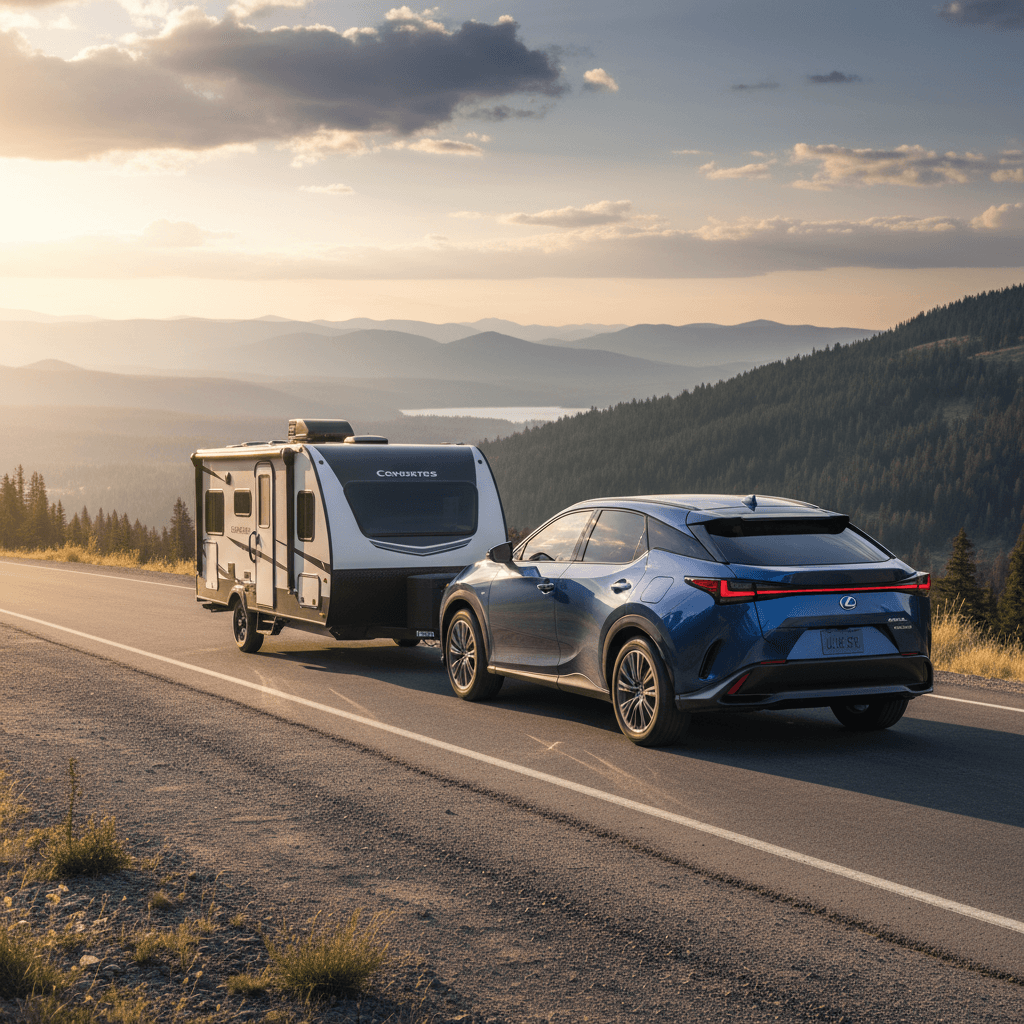
If you’re looking at a Lexus RZ as a family EV or road-trip hauler, you’re probably asking two questions: how much can it tow, and what happens to range when I do? Because EV towing chops range more dramatically than in gas SUVs, understanding the Lexus RZ towing capacity and range, by trim and by use case, is critical before you hitch up a trailer or buy one used.
Key takeaway
Lexus RZ towing and range: quick overview
Lexus RZ towing & range at a glance
Lexus doesn’t market the RZ as a heavy-duty tow vehicle, but it does support light-duty towing in most regions outside the U.S., and its battery and thermal management are engineered to handle short periods of higher load. Newer RZ variants add a slightly larger battery (around 75–77 kWh usable), more efficient powertrains, and NACS access to Tesla Superchargers, which all help make occasional towing more realistic, if you manage your speed and stop planning.
U.S. vs. Europe: towing ratings differ
Lexus RZ towing capacity by market and trim
Let’s start with the hard limits. Towing with any EV is about more than whether the motor can pull; it’s about cooling, braking, and stability. Here’s how the Lexus RZ towing capacity generally breaks down based on currently available data and typical regional ratings.
Approximate Lexus RZ towing capacity by version
Always verify with your owner’s manual and VIN label; values below are typical published ratings in markets where Lexus allows towing with the RZ.
| Model / Market | Typical tow rating (braked) | Unbraked rating | Notes |
|---|---|---|---|
| RZ 450e (Europe, early years) | 1,653 lb (750 kg) | ~750 lb (unbraked, where allowed) | Common EU rating; designed for small trailers and bike racks |
| RZ 300e (Europe) | Similar 1,650 lb class | ~750 lb | FWD layout; lighter curb weight but similar thermal constraints |
| RZ 350e / 450e (U.S.) | Often "not rated" or very low | N/A | U.S. documentation has been conservative; some owners still add aftermarket hitches for accessories only |
| RZ 550e F Sport (future/2026+) | TBD, likely similar or lower | TBD | High-performance dual-motor model prioritizes power over tow ratings; check final specs |
Towing ratings assume factory-approved tow bar and wiring. Tongue weights are estimates only.
Never assume an EV can tow
When you see the RZ’s ~1,650 lb tow rating in European data, that’s your realistic ceiling even in markets where it isn’t explicitly advertised. Practically, that means a small camping trailer, a lightweight single-axle utility trailer, or a couple of e-bikes on a small hitch rack. Anything heavier, and you’re into the territory where dedicated tow SUVs or trucks make more sense.
Lexus RZ range by trim and battery
Next question: how far can you go before you hitch anything up? Lexus has been iterating on the RZ’s battery and efficiency since launch, so you’ll see different range figures depending on model year, trim, and wheel size.
Lexus RZ estimated range by trim (U.S.-style numbers)
These are representative EPA-style ranges and credible test estimates; exact numbers vary by model year and wheel size.
| Model / Battery | Drivetrain | Official / expected range | Realistic highway range (no trailer) | Notes |
|---|---|---|---|---|
| RZ 300e (approx. 64 kWh usable) | FWD | ~266 mi EPA (earlier rating) | ~200–220 mi at 70 mph | Best efficiency in the lineup; smaller pack limits road-trip legs |
| RZ 350e (newer ~75 kWh pack) | FWD | Up to ~300 mi estimated | ~230–250 mi at 70 mph | Improved battery and efficiency versus early 300e |
| RZ 450e (71–75 kWh pack depending on year) | AWD | ~220–260 mi EPA across years | ~170–210 mi at 70 mph | Dual-motor grip, but more consumption |
| RZ 550e F Sport (77 kWh, performance) | AWD | ~225 mi WLTP-style estimate (shorter EPA likely) | ~160–190 mi at 70 mph | Prioritizes power; more fun, less range |
For any used Lexus RZ, verify the window sticker or official EPA listing for the exact range rating.
EPA vs WLTP vs reality
The practical takeaway is that even in its best configuration, the Lexus RZ is a 200–250 mile highway EV in typical U.S. driving without a trailer. That’s fine for most daily driving and regional trips, but it gives you limited headroom once you start adding aerodynamic drag from a boxy camper.
How towing impacts Lexus RZ range in the real world
With EVs, towing doesn’t just add weight; it murders aerodynamics. A small trailer poking out into the airflow adds a surprising amount of drag, especially above 60 mph. For the Lexus RZ, that means you should expect a significant range hit the moment you hitch up.
Typical range impact when towing with a Lexus RZ
Realistic scenarios based on owner experiences with similar EV crossovers
Light utility trailer, ~1,000 lb
Scenario: Open utility trailer with bikes, tools, or yard waste.
- Speed: 55–65 mph
- Range impact: ~25–35% drop
- Example: 220 mi highway becomes ~140–165 mi
Small camping trailer, ~1,500 lb
Scenario: Compact teardrop or small box camper, similar frontal area to RZ roofline.
- Speed: 55–65 mph
- Range impact: ~40–55% drop
- Example: 220 mi highway becomes ~100–130 mi
Tall cargo trailer, poor aero
Scenario: Tall enclosed trailer, significant frontal area.
- Speed: 60–70 mph
- Range impact: 50–60%+ drop
- Example: 220 mi highway can fall under 100 mi
Speed is your biggest lever
Because the RZ’s pack is in the ~64–77 kWh usable range depending on trim, you simply don’t have the same energy buffer as larger, tow-focused EVs. Where a big electric truck can lose half its range and still go 150+ miles, an RZ that loses 50% may be down to 90–130 usable highway miles between fast charges when towing.
Is the Lexus RZ actually good for towing? Use cases that work
Where the RZ shines
- Local towing days: Dump runs, hardware store trips, or hauling a lightweight open trailer within 30–50 miles of home.
- Weekend toys: Small teardrop camper for short getaways, jet skis on a compact trailer, or a single motorcycle.
- Accessory racks: Hitch-mounted bike or cargo racks that add only modest drag if they sit in the vehicle’s slipstream.
- Occasional use: If you tow a few times a year, not every weekend, the RZ’s comfort and refinement may outweigh its towing compromises.
Where the RZ struggles
- Cross-country RV trips: Day after day of 50% range penalties and frequent charging stops is exhausting.
- Heavy trailers: Boats, dual-axle cargo trailers, or anything over ~1,600 lb simply don’t fit its envelope.
- Mountain passes in heat: Sustained high-load climbs with a trailer can stress both cooling and brakes, and make planning far more complex.
- Fleet or work use: If towing is core to your job, a dedicated tow vehicle, EV or ICE, is a better fit.
Think "SUV that can tow" not "tow vehicle"
Charging and planning trips when towing with an RZ
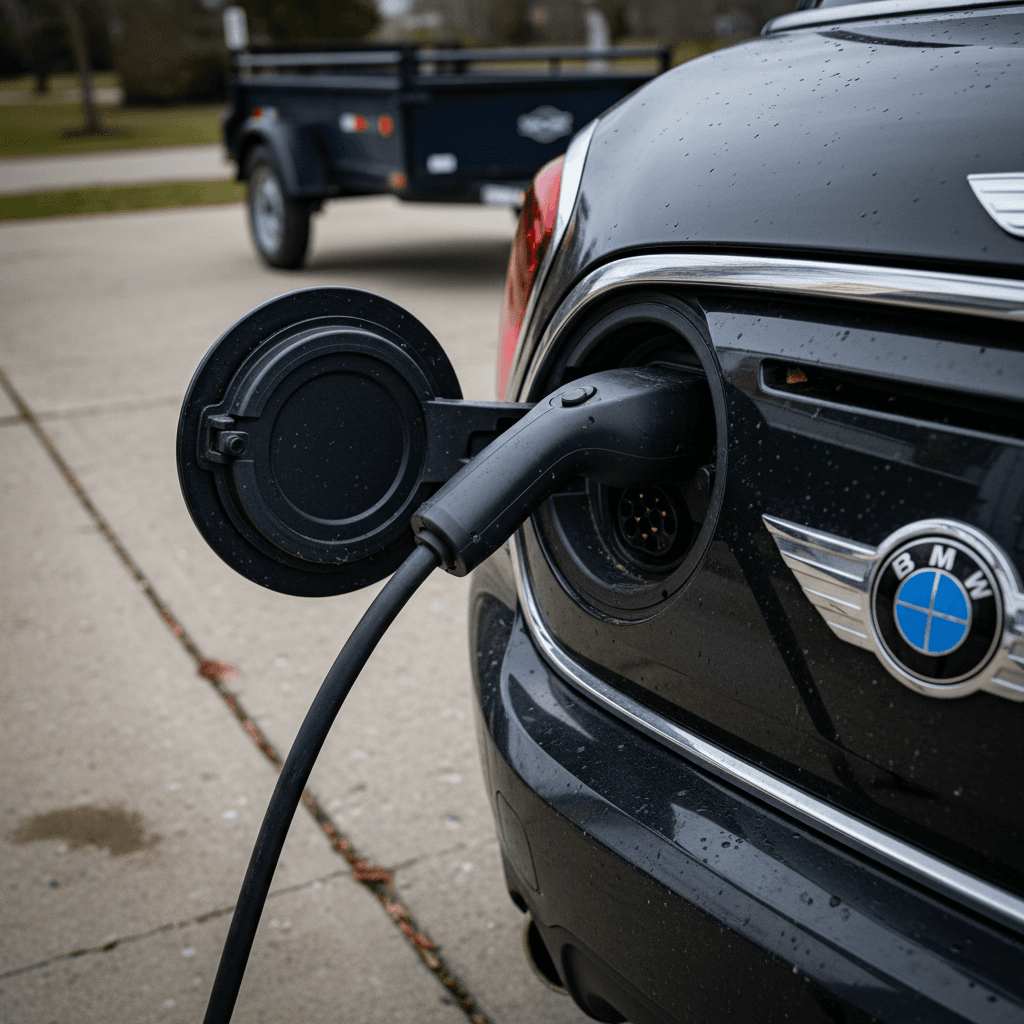
The RZ’s fast-charging story is good but not class-leading. It tops out around 150 kW on DC fast charging, and newer models add an 11 kW onboard AC charger plus a NACS port so you can use Tesla Superchargers. That’s helpful when you’re towing, but you still need to think differently about route planning.
Trip-planning checklist when towing with a Lexus RZ
1. Cut EPA range in half for first-pass planning
If your RZ is rated at 240 miles, assume <strong>120 miles between DC fast-charge stops</strong> when towing a camper at highway speeds. You can refine from there based on your exact trailer and speed.
2. Bookend fast chargers near your campsite
Aim to arrive at campsites with at least 20–30% remaining, and know where the <strong>nearest DC fast chargers</strong> or high-power Level 2 stations are before you book.
3. Use NACS and CCS networks together
With NACS support on newer RZs, you can combine <strong>Tesla Superchargers</strong> with CCS networks like Electrify America to shorten hop lengths and avoid congested sites.
4. Avoid 0–100% charging cycles on trips
Aim for <strong>10–80% DC fast-charge windows</strong>. Above ~80%, charging speeds taper off heavily, especially on a 150 kW-limited EV like the RZ.
5. Drop speed before you drop plans
If energy use looks worse than expected, slow to 55–60 mph before you abandon your plan. That small speed change often fixes efficiency issues without adding many minutes overall.
6. Consider un-hitching to charge
At some crowded sites, especially Tesla locations, you may need to <strong>drop the trailer in a nearby parking space</strong> to reach the charger without blocking others. Bring a wheel lock and hitch lock.
Protecting Lexus RZ battery health when you tow
Lexus has invested heavily in battery longevity, using improved cell chemistry, robust thermal management, and conservative charge curves. There’s even marketing language around surviving many years of high-load use, fast charging, mountain drives, and trailer towing. But no battery is magic. How you tow still matters for long-term health, especially if you later sell the RZ or trade it in.
Battery-friendly towing habits
Good practices that help preserve your RZ’s pack over the long run
Avoid sustained high-load heat
Heavy loads in hot weather push pack and motor temps up.
- Prefer early-morning or evening climbs.
- Take short breaks after long grades to cool down.
- Watch for reduced power warnings and back off quickly.
Limit time at 100% when towing
Topping to 100% occasionally is fine, but avoid sitting at full charge in hot weather.
- Charge to 90–95% before departure when possible.
- Use car’s charge limit settings at home.
- On the road, focus on 10–80% DC fast-charge windows.
Drive smoother, not just slower
Every hard launch or late brake while towing turns energy into heat.
- Use Eco or Normal rather than Sport.
- Leave more following distance so you can coast more.
- Let regen do the first round of braking, then use friction brakes.
Monitor consumption, not just SOC
Keep an eye on the mi/kWh or kWh/100 mi readout.
- Use it to tweak speed and route.
- Note patterns: headwinds, rain, and hills all show up here.
- Over time, you’ll build a mental model for your rig.
Why this matters for resale
Buying a used Lexus RZ for towing and range: what to check
If you’re cross-shopping a used Lexus RZ against other luxury EV crossovers, towing and range add an extra layer of due diligence. You’re not just buying a set of features; you’re buying whatever story that battery and driveline have lived so far.
Used Lexus RZ towing & range checklist
1. Confirm official tow rating for that VIN
Ask the seller for <strong>owner’s manual pages or documentation</strong> showing tow limits for that specific model year and market. If the U.S. manual is silent, assume "no towing" from a warranty perspective and treat any hitch as cargo-rack-only.
2. Inspect hitch, wiring, and rear structure
Look underneath for <strong>aftermarket hitches</strong>, sketchy wiring, or signs of rear-impact repair. Uneven tire wear or alignment issues at the rear can hint at heavy or misbalanced towing history.
3. Ask directly about towing use
There’s nothing wrong with an RZ that’s towed a few times a year, but you want to avoid one that spent its life <strong>pulling a camper every weekend</strong>. Honest sellers will usually tell you if you ask specific questions.
4. Get a battery health report
With a used EV, a <strong>professional battery diagnosis</strong> is as important as a mechanical inspection on a gas car. A service like the Recharged Score can quantify usable battery capacity and flag unusual degradation patterns.
5. Test real-world efficiency
On a long test drive, note <strong>mi/kWh at highway speeds</strong>. If the numbers are dramatically worse than peers, it could point to alignment, tire, or battery issues, especially important if you’ll tow.
6. Verify DC fast-charging behavior
Fast-charge the car if possible. Watch whether it <strong>quickly ramps toward 120–150 kW</strong> (when warm and low SOC) or gets stuck at low power. Chronic abuse or thermal issues can show up here.
How Recharged can help
Ready to find your next EV?
Browse VehiclesLexus RZ towing capacity and range: FAQ
Frequently asked questions about Lexus RZ towing capacity and range
Bottom line: should you tow with a Lexus RZ?
Stepping back, the Lexus RZ is fundamentally a refined electric crossover that happens to be capable of light towing, not a towing specialist. In officially rated markets, its ~1,650 lb tow capacity and mid-pack battery size make it well suited to small trailers, toys, and occasional camping trips, so long as you respect the sharp range penalty and plan your charging stops carefully.
If you’re eyeing a used RZ specifically for towing, put battery health, documented tow ratings, and real-world range ahead of cosmetic bells and whistles. That’s exactly the kind of due diligence a Recharged Score Report is designed to make easier. And if towing is just one of many things you might ask of your next EV, a well-vetted Lexus RZ can deliver the quiet, comfortable electric driving experience Lexus promised, without boxing you out of the occasional trailer weekend.