If you own, or are eyeing, a used Ford Mustang Mach-E, 2026 is a crucial year for understanding its resale value. Early model years are rolling out of basic warranties, new competitors keep undercutting prices, and EV incentives are shifting again. This 2026-focused Ford Mustang Mach-E resale value guide walks you through where values really sit today, how fast they’re falling, and what you can do right now to protect every dollar when it’s time to sell or trade.
Context: Why Mach-E values feel so volatile
Why Mustang Mach-E resale value matters in 2026
Resale value isn’t just an abstract number, it’s the biggest single cost in your total cost of ownership. For a new or nearly-new Ford Mustang Mach-E, depreciation will likely eat more money than electricity, insurance, and maintenance combined between 2021 and 2028. Understanding 2026 market reality helps you decide whether to keep, refinance, sell, or trade your Mach-E, and what a fair offer really looks like in a used-EV marketplace that’s still finding its footing.
Ford Mustang Mach-E resale highlights for 2026
Quick 2026 Mach-E resale snapshot
Big picture: Mach-E is a heavy depreciator
The Mach‑E consistently shows up on lists of EVs with the highest 5‑year depreciation, often around the 60% mark. That’s worse than the average electric compact SUV, which tends to land closer to the high‑50% range over five years.
The main culprits are aggressive new-car discounting, rapid tech turnover, and a crowded field of newer rivals from Hyundai, Kia, and Tesla.
Why 2026 is a turning point
- Early 2021–2022 Mach‑Es are exiting basic bumper‑to‑bumper warranty, making condition and battery health more decisive.
- Mid‑cycle updates like 2024–2025 powertrain tweaks and the 2026 feature reshuffle (including the optional frunk) create clear “good years” in buyers’ minds.
- Used EV prices have stopped free‑falling and are starting to stabilize, which can make 2026 a more predictable time to buy or sell.
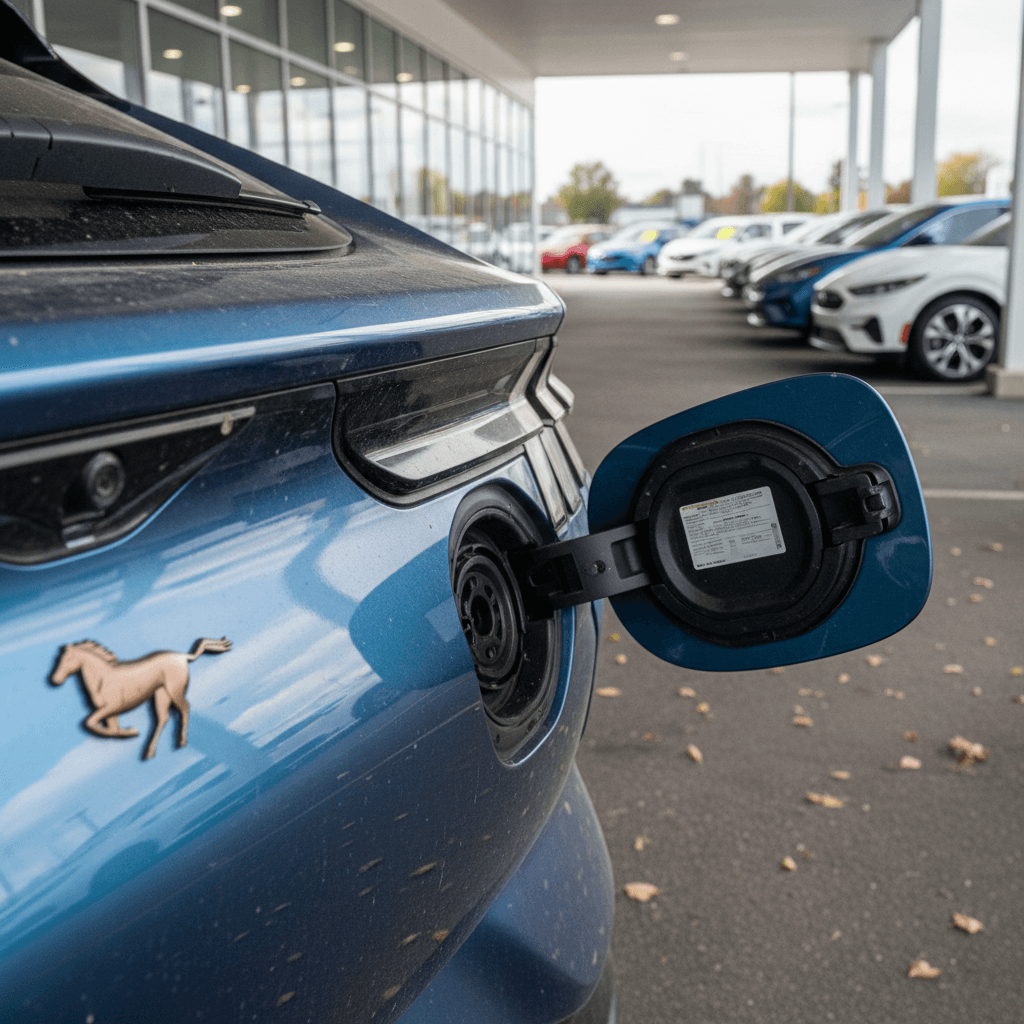
How much is a used Mustang Mach-E worth in 2026?
Exact numbers depend on your market, mileage, and battery health, but by April 2026 most used Ford Mustang Mach‑E listings in the U.S. fall into a few recognizable bands. Think of these as directional guideposts rather than hard price quotes, you’ll still want to pull real comps and, ideally, a Recharged Score on the specific car.
Typical 2026 Ford Mustang Mach-E asking-price bands
Approximate retail listing ranges in early 2026 for clean-title U.S. examples. Prices assume average mileage and no major accident history.
| Model year | Typical mileage in 2026 | Lower-mile Select/Comfort trims | Premium/California Route 1 | GT / Performance Edition |
|---|---|---|---|---|
| 2025 | 10,000–25,000 | Low-$30,000s | Mid-$30,000s | High-$30,000s–Low-$40,000s |
| 2024 | 20,000–35,000 | Mid-$20,000s–Low-$30,000s | Low‑Mid-$30,000s | Mid-$30,000s–Low-$40,000s |
| 2023 | 30,000–45,000 | Low‑Mid-$20,000s | Mid‑High-$20,000s | High‑$20,000s–Low-$30,000s |
| 2021–2022 | 40,000–70,000 | High‑$10,000s–Low-$20,000s | Low‑Mid-$20,000s | Mid‑High-$20,000s |
Use these bands as a starting point, then adjust for trim, options, mileage, condition, and battery health.
Beware of outliers, both cheap and expensive
5-year depreciation: what to expect by 2026–2030
Most data sets now agree that a typical Ford Mustang Mach‑E bought new loses roughly 55–60% of its value over the first five years, putting it in the bottom tier of EV resale performers. That isn’t catastrophic by EV standards, but it’s clearly worse than vehicles like the Tesla Model Y, which benefits from stronger brand pull and more stable pricing history.
Mach-E depreciation, simplified
What a $47,000 example might look like across ownership years.
Year 1–2: The cliff
Big MSRP cuts and incentives in 2023–2024 mean early buyers saw values drop quickly. It’s common for a $47,000 Mach‑E to lose $15,000–$18,000 in the first two years alone.
Year 3–5: Slowing losses
From roughly year three onward, depreciation usually slows to a steadier glide path. Total loss by year five often lands around 60% off MSRP, leaving a resale value in the high‑teens to low‑$20,000s for that same $47,000 build.
Year 6–8: Value floor
As long as the battery remains healthy and the pack is under warranty, Mach‑E values tend to find a floor. At this stage, mileage, cosmetics, and accident history matter more than model‑year bragging rights.
Why this is good news for 2026 buyers
What actually drives Mach-E resale value
- Battery health and remaining warranty – The single biggest lever; a healthy pack under warranty is worth thousands more than a marginal pack out of coverage.
- Trim and performance – Premium and GT models generally hold a bit more, but only if buyers care about those upgrades in your market.
- Mileage and usage pattern – 60,000 highway miles with consistent charging is often better than 25,000 miles of DC fast‑charging abuse.
- Software and hardware updates – Mid‑cycle improvements (heat pumps, revised drive units, interface updates) make some years more desirable.
- Accident and repair history – Structural repairs and airbag deployments spook EV shoppers more than a clean bumper respray.
- Macro EV market – Interest rates, tax credits, and the pace of new-model launches all push used EV prices around.
Battery health, warranty, and their impact on value
With any used EV, the pack is the asset. Ford covers the Mustang Mach‑E’s high-voltage battery for 8 years or 100,000 miles (whichever comes first), with a minimum-capacity guarantee written into that coverage. In practical terms, that means a 2021 Mach‑E still under 100,000 miles in 2026 should have several years of battery warranty left, something buyers and lenders both care deeply about.
How battery health affects your Mach-E’s resale price
1. Warranty status is a binary gate
A Mach‑E that’s still inside Ford’s 8‑year/100,000‑mile battery warranty is easier to finance, easier to insure confidently, and simply worth more. Once a car is out of warranty, savvy buyers will demand a discount, especially if replacement pack costs stay high.
2. Documented state of health builds trust
On‑board battery health readouts are imperfect, but buyers increasingly expect some data. A third‑party diagnostic like the <strong>Recharged Score</strong> gives a standardized, independently-verified view of pack condition that helps justify your asking price, or protect you from overpaying.
3. Fast-charging behavior matters
Repeated DC fast charging at high SOC (state of charge) can stress cells over time. You probably won’t lose a sale over a few road trips, but a lifetime of 150 kW charging with no home Level 2 charging history is a red flag for informed buyers.
4. Cold-climate use isn’t automatically bad
Cold weather reduces range temporarily but doesn’t automatically destroy battery value. What worries buyers more are patterns of storage at 100% charge, prolonged heat exposure, or obvious range loss compared to original specs.
Don’t hand‑wave battery issues
Model years, trims, and features that move the needle
Not every Mach‑E is treated equally by the 2026 used market. Shoppers have learned where the sweet spots are, and they’re voting with their wallets. That means certain years and trims will carry a premium, while others mainly move on price.
Which Mach-E examples look strongest in 2026?
A model-year and trim cheat sheet for resale prospects.
Early years: 2021–2022
- Attractive prices, often under $25,000.
- Some teething issues and multiple recalls, but many have already had software and hardware fixes.
- Best for value-seekers who understand warranty timelines and don’t mind older infotainment.
Mid-cycle: 2023–2024
- Benefit from running improvements and a more mature software stack.
- Still within both bumper‑to‑bumper and battery coverage.
- Resale tends to be stronger, especially on well‑optioned Premium and GT trims.
Latest updates: 2025–2026
- 2025 refresh and 2026 feature shuffles (like the now‑optional frunk) make these feel more current.
- Command the highest prices, but you’re buying at a point where early depreciation is still ongoing.
- Best suited to buyers who plan to keep the car beyond 5 years.
Trim and option notes
- GT and GT Performance sell on emotion; great if you find the right enthusiast, but not every buyer will pay big premiums.
- Premium/California Route 1 with extended-range batteries and popular colors often hit the best mix of price, range, and features.
- Oddball specs (unpopular colors, base wheels) may need sharper pricing to move.
How to check your Mach-E’s value in 2026
Instead of relying on a single pricing site or the number a dealer hands you, you’ll get a more realistic picture by triangulating from multiple sources and then adjusting for your car’s unique traits. Here’s a process that works well for the 2026 EV market.
Step-by-step: Finding a fair Mach-E value in 2026
1. Start with mainstream value tools
Run your VIN through at least two traditional sources (like trade‑in estimators and retail value guides). Use the same zip code, mileage, and trim details to keep things comparable.
2. Pull real listing comps
Search regional listings for Mach‑Es with similar year, trim, miles, and colors. Pay attention to which cars actually sell or drop off the market, those are better indicators than wildly optimistic asking prices that sit for months.
3. Adjust for battery warranty and health
Is your pack still well inside warranty and showing strong range? That’s worth a premium over the generic prices most tools assume. Conversely, if you’re near 100,000 miles or seeing meaningful range loss, be conservative.
4. Factor in recalls and repairs
Confirm that major recalls, like door-latch and high-voltage contactor campaigns, have been addressed. A fully up‑to‑date car with clean documentation is easier to sell and more defensible at the top of your price band.
5. Get a Recharged Score (if buying or selling through Recharged)
When you buy or sell a Mustang Mach‑E on <strong>Recharged</strong>, every vehicle comes with a <strong>Recharged Score Report</strong> that includes verified battery diagnostics, pricing benchmarks, and condition notes. That takes a lot of guesswork out of negotiating value.
9 ways to maximize your Mach-E resale price
You can’t change Ford’s pricing history or macro EV demand, but you can absolutely influence where your Mustang Mach‑E lands inside its natural price band. Think of this as turning small knobs that add up to real money.
- Time your sale before major warranty cliffs – If you’re approaching 8 years or 100,000 miles, consider selling while the battery warranty still has at least a year of runway left.
- Stay ahead on software and recall work – Buyers notice cluster messages and recall notices. Keep over‑the‑air updates current and print a recall-completion summary from a Ford dealer or NHTSA VIN lookup.
- Document your charging habits – A simple note in your listing like “Primarily home Level 2 charging; DC fast charging only on road trips” helps ease battery-wear fears.
- Invest in a high-quality detail – A professional interior/exterior detail plus paint touch‑ups can move a Mach‑E from “driver grade” to “pride of ownership,” which is where private‑party buyers pay the strongest money.
- Resolve minor cosmetic issues – Fix windshield chips, curb‑rashed wheels, and obvious dings. Buyers will mentally over‑deduct if they see a long to‑do list.
- Price with a strategy, not emotion – Start slightly above your target number, but not so high that you scare away test‑drive requests. Watch listing engagement and be ready to make small, timely adjustments.
- Market the EV strengths smartly – Highlight features shoppers care about in 2026: decent real‑world range, BlueCruise eligibility where applicable, over‑the‑air updates, and low maintenance costs.
- Offer flexible viewing and test drives – The more friction you remove (evening/weekend availability, clear directions, safe meeting spots), the more serious buyers you’ll convert.
- Consider selling through a specialist – Platforms focused on used EVs, like Recharged, often attract better‑educated buyers who understand Mach‑E quirks and are willing to pay for a well‑documented example.
Selling vs trading in your Mach-E in 2026
Trading in to a dealer
- Pros: Fast, low‑friction, potential tax advantage in many U.S. states (you only pay sales tax on the price difference).
- Cons: Dealers will always price in risk, especially on EVs they don’t fully understand. Expect to get below what well‑priced private listings are achieving.
- Best for: Owners who are upside‑down on a loan or who prioritize convenience over squeezing every last dollar out of the car.
Selling privately or through Recharged
- Pros: Higher potential sale price, more control over who buys your car, and the ability to tell its story, especially valuable for EVs.
- Cons: Requires time for messaging, showings, paperwork, and potentially shipping if you sell out of area.
- Best for: Owners with clean, well‑optioned Mach‑Es who are willing to invest a bit of effort to unlock that extra value.
If you’d rather not manage the process yourself, Recharged can help with instant offers, trade‑ins, or consignment-style selling where EV specialists handle the heavy lifting.
Where Recharged can help
How Recharged values a used Mustang Mach-E
Traditional book values often lag fast‑moving EV markets by months. At Recharged, we lean on real transaction data, EV‑specific expertise, and hands‑on diagnostics to price a Ford Mustang Mach‑E realistically, for both buyer and seller.
Inside the Recharged valuation process
Why a Recharged Score Report is so valuable on a Mach-E.
1. Vehicle & market profile
We start with the basics: VIN data, build sheet, mileage, options, color, and accident history. Then we map the car against current regional and national Mach‑E demand so we’re not relying on outdated averages.
2. Deep battery health diagnostics
Every vehicle on Recharged gets a Recharged Score Report, which includes independent battery health testing and a clear explanation of how that plays into pricing. This is where two seemingly identical Mach‑Es can be worth very different amounts.
3. Transparent, fair-market pricing
We benchmark your Mach‑E against comparable listings and recent sales, then present a target price range with supporting data. Whether you’re trading in, selling via instant offer, or consigning, you’ll see how we arrived at the number.
Ready to find your next EV?
Browse VehiclesFord Mustang Mach-E resale value FAQ (2026)
Frequently asked questions about Mach-E resale in 2026
Bottom line: Is the Mach-E a bad resale bet?
In 2026, it’s fair to say the Ford Mustang Mach‑E is not a resale superstar. Five‑year depreciation around 60% puts it behind the best‑holding EVs in its class. But that doesn’t automatically make it a bad ownership proposition. If you bought new at peak prices and need to sell early, the math can sting. If you’re shopping used today or you plan to keep your Mach‑E well beyond the loan term, those same depreciation curves can actually work in your favor.
The key is to treat your Mach‑E like the sophisticated, software‑defined product it is: stay ahead on updates and recalls, protect the battery, document everything, and price based on real data rather than emotion. Whether you’re buying, selling, or just planning your next move, a data‑driven valuation approach, and tools like the Recharged Score Report, can turn a confusing EV resale landscape into a transparent, predictable part of your ownership journey.