You bought a Chevrolet Silverado EV because it’s the electric truck that’s supposed to do it all, tow, haul, road‑trip, haul kids and mountain bikes. Naturally, you start thinking about a roof rack. Then you hit the wall: what’s the actual Chevrolet Silverado EV roof rack weight limit, and how much gear can you safely put up there?
Key takeaway on roof load
Silverado EV roof rack weight limit: the short answer
Let’s start with the part you actually care about: how much can you safely carry on top of a Silverado EV on the highway with a quality rack system installed?
- Most late‑model GM vehicles and half‑ton trucks that allow roof racks top out around 150–165 lb dynamic load (rack + gear) according to GM and rack fit‑guide documentation for ICE Silverados and other GM models.
- Thule and Yakima crossbar systems that already list a Silverado EV fit typically cap their dynamic rating around 165 lb, even when the bars themselves are theoretically stronger.
- Your real limit is the lowest number among: the vehicle roof rating in the owner’s manual, the rack manufacturer’s rating, and any accessory’s rating (cargo box, basket, tent).
Always confirm your specific truck
Why the official Silverado EV roof load rating is so hard to find
If you’ve gone digging through GM sites and dealer listings, you’ve probably seen tow ratings, GVWR and payload numbers for the Silverado EV, but almost nothing about roof load. That’s not an oversight; it’s how the industry works.
- OEMs publish GVWR (Gross Vehicle Weight Rating), axle ratings and payload, then tuck roof‑load rules into the manual, usually in the Loading or Roof Rack section.
- Electric trucks like the Silverado EV complicate things because the glass area and panoramic roofs on some trims may reduce allowable roof load or restrict where a rack can clamp.
- GM also knows most serious loads on a pickup live in the bed or on bed rails, not over the cab, so they don’t shout about roof capacity the way a crossover might.
Silverado EV capacity numbers in context
Where to look in your manual
Dynamic vs static load on a Silverado EV roof rack
Before you start chasing numbers, you need to understand the two very different weight limits that rack brands and tent makers like to throw around: dynamic and static.
Two kinds of roof rack weight limits
Only one of them matters while you’re actually driving
Dynamic load
Dynamic load is the weight your roof and rack can handle while driving, hitting bumps, crosswinds, emergency lane changes.
- Usually capped around 150–165 lb on many trucks.
- Includes the rack itself + all cargo.
- This is the number you must respect on the highway.
Static load
Static load is the weight your parked truck can support when forces are vertical and constant.
- Often 2–3x higher than dynamic, especially on full racks.
- Relevant for rooftop tents and people walking on a platform.
- Fine print: static ratings assume level ground and no wind gusts.
Don’t size your roof load off static numbers
How aftermarket rack weight limits relate to your Silverado EV
Once you plug “2024–2026 Chevrolet Silverado EV” into a Thule, Yakima or other fit guide, you’ll see familiar numbers: dynamic load limits in the same 150–165 lb ballpark that GM has used on earlier Silverados and other models. Here’s what that actually means for you.
Which roof rack weight limit do you follow?
Think of roof load ratings as a chain. You’re only as strong as the weakest link.
| Component | Typical Silverado EV scenario | What the number means |
|---|---|---|
| Vehicle roof (GM) | GM guidance in the manual or label, often ~150–165 lb dynamic | Maximum combined weight on the roof, including rack, while driving. |
| Rack system (Thule/Yakima/etc.) | Fit‑kit instructions list 150–165 lb for a full‑size pickup cab | If the rack is lower than GM’s number, you must obey the rack rating. |
| Accessory (box, basket, tent) | Cargo box rated 150 lb, rooftop tent rated 165 lb dynamic | This rating also includes its own weight + cargo inside; again, lowest number wins. |
When in doubt, use the lowest number between the vehicle, rack and accessory.
Do the simple roof‑load math
Real‑world setups: what you can safely carry
Let’s turn the engineering speak into actual trips. Below are common Silverado EV roof‑rack scenarios and how the numbers shake out assuming a 150–165 lb dynamic limit. Adjust if your manual specifies a different value.
Common Silverado EV roof‑rack setups (dynamic)
1. Cargo box for family road trips
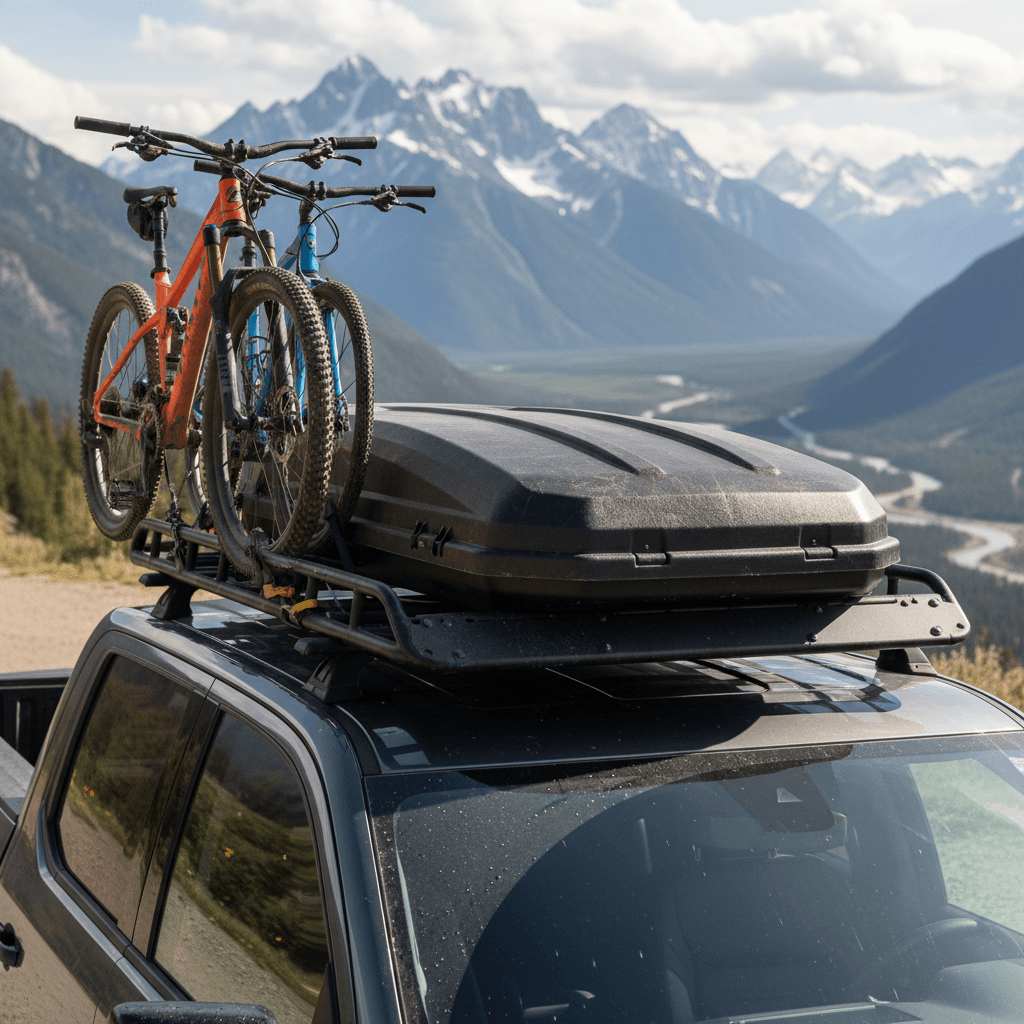
A mid‑size aero cargo box weighs ~35–45 lb. Add a typical two‑bar aero rack at ~40–45 lb and you’re already ~80–90 lb in. That leaves roughly 60–80 lb of luggage within a 150–165 lb dynamic limit, enough for soft bags, but not cast‑iron cookware and dumbbells.
2. Two kayaks on J‑cradles
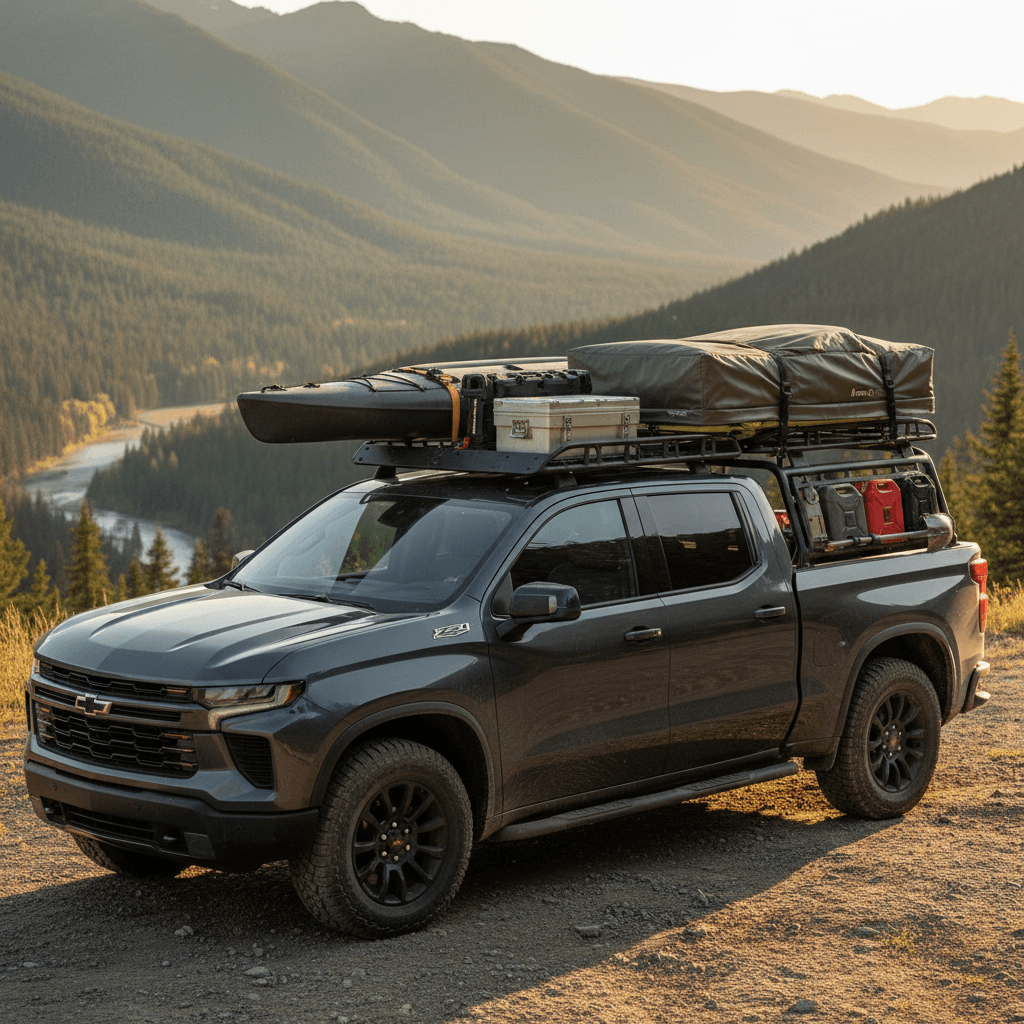
Two plastic river kayaks might be 90–110 lb total. Quality J‑cradles and rack bars add another 40–50 lb. You’re kissing 150–160 lb. It’s doable, but you must pack light and strap the boats so they don’t act like sails in crosswinds.
3. Four bikes on the roof
Four modern mountain bikes might be 28–35 lb each; call it 120–130 lb for the set. Add 40–45 lb for bars and trays and you’re ~165–175 lb, likely <strong>over</strong> a conservative factory limit. Better: two on the roof, two on a hitch rack, or all four on the hitch.
4. Just a flat platform rack
A full‑length aluminum platform can weigh 60–90 lb by itself. Throw a recovery board set and fuel can up there and you’re out of headroom before camping gear ever sees the roof. On a heavy EV, over‑roofing is easy, so weigh actual parts, not guesses.
Can you run a rooftop tent on a Silverado EV?
This is where the conversation gets spicy. A rooftop tent on a Silverado EV cab looks fantastic on Instagram and terrible in a wind‑tunnel. But it can be done safely if you respect both dynamic and static limits.
Driving to camp (dynamic phase)
Most soft‑shell rooftop tents weigh 120–160 lb before you’ve added bedding or a ladder. Mount that on 40–50 lb of crossbars and you’re already at 160–210 lb, beyond what many OEM roof ratings or clamp‑on bar systems allow while driving.
That’s why many tent makers insist on full‑rail or bed‑mounted racks for heavier tents on trucks. They want the load carried by stronger hard‑points, not sheetmetal and pinch welds intended for occasional kayaks.
Sleeping on the tent (static phase)
Once you’re parked, the story changes. A Silverado EV’s structure can easily support the static weight of two adults and a tent, commonly 500+ lb total, if that load is properly distributed through a rack designed and rated for static use.
The catch: getting the tent up there without exceeding dynamic limits on the way to the campsite. If you’re serious about rooftop camping, consider a bed rack over the Ultium battery pack instead of over‑cab bars. It’s better for weight distribution and for your range.
Rooftop tent rule of thumb
Range, noise and handling: how roof loads affect your EV
Weight is only half the story on an electric pickup. Anything you stick up in the airstream above a Silverado EV’s cab is a drag factory, and drag is what ruins range.
What a loaded roof rack does to your Silverado EV
Even a big Ultium pack can’t fight bad aero
Range hit
Big cargo boxes, bikes and kayaks can knock 10–25% off your highway range, especially if you’re running 70–80 mph. On an EV, that’s the difference between one stop and two on a road trip.
Wind noise
Aero bars help, but anything on the roof will raise cabin noise. Box lids, straps and loose fairings can hum or buzz right in the frequency where your brain likes to live.
Handling & stability
Adding 150+ lb up high makes the truck feel tippier in evasive maneuvers and more susceptible to crosswinds. That’s true of any pickup, but the Silverado EV is already heavy; don’t give physics extra leverage.
Pro‑EV packing tip
How to choose the right roof rack for your Silverado EV
Choosing hardware for a brand‑new EV truck is a little like buying furniture for a house that’s still under construction: you want parts that are both vehicle‑specific and future‑proof. Here’s how to shop smart.
Silverado EV roof rack buying checklist
1. Start with a fit guide, not a generic rack
Use Thule, Yakima or other reputable brand fit tools and select your exact Silverado EV year, cab style and roof type (glass vs steel). If the system isn’t explicitly listed for your truck, skip it until it is.
2. Confirm the dynamic rating in writing
Download the PDF instructions for the specific fit kit and crossbars. Look for a line that states the <strong>maximum permissible load</strong> for your vehicle. That’s your working roof‑rack weight limit, subject to the smaller of that and GM’s own number.
3. Weigh the rack and accessories
Manufacturers list weights, but they’re often rounded. If you’re flirting with the limit, weigh your bars, feet and carriers with a luggage scale. Then you’ll know exactly how much payload you have left for gear.
4. Prefer aero bars and low‑profile accessories
On an EV, aero matters more than macho. Choose <strong>teardrop‑shaped bars, low‑profile boxes and compact bike trays</strong> to minimize drag and noise. You’ll feel the difference in your Wh/mi readout.
5. Consider a bed rack instead for heavy use
If you’re serious about rooftop tents, spare tires or full‑time recovery gear, a dedicated <strong>bed rack or cap‑mounted rack</strong> that ties into the Silverado EV’s structure is usually safer and more stable than piling mass over the cab.
Used Silverado EV owners: quick roof‑rack checklist
If you’re shopping the used market, or just bought a pre‑owned Silverado EV, don’t assume the previous owner got the roof‑rack details right. This is exactly the sort of thing that gets improvised after a couple of YouTube videos and a Saturday at the hardware store.
Inspecting a used Silverado EV with a roof rack
1. Check mounting points and seals
Pop the doors and look at where the towers clamp. You’re hunting for crushed weatherstripping, chipped paint or misaligned doors. Rust around mounting points is a red flag on a relatively new EV.
2. Verify brand, model and fit kit
Identify the rack brand and model, then confirm online that it’s actually listed for the Silverado EV. Some owners repurpose older ICE‑truck racks that don’t share roof geometry, or weight assumptions, with the EV.
3. Ask how it’s been used
Light duty, cargo boxes, skis, is one thing. If the prior owner regularly ran a hefty rooftop tent or a couple hundred pounds of gear up there, you’ll want a careful inspection of the roof and door apertures.
4. Cross‑check capacity with documentation
Ask for the rack instructions. If they’re missing, download them. Cross‑reference the listed max load with the <strong>vehicle load section</strong> of the Silverado EV manual. Again, your rule is to follow the lowest number.
5. Factor range into your own use
If your commute or trips already stretch the truck’s usable range, consider <strong>removing the rack when you’re not using it</strong>. Those bars cost you energy every mile, even when they’re empty.
How Recharged can help
Ready to find your next EV?
Browse VehiclesFAQ: Chevrolet Silverado EV roof rack weight limit
Frequently asked questions about Silverado EV roof loads
Bottom line on Silverado EV roof rack weight limits
The Chevrolet Silverado EV is a serious workhorse with a tow rating and payload that would have embarrassed heavy‑duty diesels not long ago. But up top, it plays by the same modest rules as most modern trucks: about 150–165 lb of dynamic roof load is all you should plan on, rack and cargo combined, unless GM gives you a different number in black and white.
Use your roof for what it’s good at, light, awkward gear that doesn’t fit anywhere else, and keep the iron and the heavy camping hardware down in the bed or on a purpose‑built bed rack. Your range, your passengers and your insurance company will all sleep better.
And if you’re weighing a used Silverado EV with racks, tents or a full adventure build, consider doing it through Recharged. Every truck comes with a Recharged Score Report so you know exactly what kind of energy and battery health you’re working with before you load the roof and head for the horizon.