If you’re shopping a Ford Mustang Mach‑E in 2026, new or used, the first thing you want to know is simple: **how far will it really go on a charge?** EPA stickers promise 250–300+ miles, but real world Mustang Mach‑E range in 2026 depends heavily on battery size, trim, speed, weather, and how the car’s been treated. Let’s translate the specs and the road tests into the miles you’ll actually see on your screen.
A quick note on model years
Mustang Mach‑E range in 2026: the quick take
Real world Mustang Mach‑E range at a glance (2026)
Those numbers come from a mix of independent 70‑mph tests, owner reports, and Ford’s own usable battery capacities. In the real world, **the Mach‑E is rarely an honest 300‑mile SUV on the highway**, but it can be a very solid 230–270‑mile road‑trip companion when spec’d and driven right. Around town, you’ll often beat the highway numbers by a healthy margin.
EPA range vs real world: why your Mach‑E shows fewer miles
Every modern Mustang Mach‑E ships with an **EPA‑estimated range** number. For 2024–2025, depending on trim, that’s roughly in the mid‑200s for all‑wheel drive Standard Range, and into the low‑300s for some Extended Range rear‑drive configurations. But that test cycle averages speeds far below a typical interstate cruise, and it mixes in city driving where EVs shine.
- EPA tests average closer to **48–50 mph**, not the 70–75 mph you’ll see on American highways.
- The cycle underestimates highway aero drag, which ramps up quickly above 60 mph.
- Climate control, big wheels, and accessories can eat into range, but EPA numbers are set with specific configurations.
Don’t panic at 100% showing less than the window sticker
Real world Mustang Mach‑E range by trim (2026 snapshot)
There are dozens of Mach‑E combinations across 2021–2025: Standard Range (SR) vs Extended Range (ER), rear‑wheel drive (RWD) vs all‑wheel drive (AWD), California Route 1, GT, Rally, and various wheel and tire packages. Underneath, though, you’re mostly choosing between **two usable battery sizes**: about **72 kWh SR** and **91 kWh ER**. That’s what really sets your ceiling.
Typical 2026 real world Mustang Mach‑E range by configuration
Approximate ranges assume a healthy battery, 60–70°F ambient temperature, relatively flat terrain, moderate load, and starting from 100% to near 0%. Numbers are rounded and intended as planning guides, not guarantees.
| Configuration (2021–2025 era) | Battery | EPA rating (approx) | 70 mph highway range | Mixed driving range |
|---|---|---|---|---|
| SR RWD (Select/Premium) | Standard Range (~72 kWh) | 240–250 mi | ~210–230 mi | ~230–250 mi |
| SR AWD | Standard Range (~72 kWh) | 220–230 mi | ~190–210 mi | ~210–230 mi |
| ER RWD (Premium/Route 1) | Extended Range (~91 kWh) | 300–312 mi | ~240–270 mi | ~270–300 mi |
| ER AWD (Premium) | Extended Range (~91 kWh) | 270–290 mi | ~230–250 mi | ~250–280 mi |
| GT / Rally (ER AWD, performance tires) | Extended Range (~91 kWh) | ~260–280 mi | ~210–235 mi | ~230–260 mi |
Real world Mustang Mach‑E range looks different from the EPA sticker, especially at 70 mph.
What about the 2025/2026 updates?
City vs highway: where the Mach‑E really shines
Stop‑and‑go and suburban driving
Like most EVs, the Mustang Mach‑E is happiest in **30–50 mph traffic** with frequent chances to coast or slow down gently. The car’s **regenerative braking** recovers energy every time you lift off the accelerator, and aero drag is far lower at city speeds.
- It’s common to meet or beat the EPA number in mild‑weather city driving.
- One‑pedal driving and BlueCruise (on supported roads) help you drive smoothly, which boosts efficiency.
- Short trips in extreme cold still hurt range, but less than hammering down the interstate.
Highway and road‑trip driving
On the open road, **aerodynamic drag is your enemy**. Doubling speed roughly quadruples the drag, so the jump from 55 to 75 mph takes a big bite out of range.
- Expect **15–25% less range** at a true 70–75 mph cruise versus the EPA rating.
- AWD and performance tires add grip and fun but cost you more miles per kWh.
- Roof boxes, bike racks, and headwinds can trim another **5–15%** off highway range.
That’s why many independent 70‑mph tests land **20–25% below** the window‑sticker range number.
Easy win: use cruise control smartly
How cold, heat, and climate control cut Mach‑E range
If you live in the northern half of the U.S., 2026 Mach‑E range in January is going to look very different from June. Batteries are chemical systems, and they simply don’t like the cold. Cabin heat in an EV is electric, not waste heat from an engine, so winter comfort costs you extra energy.
Weather effects on Mustang Mach‑E range
What to expect in different conditions if you start from a mild‑weather baseline
Mild (50–75°F)
Best‑case scenario. The pack and cabin don’t need much thermal management.
- Real world range often lands within **10% of EPA** in mixed driving.
- On highway at 70 mph you’ll still see a penalty vs EPA, but it’s manageable.
Cold (below 32°F)
Expect 20–35% less range overall, more on short trips.
- Energy goes into warming the pack and cabin.
- Heated seats and wheel use less energy than blasting cabin heat.
- Pre‑conditioning while plugged in is a huge help.
Hot (85–100°F+)
A/C is cheaper than heat, but aero and cooling still nibble at your range.
- Plan for **10–20% loss** in extreme heat with A/C running.
- Parking in shade and pre‑cooling while plugged in reduce the hit.
Fast‑charging on a cold battery
Speed, driving style, and payload: the human factors
By 2026 the Mach‑E has proven itself as a quick, quiet family EV, and that’s exactly why so many owners are surprised by their **first road‑trip consumption numbers**. It’s easy to drive it like a Mustang and then wonder where the range went.
Habits that quietly steal Mach‑E range
1. Cruising at 78–80 mph
Every 5 mph over 65 hurts. A Mach‑E that can manage 250 miles at 68–70 mph might drop closer to **210–220 miles** at 78–80 mph, all else equal.
2. Jack‑rabbit launches
The instant torque is addictive, but full‑throttle starts and hard braking waste energy. Smooth, anticipatory driving lets regen do the work and keeps your consumption down.
3. Big wheels and sticky tires
Performance‑oriented GT and Rally trims, or aftermarket wheels with wide, soft tires, can trim **5–10%** off real‑world range compared with narrower all‑season setups.
4. Roof racks, boxes, and toys
A cargo box, bikes, or kayaks up top can be another **5–15% penalty** at highway speeds due to extra drag. If you can, carry gear inside or on a hitch rack instead.
5. Heavy loads and towing
Passengers, cargo, and small trailers add weight and drag. The Mach‑E isn’t rated for serious towing in all configurations, but even a loaded cabin can shave another **5–10%** off your maximum distance.
Good news: you control most of this
Used Mustang Mach‑E in 2026: battery health and range loss
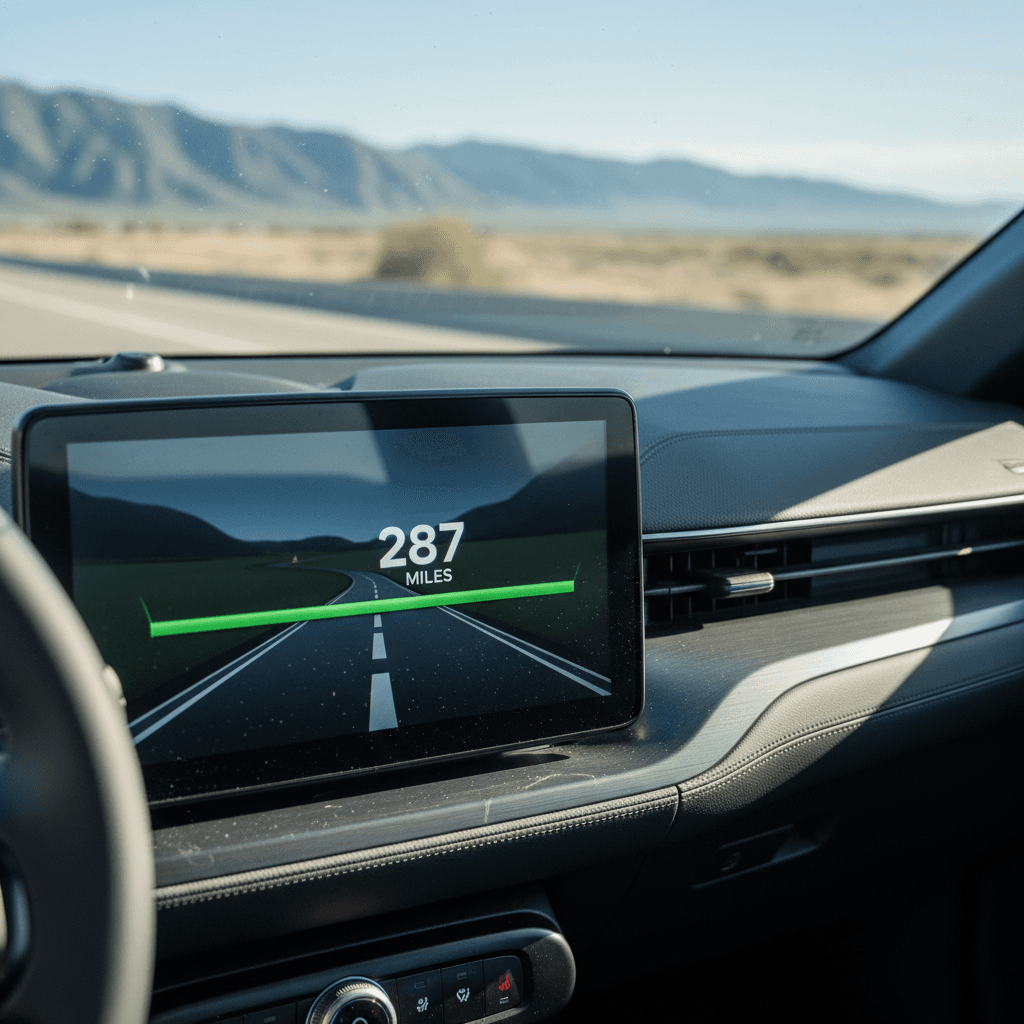
By 2026, the very first 2021 Mach‑E SUVs are five years old. That makes battery health a big part of the real‑world range story, especially if you’re shopping used. The good news: Ford engineered the pack with meaningful buffers and conservative charging behavior, so **most well‑treated Mach‑E batteries are aging gracefully**.
How age and care affect Mach‑E range
What to expect from a 2021–2024 Mach‑E in 2026
Typical degradation
Across owner data and our own analysis at Recharged, a healthy Mach‑E pack often shows **single‑digit percent loss** in the first 4–5 years.
- Roughly **5–10% capacity loss** is a reasonable expectation by year five.
- An ER Mach‑E that once delivered 260 real‑world highway miles might be closer to 235–245 miles in 2026.
Abuse and edge cases
Frequent DC fast‑charging to 100%, living in extreme heat, or letting the car sit at 0% or 100% for long stretches can accelerate wear.
- In those cases, you might see **15%+ loss** by year five.
- That’s the difference between a comfortable 230‑mile highway leg and something under 200 miles.
How Recharged helps you see the real number
How to stretch your Mach‑E range on every drive
You don’t have to baby a Mach‑E to get decent range, but a few simple habits can give you a useful 10–20% cushion, often the difference between “do we stop now?” and “we’ll grab the next charger.”
Practical ways to boost Mustang Mach‑E real world range
Pre‑condition while plugged in
Use the FordPass app or in‑car settings to warm or cool the cabin and battery **before** you unplug. You’ll spend grid power instead of battery power getting everything up to temperature.
Choose an efficient speed
On road trips, set cruise in the high‑60s or low‑70s. Dropping from 78 to 70 mph can easily save **15–30 miles** of range over a full charge on an ER pack.
Use Eco or untamed wisely
Eco mode dulls throttle response and encourages gentler driving; performance modes make it easier to burn electrons. Pick the mode that matches the trip, not just your mood.
Leverage one‑pedal driving
Turn on one‑pedal or strong regen and practice smooth lifts instead of stabs at the brake pedal. The more you let regen slow the car, the more energy you recapture.
Mind your tires
Keep tire pressures set to the door‑jamb spec, especially before long drives. Under‑inflated tires burn range and can affect safety and braking performance.
Plan smart charging stops
On a long trip, it’s often quicker to charge **from ~10–15% up to 60–70%** at fast speeds than to sit around waiting for the last 20% to creep in.
When the range isn’t enough: trims, charging, and alternatives
If you’re looking at a Mach‑E in 2026 and thinking, “I really need a comfortable 280‑mile highway cruiser, *even in winter*,” you’re in the danger zone where expectations and physics tend to collide. That doesn’t mean you should walk away from the Mach‑E, but you do need to be honest about your use case.
If you mostly commute and run errands
A **Standard Range RWD or AWD** Mach‑E is usually plenty. You’ll see excellent efficiency around town, and daily home charging makes absolute range less critical.
This is also where a used 2021–2023 Mach‑E can be a great deal: even with 5–10% degradation, the real‑world range is more than enough for typical daily use.
If you road‑trip several times a year
Look hard at **Extended Range RWD or AWD** with more miles in the tank and consider smaller wheels and all‑season tires if range matters more than looks.
Get familiar with **DC fast‑charging networks** on your usual corridors. Recharged’s Mach‑E road trip review breaks down what a full day on the highway really feels like.
If your routes are truly long and remote
You may want to cross‑shop vehicles with **larger packs or denser fast‑charging coverage** on your specific routes, or plan for slightly more frequent but shorter charging stops in a Mach‑E.
Talking with an EV specialist, like the team at Recharged, about your exact routes, climate, and budget can save you from buyer’s remorse later.
Ford Mustang Mach‑E real world range 2026: FAQs
Common questions about Mustang Mach‑E real world range in 2026
Bottom line: what to expect from a Mach‑E in 2026
If you’re eyeing a Ford Mustang Mach‑E in 2026, plan on **roughly 190–230 real‑world highway miles** from Standard Range versions and **230–270 miles** from Extended Range in good conditions, less in winter, more around town. That’s not a flaw; it’s just the honest translation of specs and test cycles into your daily life.
The real question isn’t whether the Mach‑E can ever hit its EPA number. It’s whether its **real‑world range, in your climate and at your speeds**, fits your commute, your road trips, and your nerves. If you’d like help working that out, or want a used Mach‑E with **documented battery health** instead of guesswork, that’s exactly what Recharged was built for. Browse used Mustang Mach‑E listings, dig into the Recharged Score Report for each SUV, and find the car whose range will feel effortless in 2026, not optimistic on paper.