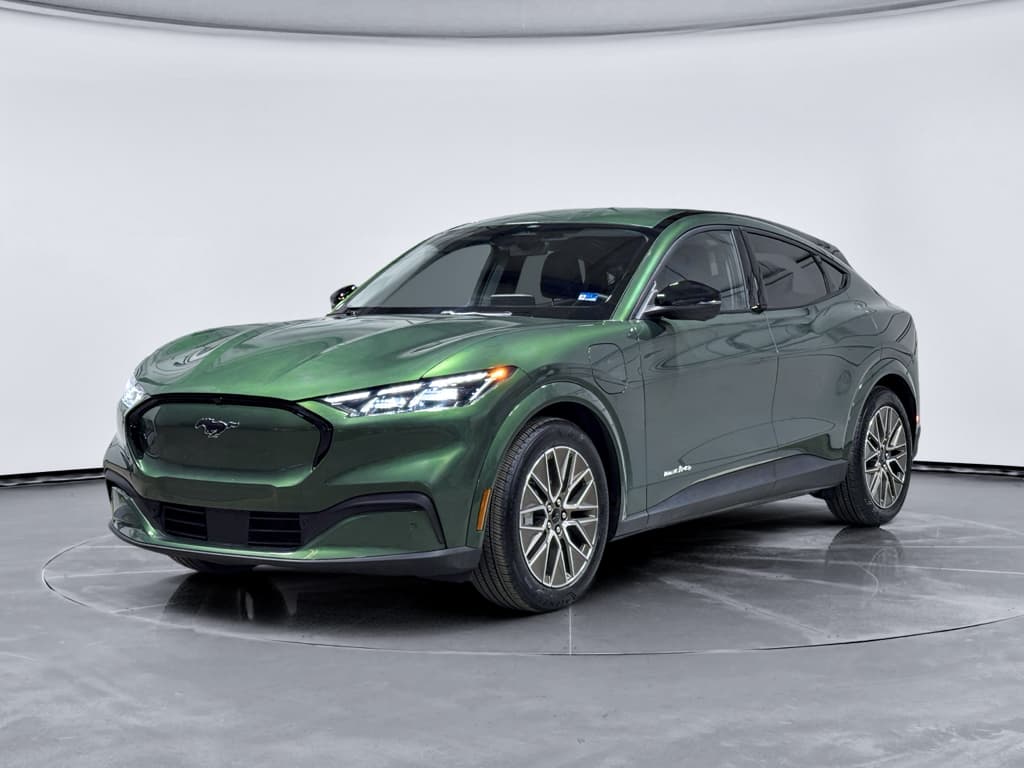
If you’re considering a Ford Mustang Mach‑E, or already own one, the real question isn’t just range or 0–60. It’s how much it costs per mile to drive. The good news: for most U.S. drivers charging at home, the Ford Mustang Mach‑E cost per mile to drive is dramatically lower than a comparable gas SUV, even with today’s higher electricity prices.
Key takeaway up front
Ford Mustang Mach‑E cost per mile: quick overview
Typical Mustang Mach‑E cost per mile (2026 snapshot)
To make this concrete, let’s use a simple baseline: many recent Mustang Mach‑E trims land around 34 kWh per 100 miles on the EPA combined cycle for extended‑range all‑wheel drive. That’s 0.34 kWh per mile. With a U.S. residential average around $0.17 per kWh, 0.34 kWh × $0.17 ≈ $0.058 per mile, or about 6 cents. Warmer climates and careful driving can bring that closer to 5 cents; cold weather, high speeds and roof racks push it toward 7–8 cents.
Rule of thumb formula
How efficient is the Mustang Mach‑E?
Before you can pin down the Ford Mustang Mach‑E cost per mile to drive, you need a handle on efficiency, how many miles you get out of each kWh. Ford offers multiple battery and drivetrain combinations, and they don’t all sip electrons at the same rate.
Approximate Mustang Mach‑E efficiency by configuration
Representative EPA‑style consumption figures for recent‑model Mach‑E trims. Your real‑world numbers will vary with weather, terrain, and speed.
| Configuration | Battery | Drive | EPA consumption (kWh/100 mi) | Miles per kWh (inverse) |
|---|---|---|---|---|
| Standard Range RWD | ~70 kWh | RWD | 31–33 | 3.0–3.2 |
| Extended Range RWD | ~91 kWh | RWD | 30–32 | 3.1–3.3 |
| Extended Range AWD | ~91 kWh | AWD | 33–36 | 2.8–3.0 |
| GT / Performance | ~91 kWh | AWD | 36–39+ | 2.6–2.8 |
Extended‑range rear‑wheel drive trims are typically the most efficient; GT and performance models trade efficiency for speed.
In day‑to‑day driving, most owners report somewhere around 2.6–3.2 miles per kWh depending on trim and climate. If you commute in mild weather at city or suburban speeds, assume the high end. If you’re pounding along at 75–80 mph in winter, use the low end when modeling your cost per mile.
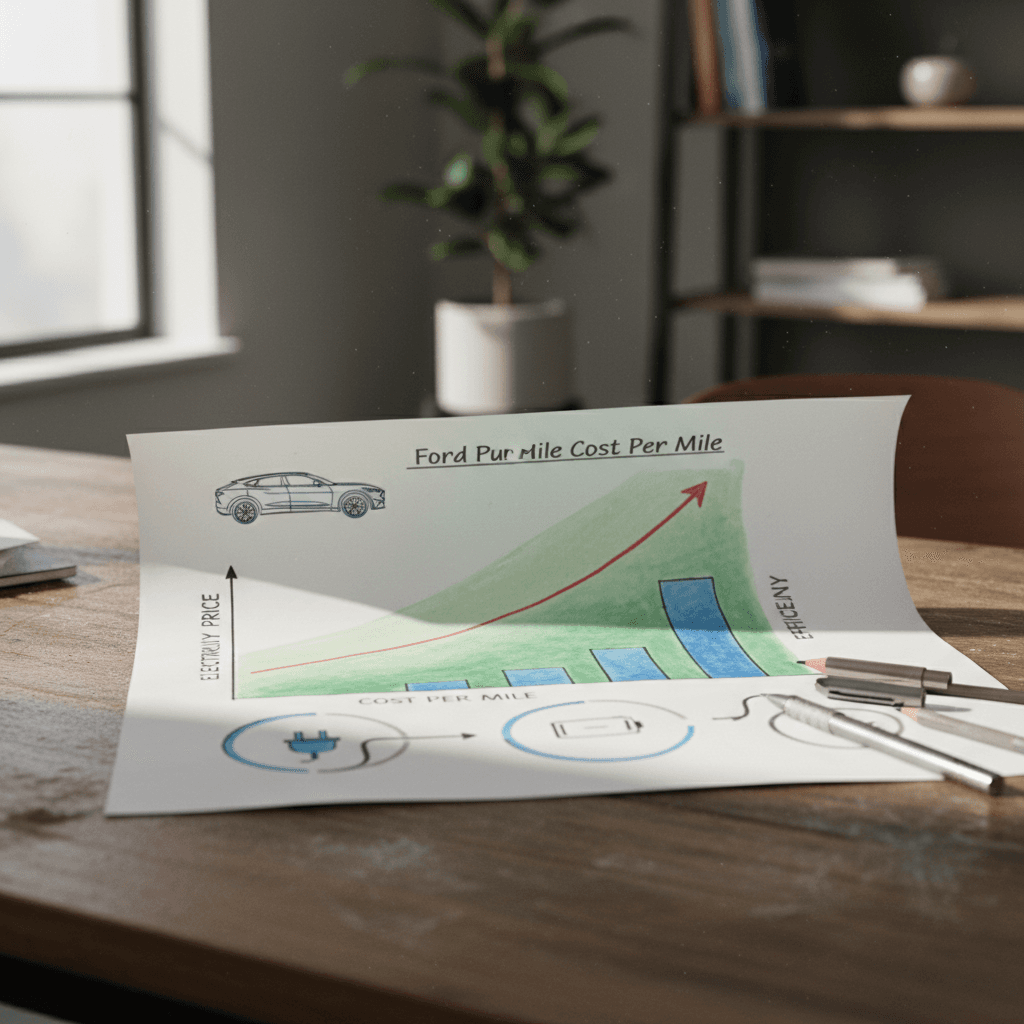
Home charging: cost per mile for a Mach‑E
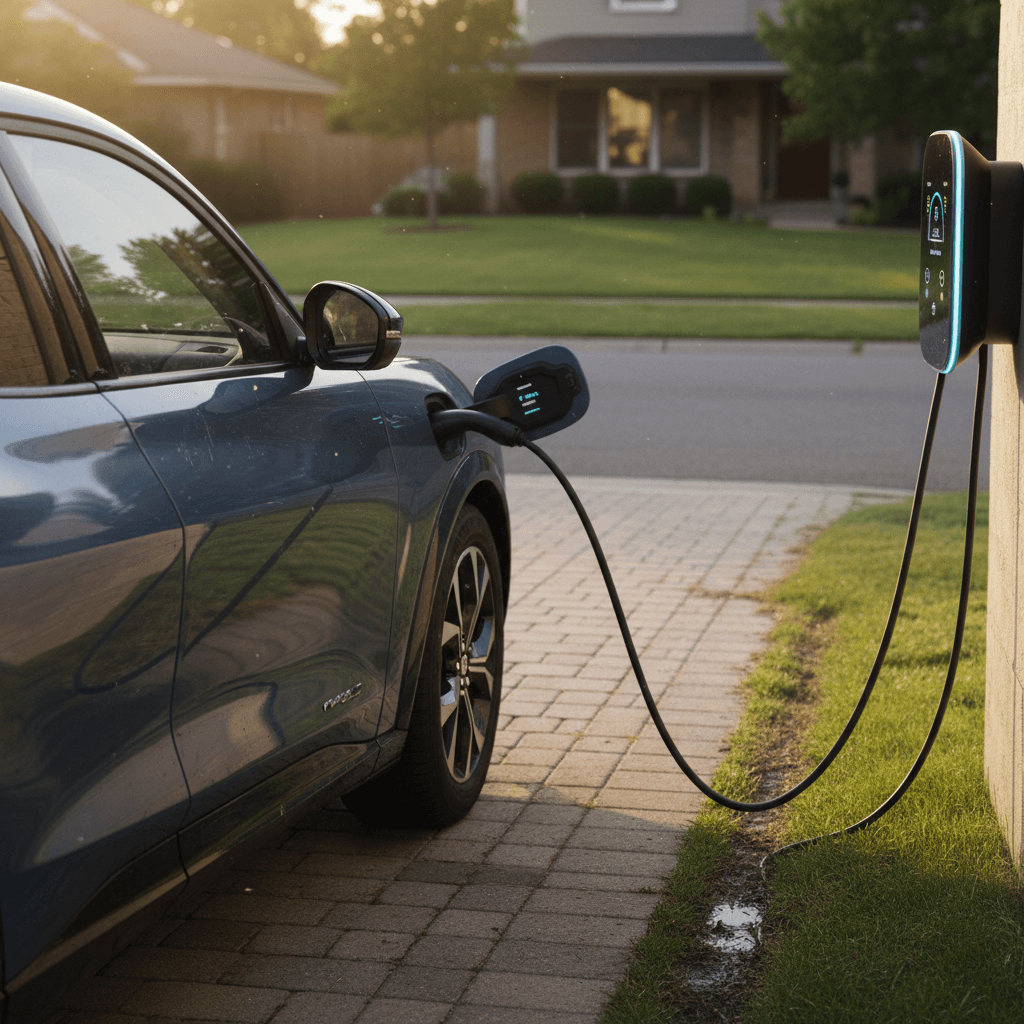
For most Mach‑E owners, home charging is where the big savings live. You’re paying your residential rate, avoiding network fees, and charging when the car is parked anyway. Let’s walk through a few realistic scenarios using that 34 kWh/100 mi baseline (0.34 kWh/mi).
Home charging cost per mile examples
Assuming 34 kWh / 100 mi (2.94 mi/kWh) as a baseline
Low‑cost power state
$0.12/kWh (many Midwest/Southern utilities):
- 0.34 × $0.12 ≈ $0.041/mi
- 1000 miles/month ≈ $41 in electricity
Average U.S. rate
$0.17/kWh (recent national residential average):
- 0.34 × $0.17 ≈ $0.058/mi
- 1000 miles/month ≈ $58
High‑cost coastal city
$0.25/kWh (common in parts of CA/NE):
- 0.34 × $0.25 ≈ $0.085/mi
- 1000 miles/month ≈ $85
Don’t forget charging losses
If you have access to off‑peak or EV‑specific rates, your cost per mile can drop even further. In some utility territories, overnight EV plans fall under $0.10/kWh, which pushes a Mach‑E down near $0.03–$0.04 per mile, cheaper than many people spend on windshield washer fluid.
Checklist: getting the lowest home cost per mile
1. Enroll in an EV or time‑of‑use rate
Call your utility or check your online account for EV‑specific or off‑peak plans. Shifting most charging to overnight can instantly cut your Mach‑E cost per mile by 20–40% in high‑rate regions.
2. Use scheduled charging
Set your Mach‑E or charger to start after off‑peak hours begin. That way you automatically refuel at the cheapest times without having to think about it.
3. Right‑size your home charger
A 40A–48A Level 2 charger is more than enough for most drivers. Oversizing the hardware doesn’t make each mile cheaper; the electricity rate is what matters.
4. Keep cable runs reasonable
If you’re installing a new circuit, minimizing distance and using proper wire gauge keeps losses low and improves efficiency slightly over years of driving.
Public DC fast charging cost per mile
If home charging is the EV equivalent of buying groceries and cooking, public DC fast charging is like eating at restaurants. It’s convenient and necessary on road trips, but you pay a premium. For many networks, posted prices today cluster between $0.35 and $0.55 per kWh, with some outliers on either side, especially in high‑cost electricity markets.
Cost per mile on paid fast charging
Using the same 34 kWh/100 mi baseline (0.34 kWh/mi):
- At $0.35/kWh: 0.34 × 0.35 ≈ $0.12/mi
- At $0.45/kWh: 0.34 × 0.45 ≈ $0.15/mi
- At $0.55/kWh: 0.34 × 0.55 ≈ $0.19/mi
Factor in charging losses and pre‑conditioning and it’s realistic to end up in the $0.13–$0.20 per‑mile range on road trips.
When DC fast costs rival gas
In high‑price regions at $0.50+ per kWh, your energy cost per mile can approach that of a reasonably efficient gas crossover. You still avoid oil changes and many other maintenance items, but don’t assume every EV mile is automatically cheaper if you rarely plug in at home.
For occasional road trips, the overall average still looks good because you’re blending a few expensive DCFC miles into many cheap home‑charged miles.
Planning to rely on public fast charging?
Mach‑E cost per mile vs a gas SUV
So how does the Ford Mustang Mach‑E cost per mile to drive compare to a conventional gasoline crossover or SUV? The cleanest comparison is to look only at fuel or energy cost per mile, then layer in maintenance.
Energy cost per mile: Mach‑E vs typical gas SUV
Simple comparison using realistic U.S. averages in 2026. Maintenance differences are discussed below the table.
| Vehicle type & scenario | Assumptions | Energy cost per mile |
|---|---|---|
| Mach‑E, home charging | 34 kWh/100 mi, $0.17/kWh | ≈ $0.06/mi |
| Mach‑E, high‑cost home power | 34 kWh/100 mi, $0.25/kWh | ≈ $0.09/mi |
| Mach‑E, mixed (70% home, 30% DCFC) | 70% at $0.17, 30% at $0.40 | ≈ $0.08–$0.09/mi |
| Mach‑E, mostly DCFC | 34 kWh/100 mi, $0.45/kWh | ≈ $0.15/mi |
| Gas SUV (28 mpg, national avg gas) | Gas $3.50/gal | $3.50 ÷ 28 ≈ $0.13/mi |
| Gas SUV (28 mpg, high gas prices) | Gas $4.50/gal | $4.50 ÷ 28 ≈ $0.16/mi |
Even with elevated electricity prices, a home‑charged Mach‑E usually wins on pure energy cost per mile.
On fuel alone, a home‑charged Mach‑E at average U.S. power prices tends to land at roughly half the cost per mile of a 28‑mpg gas SUV. When you stack on reduced maintenance, no oil changes, fewer brake jobs thanks to regen, fewer moving parts, the gap widens over a six‑ to ten‑year ownership window.
Where used Mach‑E shines
5 factors that change your Mach‑E cost per mile
- Your local electricity price (and whether you charge mostly at home or in public)
- Your Mach‑E trim (RWD vs AWD, standard vs extended range, GT vs non‑GT)
- Driving style and speed (steady 65 mph vs 80 mph, smooth vs aggressive)
- Climate and use of HVAC (cold winters and very hot summers increase consumption)
- Battery health and how often you fast‑charge or sit at 100%
How each factor moves your cost per mile
Use these to adjust the rough $0.05–$0.07 home‑charging baseline
1. Electricity price
Biggest lever. Doubling your rate from $0.13 to $0.26/kWh almost doubles your energy cost per mile. This is why shopping utility plans matters more than obsessing over tiny efficiency gains.
2. Trim & drivetrain
Extended‑range RWD trims tend to be the most efficient. GT and performance models trade efficiency for acceleration. AWD often adds a few kWh/100 mi, nudging your cost per mile up by a cent or two.
3. Speed & driving style
Above ~65 mph, aero drag climbs quickly. Sit at 80 mph with aggressive passing and your consumption can jump 20–30%, turning a $0.06/mi car into a $0.08/mi car even at the same electricity rate.
4. Weather & HVAC
Cold‑soaked batteries in winter and heavy A/C use in summer both increase kWh/100 mi. In very cold climates, it’s normal to see winter cost per mile 30–40% higher than your mild‑weather baseline.
5. Battery health & DCFC use
Normal degradation (say, 5–10% over many years) has a modest impact, but heavy DC fast charging can increase both energy use and long‑term battery wear, which shows up in total cost per mile when you eventually sell or trade in.
6. Access to home/work charging
The more miles you can refuel at home or a low‑cost workplace charger, the lower your blended cost per mile. Owners who can almost always plug in cheaply see the biggest savings versus gas.
Used Mustang Mach‑E: cost per mile over the long run
From a total‑cost‑of‑ownership standpoint, a used Mustang Mach‑E can be especially compelling. The energy cost per mile is already low; the open question for many shoppers is battery health and long‑term value. That’s where buying from an EV‑focused retailer like Recharged changes the calculus.
Why used can lower cost per mile
- Depreciation front‑loaded: Early‑year value drops are absorbed by the first owner, so you pay less for each future mile.
- Energy cost stays low: Electricity doesn’t care if the car is brand‑new or five years old; your $0.05–$0.07 home‑charging cost per mile is similar.
- Maintenance stays modest: Even as the vehicle ages, no timing belts, spark plugs, or exhaust systems appear on the schedule.
How Recharged helps you quantify it
Every Mach‑E sold through Recharged includes a Recharged Score Report with verified battery health and fair‑market pricing. That lets you estimate future range and cost per mile with much more confidence than buying a used EV blindly.
Recharged also offers financing, trade‑in options, and nationwide delivery, so you can run the numbers on a used Mach‑E entirely online and see how it stacks up against your current gas vehicle on a per‑mile basis.
Pro move: calculate your all‑in cost per mile
Practical ways to lower your Mach‑E cost per mile
Cost‑cutting playbook for Mach‑E owners
1. Maximize cheap charging opportunities
Prioritize home charging on an EV‑friendly electricity plan. If your workplace offers free or discounted Level 2 charging, treat that as your primary fuel source and reserve DC fast charging for trips.
2. Drive at the speed of efficiency
You don’t have to hypermile, but holding closer to 65–70 mph instead of 80 mph on the highway can trim 10–20% off consumption, effectively lowering your cost per mile without touching your rate plan.
3. Pre‑condition on the plug
In cold weather, pre‑heat the cabin and battery while the Mach‑E is still plugged in. That way, the grid (not the traction battery) pays the penalty, and your on‑road efficiency remains higher.
4. Keep tires properly inflated
Under‑inflated tires create extra rolling resistance. A few PSI low might not sound like much, but across tens of thousands of miles it’s effectively a stealth tax on your cost per mile.
5. Plan charging stops strategically
On road trips, charging from about 10–70% is usually more efficient and cheaper per kWh if your network has session fees or demand‑based pricing. Lingering to 90–100% often costs more time and money.
6. Leverage apps for pricing
Use charging apps to compare network prices along your route. Swapping a $0.55/kWh stop for a $0.35/kWh alternative can save several dollars per charge and meaningfully reduce trip‑average cost per mile.
Watch out for idle and session fees
Ford Mustang Mach‑E cost per mile: FAQ
Frequently asked questions about Mach‑E cost per mile
Bottom line: what you should budget per mile
When you cut through the noise, the story is straightforward: for a typical U.S. driver with access to home charging, the Ford Mustang Mach‑E cost per mile to drive usually falls between $0.05 and $0.07 for electricity, with public fast‑charging miles costing more and gas‑equivalent SUVs often sitting in the $0.13–$0.16 range just for fuel.
Your exact number will depend on your electricity rate, trim, climate, and how often you need DC fast charging. But in most realistic scenarios, especially if you buy a well‑vetted used Mach‑E with documented battery health, the Mach‑E delivers a compelling blend of performance and low operating cost per mile. If you’re ready to put hard numbers to your own situation, you can browse used Mach‑E inventory, get a Recharged Score Report, and even pre‑qualify for financing online, all before you step into a showroom or schedule a test drive.