What do Recharged’s EV sales figures show?
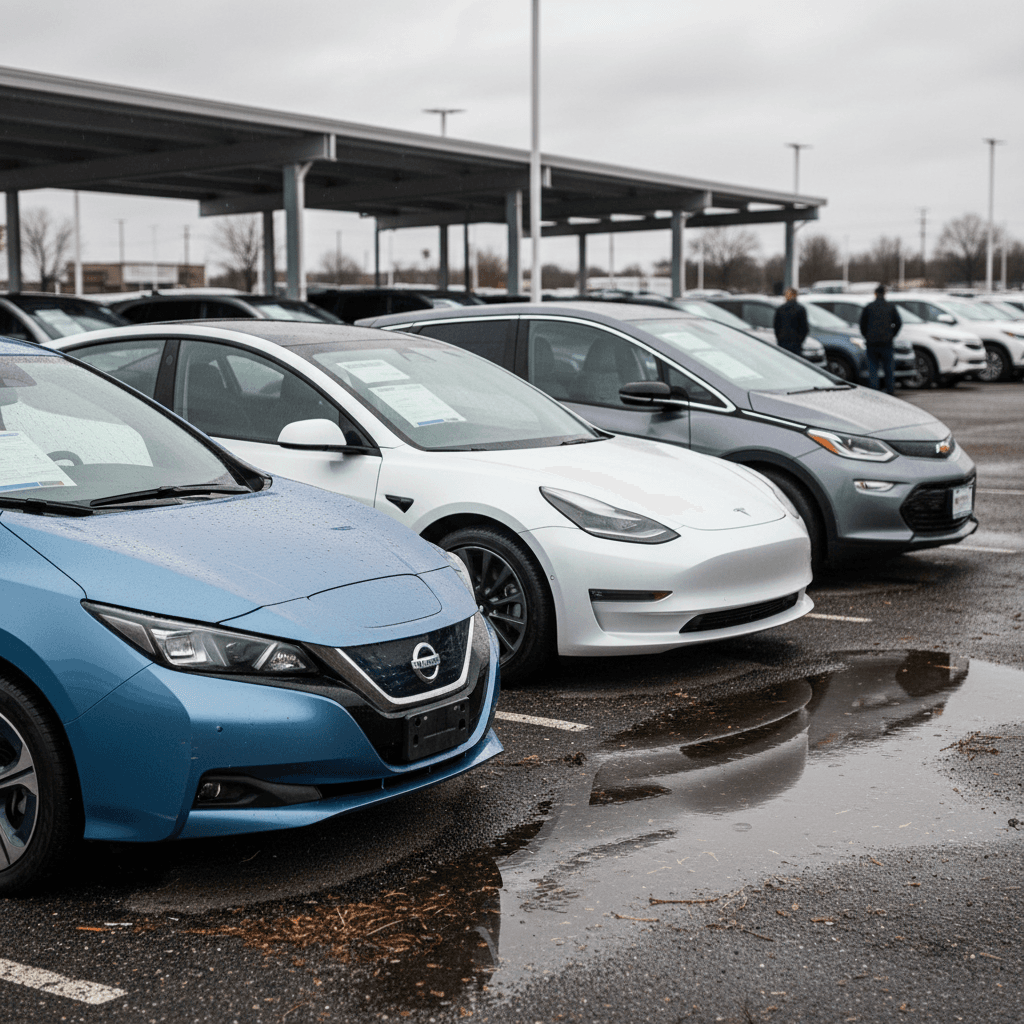
Recharged’s trailing 12-month data shows a broad used-EV retail market with a $27,297 median sale price across 1,796 completed sales. Buyers paid an average of $29,901, which sits above the median because higher-priced vehicles pull the average upward. These are retail transaction prices, the amounts buyers paid at Recharged, not asking prices, seller payouts, discounts, or a measure of the entire U.S. EV market.
Scope of the 2026 statistics
That scope is important because broad EV headlines often combine new vehicles, used vehicles, registrations, deliveries, and manufacturer estimates. Recharged’s dataset measures one specific outcome: completed used-EV retail sales. For a shopper, that makes it useful for understanding what buyers actually paid rather than what sellers initially advertised.
Recharged data
Used EV battery health
94%
avg remaining capacity
From Recharged battery inspections, not manufacturer estimates.
- Lowest
- 63%
- Median
- 95%
- Highest
- 100%
- Est. range
- 266 mi avg
- Cell balance pass
- 100%
- Quick charges
- 18 avg
- Slow charges
- 65 avg
Average cell imbalance: 7.3 mV
Based on vehicles Recharged tested
Recharged data
Recent EV sold prices
$27,297
median sold price
What buyers actually paid through Recharged, not list price.
- Lowest
- $500
- Average
- $29,901
- Highest
- $129,998
Monthly median sold price
Based on Recharged sales in the last 12 months
Every EV is battery-tested with a Recharged Score. Nationwide delivery.
Retail prices fell early, then climbed
Monthly median prices reached an early-year low before moving higher through the later months in Recharged’s data. The median was $29,049 in October 2025, fell to $23,928 in February 2026, reached $27,699 in June, and stood at $28,922 in August. The September-to-date median was $30,998 as of the September 22 snapshot, so it represents an incomplete month rather than a final September result.
The direction of the median doesn’t prove that every used EV appreciated. The vehicles sold each month can differ by model, age, mileage, equipment, and condition, so changes in the inventory mix can move the median. You should read the trend as evidence that Recharged’s completed-sale mix shifted toward higher retail prices after February, not as a promise that a particular vehicle will follow the same path.
Battery health changes what a sales count can tell you
Battery diagnostics add essential condition data that a price or sales count can’t provide. Across 2,242 Recharged Score inspections, the median tested remaining capacity was 94.9% of original capacity, while the average was 93.9%. Median tested real-world range was 268 miles, and the average was 266 miles across the inspected fleet.
With an EV, there’s more technology and battery information to understand, so we pull market value, vehicle history, and battery health together to help buyers decide whether a car is worth considering.
Those battery and range figures describe a varied group of vehicles, not the expected result for every EV. Remaining capacity measures how much energy the battery can hold compared with when it was new, while tested range is also affected by vehicle design, battery size, temperature, speed, and accessory use. If you’re comparing cars, review the individual vehicle’s diagnostic report and learn how used-EV battery health is measured instead of relying on a fleet average alone.
The policy break matters when reading the trend
These monthly price observations cover the period after the former federal new- and used-EV tax credits expired. The credits ended for vehicles acquired after September 30, 2025, and Recharged’s monthly trend begins in October 2025. That makes this a post-credit retail dataset rather than a continuation of the incentive-supported market that came before it.
As the tax credit approached expiration, buyers pulled a lot of demand forward from the fourth quarter into the third quarter, and the available inventory became harder to replace.
That timing complicates year-over-year comparisons because the market crossed a significant policy boundary. A burst of purchases before expiration can leave fewer near-term buyers afterward, while inventory assembled for credit eligibility may also change. You therefore shouldn’t interpret the early-2026 low or later increase as the product of a single cause without model-level, age, mileage, and inventory-mix analysis.
Don’t subtract a federal credit
How should you use these statistics?
Use the figures as market context, then evaluate the price and condition of the specific EV you’re considering. A median tells you where the middle completed transaction landed, but it doesn’t account for every difference between two vehicles. The strongest comparison combines transaction data with battery diagnostics, history, mileage, equipment, and current financing costs.
A practical used-EV data checklist
Start with completed prices
Use retail sale prices as market evidence, not advertised asking prices or projected values.
Check the inventory mix
Compare vehicles of similar age, mileage, model, equipment, and condition before drawing a conclusion.
Verify the battery
Review tested remaining capacity and real-world range for the individual EV, not just a fleet-wide average.
Build a current budget
Compare the full price and financing terms without assuming a federal EV tax credit is available.
If you’re new to electric vehicles, a structured used-EV buying process can help you separate meaningful data from marketing claims. You can also review what determines real-world EV range and compare financing based on the total amount paid, not only the monthly payment. The goal isn’t to find a vehicle that matches the fleet median exactly; it’s to determine whether a specific vehicle offers fair value for its verified condition.
Instant offer, trade-in, or consignment. Pickup available.
EV sales statistics FAQ
The useful takeaway is quality-adjusted value
The strongest reading of the data is that used-EV value can’t be reduced to sales volume or price alone. Recharged’s completed transactions show the direction of retail pricing, while its battery inspections reveal how much capacity and tested range the vehicles retained. When you combine those measures through a Recharged Score Report, you get a more useful answer to the question that matters: whether a particular EV is fairly priced for its actual condition.