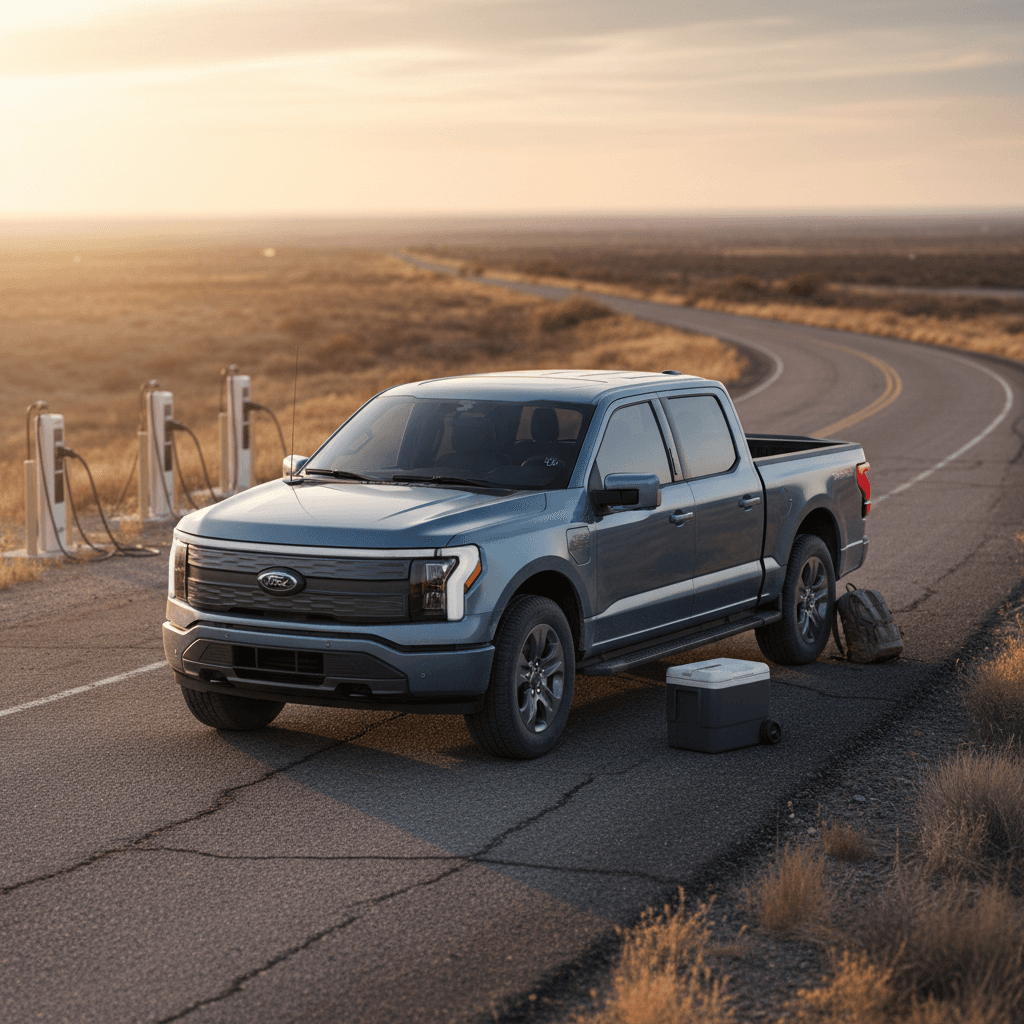
The window sticker on a Ford F-150 Lightning looks reassuring: up to around 320 miles of EPA-estimated range for extended-range models, and roughly 230–240 miles for standard-range trucks. But if you’re reading this, you already know the real question isn’t what it does in a lab. It’s what the F-150 Lightning’s real-world range looks like in 2026, on the highway, in winter, and with a trailer hooked up.
Quick take
Why real-world range matters more than EPA numbers
The EPA test cycle is a useful benchmark, but it’s not built around a 6,000‑plus‑pound pickup with a bluff nose and a 24-foot camper in tow. Ford’s advertised range for the F-150 Lightning, up to about 320 miles for 2024–2025 extended-range 4WD models, comes from a mixed city/highway cycle at moderate speeds and without heavy loads. In 2026, many owners are discovering a familiar reality: how and where you drive matters as much as which battery you choose.
- The EPA number assumes moderate speeds, limited hard acceleration, and no trailer.
- Electric trucks suffer more range loss at highway speeds and in cold weather than smaller, slipperier EVs.
- Payload and towing hit range twice: extra weight and more aerodynamic drag from the trailer’s big frontal area.
Don’t compare to small EVs
EPA range vs 2026 real-world results
F-150 Lightning range at a glance (2024–2025 trucks in 2026)
Ford hasn’t radically changed the Lightning’s battery choices going into the 2026 model year. You’ll still see two main packs in the wild:
Typical EPA vs. real-world range for F-150 Lightning
Approximate ranges for 2024–2025 4WD trucks as seen in 2026 driving, assuming a healthy battery and reasonable driving habits.
| Configuration | EPA combined range | Real-world mixed driving (suburban/city + some highway) | Real-world highway (70–75 mph, no trailer) |
|---|---|---|---|
| Standard-range (SR) 4WD | ~230–240 mi | ~190–230 mi | ~150–190 mi |
| Extended-range (ER) 4WD, 18–20" wheels | ~300–320 mi | ~240–320 mi | ~200–250 mi |
| Extended-range (ER) Platinum / 22" wheels | ~280–300 mi | ~220–280 mi | ~190–230 mi |
Real-world numbers are averages and can vary significantly with speed, weather, load, and wheel/tire choice.
Look at efficiency, not just miles
City vs highway: how speed shapes F-150 Lightning range
In-town and mixed commuting
In stop-and-go driving, the Lightning is in its element. Regenerative braking recovers energy, and speeds stay low enough that the truck’s bricklike aerodynamics don’t punish you.
- Many owners report meeting or slightly beating EPA range in mild weather on suburban routes.
- Mid‑2s mi/kWh (2.3–2.7) is common around town, especially in 35–55 mph zones.
- Heat pumps and preconditioning help minimize winter losses in newer builds.
Highway and long-distance cruising
Crank the cruise control to 75 mph and the story changes. Air resistance climbs fast with speed, and the Lightning’s frontal area works against you.
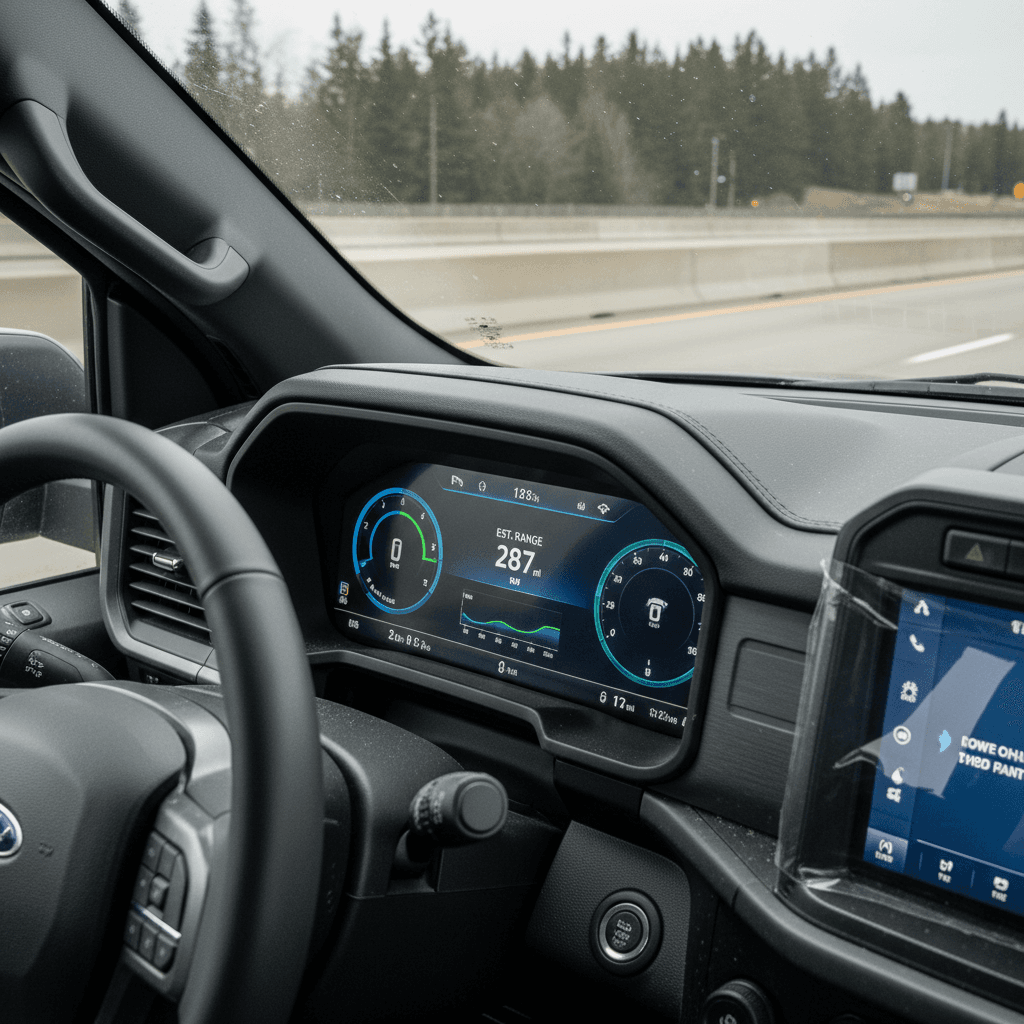
- At 70–75 mph, it’s normal to see 20–35% less range than the EPA sticker suggests.
- Efficiency often drops to ~2.0 mi/kWh or a bit less, especially with large wheels.
- Stick closer to 65 mph and you can claw back 20–40 extra miles per charge on an ER truck.
Sweet spot speeds
Towing and hauling: what you really get
Ford advertises up to 10,000 pounds of towing capacity with the right F-150 Lightning configuration. The truck can absolutely pull it, but you pay at the plug. Independent testing and owner reports through 2025 consistently show highway towing cutting range roughly in half, sometimes more, depending on trailer size and speed.
Common 2026 towing scenarios and range expectations
Assuming an extended-range 4WD Lightning with a healthy battery, starting near 100% state of charge.
Light utility trailer (~2,000–3,000 lb)
- At 60–65 mph, many owners see 150–200 miles between charges.
- Plan on 40–50% less range vs. driving empty at the same speed.
Mid-size travel trailer (~4,500–6,000 lb)
- Third‑party tow tests at 70 mph have seen ~100 miles of usable range before needing to recharge.
- That’s often about one‑third to one‑half of the advertised EPA number.
Work trailer & payload mix
- Mixing tools in the bed and a small trailer? Expect something between the two extremes.
- With smart speed management, 120–170 miles per charge is a reasonable planning target.
The 100‑mile towing bubble
Checklist: getting the best towing range from your Lightning
1. Slow down a notch
Dropping from 72–75 mph to 62–65 mph can easily add 20–40 miles of towing range with a mid‑size trailer.
2. Mind your trailer shape
A low, streamlined trailer punishes your range far less than a tall, square RV. Height and frontal area matter more than the weight on the spec sheet.
3. Precondition while plugged in
If your truck and route planner support it, warm or cool the battery and cabin while you’re still connected to home power to avoid burning precious range at the start of your tow day.
4. Use truck-friendly chargers
Plot DC fast chargers with pull‑through or trailer‑friendly layouts so you don’t waste time dropping the hitch for every stop.
5. Start your day high
Leave with as full a battery as practical. With towing, burning the top 20–30% of the pack happens quickly.
Weather, load, and terrain factors that eat into range
- Cold weather: Below freezing, a Lightning can easily lose 20–35% of its range to cabin heating and a colder, less efficient battery, especially on short trips where the truck never fully warms up.
- Summer heat: A/C is less punishing than heat, but 95°F days still take a noticeable bite, particularly at highway speeds.
- Big wheels and tires: Platinum and other trims with 22‑inch wheels typically see less range than ER trucks on smaller wheels.
- Elevation and headwinds: Long climbs and strong headwinds combine with the truck’s big nose to hammer highway efficiency.
- Payload: A bed full of gear matters less aerodynamically than a big trailer, but weight alone still trims a chunk of range, especially around town.
Winter driving trick
Real owner experiences in 2026
By 2026, thousands of 2022–2025 F-150 Lightnings have real miles under their wheels, and a clear pattern has emerged. Owners who treat the truck like a traditional F-150, high speeds, frequent heavy towing, little planning, tend to be the ones most surprised by the range hit. Owners who drive it like a big, fast EV generally report that it does what they expected, and sometimes more.
Three common Lightning owner range stories
If you’re cross-shopping or considering a used Lightning, you’ll probably see yourself in one of these.
Suburban commuter
Profile: 30–60 mile round trip, mostly 45–65 mph, rarely tows.
- Reports meeting or modestly beating EPA range in spring and fall.
- Charges mostly at home; public DC fast charging is rare.
- Winter still stings, but trips are short enough that it’s no drama.
Highway road-tripper
Profile: 200–400‑mile days at 70–75 mph, family trips, occasional light trailer.
- Sees 65–80% of EPA on long highway days without a trailer.
- Plans to stop every 150–200 miles for a fast charge.
- Uses route planners that understand truck charging speeds and networks.
Weekend tower
Profile: Pulls a 4,000–6,000 lb camper or enclosed trailer 3–10 weekends a year.
- Plans for ~100–150 miles between DC fast charges depending on trailer and speed.
- Uses a second gas truck or rental for the longest hauls.
- Happy with the Lightning the other 90% of the time, especially around town.
Every electric pickup plays the same game: the brochure shows big tow numbers, the real world shows big range penalties. The owners who fall in love with their Lightnings are the ones who match the truck’s strengths to their lives instead of the other way around.
How to plan trips with an F-150 Lightning in 2026
Planning a trip in a Lightning isn’t hard, but it does reward the kind of mindset long‑time RV owners already have: know your route, know your fuel stops, and build in some buffer. The good news in 2026 is that the DC fast‑charging landscape for non‑Tesla EVs is improving, and more Ford owners can tap into Tesla’s Supercharger network with the right adapter or built‑in NACS port, depending on model year.
Step-by-step: planning a Lightning road trip
1. Start with honest range assumptions
For highway days without a trailer, use <strong>70–80% of your EPA number</strong> as a planning baseline. With a mid‑size trailer, plan around <strong>35–60%</strong> depending on speed and weather.
2. Use EV-aware route planners
Apps that understand charging speeds and networks, rather than generic map apps, will give you realistic stop timing and charger options.
3. Target 10–70%, not 0–100%
Fast chargers work best in the middle of the battery. Stopping more often and charging from ~10–70% can be <strong>faster overall</strong> than stretching to 90–100% every time.
4. Check charger layouts
When you’re towing, filter for <strong>trailer‑friendly sites</strong> with pull‑through bays or easy access, so you’re not stuck dropping the hitch in a crowded parking lot.
5. Watch your consumption live
Keep an eye on the Lightning’s mi/kWh readout during the first leg of your trip. If it’s worse than you expected, adjust your speed or your next stop while you still have options.
6. Have a Plan B
On unfamiliar routes, identify a backup charger or two within 20–30 miles of your primary target in case a site is busy or offline.
Used F-150 Lightning buying tips: battery health and range
With Ford winding down the original fully electric F-150 Lightning and pivoting toward an extended‑range plug‑in version, the used market for today’s trucks will only get more important. That’s good news if you want an all‑electric pickup at a more approachable price, but you’ll want to go in with your eyes open about battery health, range, and how the truck was used.
What to look for in a used F-150 Lightning
Battery health, equipment, and history matter more than paint colors.
1. Verify battery health
Ask for documentation of the truck’s state of health and charge history. At Recharged, every Lightning comes with a Recharged Score Report that includes independent battery diagnostics, so you can see how much usable capacity is left instead of guessing.
2. Understand its past life
Was this a commuter, a work truck, or a dedicated tow rig? A lightly used suburban truck that rarely fast‑charged will generally hold range better than one that lived on DC fast chargers with a heavy trailer.
3. Match range to your reality
If your daily needs are under 80 miles, a healthy standard‑range truck can be a great value. If you want to road trip or tow regularly, you’ll appreciate the extended‑range battery, and you should budget accordingly.
4. Factor in incentives and financing
Used EV tax incentives and EV‑friendly financing can improve the math. Recharged can help you compare offers, value your trade‑in, and arrange nationwide delivery so you can focus on choosing the right truck, not chasing paperwork.
Why a third-party battery report matters
How Recharged tests and rates F-150 Lightning range
On paper, every Lightning looks like a superhero: big tow numbers, fast 0–60 times, and official range figures that rival long‑legged gas trucks with oversized tanks. At Recharged, we’re more interested in what the truck delivers when you’re late for work, it’s 25°F outside, and there’s a headwind coming home with the trailer.
1. Controlled efficiency runs
We run repeatable highway loops at fixed speeds, typically 65 mph and 75 mph, on the same sections of road. That lets us compare trucks directly and translate mi/kWh into realistic highway ranges.
2. Mixed-use scenarios
Our testers cycle through city, suburban, and rural two‑lane routes to see how the Lightning behaves when life isn’t a straight line. We log temperature, elevation, and driving style so we can tell you where the truck shines and where it needs more planning.
3. Battery health diagnostics
Using specialized tools, we measure a truck’s usable capacity and charging behavior over time. That data feeds into each vehicle’s Recharged Score, so you can compare one used Lightning to another with confidence.
Shopping used? Lean on the data.
Ford F-150 Lightning real-world range 2026 FAQ
Frequently asked questions about F-150 Lightning real-world range in 2026
Bottom line: is the F-150 Lightning’s range enough for you?
By 2026, the Ford F-150 Lightning has proven what many early adopters suspected: as a daily driver and occasional tower, its real-world range is more than enough for a lot of Americans. As a long‑distance tow rig running flat‑out across three states in a day, it still asks you to slow down and plan ahead. If you’re honest about how you actually use a truck, how far, how fast, how often you tow, you’ll know quickly whether the Lightning’s real numbers line up with your life.
If they do, the used market is becoming one of the smartest ways to get into an electric pickup. With tools like the Recharged Score battery health report, transparent pricing, EV‑savvy financing, and nationwide delivery, shopping a used F-150 Lightning through Recharged can give you the truck you want and the range you need, without crossing your fingers every time you leave the driveway.