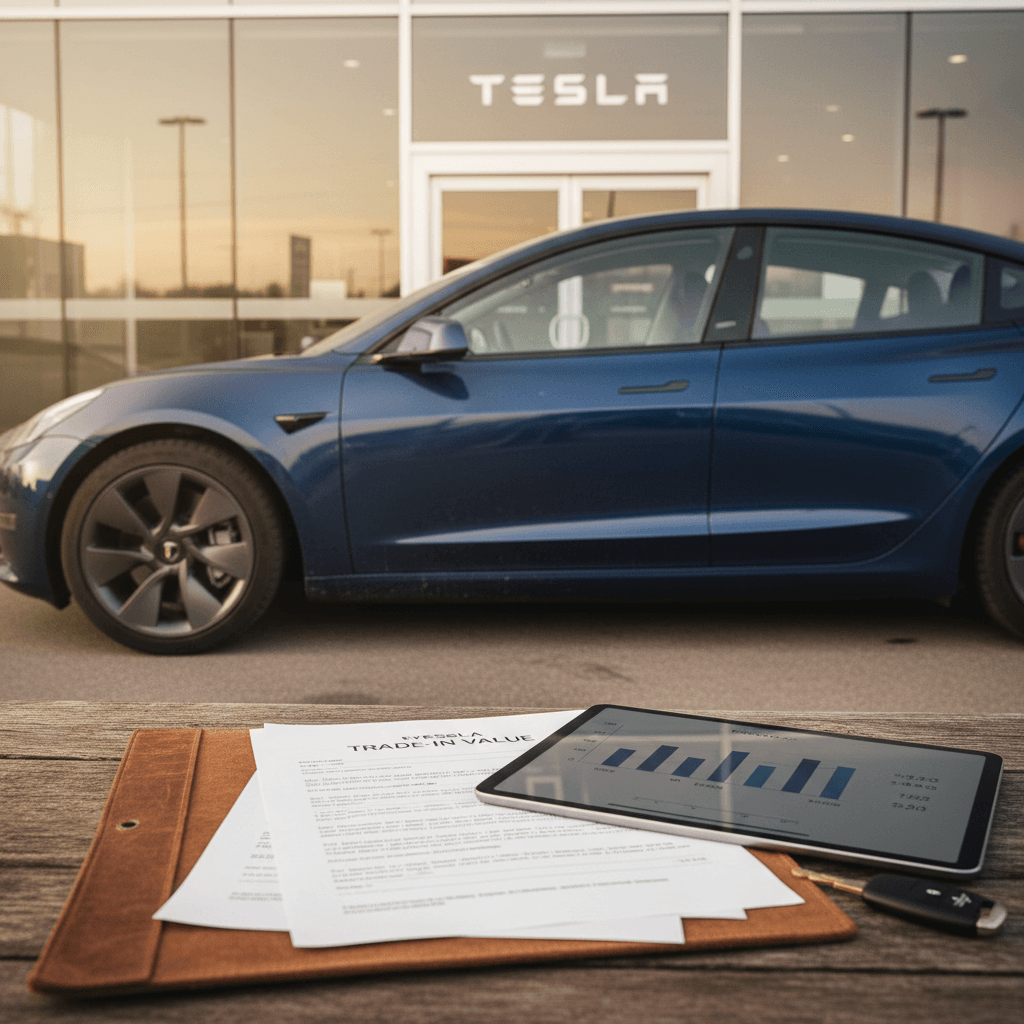
You bought a 2024 Tesla Model 3, enjoyed the new interior and the sharper styling, and now you’re staring down a trade-in quote that feels…punishing. The 2024 Tesla Model 3 trade-in value story is complicated: falling new prices, heavy depreciation, and wildly different offers depending on where you shop it. The good news is you have more leverage than you think, especially if you understand how buyers are really pricing your car.
Quick snapshot
2024 Tesla Model 3 trade-in value basics
Before you haggle over the last $500, it helps to pin down what value we’re actually talking about. When people google “2024 Tesla Model 3 trade in value,” they’re usually mixing three different numbers:
- Trade-in value: what a dealer or retailer will credit you if you hand them your Model 3 and buy something else from them. This is usually the lowest number, but it can reduce your sales tax bill in many states.
- Wholesale / auction value: what that same dealer thinks they could get if they dump your car at auction next week. This is the invisible floor under every offer.
- Private-party value: what you might get selling the car yourself to another human being. This is usually the highest number, but it costs you time and effort.
Online guides (KBB, Edmunds, etc.) are useful anchors, but actual offers on a 2024 Model 3 are now dancing to a different drummer: Tesla’s nonstop price moves on new cars, rising used supply, and skittish lenders around EVs. Your goal isn’t to win a theoretical price-guessing contest. It’s to understand the **realistic range** for your car and then push toward the top of it.
2024 Model 3 value snapshot (early 2026, U.S.)

How much is a 2024 Tesla Model 3 worth on trade-in today?
Let’s pin this down to ballpark ranges as of spring 2026 in the U.S. We’ll assume average mileage (around 12,000–15,000 miles per year), clean title, no major accidents, good tires, and no glaring cosmetic damage.
Typical 2024 Tesla Model 3 trade-in ranges (U.S., early 2026)
Approximate wholesale / trade-in value ranges assuming clean condition and average miles. Your exact number will vary by region, color, options, and market mood.
| Trim | Typical mileage | Rough trade-in range | Notes |
|---|---|---|---|
| RWD (base) | 15,000–25,000 mi | $26,000–$29,000 | Cheapest to buy new; used values compressed by Tesla price cuts. |
| Long Range AWD | 15,000–25,000 mi | $28,000–$32,000 | Still the sweet spot: extra range and AWD help resale. |
| Performance | 10,000–20,000 mi | $30,000–$35,000 | Enthusiast demand keeps these stronger, especially with clean wheels and tires. |
Use this as a sanity check, not a promise. The same car can draw very different offers depending on who you ask.
These are ranges, not guarantees
On the retail side, you’ll often see those same cars advertised in the **high-$20,000s to low-$40,000s**, depending on options like Long Range, Performance, paint, wheels, and any software packages. That spread, what you see on the lot versus what you’re offered, is where every dealer tries to pay for reconditioning, auction fees, profit, and a cushion against further depreciation.
What actually drives your 2024 Model 3 trade-in value?
Four big levers on 2024 Model 3 trade-in value
You can’t control the whole market, but you can manage these.
1. Mileage & usage
2. Condition & history
3. Battery health & charging habits
4. Trim, options & market timing
Why Recharged cares so much about battery health
Depreciation: how fast is your 2024 Model 3 losing value?
If you feel like your 2024 Model 3 has aged like a banana in the sun, you’re not wrong. Tesla’s aggressive new‑car price cuts and a wave of off‑lease cars have put unique downward pressure on used prices. Early data on facelifted 2024 models shows some owners seeing **30–40% of value disappear in the first 12–24 months**, especially on higher‑MSRP builds.
- On a base RWD car that stickered around **$39,000–$41,000**, a trade-in in the high-$20,000s means you’ve already eaten roughly $10,000–$13,000 in depreciation.
- On a Performance model that easily cleared **$55,000** with options, a mid‑$30,000s trade-in means the hit can be closer to **$18,000–$20,000** in under two years.
Don’t chase a falling knife
The flip side: compared with many early EVs, the Model 3 still holds value reasonably well over a longer horizon. Once the first big drop is behind you and the market stops whipsawing, the curve tends to flatten. If you’re only a year in and the numbers hurt, it may simply be too early to sell, unless you absolutely need out.
Real-world offers vs price guides (why they don’t match)
You punch your VIN into a price guide, see a comforting trade-in estimate of $29,000, then your first real offer comes in at $25,500. Is the dealer ripping you off? Maybe. But there are structural reasons **EV trade-in offers often lag the pretty numbers on your screen**.
How guides see your 2024 Model 3
- They blend auction data, recent retail sales, and historical depreciation curves.
- They assume a “typical” buyer appetite and a relatively stable new-car price.
- They don’t fully adjust in real time when Tesla slashes MSRPs or floods the used market.
How buyers see your 2024 Model 3
- They have to own the risk of further price drops and softening demand.
- They factor in reconditioning costs, auction fees, transport, and profit.
- They’re wary of battery uncertainty and lender skepticism around EV residuals.
Use guides as a compass, not a contract
How to boost your 2024 Model 3 trade-in offer
You can’t talk a $26,000 car into being worth $36,000. But you can absolutely move yourself from the bottom of the range to the top. Think less like a desperate seller and more like someone packaging a compelling asset.
Seven moves that usually add real dollars
1. Fix the easy cosmetic stuff
You don’t need a concours restoration. But repairing curb‑rashed wheels, major paint scuffs, and cracked glass can remove obvious bargaining chips from the buyer’s hand. A $250 wheel repair that moves your offer by $750 is money well spent.
2. Detail it like a retail car
A professional interior and exterior detail makes your 2024 Model 3 look more like a value‑adding asset and less like someone’s stressed‑out commuter pod. Buyers are still human; first impressions move numbers.
3. Gather every service and charging record you can
Print or save your service history, tire receipts, and any documentation that shows you didn’t abuse fast charging or neglect basic upkeep. With EVs, perceived **battery care** is the new oil‑change logbook.
4. Present a clean history report up front
If your Carfax is clean, bring it. If there was a minor bumper scrape properly repaired, be ready to explain it calmly. Buyers hate surprises more than they hate minor repairs.
5. Time your sale around demand, not panic
Tax‑credit rule changes, new‑model launches, and interest‑rate shifts can all punish or reward your timing. If you’re not forced to sell in the next 30 days, grab offers across a 2–3 month window and watch how they move.
6. Shop your car beyond Tesla’s trade-in
Tesla’s own trade-in bids can be surprisingly soft, especially if they’re already overstocked on your exact spec. Online buyers, used‑car superstores, and EV‑focused platforms like <strong>Recharged</strong> often see more value in a clean 2024 Model 3 than Tesla does.
7. Get a battery health report
A third‑party or marketplace‑provided battery health report (like the <strong>Recharged Score</strong>) can move you out of the “mystery EV” bucket. If your pack is healthier than average, that’s real money.
Where to sell: Tesla trade-in vs CarMax vs Recharged
The easiest offer is rarely the best one. Each type of buyer is playing a different game with your 2024 Model 3. Understanding their incentives helps you decide whether to take the quick exit or squeeze out a few more thousand dollars.
Common ways to move a 2024 Model 3
What you gain, and what you give up, with each option.
Tesla trade-in
- Pros: Seamless if you’re buying another Tesla; paperwork is simple; you roll equity (or negative equity) straight into the new deal.
- Cons: Often one of the lower offers; they may be long on your exact spec; little appetite for negotiation.
Big-box used retailers
- Pros: Instant offers, fast transactions, you don’t have to list or show the car.
- Cons: They’re not EV specialists; many price to cover for battery risk and future value swings.
Recharged (EV specialist)
- Pros: Built around used EVs; we verify battery health, market the car nationwide, and back it with a Recharged Score report so buyers pay real value for your specific car, not an average Tesla.
- Cons: If you consign instead of taking an instant offer, you wait for the right buyer, but usually at a stronger net number.
How Recharged can slot into your plan
Financing, negative equity, and when to wait
Here’s where the conversation stops being about cars and starts being about math. A lot of 2024 Model 3 owners financed at high interest rates and relatively low down payments. Combine that with heavy first‑year depreciation and you get the unhappy phrase: **negative equity**, you owe more on the loan than the car is worth.
- If your payoff is $38,000 and the strongest trade-in offer is $30,000, you’re $8,000 underwater. That negative equity doesn’t vanish; it either gets rolled into the next loan or paid out of pocket.
- Rolling negative equity into a new EV, especially another Tesla, can trap you in a cycle of always being behind the car’s value curve.
- If you can tolerate the car for another 12–18 months and make extra principal payments, you may be able to meet the curve instead of constantly chasing it.
Check value before you apply for new financing
In some cases, major life change, business write‑off, or a car you simply don’t trust anymore, it can still make sense to eat some negative equity to get out. But know the size of the bite you’re taking, and make sure the next car isn’t just another fast‑depreciating toy on a long note.
FAQ: 2024 Tesla Model 3 trade-in value
Common questions about 2024 Model 3 trade-ins
Bottom line: getting fair value for your 2024 Model 3
The 2024 Tesla Model 3 is a terrific EV and a bruising lesson in how quickly modern car values can move. A car that felt bulletproof in your driveway can look surprisingly fragile on a spreadsheet. But you’re not powerless. Understand the realistic value range for your trim and mileage, tighten up condition, document your battery health, and refuse to settle for a single lukewarm offer.
If you decide it’s time to move on, consider selling through a used‑EV specialist. On Recharged, every car carries a **Recharged Score battery health report**, expert pricing guidance, and nationwide exposure, so you’re not just another anonymous VIN in a wholesaler’s feed. Whether you take an instant offer, consign your car for more, or trade into a different EV, the goal is the same: turn your 2024 Model 3 into your next chapter without leaving thousands on the table.