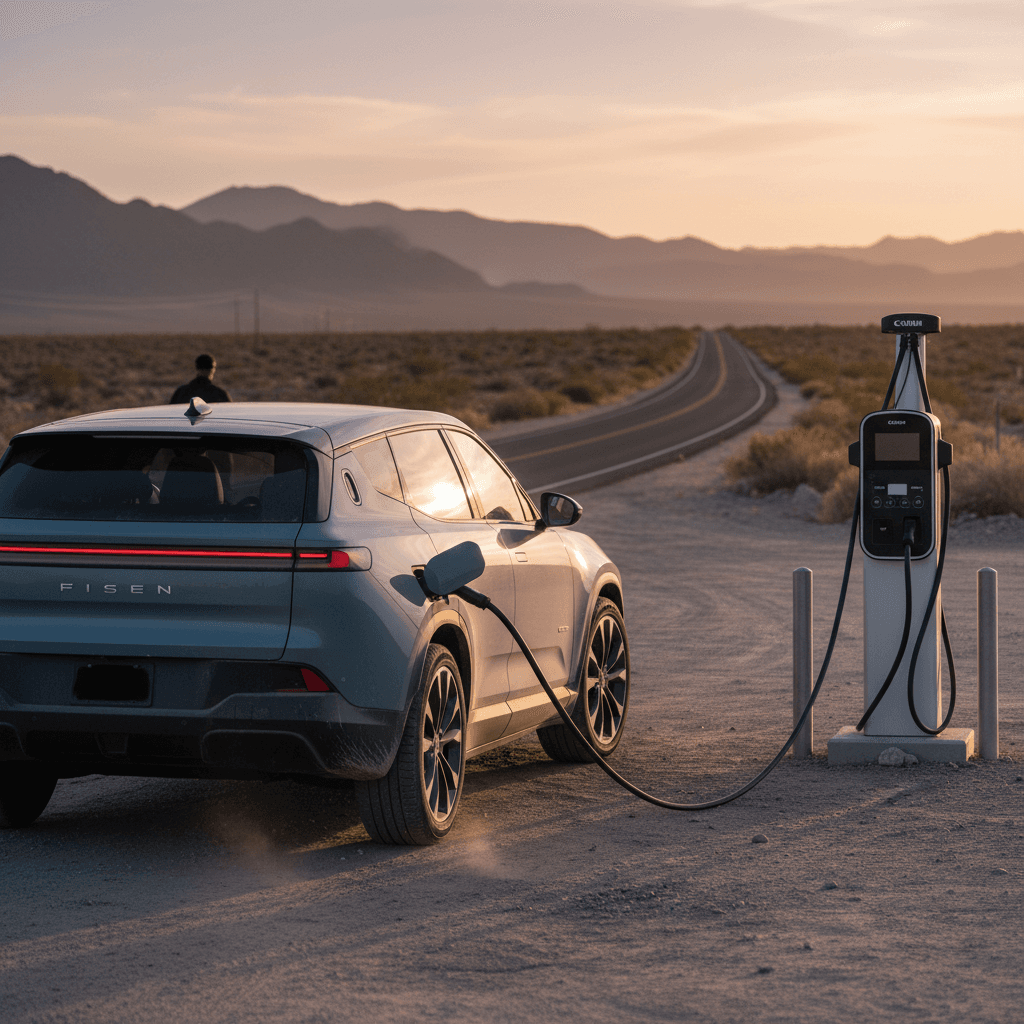
If you’re considering a Fisker Ocean for road trips, you’re probably drawn to its big battery claims, beachy branding, and that massive panoramic roof. But with Fisker itself now gone and owners effectively keeping the brand alive, you need more than marketing promises, you need a clear, realistic Fisker Ocean road trip review that reflects how this SUV behaves in the real world today.
Context: Fisker the company is gone
Who this Fisker Ocean road trip review is for
- Drivers who already own a Fisker Ocean and want to understand its strengths and weak spots on long trips.
- Used‑EV shoppers who see Oceans priced far below comparable Tesla Model Y, Ioniq 5, or Mustang Mach‑E and are wondering if the discount is worth it.
- EV‑curious drivers comparing the Ocean with more mainstream options for family road‑trip duty.
I’ll break down real‑world highway range, DC fast‑charging behavior, software and reliability on the road, and what has changed now that Fisker is no longer backing the car. I’ll also touch on how a used Ocean might fit into the broader used EV buying landscape if you’re shopping today.
Fisker Ocean range on paper vs on the road
Fisker Ocean claimed range vs tested reality
On paper, the Fisker Ocean looks like a road‑trip star. Top trims with the big pack are rated up to around 360–440 miles of range depending on cycle and wheels, with the Sport promising around 230 miles. In practice, especially at U.S. highway speeds, those numbers are optimistic.
Instrumented testing and owner logs suggest the Ocean Extreme’s true all‑purpose range clusters around the mid‑200s, roughly 260–280 miles on a full charge in reasonable conditions if you’re mixing highway and city. Push typical American interstate speeds (70–80 mph) and that drops further, just like it does in many EVs, but the gap between the spec sheet and reality is wider here than in something like a Model Y Long Range.
Don’t plan around the brochure number
Highway efficiency: what you can really expect
Typical Ocean highway behavior
- Owners report 2.3–2.7 mi/kWh at 65–75 mph in moderate weather.
- Base Sport models see ~190–220 miles on a full charge with mostly highway driving.
- Large‑battery trims can clear 250 miles, but not the 400‑plus suggested by WLTP‑style ratings.
- Big wheels and aggressive driving can knock another 10–15% off range.
How that compares to rivals
- A Tesla Model Y Long Range or Hyundai Ioniq 5 typically delivers highway efficiency that’s closer to its rating.
- The Ocean feels competitive when you slow down or do more mixed driving, but it’s less forgiving at 75–80 mph.
- If you routinely drive in cold climates, the lack of sustained OEM software optimization support is a concern for long‑term efficiency tuning.
Practical rule of thumb

DC fast charging on a road trip
Range is only half the story. For road trips, how the Fisker Ocean charges from 10–80% at DC fast chargers is just as important. Fisker quoted about 34–35 minutes from 10–80% on a DC fast charger for large‑battery trims, implying peak power around 180 kW. That’s competitive on paper, but real‑world behavior is uneven.
Fisker Ocean road‑trip charging experience
What owners actually see at highway DC fast chargers
Peak power when things go right
Many owners report seeing 130–170 kW briefly on high‑power chargers when starting around 10–20% state of charge, especially in warm weather.
When the car and charger handshake properly, a 10–60% top‑up can be pretty quick.
Inconsistent sessions & red lights
Others report sessions that fail to start, or drop to ~35 kW, sometimes needing multiple plug‑in attempts or moving to another stall or network.
This inconsistency makes road‑trip planning more stressful than in more mature EVs.
Best‑case vs worst‑case stop times
Best case: ~35 minutes 10–80% on a strong charger. Worst case: hunting for a working station or crawling at low power, stretching a stop past an hour.
That spread is wider than you want on a tight schedule.
DC fast charging is a risk factor
Software quirks and reliability when you’re far from home
Any modern EV is a rolling software platform, and the Ocean is no exception. Early cars shipped with rough, sometimes dangerously buggy software. Fisker pushed several over‑the‑air (OTA) updates to address braking feel, driver‑assistance behavior, and basic stability. That process, however, was fragile, some owners experienced failed updates or even temporarily bricked cars, and 12‑volt battery issues were common during OTA events.
After Fisker collapsed, thousands of Ocean owners effectively became their own car company, forming nonprofit and commercial entities to support software, recalls, and parts without the factory that built the vehicle.
Today, with no functioning Fisker Inc., the Ocean’s software future rests largely with the Fisker Owners Association (FOA) and third‑party developers. They’ve already built replacement apps and are exploring firmware support, but that’s a fundamentally different risk profile than a vehicle supported by an OEM with deep engineering and warranty budgets.
Why this matters for road trips
Trip comfort, cabin noise and driver assistance
Comfort & cabin experience
- Seats & ride: The Ocean’s seats are comfortable enough for medium‑length stints, though the ride can feel busy on large wheels and rough pavement.
- Space: Plenty of legroom and cargo space for a family road trip; the boxy form and big glass help with outward visibility.
- Noise: Wind and road noise are acceptable, but not as hushed as premium competitors. Long days at 75 mph feel more mid‑market than luxury.
- Party tricks: Features like "California Mode" (rolling down nearly every window) are fun at rest stops but irrelevant at highway speeds.
Driver assistance & fatigue
- The Ocean launched without the polished, confidence‑inspiring driver‑assist suites you see from Tesla, Hyundai, Ford, or GM.
- Updates improved some behaviors, but the overall system maturity lags the class, and ongoing development is uncertain.
- On road trips, that means more manual workload on the driver, less smooth lane‑keeping, more micro‑corrections, and potentially more fatigue.
Where the Ocean does well
Planning a Fisker Ocean road trip: step‑by‑step
Pre‑trip checklist for Fisker Ocean owners
1. Update software and verify basics
Make sure your Ocean is on the latest stable software version that the community regards as reliable. Before a big trip, confirm that the key fobs work, the main screen boots consistently, and the car wakes from sleep without drama.
2. Test DC fast‑charging locally
Well before departure, visit at least <strong>two different DC fast‑charging networks</strong> near home. Confirm that sessions start reliably and note what power levels you see between 10–60% state of charge.
3. Plan conservative legs
When mapping, treat your practical highway range as <strong>60–70% of the rated figure</strong>. Build your route around that reduced range and add a buffer of at least 15–20% state of charge at arrival.
4. Identify backup chargers
For every planned stop, bookmark <strong>at least one alternate DC site</strong> within 10–20 miles. Include a few Level 2 options (hotels, destination chargers) in case fast chargers are down or incompatible.
5. Pack a 120V/240V backup plan
Carry your included Level 1/2 cable (if applicable) and confirm whether you can access a 240V outlet at your lodging or a friend’s place. Level 2 can rescue a trip if DC fast charging proves unreliable.
6. Bring contact info and tools
Bookmark the Fisker Owners Association resources, local independent EV shops along your route, and any third‑party apps you rely on. A portable 12‑volt jump pack isn’t a bad idea given the Ocean’s sensitivity to 12V issues.
Route‑planning apps matter
How the Fisker collapse changes road‑trip ownership
When Fisker went under in 2024, it left roughly 10–12,000 Oceans on the road with no traditional factory support. In response, owners organized into the Fisker Owners Association (FOA) and related entities to keep these vehicles usable, managing parts pipelines, third‑party apps, and even some software fixes.
Owning an Ocean in a post‑Fisker world
What it means specifically for road‑trip use
Parts & service
Independent shops and FOA‑linked distributors are stepping in for common wear items and some warranty‑type repairs. For a long road trip, you’re relying on this still‑forming ecosystem if something breaks far from home.
Apps & software
Third‑party apps can restore or enhance remote functions and trip data, but long‑term firmware support is uncertain. That’s a different risk profile than, say, a Ford or Hyundai that’s still under factory OTA development.
Risks for road‑trip reliability
- No OEM safety net: If a software bug strands you, you don’t have a traditional dealer network to fall back on.
- Recall handling is complex: Some safety‑critical issues have involved non‑OEM actors coordinating fixes.
- Resale uncertainty: A breakdown on a trip is stressful enough; doing it in a car with unclear long‑term value adds another layer of anxiety.
Upside: pricing and community
- Used Oceans are deeply discounted versus original MSRP, sometimes tens of thousands below comparable new EVs.
- The owner community is unusually active and solutions‑oriented, especially around trip planning and troubleshooting.
- If you’re a technically inclined, risk‑tolerant buyer, that community can partly offset the lack of a factory.
Should you buy a used Fisker Ocean for road trips?
Fisker Ocean as a road‑trip EV: pros and cons
How the Ocean stacks up specifically for long‑distance driving, not just daily commuting.
| Factor | Fisker Ocean | What it means on a road trip |
|---|---|---|
| Highway range | Respectable but below brochure claims at speed | Plan around mid‑200s miles for big‑battery trims, less for Sport. |
| DC fast charging | Capable but inconsistent | Can be quick when it works; failures and low‑power sessions are more common than in class leaders. |
| Software maturity | Improved but fragile, now community‑maintained | Higher risk of glitches far from home, especially long‑term. |
| Comfort & space | Roomy cabin, decent comfort | Family‑friendly cargo and legroom; noise and ride are mid‑pack. |
| Driver assistance | Behind top rivals | More manual workload on the driver over long stints. |
| Ownership support | No OEM, community + independents | Great community effort, but not a substitute for a functioning automaker. |
| Purchase price | Very low used pricing vs spec sheet | Significant savings, but you’re being compensated for real risk. |
Compare these trade‑offs against more conventional choices like Tesla Model Y, Hyundai Ioniq 5, Kia EV6, or Mustang Mach‑E.
Who the Ocean makes sense for
If you do decide to pursue a used Ocean, treat it like any other complex used EV, but with even more scrutiny. You’ll want independent battery health data, charging‑behavior verification, and a clear picture of recall and software history before you trust it for cross‑country miles.
Where Recharged can help
Fisker Ocean road trip FAQ
Frequently asked questions about Fisker Ocean road trips
Bottom line: is the Fisker Ocean a good road trip EV?
Viewed purely as hardware, the Fisker Ocean is a competent, spacious electric SUV with decent real‑world range and potentially competitive DC fast‑charging speeds. But road trips expose system‑level weaknesses: optimistic range ratings, inconsistent charger handshakes, and a software stack now maintained by a passionate but resource‑constrained community rather than a functioning automaker.
If you’re an early‑adopter type who values design and is comfortable building in extra margin for the unknown, an Ocean can still be a memorable road‑trip partner, especially at the steep discounts we’re now seeing on the used market. If, on the other hand, you want a no‑drama long‑distance EV for family duty, the rational answer is to treat the Fisker Ocean as an interesting footnote in EV history and look to more conventional options.
Either way, if you’re cross‑shopping the Ocean against other used EVs, this is where a data‑driven partner helps. Recharged combines verified battery health, transparent pricing, and EV‑specialist advice so you can decide if the savings on an orphaned brand justify the compromise, or whether a different used EV will make your next road trip a lot more predictable.