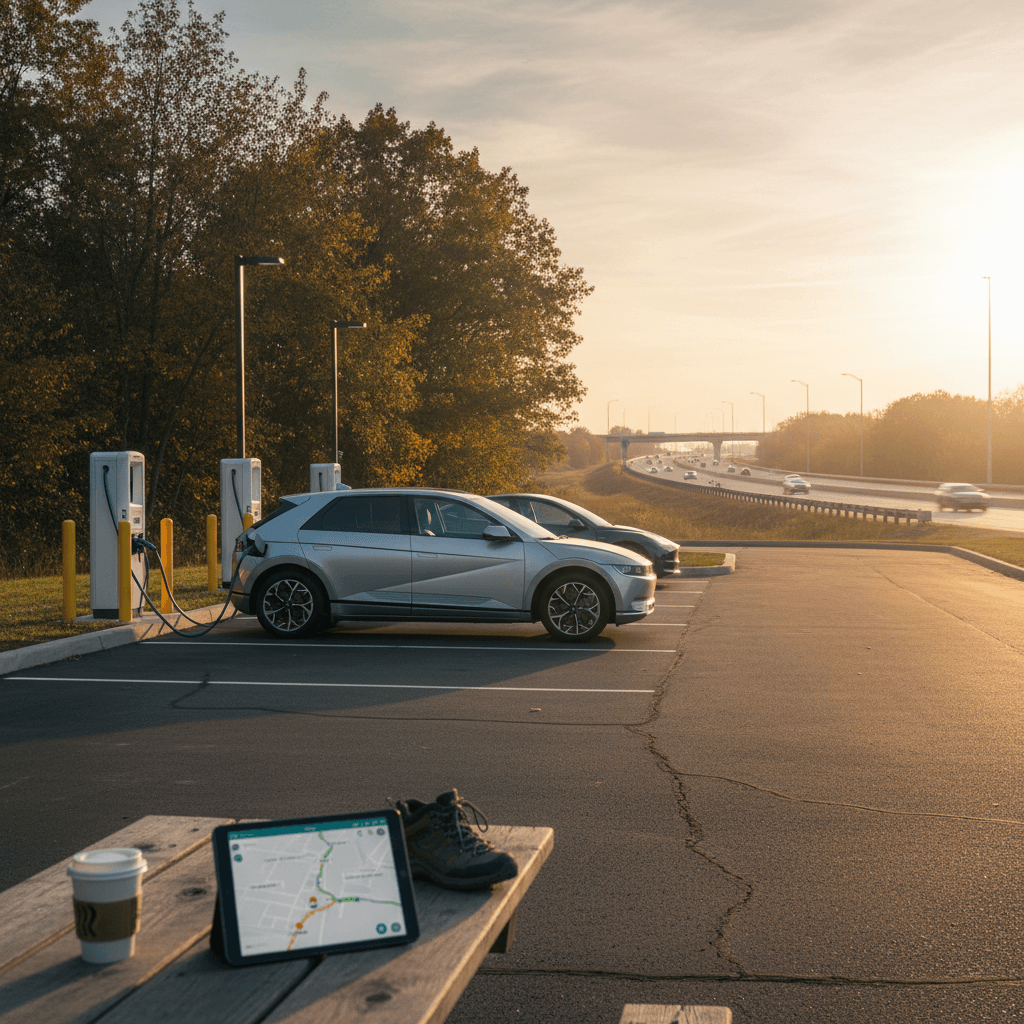
Planning an EV road trip on the East Coast is a lot easier than it was just a few years ago. From Maine lighthouses to Florida beaches, the I‑95 corridor is now lined with DC fast chargers from Tesla, Electrify America, EVgo, and others, so the real challenge isn’t “Is it possible?” but “How do I pick a smart route and avoid stress?”
What this guide covers
Why the East Coast is EV road-trip friendly
If you look at public charging density, the East Coast is one of the most EV‑friendly regions in the U.S. Northeast states like Massachusetts, Connecticut, Rhode Island, New Jersey, and Maryland now rank among the top states for chargers per square mile, and New York and Florida are in the top tier for total public chargers. That concentration is exactly where most East Coast road trippers drive.
Charging coverage that makes East Coast EV trips workable
Think in corridors, not just stations
How far can you go? Choosing an East Coast EV route
Start by matching your real-world highway range to the scale of your trip. On the East Coast, most highway fast chargers are 35–70 miles apart on busy stretches, but you’ll still see 90–120‑mile gaps in rural Maine, the Carolinas, and parts of Georgia. That means even many older used EVs can handle an East Coast run if you keep daily legs realistic.
- If your usable highway range is 220–300+ miles, you can comfortably plan 150–200‑mile legs and skip some chargers.
- If you have 160–220 miles of range, plan 120–150‑mile legs and expect 2–3 DC stops per 500‑mile day.
- If your range is under 160 miles, stick to shorter days (250–350 miles) on the best-covered corridors like Boston–DC or DC–NYC.
Watch for rural gaps
Sample EV road trip East Coast routes
You can build hundreds of variations, but these sample EV road trip East Coast routes illustrate what’s realistic for different ranges and vacation styles. Use them as starting points, then refine with PlugShare, A Better Routeplanner (ABRP), or your vehicle’s native planner.
Three popular East Coast EV routes
From long-haul I‑95 runs to scenic weekend getaways
Maine to Florida “Big One”
Route: Portland, ME → Boston → NYC → DC → Raleigh → Savannah → Orlando → Miami
Best for: Newer EVs (220+ mile usable range) and families who want a once‑in‑a‑lifetime coastal run.
Time: 7–10 days with sightseeing; more if you detour to beaches or national parks.
Northeast City String
Route: Boston ↔ NYC ↔ Philadelphia ↔ Baltimore ↔ Washington, DC
Best for: Short‑range or older used EVs, chargers are dense and speeds vary but options are plentiful.
Time: 3–6 days; easy to do as a loop or one‑way with a train ride back.
Mid‑Atlantic & Carolinas Coast
Route: DC → Richmond → Outer Banks (NC) → Wilmington → Charleston → Savannah
Best for: Beach‑focused road trips in spring or fall, when temps are mild and chargers are less crowded.
Time: 5–8 days depending on beach days.
Example: Portland, ME to Miami, FL on I‑95
This is the archetypal EV road trip East Coast route, about 1,750–1,800 miles, similar to Electrify America’s recent Portland–Key West validation drive. With a modern crossover EV, it’s very doable in a week without feeling rushed.
Sample Portland–Miami EV itinerary (for ~250‑mile range EV)
Assumes you start at 90–100% and charge to 60–80% at each fast‑charge stop. Adjust to your EV’s efficiency and battery size.
| Day | Approx. Leg | Typical Stops & Notes | Charging Strategy |
|---|---|---|---|
| Day 1 | Portland → Boston → Providence | Short hops with dense charging around Boston and Providence. | Start full, one quick 20–30 min DC stop near Boston or Providence if needed. |
| Day 2 | Providence → NYC metro | Follow I‑95 through CT service plazas and urban DC fast hubs. | Plan 1–2 DC fast charges; aim to arrive in the NYC area with ~40–60%. |
| Day 3 | NYC → Philadelphia → Baltimore → DC | Charger‑dense metro stretch with plenty of options. | Two shorter DC sessions (20–30 min each) instead of one deep 0–90% session. |
| Day 4 | DC → Richmond → Raleigh | Coverage thins slightly south of Richmond but is still strong along I‑95. | Charge in northern VA, then again near Richmond or south of it. |
| Day 5 | Raleigh → Savannah or Jacksonville | The longest more rural feel; expect 2–3 DC stops. | Keep buffers higher (20–25% arrival SOC) in case a site is busy or offline. |
| Day 6–7 | Jacksonville → Orlando → Miami | Plenty of urban and highway chargers; mix of networks. | Choose chargers near your hotel/attractions for overnight top‑ups at Level 2. |
You don’t need to copy these exact towns; use them as a framework in a route planner.
Tesla vs. non‑Tesla along this route
Planning your charging stops
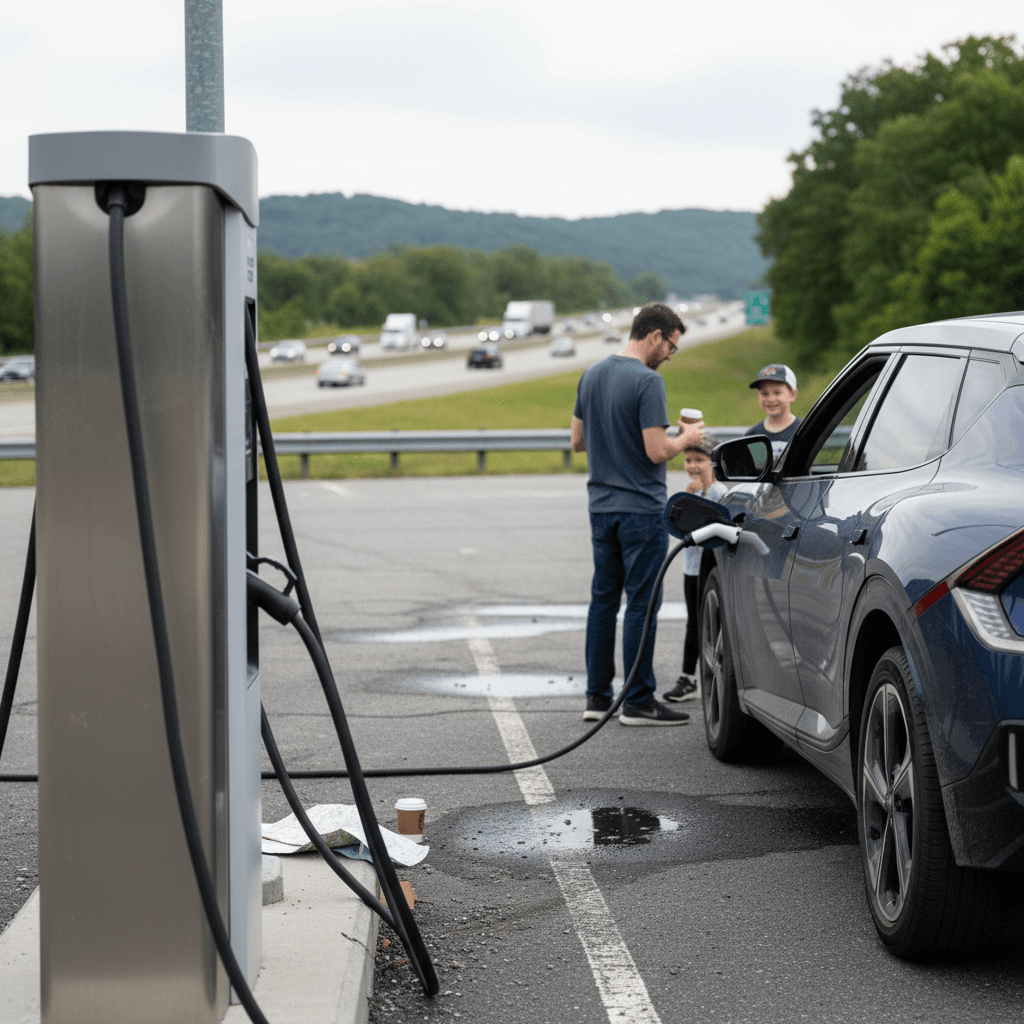
On an East Coast EV road trip, charging stops are your itinerary’s backbone. You don’t need to micromanage every kilowatt-hour, but you do want a plan that respects your vehicle’s limits and the realities of the I‑95 corridor.
Step-by-step: map your charging before you leave
1. Lock in daily mileage targets
Decide whether you want 300‑mile “touring” days or shorter 200‑mile days with more sightseeing. Then back into how many DC fast stops that implies for your range.
2. Use a proper EV trip planner
Tools like PlugShare’s Trip Planner or A Better Routeplanner (ABRP) let you enter your exact EV, charger preferences, and state-of-charge limits to generate realistic routes.
3. Favor clusters over one-off sites
In rural stretches, aim for towns with two or more DC fast sites, ideally across different networks, so you have a Plan B if one station is down or full.
4. Keep a healthy buffer
On unfamiliar routes, plan to arrive with at least 15–20% charge remaining, and bump that to 25% in cold weather or if chargers are sparse.
5. Combine stops with meals and attractions
Look for chargers near restaurants, grocery stores, outlet malls, and walkable downtowns. A 35‑minute charge feels much shorter when you’re eating or exploring.
6. Save your route and backup options
Save your trips in PlugShare or ABRP and download offline maps in Google Maps, Apple Maps, or your in‑car system in case of spotty cell service.
Apps and tools to plan an East Coast EV route
You can absolutely drive an East Coast EV trip with just your car’s built‑in navigation and one network app. But having a small toolkit makes it far easier to adjust if weather, traffic, or charger issues force a change.
Core tools for East Coast EV route planning
At minimum, install your main charging network app plus one community map
Vehicle & network apps
- Tesla app and in‑car nav for Superchargers and Magic Dock locations.
- Electrify America, EVgo, and your automaker’s app (FordPass, myHyundai, etc.).
- Turn on charger filters by plug type and minimum power (e.g., 100 kW+).
Community charger maps
PlugShare is still the go‑to for user check‑ins, photos, and recent reliability reports. Filter for your connector type and choose locations with good scores and recent activity before a long detour.
Trip planners
- PlugShare Trip Planner – plan on desktop, then sync to your phone.
- A Better Routeplanner (ABRP) – set your EV model, consumption, and SOC targets; great for older or non‑Tesla EVs.
- Your car’s native planner – many newer EVs will propose fast‑charge stops automatically.
Don’t forget low-tech backups
Driving and charging strategies that actually work
On a long East Coast EV route, how you drive and when you charge can matter as much as the route itself. Small tweaks can shave hours off a multi‑day trip, or make a lower‑range used EV feel far less stressful to live with on the road.
Smart charging strategy
- Charge more often, not fuller. Most EVs charge fastest from about 10–60% or 15–70%. Two 25‑minute sessions can be faster than one 60‑minute 5–95% slog.
- Aim for next‑stop arrival around 10–20%. That keeps sessions quick while leaving a margin for traffic or weather.
- Use overnights wisely. Even a basic Level 2 charger at your hotel or rental can add 150–250 miles while you sleep.
Efficient driving habits
- Set a realistic cruise speed. Jumping from 70 to 80 mph can noticeably cut range on boxier crossovers.
- Manage climate settings. In winter, use seat and wheel heaters more than blasting cabin heat; in summer, pre‑cool while plugged in.
- Pack wisely. Roof boxes and heavy cargo hurt efficiency. If you must use a box, keep speeds moderate on long highway legs.
Avoid the “0% hero run”
Special considerations for used EVs on long trips
If you’re driving a used EV, or shopping for one specifically because you want to road‑trip, range and battery health matter more than badge or paint color. Many early‑generation EVs can absolutely handle East Coast trips, but you’ll want to plan conservatively.
- Assume your real‑world highway range is lower than the original EPA number, especially on older cars.
- Plan shorter legs (90–130 miles) through rural stretches so you’re not dependent on a single station.
- Favor routes with overlapping networks (e.g., I‑95 where Tesla, Electrify America, and others all operate).
- Aim for moderate state‑of‑charge swings (20–70%) rather than frequent 0–100% charges on DC fast, which can be harder on aging packs.
How Recharged helps if you’re still shopping
Cost and time: what to expect
Your exact costs will depend on local kWh pricing, your EV’s efficiency, and how much of your charging happens at home or overnight versus high‑speed highway sites. But you can make some reasonable ballpark estimates for an East Coast EV road trip route.
Ballpark cost and time for common East Coast EV trips
Assumes highway efficiency around 3.0–3.5 mi/kWh, DC fast pricing around $0.35–$0.45/kWh, and 1–3 fast‑charge stops per day.
| Trip Type | Distance (round trip) | Typical Days Driving | Approx. DC Fast Cost | Total Charging Time |
|---|---|---|---|---|
| Northeast city loop (Boston–NYC–DC) | 800–1,000 miles | 3–5 days | $90–$150 | 3–6 hours total across the trip |
| Mid‑Atlantic beach run (DC–Outer Banks–Charleston) | 1,000–1,300 miles | 5–7 days | $130–$220 | 4–7 hours total |
| Full Portland–Miami corridor | 3,400–3,600 miles | 7–12 days | $350–$550 (less if you mix in home/hotel L2) | 12–20 hours total, spread over many short stops |
Use this as a framework; plug your own kWh prices and range into a planner for more precise numbers.
Build in buffer time
EV road trip East Coast route: FAQ
Frequently asked questions about East Coast EV routes
Bottom line: making your East Coast EV road trip easy
An EV road trip on the East Coast no longer has to be a science experiment. With robust charging coverage along I‑95 and dense infrastructure in Northeast metros and major coastal cities, your focus can shift from “Will I make it?” to “Where do I actually want to stop?” If you plan realistic legs, lean on modern trip‑planning tools, and give yourself a little buffer, you can drive from lighthouses in Maine to art deco in Miami with far less drama than the headlines suggest.
If you’re still choosing the right EV for that dream route, Recharged can help you compare used electric vehicles by verified battery health, real‑world range, and total ownership cost. Either way, the East Coast is ready for your first, or next, electric road trip.