If you follow headlines, you’d think every EV in 2026 is about to get a 1,000‑mile solid‑state battery that charges in 10 minutes. The reality is more nuanced, but also more useful if you’re trying to decide which EV to buy now, especially on the used market. EV battery technology in 2026 is quietly reshaping range, reliability, and pricing in ways that matter far more than the hype cycles.
Context: 2026 is a transition year
Why EV battery technology in 2026 actually matters to you
1. Range and charging you can actually live with
Energy density gains and better fast‑charging chemistry mean newer EVs can deliver 300–400 miles of usable range with packs that aren’t absurdly large, and they recharge faster than early‑2010s EVs ever could. That changes whether you can road‑trip comfortably, or rely on fast charging instead of home charging.
2. Battery health and resale value
As chemistries like LFP and LMFP take over, degradation profiles look flatter and more predictable. That’s a big deal if you’re buying a used EV: you’re less likely to inherit someone else’s battery anxiety, and tools like the Recharged Score help you see the real state of the pack before you commit.
On top of that, 2026 batteries are designed around stricter safety standards, better thermal management, and packaging tricks like cell‑to‑pack integration. All of this affects how an EV ages, and whether it still feels like a modern car in 8–10 years.
Battery basics in 2026: What’s under the floor of most EVs
- Nearly all modern EVs still use some form of lithium‑ion chemistry with liquid or gel electrolytes.
- Energy is stored in thousands of cells, organized into modules and then a pack, usually forming a structural part of the floor.
- Typical pack‑level energy density for 2024–2026 production EVs lands in the rough range of 150–200 Wh/kg, depending on chemistry and packaging.
- Thermal management (liquid cooling, heat pumps, smarter software) is now as important as cell chemistry for keeping performance and degradation in check.
Don’t obsess over cell chemistry labels
The main EV battery chemistries you’ll see in 2026
The 2026 EV battery chemistry lineup
From workhorse LFP to emerging LMFP and high‑nickel cells
Nickel‑based NMC / NCA
Where you’ll see it: Long‑range and performance EVs; many premium brands.
- Higher energy density → more range per kg.
- Relies on nickel, sometimes cobalt → higher cost and supply risk.
- Good cold‑weather performance and strong fast‑charging, with proper cooling.
LFP: Lithium Iron Phosphate
Where you’ll see it: Value‑oriented EVs and new mass‑market models in 2025–2026.
- Lower energy density but very long cycle life.
- Excellent safety and heat tolerance.
- Lower material cost and no nickel or cobalt.
It’s increasingly the default choice for everyday range EVs, including new versions of popular models coming to market around 2026.
LMFP and high‑manganese blends
Where you’ll see it: Newer Chinese and global models focused on long range without premium pricing.
- Adds manganese to LFP (LMFP) to boost energy density into roughly the 190–210 Wh/kg pack range in early deployments.
- Aim: LFP‑like safety and cost with closer‑to‑nickel energy density.
- Still ramping globally but a major trend line heading into the late 2020s.
Spec sheets vs. reality
Solid-state and semi-solid batteries: where we really are in 2026
Solid-state and semi-solid progress by 2026
The key idea behind solid‑state batteries is replacing flammable liquid electrolytes with solid materials, which promises higher energy density, faster charging, and improved safety. In 2026, we’re seeing three important things at once: aggressive roadmaps from major cell makers, ambitious range claims from Chinese OEMs using semi‑solid packs, and early proof‑of‑concept vehicles and motorcycles using exotic chemistries.
- Some Chinese brands and university–industry collaborations are demonstrating semi‑solid or hybrid solid‑state packs with ranges around 600–1,000 miles on generous test cycles and pack‑level energy densities near or above 280 Wh/kg.
- Suppliers in Korea, Japan, Europe, and the U.S. are targeting late‑decade mass production with charging times in the single‑digit‑minute range from 10–80% on 800–1,200 V architectures.
- Independent verification, durability data, and cost per kWh are still big question marks. Until those are nailed down, you’ll mostly see these technologies in halo products or limited fleets.
How to think about solid-state in 2026
Sodium-ion and other alternative chemistries
If solid‑state dominates the hype, sodium‑ion is where some of the most interesting real‑world experimentation is happening in 2026. One Chinese automaker, working with a major cell supplier, is launching an EV this year using a roughly 45 kWh sodium‑ion pack that delivers about 248 miles of range on the local test cycle, enough for many commuters and fleet applications.
Beyond lithium: how new chemistries fit in
Don’t expect them to replace all lithium‑ion, but they change the edges of the market
Sodium‑ion (Na‑ion)
- Uses abundant sodium instead of lithium → lower theoretical cost and less supply risk.
- Early packs show ~150–175 Wh/kg cell‑level density, lower than today’s EV lithium‑ion.
- Shines in cold weather performance and fast‑charging potential, attractive for city EVs and buses.
Lithium‑sulfur & lithium‑metal
- Offer very high theoretical energy density and lower material footprint.
- Multiple start‑ups are targeting aviation, heavy‑duty, and niche EVs before mass‑market cars.
- Cycle life and dendrite formation are the big engineering challenges.
Exotic solid chemistries
- Some 2026 announcements tout solid‑state cells with 400 Wh/kg+, 5‑minute charging, and huge cycle life numbers.
- You may see these first in motorcycles, premium performance EVs, or commercial pilots rather than mainstream crossovers.
- As always, watch for independent testing, not just launch‑day slides.
Don’t wait forever on the next chemistry
Charging speeds, energy density and real-world range
Two trends define EV battery technology 2026: gradual but real improvements in energy density, and much faster DC fast‑charging driven by better chemistries and high‑voltage architectures. Even without solid‑state, 2025–2026 lithium‑ion cells are enabling charge curves that would have sounded like science fiction a few years ago.
How 2026 batteries change the charging experience
Typical real‑world ranges and fast‑charge performance by chemistry and segment (approximate, not model‑specific).
| Segment & chemistry | Typical usable pack size | Realistic highway range | 10–80% fast‑charge time (best‑case) | Best fit for |
|---|---|---|---|---|
| Entry EV with LFP | 45–60 kWh | 180–240 miles | 25–35 minutes on 100–150 kW | Urban & suburban drivers, short trips |
| Mid-size crossover with LMFP / high‑Mn | 70–85 kWh | 260–320 miles | 20–30 minutes on 150–250 kW | One‑car households, mixed driving |
| Long‑range premium EV (high‑Ni) | 90–120 kWh | 320–420 miles | 15–25 minutes on 250–350 kW | Frequent road‑trippers, towing, high performance |
Use these as directional ranges; always check the specific model’s tested results.
Look at the 10–80% window
Battery longevity, degradation and warranties
For most drivers, the single most important question is not “What’s the Wh/kg?” It’s “How much usable range will I have, and for how long?” The answer is shaped by chemistry, pack design, software, and how the car was used.
Key factors that affect EV battery life in 2026
1. Chemistry choice (LFP vs NMC/NCA vs LMFP)
LFP and LMFP are generally more tolerant of frequent fast‑charging and high state‑of‑charge without rapid degradation. High‑nickel cells tend to deliver more range per kg but can be more sensitive to heat and high‑SOC storage if not carefully managed.
2. Thermal management quality
Modern packs rely on sophisticated liquid cooling and software. A well‑engineered cooling loop often matters more than the marketing name of the chemistry when it comes to long‑term health.
3. Daily charging habits
Living at 100% SOC and fast‑charging constantly is still harder on any pack. Charging to 70–90% for daily use, with occasional deep cycles, is friendlier, even with the more robust 2026 chemistries.
4. Usage profile and climate
High annual mileage isn’t automatically bad if the pack is well‑managed; repeated high‑speed, high‑temp fast‑charging in very hot climates still accelerates wear. Cold climates mainly affect short‑term performance unless pre‑conditioning is lacking.
5. OEM software updates
Manufacturers increasingly tweak charge curves and thermal strategies via OTA updates. That can extend life or, occasionally, cap peak performance to protect aging packs.
Modern warranties are conservative
What 2026 battery tech means for used EV buyers
All of this innovation can feel abstract until you’re staring at two used EV listings and trying to figure out which one is the safer bet. Here’s how EV battery technology 2026 changes that decision.
Newer chemistries flatten the risk curve
Late‑model EVs with LFP or LMFP packs tend to show slower, more linear degradation. That means a three‑ or four‑year‑old car is more likely to retain a healthy share of its original range, and you’re less exposed to outlier cases of early pack replacement.
More data, less guessing
Between better onboard diagnostics and third‑party analytics, you no longer have to accept “Battery seems fine” as an answer. You can see how a specific VIN has aged and how its chemistry tends to behave across thousands of vehicles.
Don’t rely on range estimates alone
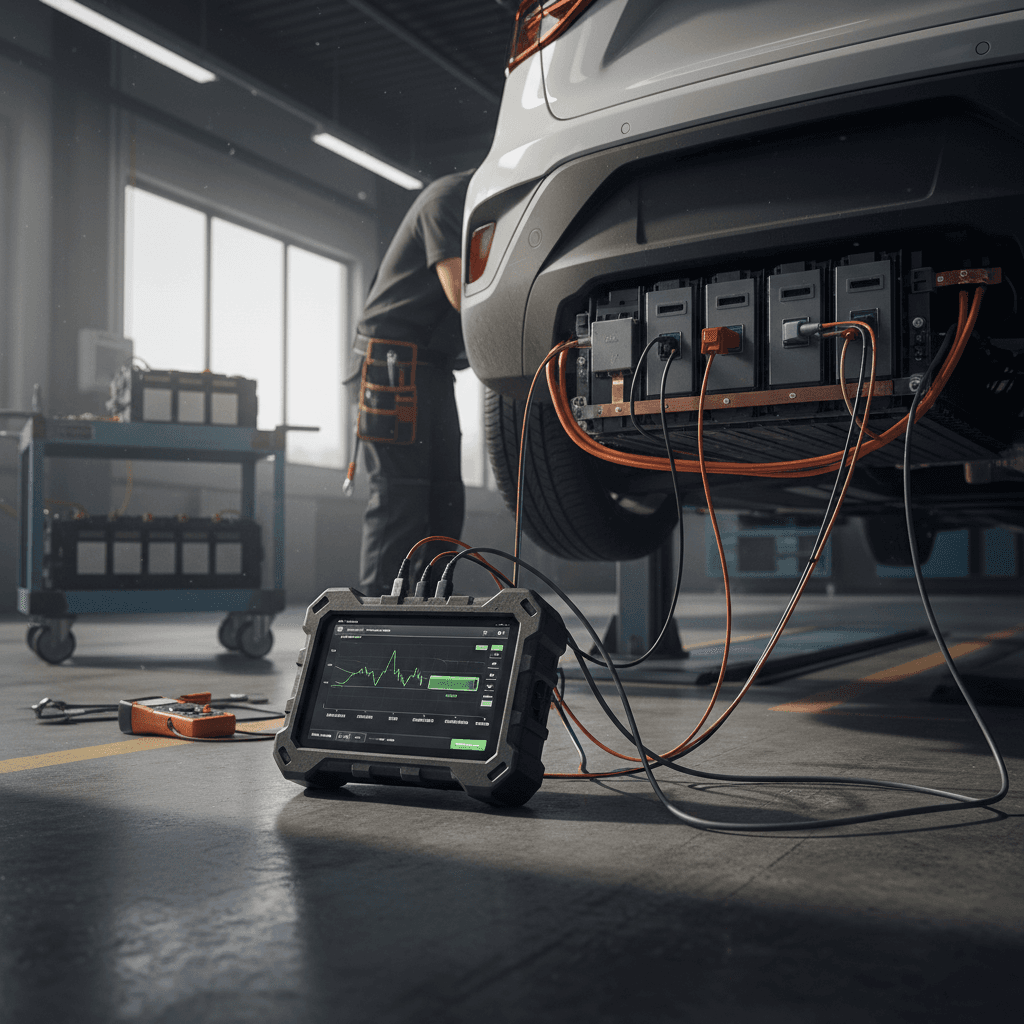
How Recharged evaluates EV battery health
Because batteries are now the single largest value component in an EV, Recharged builds its entire buying and selling experience around transparent battery health, not just odometer readings and Carfax entries.
What goes into a Recharged Score battery assessment
Turning raw chemistry and usage data into something you can actually act on
Deep pack diagnostics
We use specialized diagnostics to look beyond simple state‑of‑charge estimates. That includes pack balance, available capacity relative to original spec, and error code histories that can hint at past thermal or charging issues.
Data from thousands of EVs
Battery health for your specific VIN is compared to large fleets of the same model and chemistry. That lets us spot whether a car is aging better, worse, or about as expected versus its peers.
Plain‑language Recharged Score Report
All of this is rolled into a Recharged Score Report that’s included with every vehicle: a clear summary of battery health, projected usable range, and how that interacts with remaining warranty coverage.
Ready to find your next EV?
Browse VehiclesTurn chemistry into a shopping advantage
Looking ahead: 2027 and beyond
Where EV batteries are headed after 2026
For everyday drivers
Expect gradual range gains, not overnight 2x jumps, as LFP/LMFP and pack integration improve.
Fast‑charging times will keep dropping into the 10–20 minute 10–80% window on more mainstream models.
Battery warranties will likely stay conservative even as real‑world degradation trends improve, which is good news for second owners.
For tech-focused early adopters
Watch for limited‑run solid‑state or semi‑solid EVs from Chinese and Japanese manufacturers late this decade.
Ultra‑fast‑charging chemistries paired with 800–1,200 V architectures may reach mass‑market crossovers by the early 2030s.
Vehicle‑to‑grid and bidirectional charging will become as important as raw capacity for many buyers, turning your pack into an energy asset as well as a fuel tank.
The big story of this decade isn’t the single breakthrough battery that solves everything. It’s the slow, steady industrialization of safer, cheaper chemistries and smarter pack design that make EVs boringly reliable appliances, and that’s exactly what mass adoption needs.
FAQ: EV battery technology 2026
Frequently asked questions about EV battery technology in 2026
Bottom line: How to use this battery tech shift to your advantage
EV battery technology in 2026 isn’t a single moonshot; it’s a steady tightening of the screws across chemistry, cooling, packaging, and software. LFP and LMFP are making everyday EVs tougher and cheaper to run, high‑nickel packs are delivering serious range, and the first waves of solid‑state and sodium‑ion tech are starting to show what the next decade will look like. As a shopper, especially in the used market, you don’t need to decode every acronym. You need to know that the pack in front of you has the range, charging performance, and verified health that match your life.
That’s why Recharged centers every vehicle around a transparent Recharged Score Report, fair market pricing, and EV‑specialist guidance, whether you’re buying online, trading in, or visiting our Experience Center in Richmond, VA. The tech will keep evolving. Your job is simple: pick the right chemistry, the right range, and the right battery health for how you actually drive, and let the next breakthrough arrive when you’re ready for your next EV.