Some people say “I’ve got an electric car corner in my brain now” – that mental space where range, charging, tax credits and battery health chase each other around like cats in a sack. If that’s you, this guide is your exit ramp: a clear, practical way to think about used EVs so you can buy confidently instead of doom‑scrolling forums at 1 a.m.
What this guide is really about
What people really mean by “electric car corner”
When shoppers talk about their electric car corner, they’re rarely talking about a physical place. It’s that mental wedge between curiosity and commitment. You’ve seen the Superchargers at Costco, you know your neighbor just traded into a Model 3, and you’re tired of paying for premium unleaded, but you’re not quite ready to pull the trigger.
The anxiety corner
On one side you’ve got worries: battery degradation, expensive unknown repairs, winter range, resale value. Maybe you’ve heard horror stories about early Leafs with cooked packs or sketchy auction cars.
The opportunity corner
On the other side is the upside: dramatically lower running costs, smoother driving, HOV perks in some states, and the fact that many used EVs sell at deep discounts compared with their original sticker.
A better way to frame your corner
Why the used EV corner of the market is booming
Zoom out from your personal electric car corner and you’ll see something big: the used EV market in late 2024–2025 is finally behaving like a real, functioning marketplace. Early adopter cars are filtering down, lease returns are piling up, and prices have corrected from the COVID insanity.
The used EV landscape in 2025
But prices aren’t the whole story
Who stands to win in the used EV corner?
Three buyer profiles that often come out ahead
Urban & suburban commuters
If you drive 30–60 miles a day and can charge at home or work, a used EV with 180–220 miles of real range is basically overkill, and a huge upgrade over stop‑and‑go gas driving.
Two‑car households
Keep one gas car for road trips and turn your second car into an EV. For many families, this is the easiest way to test‑drive EV ownership without going all‑in.
Value hunters
If you’re willing to buy a 3–6‑year‑old EV, you can acquire a technologically advanced car for the money people are spending on basic compact sedans, if you understand the battery.
Battery health: the real electric car corner you must understand
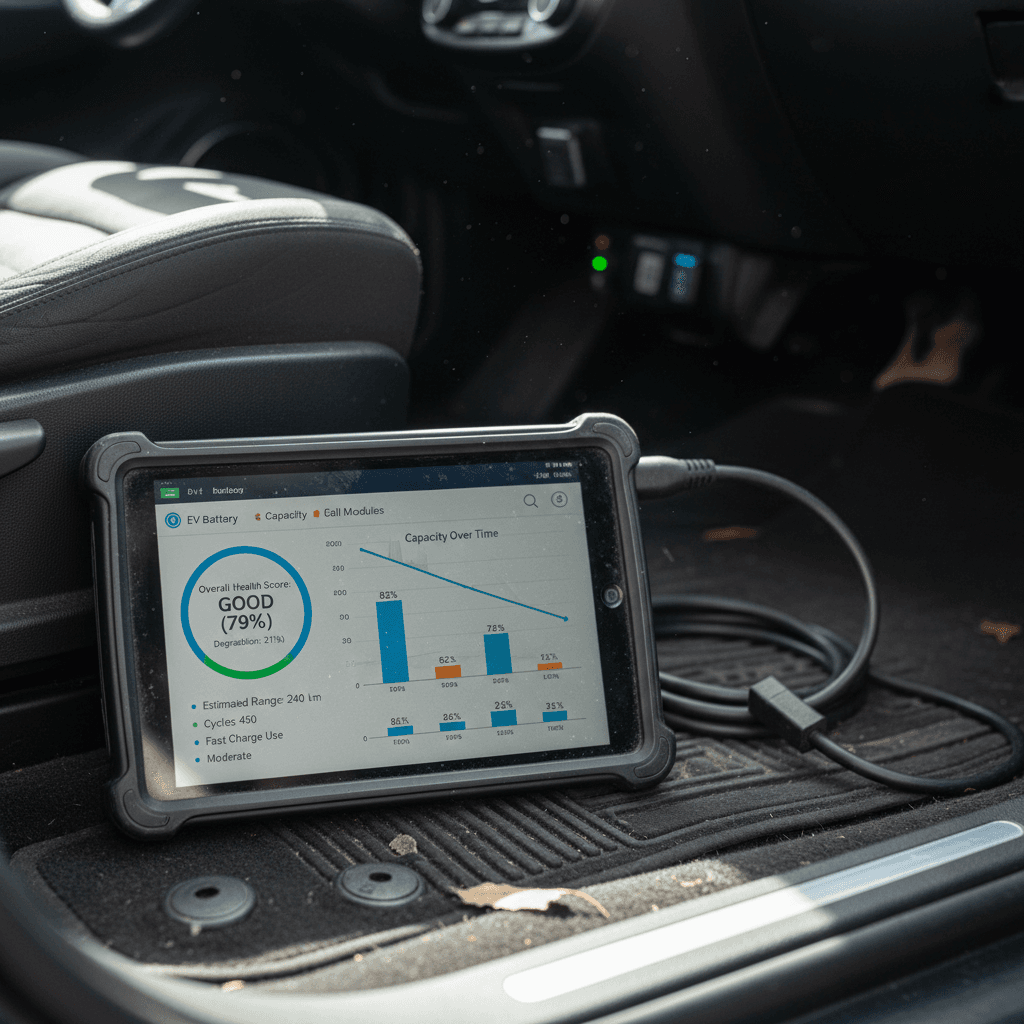
In gas-car land, you worry about transmissions and timing chains. In EV land, the pack is the plot. It’s the single most expensive component in the car, and it quietly controls everything you care about: range, performance, and resale value.
Key EV battery concepts for shoppers
Four terms that should live rent‑free in your electric car corner.
| Term | What it means | Why it matters when buying used |
|---|---|---|
| State of Health (SoH) | Battery capacity vs. when new, usually as a percentage | Gives you a high‑level view of remaining range potential. |
| Degradation | Permanent loss of capacity over time | Helps you judge if the previous owner used and charged the car gently. |
| Cycle count | How many full charge–discharge cycles the pack has seen | Two EVs with the same miles can have very different cycle counts, and very different future life. |
| Cell balance | How similar the individual cell voltages are | Poor balance can mean one weak cell limiting the whole pack and causing sudden range loss. |
You don’t need an engineering degree, just a working vocabulary.
The nightmare scenario (and how to avoid it)
Battery checks that should be non‑negotiable
1. Get an objective SoH number
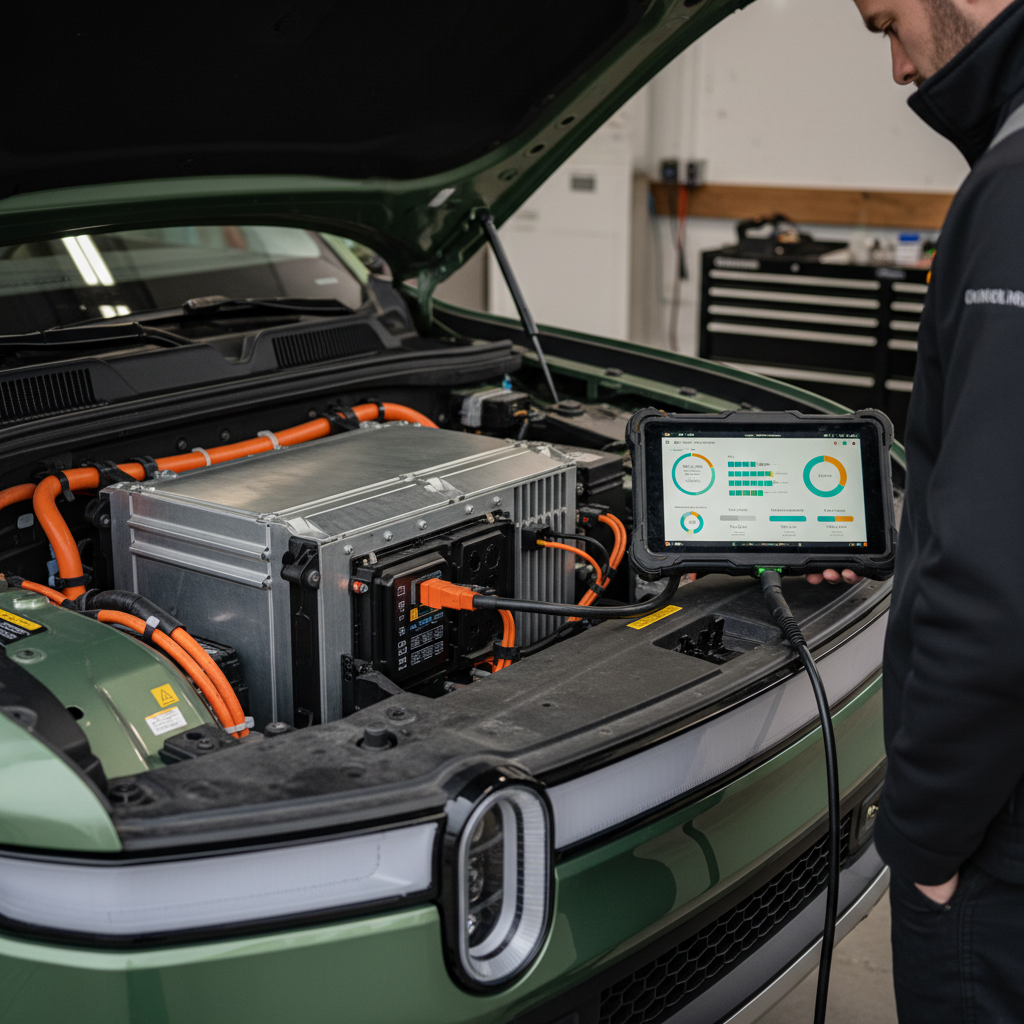
Look for a professional battery report rather than trusting a dashboard guess. Recharged vehicles include a Recharged Score battery health report with verified SoH so you’re not guessing.
2. Look at fast‑charging history
Frequent DC fast charging isn’t automatically bad, but lots of hot, rapid charging over time can speed up degradation. A good report will call this out.
3. Consider climate and previous use
Hot climates and ride‑hail or delivery duty are harder on packs than mild‑climate commuter use. Ask how and where the car lived.
4. Test drive from higher to lower state of charge
On your test drive, start above 60% and drive it down. Watch whether the gauge behaves smoothly or whether it loses big chunks of range suddenly below 30%.
5. Check for software limits, not just hardware
Some automakers cap capacity via software updates on certain packs. A good inspection distinguishes between a hardware‑tired pack and software‑limited range.
For EVs, the real odometer lives in the battery: how it’s been charged, how hot it’s been run, and how carefully it’s been managed.
How to read a used EV like a pro in 20 minutes
You don’t need to be a technician. You just need a repeatable process. Here’s a 20‑minute playbook you can run on any used EV, whether you’re standing on a dealer lot or scrolling through a listing on your couch.
Your 20‑minute electric car corner checklist
Four quick angles that reveal most of the story
1. Body & history
Look for accident repairs, uneven panel gaps, curbed wheels and mismatched tires. An EV that’s been cosmetically neglected may have been mechanically neglected too.
2. Battery report
With Recharged cars, this is baked in as the Recharged Score. Elsewhere, ask for a recent dealer or third‑party battery health test; if nobody can produce one, that’s a red flag.
3. Short drive
Take a mixed drive: surface streets plus a brief highway run. Note how quickly the state‑of‑charge drops and whether power feels consistent down to about 20–25%.
4. Charging behavior
If you can, plug in. Does the car accept a charge without drama? Any error messages or weird fan noises? A car that’s fussy about charging is a car you don’t want.
Use the listing itself as a test
- Start with the battery: Look for a clear SoH number and remaining battery warranty details in the listing. Recharged vehicles surface this right next to the price.
- Check real‑world range: Compare the posted range with independent reviews for that model year. If a car that should do 260 miles is only realistically good for 180, the price should reflect that.
- Inspect the interior tech: Outdated infotainment, missing software updates, or broken driver‑assist features may signal a car that’s been neglected across the board.
- Confirm charging port type and cables: Make sure the connector matches your local infrastructure and that essential cables (like the Level 1 or portable Level 2 charger) are included.
- Match the car to your life: A sleek performance sedan with a 50‑mile commute and no home charging is a mismatch; a compact EV with modest range can be perfect for a short, predictable daily loop.
Pricing, value and depreciation in your electric car corner
EV pricing looks strange if you’re used to gas cars. A five‑year‑old luxury EV might be priced like a new mid‑trim compact, while a humble hatchback holds surprising value because it sips electrons and has a bulletproof pack. Your job is to separate headline price from total value.
What actually drives used EV value?
When you’re comparing cars in your short list, keep this mental grid handy.
| Factor | Helps value when… | Hurts value when… |
|---|---|---|
| Battery health | SoH is high, degradation is gradual and well‑documented | SoH is unknown, capacity drops sharply at low charge, or a weak cell is suspected. |
| Charging speed | Car supports solid DC fast charging and healthy Level 2 rates | Charging is limited by hardware or software and doesn’t match your road‑trip plans. |
| Software & support | OEM still issues updates, maps and feature support | Platform is abandoned or key features are deprecated. |
| Incentives & fuel costs | Your local electricity is cheap and you can charge at home or work | You’ll rely on pricey public DC fast charging for most of your energy. |
| Use case fit | The car’s real‑world range comfortably covers your routine with margin | You’ll constantly run the pack near 0–10% just to get through the week. |
A cheaper sticker doesn’t mean better value if the battery is tired or the tech is obsolete.
How Recharged prices used EVs
How Recharged simplifies your electric car corner
If your electric car corner currently looks like a conspiracy wall, articles, YouTube reviews, Reddit threads, dealer ads, this is where things calm down. Recharged is built around a single idea: make used EV ownership as simple and transparent as buying a great used gas car, if not simpler.
What you get when you shop used EVs with Recharged
Designed from the ground up for electric, not retrofitted from gas
Verified battery diagnostics
Every vehicle on Recharged comes with a Recharged Score battery report that goes beyond a dashboard guess, capacity, charging behavior, and health trends are all included.
Fully digital buying experience
Browse, compare, finance and sign online. You can even get an instant offer or consignment for your current car, all from your couch.
Nationwide delivery & EV‑savvy support
Recharged offers nationwide delivery plus EV‑specialist support before and after the sale, and an in‑person Experience Center in Richmond, VA if you want to kick the tires yourself.
Ready to find your next EV?
Browse VehiclesFinancing built for EVs
Recharged offers financing options tailored to used EVs, where the battery’s documented health can actually work in your favor. A stronger pack and clear diagnostic history can support the value story with lenders and future buyers.
Trade‑in, instant offer or consignment
Already own a car? Use it to shrink your electric car corner. Recharged can provide an instant offer, trade‑in value, or consignment path, so you’re not trying to juggle a private sale while learning EV alphabet soup.
Try this tonight in your browser
FAQ: common electric car corner questions
Electric car corner: Frequently asked questions
Wrapping up: map your own electric car corner
Your electric car corner doesn’t have to be a tangle of rumors and Reddit threads. Once you understand that battery health, real‑world range and value are the three load‑bearing walls, everything else, paint color, wheel size, brand snobbery, is interior decoration.
- Start with your life, not the car: daily miles, home charging, road‑trip habits.
- Insist on real battery data, SoH, charging history, and any signs of cell imbalance.
- Judge price through the lens of battery health and use case, not just age and miles.
- Use marketplaces like Recharged that specialize in used EVs and put battery facts on the first page, not the last.