If you drive an electric car and someone hits you at a stoplight, you’re not just dealing with dented metal, you’re dealing with high‑voltage wiring, battery cooling lines, and a car that’s basically a rolling computer. That’s why you don’t want just any collision shop. You want an electric car body shop specialist who understands how to fix the damage without putting you, or your EV’s battery and safety systems, at risk.
EV Collision Repair Is a Different Game
Why EVs Need a Different Kind of Body Shop
On the surface, collision damage on an EV looks just like any other car: crumpled fender, cracked bumper, maybe a bent suspension arm. Underneath, it’s a different story. The battery pack is part of the structure, high‑voltage cables may run through the damaged area, and radar, cameras, and lidar are hiding behind what used to be simple plastic bumper covers.
Why Your EV Needs a Specialist, Not a Guess
A generalist shop may be excellent with traditional unibody steel repairs, but if they’re guessing on battery inspection, high‑voltage isolation, or ADAS calibration, you’re the test case. That’s not where you want to be.
What Is an Electric Car Body Shop Specialist?
An electric car body shop specialist is a collision repair facility that has specific training, tooling, and OEM approvals to work safely on battery‑electric and plug‑in hybrid vehicles. Think of them as cardiologists in a world full of general practitioners: every shop knows what a heart is, but only a few are trained to open your chest.
What Sets an EV Body Shop Specialist Apart
Look for these traits before you hand over the keys.
High‑Voltage Trained Techs
Technicians have formal training in EV systems, including safe power‑down procedures, battery inspection, and high‑voltage component handling.
EV‑Specific Equipment
The shop owns insulated tools, battery lifting tables, heavier‑duty frame benches, and OEM‑approved scan tools, not just a generic code reader.
OEM & I‑CAR Credentials
They maintain manufacturer approvals (Tesla, Rivian, Hyundai, etc.) and industry credentials like I‑CAR Gold Class with EV courses completed.
Some shops now specialize entirely in EVs, Tesla, Rivian, Lucid, Hyundai IONIQ, Kia EV series, and more, while others dedicate a portion of their facility and staff to EV collision work. Either way, the key is that EVs aren’t an afterthought; they’re an intentional focus.
EV Safety 101: High Voltage, Batteries, and Fire Risk
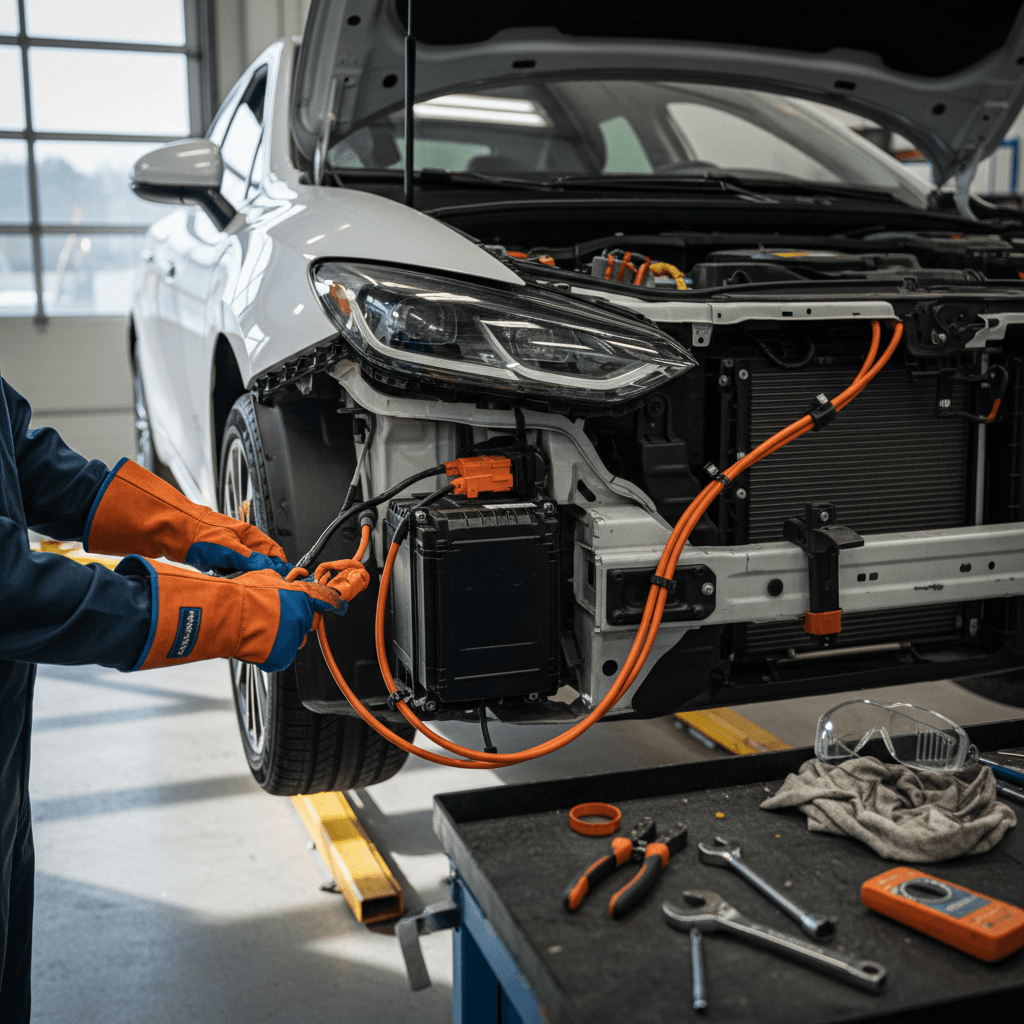
Every collision repair on an EV is a safety exercise first and a cosmetic job second. Before a panel is removed, a specialist shop will de‑energize and isolate the high‑voltage system, then determine whether the battery, cooling lines, or orange‑sheathed cables run through the damaged zone.
- High‑voltage isolation: Following OEM procedures to power down, lock out, and verify zero energy before any cutting, welding, or pulling.
- Battery pack inspection: Checking for cracks, leaks, swelling, or abnormal temperatures, even if external damage looks minor.
- Cooling system checks: Many EV battery packs share coolant with drive units and onboard chargers; leaks must be found and repaired.
- Thermal runaway prevention: Shops should have defined procedures and isolation zones for any EV with potential battery damage.
Why Heat Matters in the Paint Booth
If a shop can’t clearly explain how they make an EV safe to work on, or they dismiss these steps as "overkill," that’s your cue to keep looking.
OEM Certifications That Matter for EV Collision Repair
The alphabet soup of certifications can be confusing, but for electric vehicles, some badges really do separate the specialists from the dabblers. Automakers now run EV‑specific collision programs that require shops to buy approved tools, complete training, and follow factory repair procedures.
Common OEM Programs for Electric Vehicle Body Repair
Ask whether your prospective shop participates in one or more of these programs, or the equivalent for your brand.
| Brand / Group | Typical Program Name | What It Usually Covers | Why It Matters |
|---|---|---|---|
| Tesla | Tesla Approved / Certified Collision Center | Structural and cosmetic repairs, aluminum body work, HV safety, access to structural parts. | Ensures your Tesla is repaired with correct welds, adhesives, and parts, many structural components are restricted to approved shops. |
| Rivian | Rivian Certified Collision Center | Full structural repairs on R1T/R1S and commercial EVs, battery protection procedures. | Rivian controls access to many parts; certification proves the shop can restore crash performance. |
| Hyundai / Kia | OEM Certified Collision / EV Program | EV‑specific procedures for IONIQ 5/6, EV6, etc., plus ADAS calibration. | Important for mixed‑material bodies and integrated battery structures. |
| Honda / Acura | Certified Collision + EV Add‑On | Enhanced EV collision program layered on top of standard certification. | Confirms the shop is trained on Prologue, ZDX, and future EV architectures. |
| General Motors | GM EV / Ultium‑Capable Certified | Procedures for Ultium‑based EVs (Chevrolet, GMC, Cadillac). | Critical when repairs are near the Ultium pack or underbody structure. |
Certification names vary by manufacturer, but the idea is the same: factory‑approved training, tooling, and audits.
Quick Credential Checklist
Inside an EV-Savvy Body Shop: Training, Tools, and Tech
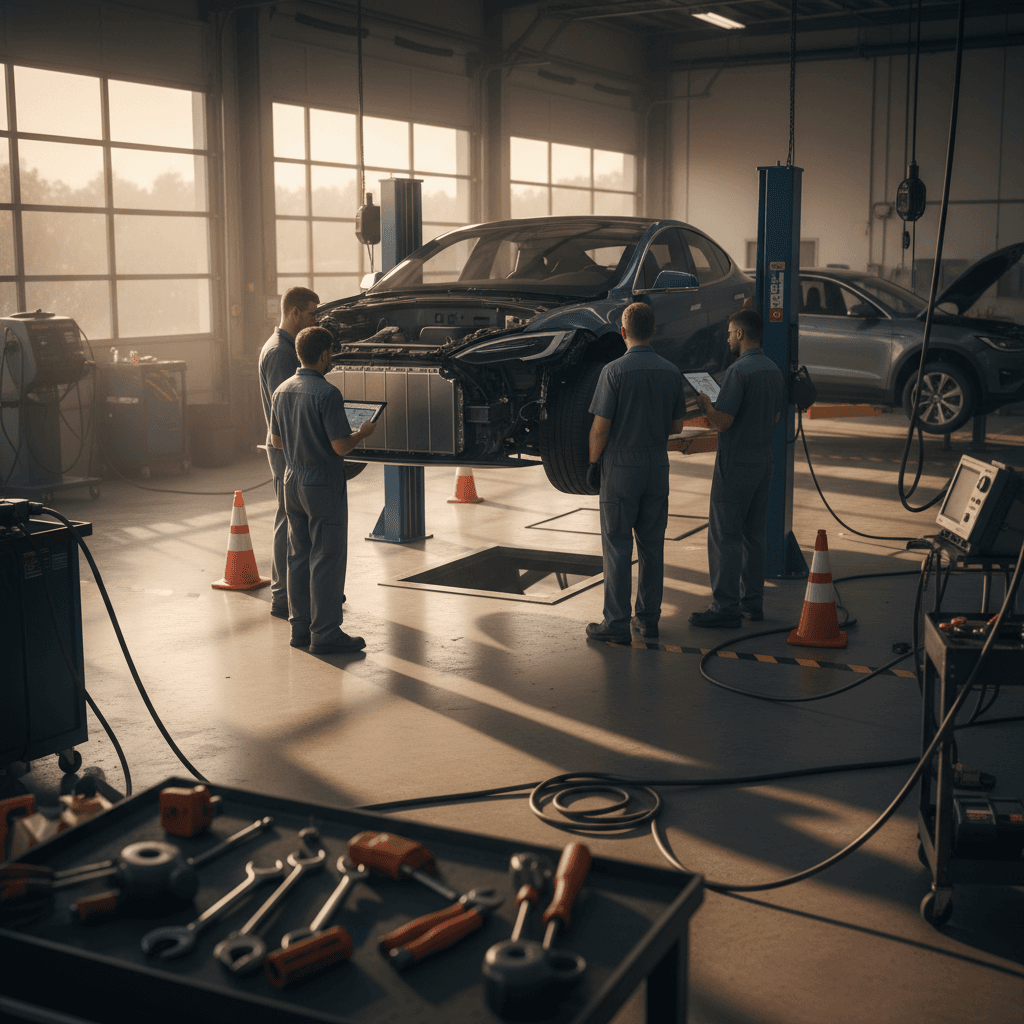
Specialists don’t just bolt on parts. They invest heavily in training and equipment to repair EVs correctly the first time. That investment is one of the best signals that a shop takes electric vehicles seriously.
Behind the Scenes of an Electric Car Body Shop Specialist
What you’ll find in a shop that truly understands EVs.
Specialized Training
Technicians complete high‑voltage safety, EV damage analysis, and brand‑specific collision courses, often hundreds of hours across the team, with recertification every few years.
Heavy‑Duty Equipment
EVs are heavier, so lifts and frame benches are rated accordingly. Many also have dedicated aluminum bays and welders to keep steel and aluminum tooling separate.
Advanced Diagnostics
Factory‑level scan tools, battery and thermal monitoring equipment, and calibration systems for cameras and radar are standard, not optional extras.
Red Flags in a "We Work on EVs" Shop
How to Choose the Right Electric Car Body Shop Specialist
You don’t need to become a collision expert, you just need to ask the right questions. Here’s a practical way to vet an electric car body shop specialist before your EV spends a month on their frame bench.
7-Step Checklist for Choosing an EV Body Shop
1. Confirm EV Experience
Ask how many EVs they repair each month and which models. You want a shop that sees your brand regularly, not one that’s "excited to work on its first" EV like yours.
2. Ask About OEM and I‑CAR Certifications
Request a simple list or look for logos in the lobby: Tesla, Rivian, Hyundai, Kia, GM, Honda, etc., plus <strong>I‑CAR Gold Class</strong> or equivalent. No certifications, no deal.
3. Verify High‑Voltage Safety Procedures
Ask: “Who is your high‑voltage safety lead, and what’s the process for powering down my car?” They should talk about lockout/tagout, verification of zero energy, and battery temperature monitoring without hesitation.
4. Clarify Battery Inspection Protocols
If the impact was near the floor, rocker, or underbody, your shop should have a defined <strong>battery inspection process</strong> and know whether your brand requires dealership involvement for battery R&I (removal and installation).
5. Confirm ADAS Calibration Capabilities
Modern EVs rely heavily on cameras and radar. Ask whether they perform ADAS calibrations in‑house or partner with a specialist, and whether those calibrations will be documented on your final invoice.
6. Review Parts and Repair Philosophy
Look for a bias toward <strong>OEM parts and procedures</strong>, especially in structural and safety‑critical areas. A shop that pushes questionable aftermarket parts on a new EV should set off alarms.
7. Get a Transparent, Written Estimate
Estimates on EVs often evolve after disassembly and OEM scans. That’s normal. What you want is a shop that explains potential unknowns up front, updates you as they go, and documents every supplement for you and your insurer.
Use Your Network, But Verify
Working With Insurance on Electric Vehicle Repairs
Your insurer’s preferred body shop network may or may not include strong EV specialists. You’re generally allowed to choose your own repairer, but you’ll want to be strategic about how you communicate and document things.
How to Talk to Your Insurer
- Explain that your vehicle is an EV with high‑voltage and ADAS systems, and you want a shop that’s certified for your brand.
- Ask if they have an EV‑capable shop in their network; if not, provide the name of the specialist shop you prefer.
- Request in writing that the shop use OEM repair procedures and document any deviations.
Protecting Yourself on Paper
- Keep copies of the estimate, supplements, pre‑ and post‑repair scan reports, and calibration certificates.
- Ask the shop to note any remaining damage or limitations if your insurer refuses to pay for a recommended OEM procedure.
- Store all repair paperwork with your vehicle records, these documents matter later if you sell or trade the car.
When the Cheapest Estimate Isn’t the Best
How Repair Quality Affects Your EV’s Long-Term Value
On a gasoline car, a mediocre repair might mean a bit more wind noise or an off‑shade paint blend. On an EV, poor collision work can haunt you in ways that aren’t obvious until later: unexplained range loss, repeated warning lights, or premature battery and tire wear from misalignment or bent mounting points.
Why EV Repair Quality Follows the Car
A good specialist protects more than just cosmetics.
Structural Integrity
Correct sectioning, welding, bonding, and adhesive use restore crash protection. Shortcuts can weaken crumple zones and compromise safety in a future accident.
ADAS & Range Performance
Improperly mounted sensors or damaged undertrays and air deflectors can hurt efficiency and make driver‑assist systems unreliable or annoying.
Resale & Trade‑In
Documented repairs by a reputable electric car body shop specialist support your vehicle’s story when you sell or trade, especially in the growing used‑EV market.
At Recharged, every used EV includes a Recharged Score battery and vehicle health report, which accounts for past repairs, diagnostic data, and battery condition. Cars that have been through competent EV‑savvy collision centers stand out, for reliability, safety, and long‑term value.
What to Expect: EV Body Repair Costs and Timelines
Electric‑car collision repairs tend to cost more and take longer than comparable gas‑car repairs, even when the damage looks similar. That’s not just mark‑up; it’s the reality of extra procedures, parts cost, and limited EV‑qualified labor.
Typical Differences Between EV and Gas Car Collision Repair
Actual numbers vary by brand, region, and severity, but the pattern is clear: EV repairs are more complex.
| Aspect | Typical Gas Car | Typical EV | Why EVs Differ |
|---|---|---|---|
| Initial diagnostics | Basic code scan | Full vehicle scan + EV system checks | High‑voltage and battery checks add time and complexity. |
| Labor rates | Standard collision rate | Often +$5–$20/hour vs. base rate | Specialized EV training and safety protocols. |
| Parts access | Widely available | Can be back‑ordered or restricted | OEMs control structural and battery‑adjacent parts more tightly. |
| Cycle time for moderate hit | 1–2 weeks | 2–4+ weeks | More steps: scans, calibrations, OEM consultations, parts delays. |
| Out‑of‑pocket risk if done wrong | Mainly cosmetic | Battery, HV, and ADAS issues | Mistakes can lead to very expensive secondary repairs. |
Use this as a directional guide, not a quote. Always rely on a written estimate from your chosen shop.
Plan for a Longer Repair Window
FAQ: Electric Car Body Shop Specialists
Frequently Asked Questions About EV Body Repair
The bottom line: an electric car body shop specialist protects more than paint and panels. They protect your battery, your safety systems, and the long‑term value of your EV. Before your next accident, or right after the one you just had, take the time to find a shop that treats your electric car like the high‑voltage machine it is. And if you decide a repaired EV no longer fits your plans, or you’re ready to move into a different model, Recharged can help you trade in, sell, or upgrade with confidence, backed by real battery data and expert EV guidance.