If you’re new to electric vehicles, one-pedal driving can sound like a gimmick, or a recipe for jerky stops. In reality, it’s just a smarter use of regenerative braking, and when you understand the pros and cons it can make daily driving smoother, more efficient, and easier on your brakes.
Quick definition
What is one-pedal driving?
In a traditional gas car, your right foot constantly alternates between the gas and brake pedals. In an EV with one-pedal driving (sometimes called e-Pedal, i-Pedal, One-Pedal Drive, or Single-Pedal Mode), the accelerator does double duty. When you release it, the car doesn’t just coast, it actively slows using regenerative braking, often strongly enough to bring you all the way to a stop.
- Normal driving: Press the accelerator to speed up, lift to slow down.
- Regenerative braking: The motor runs in reverse as a generator, turning your motion back into electricity instead of wasting it as heat.
- Full stop in many EVs: At low speed and with the right settings, the car can hold itself at 0 mph without touching the brake pedal.
Different names, same basic idea
How one-pedal driving actually works
Mechanically, nothing magical happens when you switch on one-pedal mode. You’re simply telling the car to use maximum practical regenerative braking as soon as you lift off the accelerator, instead of waiting for you to press the brake pedal.
Under the skin: what your EV is doing
Same hardware as normal regen, different tuning and feel
1. Motor becomes a generator
2. Battery recovers energy
3. Blended braking takes over
Factory settings matter
Key benefits: Pros of one-pedal driving
Why many EV owners swear by one-pedal driving
Pro #1: Less fatigue, more control
Once you’ve adapted, one-pedal driving can feel almost like using cruise control at city speeds. You time your lifts off the pedal to meet red lights and slower traffic, and the car smoothly decelerates without the second step of moving to the brake. Human-factors research has found that this can reduce cognitive workload and increase perceived enjoyment for many drivers in everyday use.
Pro #2: Lower brake wear and simpler maintenance
Because regenerative braking does most of the work in one-pedal mode, your friction brakes step in mainly for hard stops or at very low speeds. Fleet and commercial EV operators that lean on one-pedal driving commonly report much longer intervals between brake-pad replacements, sometimes measured in years rather than tens of thousands of miles of heavy city use.
Good news for used EV buyers
Pro #3: Better efficiency in the right conditions
On routes with frequent stops, hills, or lower‑speed traffic, aggressive regen helps you reclaim energy that would otherwise disappear as heat. In those situations, consistent one-pedal driving can stretch your usable range compared with mostly using friction brakes.
Drawbacks: Cons and common complaints
Con #1: Learning curve and motion sickness
If you time your lifts poorly, or switch back and forth with normal cars, it’s easy to make passengers nod forward as the car grabs regen sooner than they expect. Some drivers also report foot or ankle strain from constantly feathering the pedal to get the exact deceleration they want.
Most people adapt over a few days, but if you share the car with drivers who are used to coasting, expect complaints at first.
Con #2: Not ideal for every road or driver
On the highway, strong regen every time you lift can feel tiring if you just want to lift and coast. In that scenario, many drivers prefer a lighter regen setting or conventional two‑pedal driving.
Some owners also turn one‑pedal off on gravel, steep off‑road descents, or mixed‑traction surfaces where they want very precise control over how quickly weight transfers between axles.
Con #3: Inconsistent behavior when regen is limited
Regenerative braking strength depends on battery temperature, state of charge, and traction. On a cold morning or with a nearly full battery, your EV may cut back regen so it doesn’t over‑stress the pack. That means the same pedal lift that normally gives you a firm slowdown might suddenly feel weaker, and some cars will quietly blend in more friction braking to compensate.
Watch for regen limit warnings
Con #4: Not everyone likes the feel
Some drivers simply prefer the familiar rhythm of pressing the brake pedal to slow down and letting the car coast when they lift. They may find strong one-pedal tuning "on‑off" or intrusive, especially in suburban driving where you often want to glide rather than slow aggressively. That’s why many automakers now let you dial in multiple regen levels, and why it’s fine if you decide one-pedal isn’t for you.
Is one-pedal driving safe, and what about brake lights?
Regulators in the U.S. and abroad have been looking closely at how one-pedal driving interacts with brake lights and stopping performance. The big picture: properly designed systems are considered safe, and in many situations they can actually help you slow sooner in an emergency because the car starts decelerating the moment you lift off the accelerator.
How your EV handles brake lights in one-pedal mode
Behavior can vary by brand and software version, but most modern EVs follow similar rules.
| Situation | Typical behavior | What you should know |
|---|---|---|
| Gentle lift off accelerator | No brake lights until deceleration passes a threshold | Car may slow slightly without lighting the lamps, similar to light engine braking in a gas car. |
| Medium/strong lift (noticeable decel) | Brake lights turn on automatically | Most EVs illuminate the lights once decel is similar to pressing the brake in an ICE car. |
| Hard braking or panic stop | Full brake lights plus ABS and any collision-avoidance systems | Blended regen and friction braking work together to meet safety standards. |
Always confirm brake-light behavior on your specific vehicle, especially if you buy used.
What regulators care about
One-pedal vs coasting: What’s best for efficiency?
You’ll often hear two schools of thought: one says "maximize regen with one-pedal"; the other says "coasting is king." Both have a point. From a physics standpoint, the most efficient move is not to slow down at all, if you can maintain a steady speed and avoid braking, you waste less energy than you’ll ever recover through regen.
When one-pedal driving shines
- Urban routes with frequent lights and stop signs
- Hilly terrain where you often slow on descents
- Stop‑and‑go traffic where you constantly adjust speed
Here, the choice isn’t between coasting and regen, it’s between regen and burning that energy away in friction brakes. One‑pedal helps you capture more of it.
When light regen or coasting works better
- Steady highway cruising with long gaps between exits
- Rural roads where you can see far ahead
- Hyper‑miling runs where you time lifts far in advance
In these cases, a low‑regen setting or traditional two‑pedal driving can yield slightly better range, because you avoid slowing more than you need to.
Think of one-pedal as a tool, not a religion
When you should use one-pedal driving, and when to turn it off
Practical guidelines for turning one-pedal on or off
Use it in city and suburban traffic
In low‑speed, stop‑and‑go conditions, one-pedal driving reduces fatigue and helps you recapture more energy from constant speed changes.
Use it on familiar hilly routes
If you know the road and can anticipate hills, strong regen can manage speed on descents without riding the brakes.
Consider turning it down on slick roads
Modern traction control systems are very good, but some drivers prefer gentler regen, or traditional two‑pedal driving, on snow, ice, or loose gravel to keep weight transfer predictable.
Dial it back on long highway stretches
If you find yourself constantly modulating the pedal just to avoid slowing too much, try a lighter regen setting or normal coasting at higher speeds.
Turn it off for nervous new EV drivers
If a family member or friend is test‑driving your EV for the first time, starting with conventional brake behavior can make the transition less intimidating.
Re‑enable it when you’re comfortable again
As you get used to your EV’s feel, experiment with stronger regen levels for a week at a time to see what genuinely works best for your routes.
Don’t treat the brake pedal as optional
How to set up one-pedal driving in popular EVs
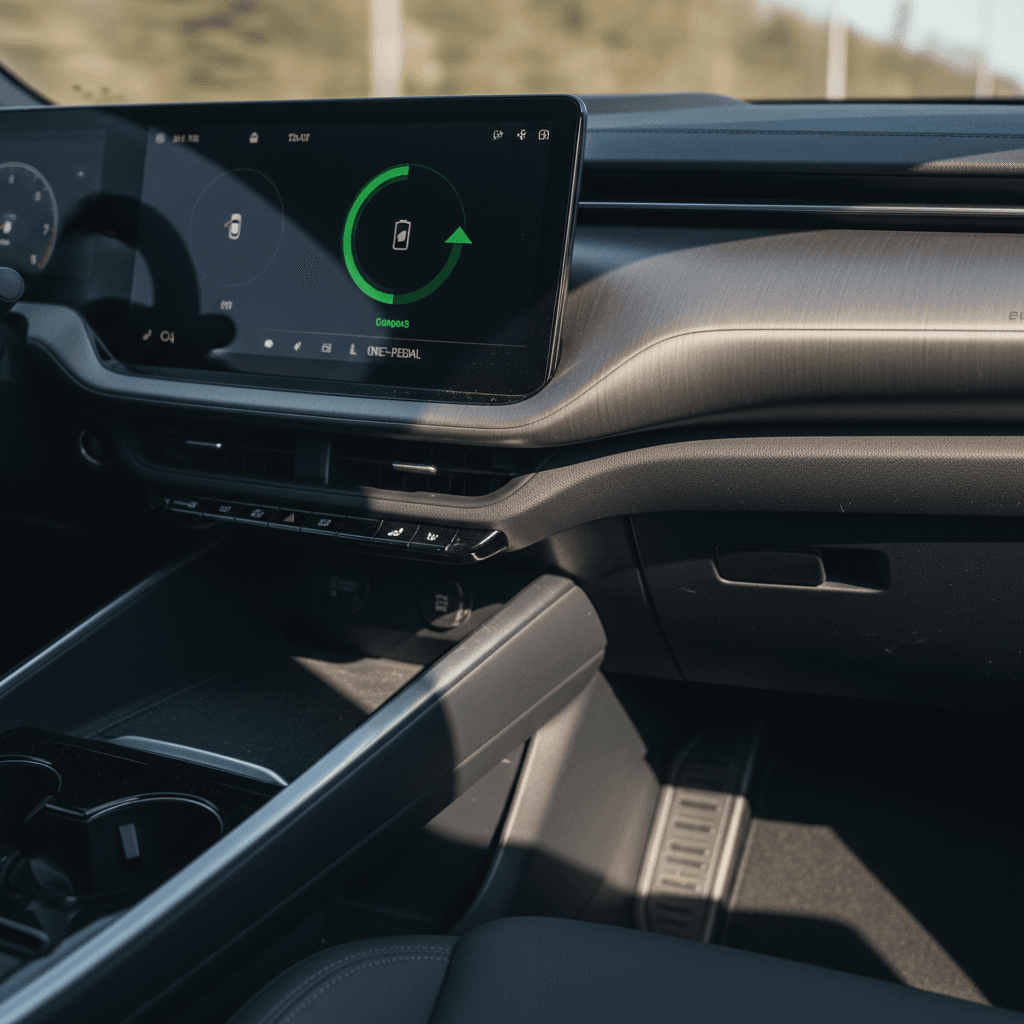
The exact menus and labels vary, but most EVs let you choose how aggressive regen should be and whether the car will hold itself stopped without the brake. Here’s what to look for in your settings, especially important if you’re test‑driving or buying used and want to feel how the car behaves before committing.
Finding one-pedal driving settings in common EV families
Menu names change with software updates, but these patterns hold across many recent model years.
| Brand examples | What it’s usually called | Where to look |
|---|---|---|
| Nissan LEAF, Ariya | e-Pedal / e-Pedal Step | Drive mode or EV settings; often a dedicated button near the shifter. |
| Chevy Bolt EV/EUV, Blazer EV, Equinox EV | One Pedal Driving | Vehicle settings → Drive mode or Regen; plus steering‑wheel paddle for extra regen in some models. |
| Ford Mustang Mach‑E, F-150 Lightning | One-Pedal Drive | Settings → Drive Modes or Driving Assistance; toggle per profile. |
| Hyundai Ioniq 5/6, Kia EV6 | i-Pedal / Regen Level 0–3 | Steering‑wheel paddles adjust regen on the fly; one setting enables one‑pedal behavior. |
| Tesla Model 3/Y/S/X | Regenerative Braking / Stopping Mode | Pedals & Steering or Driving settings; choose high regen and a stopping mode (Hold vs Roll). |
Always confirm with your specific owner’s manual or on‑screen help.
Test both extremes on a long drive
Used EV shopping: How one-pedal driving fits in
If you’re shopping the used market, one-pedal driving is less a make‑or‑break feature and more a question of how the previous owner drove and how the car feels to you. But it still plays a role in long‑term ownership costs and day‑to‑day satisfaction.
What to think about when buying a used EV with one-pedal capability
Questions to ask and things to feel for on a test drive
Battery & regen behavior
Brake condition
Your comfort level
Where Recharged fits in
FAQ: One-pedal driving explained
Common questions about one-pedal driving
Bottom line: Is one-pedal driving right for you?
One-pedal driving isn’t a magic trick, and it isn’t mandatory. It’s simply a different way of using regenerative braking that many EV owners end up loving for its convenience, smoothness, and potential efficiency gains. The pros, lower brake wear, less fatigue in traffic, and better energy recovery, are meaningful, but they’re balanced by a real learning curve and driving‑style tradeoffs on slick roads or long highway runs.
If you’re EV‑curious or shopping for a used electric car, treat one-pedal driving as one more tool in the box. Test it on familiar routes, experiment with different regen levels, and see how your body and your passengers react. And if you want help comparing how different models behave, Recharged’s EV‑specialist team can walk you through options, battery health, and daily‑driving feel so you end up with an EV that matches the way you like to drive.