A beach trip in an electric car can be the best kind of quiet: no engine drone on the highway, just the surf when you open the door. But coastal driving adds a few twists, charging near popular beaches, sand, salt air, and holiday traffic, that gas-car guides barely touch. These electric car beach trip tips will help you plan the route, protect your EV, and enjoy the water without watching your state of charge like a hawk.
Good news for 2026 beach trips
Why EVs Are Great for Beach Trips
Electric vs. Gas: Why EVs Shine at the Shore
Comfort, quiet, and control matter more than you think on a beach getaway.
Cool and Quiet at the Beach
You can run A/C at idle without guilt while kids nap or you wait on someone grabbing snacks, and there’s no engine noise competing with the waves.
Stop‑and‑Go Friendly
Beach traffic is brutal for gas mileage but kinder to EV range. Regenerative braking recovers energy instead of wasting it as heat in bumper‑to‑bumper lines.
Low Local Emissions
Zero tailpipe emissions in crowded coastal towns means cleaner air in packed parking lots and boardwalk streets.
If your beach tradition has always involved a rented crossover with sand in the carpets and a hot engine bay cooking everything in the trunk, an EV is an upgrade. The trick is tailoring your trip to your car’s range and the coastal charging you actually have, not the charging you wish were there.
Plan Your Coastal Charging Strategy
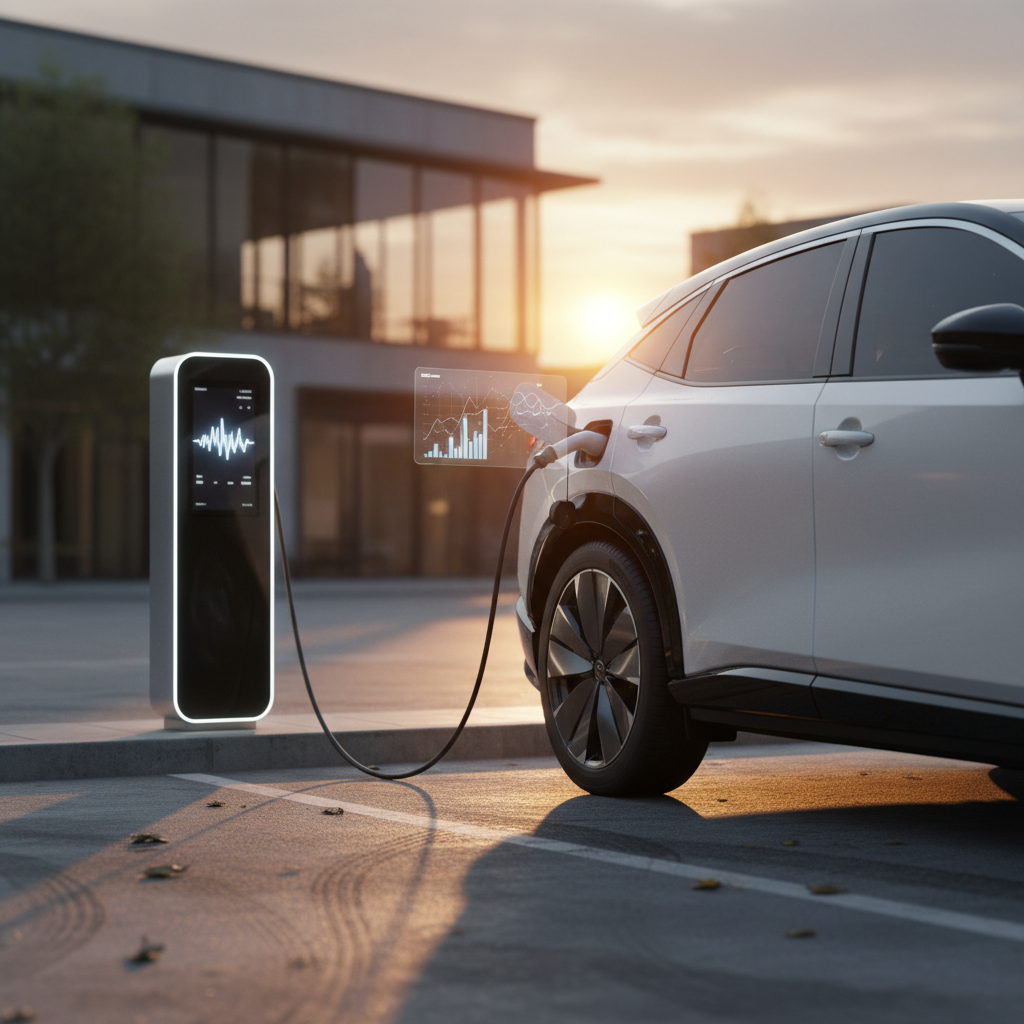
Before you think about coolers and chairs, lock in your charging plan near the beach. Holiday weekends can overwhelm both parking and plugs, so you want backups ready.
- Use an EV trip planner (A Better Routeplanner, ChargeHub, PlugShare, your car’s native planner, or the Tesla app) to map DC fast chargers and Level 2 options near your destination.
- Zoom in on your actual beach town: look for chargers at grocery stores, outlet malls, hotels, and municipal lots within 5–15 minutes of the sand.
- Check recent user check‑ins and photos so you’re not counting on a station that’s often broken or blocked by gas cars.
- If you’re staying at a rental, ask **specific** charging questions: Is there a 120V outlet in the parking area? A 240V dryer outlet? Any on‑site Level 2 charger?
- For condos and hotels, search the listing name in PlugShare or the ChargeHub map; many properties quietly add EV parking before they bother updating websites.
Charging Time Benchmarks for a Beach Trip
Book around the charger, not the other way around
How Much Range You Really Need for the Beach
Most beach trips fall into two patterns: a **same‑day dash** or a **multi‑day vacation**. The range you need, and how aggressively you manage state of charge, depends on which trip you’re planning.
1. Day trip within 120–150 miles
- Leave home at 90–100% if your manual allows frequent full charges on road‑trip days.
- Plan to arrive at the beach with **30–50%** so you can handle detours, beach cruising, or AC time.
- Top up at a DC fast charger or Level 2 near the coast while you eat, then head home with 60–80%.
If you’re in a short‑range EV (150–200 miles EPA), one well‑timed fast‑charge stop each direction usually does it.
2. Week‑long beach vacation
- Think in terms of **daily usage**, not just the drive down. Many families only drive 10–40 miles a day once they arrive.
- If you have overnight Level 2, arriving with 20–30% is fine, you’ll refill while you sleep.
- Without home‑base charging, aim to start each day around **60–80%** by using nearby fast chargers every couple of days.
In practice, a used EV with 200+ miles of real‑world range is more than enough for most coastal vacations.
Watch headwinds and highway speed on coastal routes
Parking and Driving on Sand With an EV
Here’s where beach trips in an EV diverge sharply from a crossover with a big steel gas tank. EVs carry a heavy battery pack, low in the chassis. That’s good for stability, but not great for deep, soft sand. You want to avoid burying that battery sled in a mess that takes a tow truck and a vacation’s worth of cash to solve.
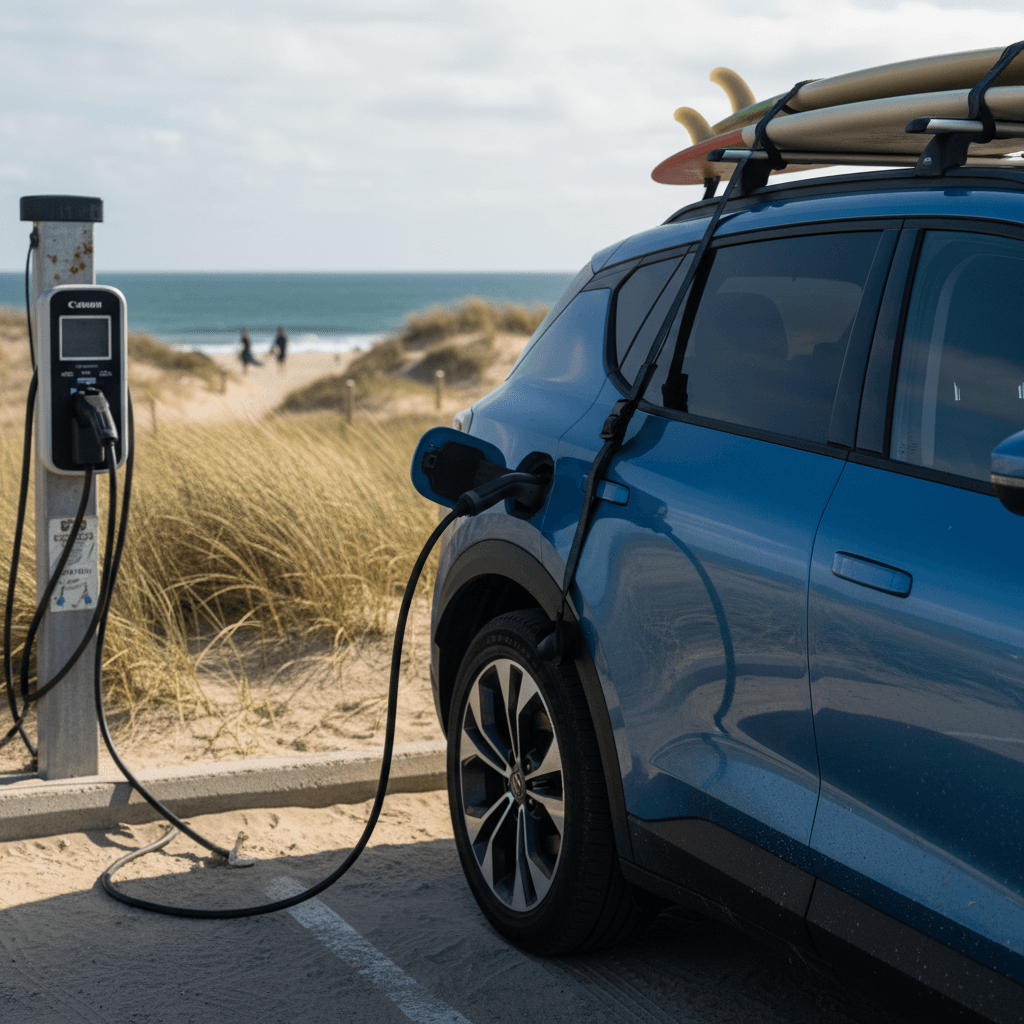
If Your Beach Allows Driving, Use This EV Sand Checklist
1. Know your car’s actual capabilities
Check the owner’s manual: some EVs have specific sand or off‑road modes, ground‑clearance notes, and warnings about water or sand ingestion. Crossover EVs with all‑wheel drive and off‑road modes cope better; low‑slung sedans usually should not be on soft sand at all.
2. Stay on hard‑packed sand when possible
Many drive‑on beaches have a firm lane near the waterline and deep sugar sand higher up. Follow local guidance and other tracks, and never stop in the softest, churned‑up sections.
3. Air down your tires (within reason)
On soft sand, lowering tire pressure increases the contact patch and helps prevent digging in. Local advice often lands in the high‑teens to mid‑20s psi range for trucks and SUVs, but always follow your vehicle and tire manufacturer’s minimum recommendations and re‑inflate before highway speeds.
4. Turn off aggressive traction control, use sand modes
Many EVs offer sand/snow modes that allow a little wheelspin and adjust power delivery. They can be the difference between crawling out and burying the car. Learn how to switch modes before you’re in the deep stuff.
5. Keep momentum, avoid sudden stops and starts
Steady, low‑speed momentum is your friend. Hammering the accelerator from a stop in deep sand just digs holes, easy to do with instant EV torque.
6. Have an exit plan (and basic recovery gear)
If you’re determined to drive on sand, carry a tire gauge, portable air compressor, a shovel, and traction boards. Know how to call for local tow or beach rescue if it all goes sideways.
When you absolutely should not drive your EV on the beach
Protecting Your EV From Salt, Sand, and Sun
Coastal air is hard on every vehicle. Salt‑laden mist and fine sand work their way into brakes, suspension, paint, and electrical connectors. EVs add high‑voltage systems and battery cooling hardware to that list. You don’t need to baby the car, but you do need a routine.
Simple Habits to Keep Salt From Eating Your EV
You can’t see corrosion starting, but you can stay ahead of it.
Rinse Underbody and Wheel Wells
After any day with salty spray or sand driving, stop at a car wash with an underbody rinse or use a hose at home. Focus on brakes, suspension, and the lower rocker panels.
Clean Weatherstripping and Door Sills
Sand trapped in seals grinds away at paint and rubber. A quick wipe of door jambs and hatch sills keeps grit from working into latches and wiring pass‑throughs.
Protect Paint and Interior From UV
Coastal sun is brutal. Park in shade when possible, use a windshield sunshade, and consider a ceramic coating or quality wax to help paint shrug off salt and UV.
Electrical connections
Salt air accelerates corrosion on connectors, grounds, and sensors. EVs are well‑sealed, but nothing is perfect. If you live or park within a few blocks of the ocean, ask your service provider to check and clean key grounds and 12‑volt battery terminals every year or two.
Avoid leaving your charge port door open when you don’t need it, and gently blow or brush sand out of the inlet before you plug in.
Battery and cooling system
The high‑voltage pack is sealed, but radiators and cooling lines are still exposed to salt and sand. Have the underside inspected on a regular maintenance schedule, especially if you frequently drive on salty winter roads or near the surf.
If you’re shopping a used EV that’s lived at the beach, a platform like Recharged can provide a battery health report and underbody photos so you’re not guessing what years of salt have done underneath.
Make post‑beach cleanup part of the ritual
Packing Checklist: EV Essentials for a Beach Trip
You already know about towels and sunscreen. This list is about the gear that keeps your **electric** beach trip smooth, even when chargers are busy or the weather misbehaves.
EV‑Specific Beach Trip Packing List
Mobile charge cable and adapters
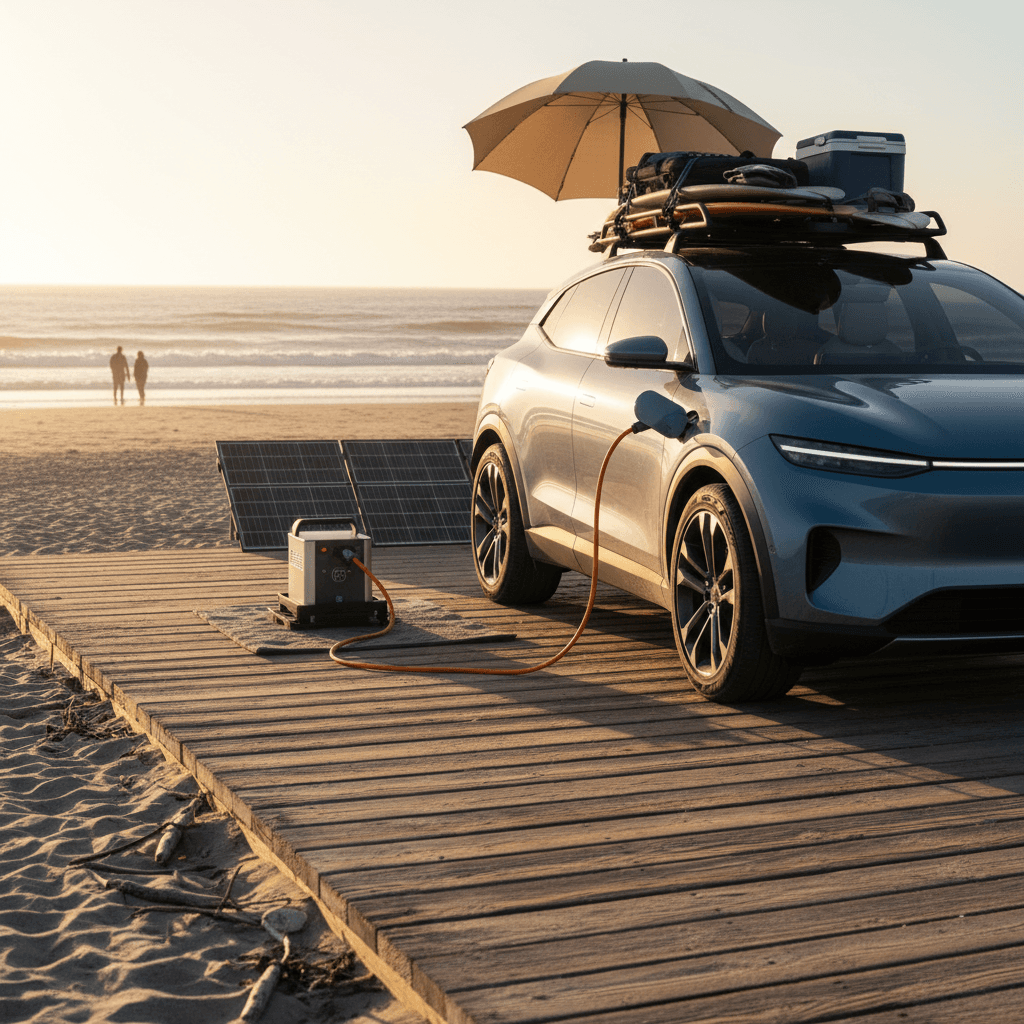
Bring your Level 1 (120V) cable and any Level 2 adapters your car supports (NEMA 14‑50, 14‑30, etc.). If you have a portable Level 2 unit, toss it in the trunk, you might find a friendly RV park or rental outlet to plug into.
Charging cards and apps
Install and log into apps for the big coastal networks you’ll see on your route (Tesla, Electrify America, EVgo, ChargePoint, Shell Recharge, etc.). Carry at least one RFID card or backup payment method in case an app flakes out.
Extension cord (used carefully)
If your rental only has a distant 120V outlet, a **heavy‑gauge outdoor extension cord** rated for continuous load can be a trip‑saver. Keep runs as short as possible and never daisy‑chain cords.
Tire repair and inflation kit
Beach parking lots hide shells, screws, and driftwood. Pack a plug kit, a 12V or onboard air compressor, and a true pressure gauge. If you air down for sand, you’ll need the compressor to get back to highway pressures.
Basic recovery gear if you’ll be on sand
A compact shovel, folding traction boards, and a tow strap rated for your vehicle weight are cheap insurance if your beach allows driving and you plan to join the fun.
Interior protection
Deep floor mats and a cheap fitted sheet over the cargo area do wonders. Sand in carpets is just annoying; sand in seat tracks and under battery‑cooling vents is worse.
Saving Time and Money on Beach-Trip Charging
Beach towns are expert at relieving visitors of their money. Charging doesn’t have to join that list. A little planning can tilt more of your budget toward seafood and less toward electrons.
Common Beach Trip Charging Options
How typical charging choices stack up for a coastal vacation.
| Charging Option | Best Use Case | Pros | Cons |
|---|---|---|---|
| Home charging before you leave | Starting trip full | Cheapest per kWh; convenient | Requires home EVSE or accessible outlet |
| DC fast charging on the highway | Covering long distances quickly | Very fast; located near food and restrooms | Highest per‑kWh price; busy on holidays |
| Hotel or condo Level 2 | Overnight top‑offs | Charges while you sleep; often flat fee or free | May be limited to a few spaces; can be ICEd or occupied |
| Public Level 2 in town | Park‑and‑play at the beach or shops | Lower cost than DC; good for 2–4 hour activities | Too slow for big road‑trip jumps alone |
| 120V at your rental | Last‑resort trickle while parked | Works almost anywhere; keeps battery from slowly draining | Adds little range per hour; must be wired safely |
Prices are examples, always check your provider’s current rates.
Arrive low, leave high
Buying or Bringing a Used EV to the Beach
If you’re driving a used EV, or shopping for one specifically to handle summer beach duty, you’re asking the right questions. Coastal trips expose weak batteries, dodgy cooling systems, and existing corrosion faster than a gentle suburban commute does.
Questions to ask about a used coastal EV
- Has the car spent its life within a few miles of the ocean? Ask for service records and underbody photos.
- Any history of flood damage or "water intrusion" notes? Those are red flags for high‑voltage systems.
- What’s the current battery health? A car that has done lots of DC fast charging in hot weather can show more degradation.
How Recharged can help
Every EV sold through Recharged comes with a Recharged Score Report that includes verified battery health, fair‑market pricing, and photos that help you see what’s going on under the skin.
If you want a car that can haul kids and coolers to the shore without surprise range loss, working with EV specialists who understand battery diagnostics is worth it, especially for vehicles that have lived near salt air.
Electric Car Beach Trip FAQ
Common Questions About EV Beach Trips
Key Takeaways for Your Next EV Beach Trip
An electric car beach trip isn’t a stunt anymore, it’s just a smarter, quieter way to travel. If you plan your charging before you pack your cooler, give yourself realistic range margins, and treat sand and salt as something to manage instead of fear, your EV will handle the coast just fine.
Build the habit of rinsing the car after sandy drives, keep a small kit for tires and charging in the trunk, and be honest about whether your particular EV belongs on the soft sand or in the paved lot. And if you’re shopping for a used EV with beach duty in mind, leaning on detailed battery health data, like the Recharged Score Report, can make the difference between a carefree summer and a stressful one.