If you’ve heard that electric vehicles are “more efficient” than gas cars but aren’t sure what that really means, you’re not alone. The efficiency of electric cars is the quiet superpower behind their lower running costs, strong performance, and shrinking environmental footprint, especially as the grid gets cleaner.
Key takeaway
Why the efficiency of electric cars matters
Efficiency sounds like a boring engineering metric, but for you it boils down to three very human concerns: how much you pay per mile, how far you can go between charges, and how much climate and air pollution your car ultimately creates.
How efficient are electric cars today?
Those numbers explain why so many drivers who switch to electric are surprised at how rarely they need to “fill up,” and why their utility bill usually rises far less than their gasoline spending drops, even in states with higher electricity prices.
Tip for shoppers
How efficient are electric cars vs gas cars?
Electric car: battery to wheels
- Battery → inverter → motor → wheels. There’s no engine idling, no gear hunting, and very little waste heat.
- Typical energy losses come from charging (about 10%), power electronics, the motor itself, and accessories like HVAC and lights.
- Realistically, you’re getting roughly 65–90% of battery energy to the wheels, plus a bonus from regenerative braking that recaptures energy when you slow down.
Gas car: fuel tank to wheels
- Tank → engine → transmission → wheels. Combustion is messy and hot, and most of the energy simply turns into heat.
- Roughly 75–84% of gasoline’s energy disappears as heat, friction, and parasitic losses (cooling system, drivetrain, accessories).
- That leaves only about 16–25% of the fuel’s energy turning the wheels, and there’s no regenerative braking to claw any of it back.
From a driver’s seat, you feel this difference as instant torque, quiet operation, and fewer stops for fuel. Under the skin, it’s simply physics: electric motors are inherently better at turning energy into motion than internal combustion engines.
Don’t ignore efficiency when choosing an EV
MPGe, kWh per 100 miles, and miles per kWh explained
Automakers and the EPA use several different metrics to describe the efficiency of electric cars. They look confusing at first, but once you translate them into “how far can I go for a dollar?” they start to make sense.
Three ways EV efficiency is shown
They’re all connected, you just look from a different angle depending on what you care about.
MPGe (miles per gallon equivalent)
MPGe compares EVs to gas cars using a common energy unit. The EPA assumes one gallon of gas contains 33.7 kWh of energy.
A typical modern EV at around 106 MPGe is getting more than three times the mileage of a 30 MPG gas car on the same amount of energy.
kWh per 100 miles
This tells you how much electricity an EV uses to travel 100 miles. Lower is better.
Many efficient sedans fall around 25–30 kWh/100 mi, while heavier SUVs and trucks often use 35–45 kWh/100 mi or more.
Miles per kWh
This flips the previous metric: miles you travel on each kWh. Higher is better.
Compact EVs can deliver roughly 3.8–4.2 mi/kWh, mid-size sedans often land around 3.2–3.8 mi/kWh, while large SUVs and trucks come in lower.
Sample efficiency ratings for different vehicle types
Approximate real-world efficiency ranges to give you a sense of how various vehicles stack up. Individual models will vary.
| Vehicle type | Typical MPGe (EPA combined) | kWh/100 miles | Miles per kWh |
|---|---|---|---|
| Efficient compact EV | 120–135 MPGe | 23–28 | 3.5–4.3 |
| Mid-size electric sedan | 105–120 MPGe | 26–30 | 3.3–3.8 |
| Electric crossover/SUV | 90–110 MPGe | 30–36 | 2.8–3.3 |
| Electric pickup truck | 70–90 MPGe | 37–50 | 2.0–2.7 |
| Average new gas car (for comparison) | 27 MPG | ~124 kWh/100 mi equivalent | 0.8–1.0 |
Sedans and hatchbacks tend to be the most efficient electric cars, while large SUVs and pickups trade efficiency for space, capability, and towing.
How to read a window sticker
Real-world efficiency: what drivers actually see
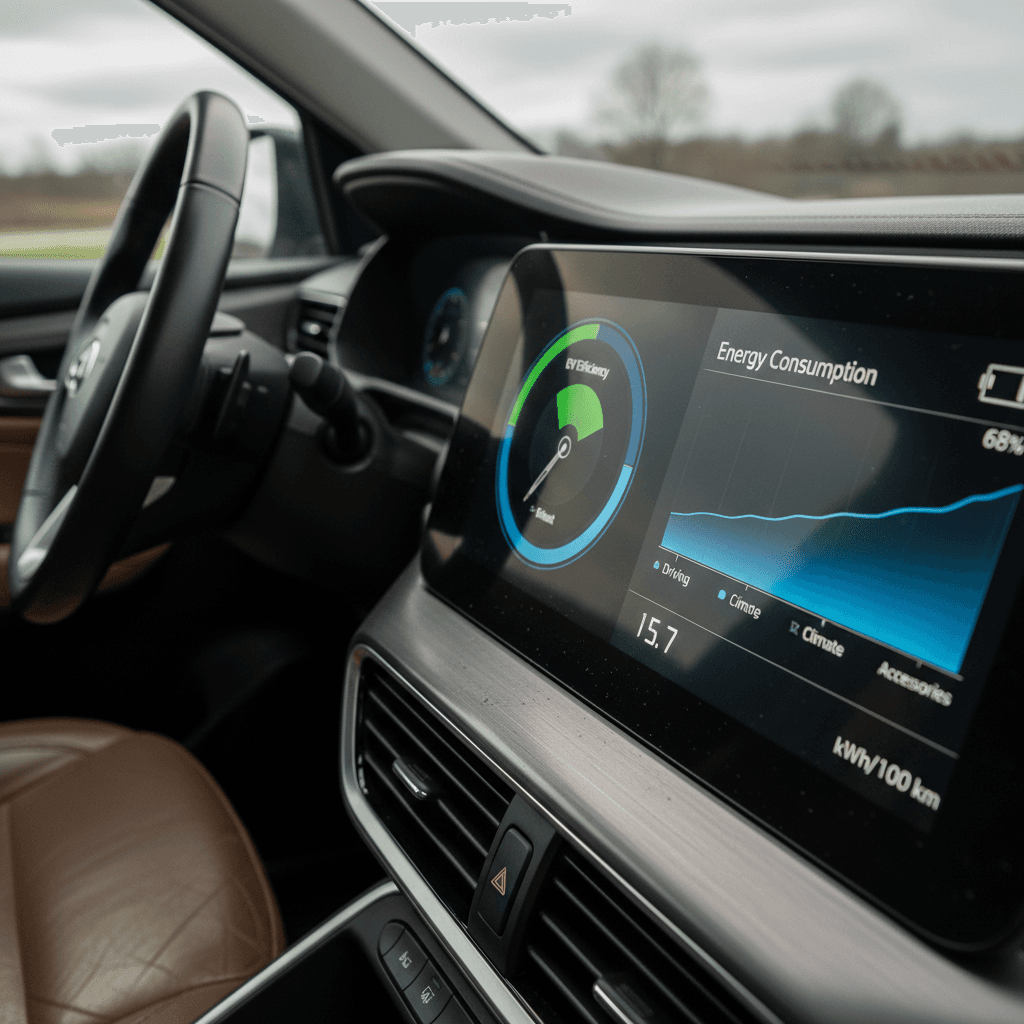
Like gas mileage stickers, EPA ratings for EVs are a standardized lab test, not a guarantee. Independent range and consumption tests from outlets like Edmunds and Car and Driver routinely find that many EVs either meet or exceed their official ratings on the highway when driven at steady speeds.
- Some compact and mid-size EVs easily deliver 3.5–4.0 miles per kWh in moderate weather at highway speeds.
- Performance-oriented or very heavy models may land closer to 2.5–3.0 miles per kWh.
- Cold weather, steep hills, high speeds, and big wheels or knobby tires can quickly drag an EV’s efficiency, and range, down.
Cold weather is a big deal
9 factors that change your EV’s efficiency
Two owners of the same electric car can see very different efficiency numbers. Here are the main levers that move the needle up or down.
What actually affects the efficiency of electric cars?
1. Speed
Above about 60 mph, aerodynamic drag ramps up sharply. That’s why a steady 70–75 mph highway cruise can use far more energy than a relaxed 60 mph drive, even on flat ground.
2. Temperature
Batteries and humans both like mild weather. Extreme cold or heat forces your car to spend extra energy on thermal management and climate control, reducing miles per kWh.
3. Driving style
Smooth, anticipatory driving lets regenerative braking recapture energy and avoids wasteful bursts of acceleration. Think train engineer, not drag racer.
4. Vehicle size and weight
A tall, heavy, boxy SUV has to shove more air and mass around than a low, light hatchback. That shows up as higher kWh per 100 miles, especially in stop‑and‑go traffic.
5. Tires and wheels
Wide performance tires and large wheels look great but usually add drag and weight. Low‑rolling‑resistance tires and aero wheels help the same car travel farther on each kWh.
6. Climate control use
Cranking the heat in winter or maxing out the A/C in a heatwave can temporarily dent efficiency. Seat and steering‑wheel heaters usually sip less energy than blasting warm air.
7. Terrain and cargo
Long climbs, heavy loads, roof boxes, and bike racks all increase energy use. Regenerative braking earns some of that back on the way down, but not all of it.
8. Battery state of charge
Most EVs are most efficient in the middle of their charge range. Very high or very low states of charge can slightly reduce efficiency and peak power.
9. Software and updates
Automakers often tweak thermal management, motor control, and charging logic with over‑the‑air updates, which can subtly improve (or occasionally reduce) efficiency over time.
Efficiency of electric cars and your cost per mile
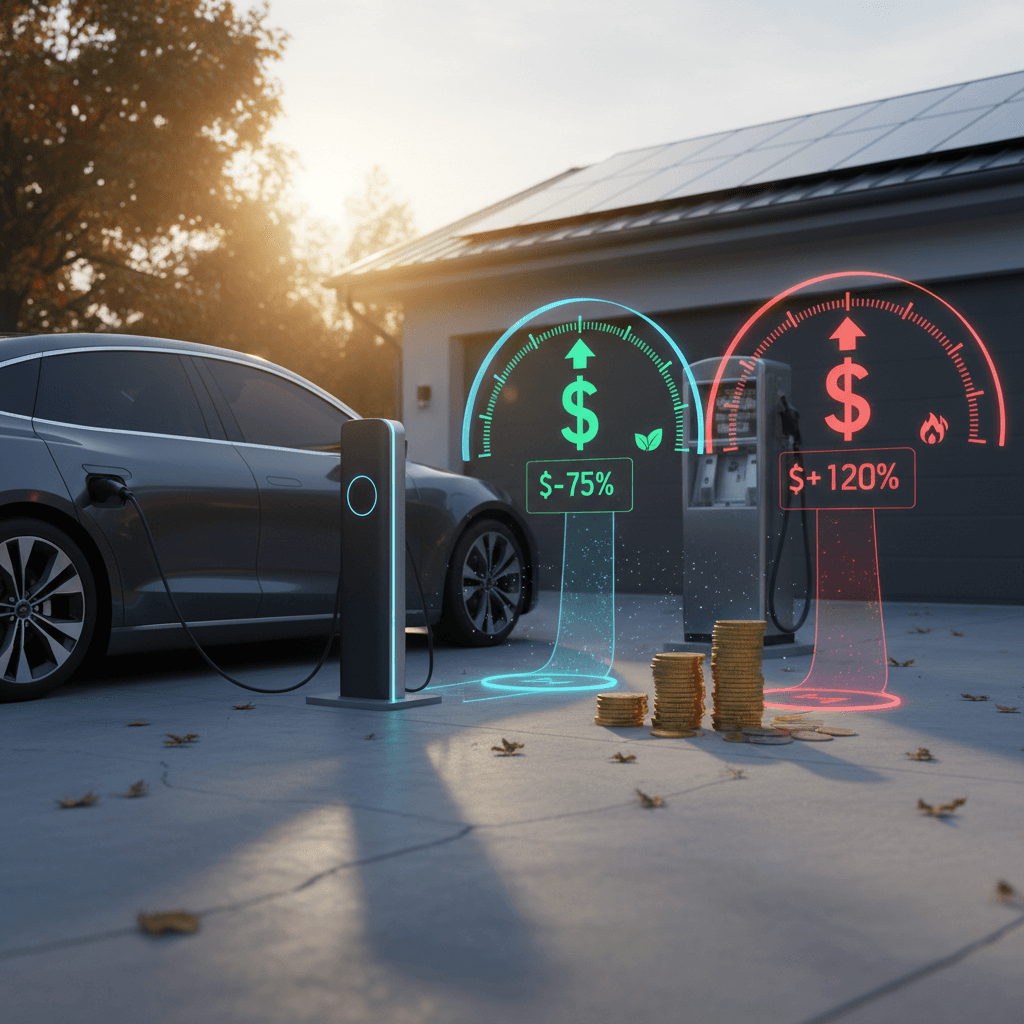
The practical question most shoppers care about is simple: with today’s prices, does an efficient EV actually save money compared with a gas car? In 2025, in every U.S. state, the answer is still yes on fuel costs per mile, even after accounting for a mix of home and public charging.
Translating efficiency into cost per mile
Using typical 2025 U.S. energy prices and average vehicle efficiency.
Example: Efficient EV sedan
- Efficiency: ~28 kWh/100 mi (about 3.6 mi/kWh).
- Average residential electricity: ≈$0.16–$0.17/kWh.
- Home charging cost: roughly $4.50–$5.00 per 100 miles.
- That’s about 4.5–5 cents per mile if you mostly charge at home.
Example: Typical gas car
- Efficiency: ~27 MPG combined.
- Average gasoline: ≈$3.15/gal nationally in 2025.
- Fuel cost: about $11.50–$12.00 per 100 miles.
- That’s roughly 11–12 cents per mile in fuel alone.
Nationwide picture
Of course, regional prices matter. High electricity and low gasoline prices can narrow the gap; low electricity and high gasoline prices widen it dramatically. But the efficiency advantage of electric drivetrains gives EVs a solid head start in most of the country.
Look at your own utility bill
Efficiency when buying a used electric car
If you’re shopping for a used EV, the badge on the trunk doesn’t tell you how efficient that specific car is today. Two identical models can perform very differently depending on how they were driven, charged, and maintained.
- A well‑designed compact EV with healthy tires and a gently used battery might still deliver 3.5–4.0 miles per kWh.
- A neglected performance EV on oversized wheels could struggle to hit 2.5 miles per kWh in the same conditions.
- Battery health affects usable capacity more than instantaneous efficiency, but the two interact: a smaller usable battery means every inefficiency hurts your real‑world range more.
How Recharged helps here
Simple ways to improve your EV’s efficiency
You don’t have to hyper‑mile or crawl in the slow lane to benefit from the inherent efficiency of electric cars. A few common‑sense habits will get you most of the way there.
Practical tips to squeeze more miles from every kWh
1. Use Eco or efficiency modes
Most EVs offer driving modes that soften throttle response and optimize climate control. If you’re new to EVs, start in Eco and only move to Sport when you really want the punch.
2. Precondition while plugged in
On cold or hot days, preheat or precool the cabin while the car is still connected to your charger. That way, you use grid power instead of draining your battery to get comfortable.
3. Mind your speed on the highway
Creeping down from 75 mph to 65 mph can noticeably improve miles per kWh, especially in taller, boxier vehicles. On long trips, this can be the difference between one fast charge and two.
4. Check tire pressure regularly
Underinflated tires add rolling resistance and hurt efficiency, just as in a gas car. A quick pressure check every few weeks keeps your EV driving efficiently and safely.
5. Travel lighter when you can
Roof boxes, bike racks, and a trunk full of heavy gear all cost energy. Remove what you don’t need regularly, and consider using an efficient hitch rack instead of a big rooftop box.
6. Learn to coast and regenerate smoothly
Practice lifting off the accelerator early for stops so the car can use regenerative braking instead of friction brakes. It turns your forward motion back into usable energy.
Don’t sacrifice safety for range
Frequently asked questions about electric car efficiency
EV efficiency: your questions answered
The bottom line on the efficiency of electric cars
Efficiency used to be something only engineers and hyper‑milers obsessed over. With electric cars, it’s the quiet force that makes the whole ownership experience work: fewer stops, lower running costs, and a much cleaner emissions profile over the life of the vehicle.
When you compare an EV to a gas car, remember that the efficiency of electric cars means you’re getting three to four times more useful motion from every unit of energy. On your bank statement, that shows up as fewer dollars spent per mile; on the road, it shows up as smooth, effortless acceleration and long stretches between charges.
If you’re considering a used EV, that’s where a transparent view of efficiency and battery health really matters. Recharged was built to make that easy: every car comes with a verified battery report, fair‑market pricing, and EV‑savvy support so you can choose a car that fits your driving style, your budget, and your expectations for real‑world efficiency.
Electric vehicles aren’t just a different way to fuel your commute; they’re a fundamentally more efficient way to turn energy into motion. Once you understand that, it becomes much easier to decide whether now is the right time for your first, or next, EV.