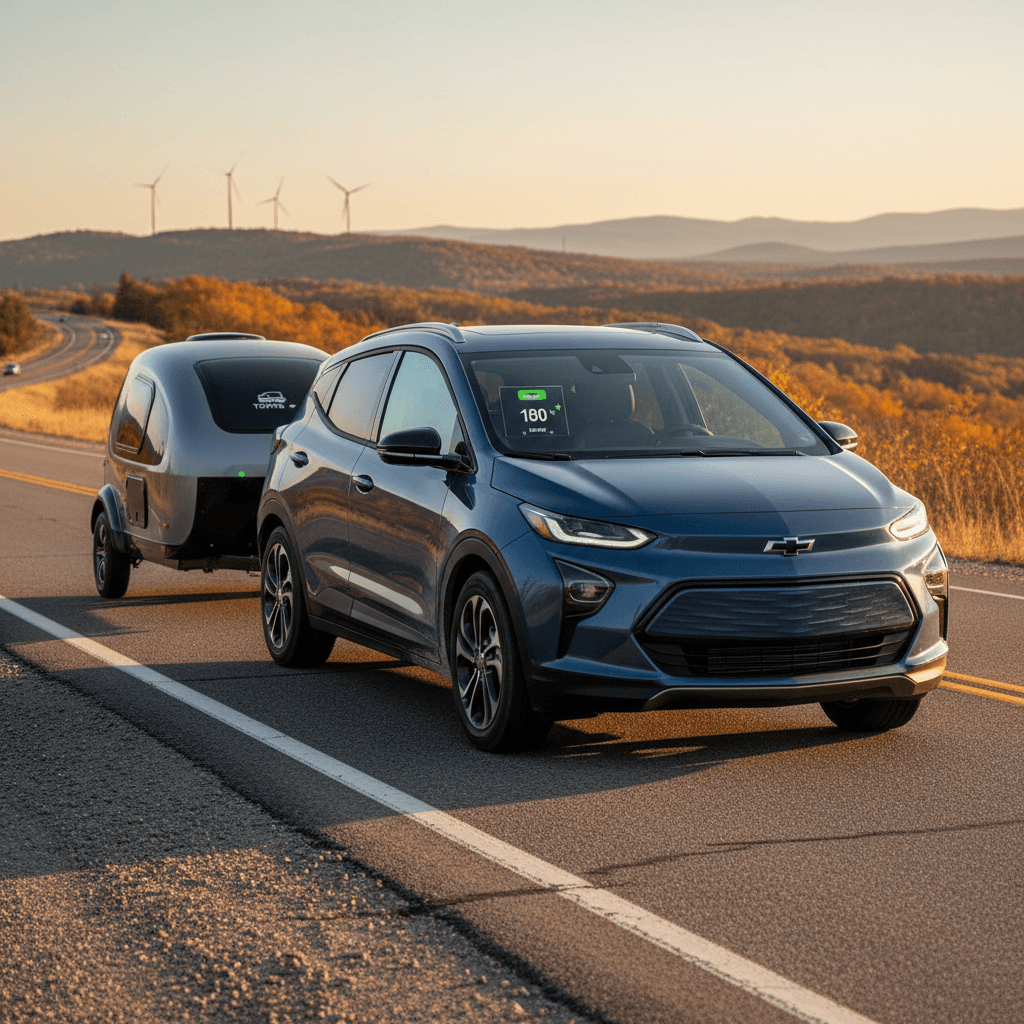
If you own a Chevy Bolt EUV or you’re shopping for a used one, you’ve probably wondered: what’s the real Chevy Bolt EUV towing capacity and how badly does towing hurt range? GM never gave the Bolt EUV an official tow rating in North America, but owners routinely add hitches for small trailers, bike racks, and cargo carriers. This guide pulls together what the specs, hitch manufacturers, and real-world data tell us so you can tow (or haul gear) without abusing your battery or stranding yourself.
Short answer
Chevy Bolt EUV towing basics at a glance
Key Chevy Bolt EUV specs that matter for towing
Two things define how practical the Chevy Bolt EUV is for towing: how much weight the structure and hitch can safely carry, and how much extra energy it takes to pull that load through the air. Officially, Chevrolet leaves towing capacity blank for the Bolt EUV in North American spec sheets, which is why third‑party hitch ratings and owner experience matter so much here.
Official Chevy rating vs aftermarket hitches
What Chevrolet says
- U.S. spec sheets list no official towing capacity for the Bolt EUV.
- Owner’s manual language is conservative, often discouraging trailer towing.
- No factory tow package, wiring, or trailer stability features are offered.
- This protects GM from liability more than it reflects absolute mechanical limits.
What hitch makers say
- Draw‑Tite’s Class 3 receiver for the Bolt EUV is rated for 2,000 lbs gross trailer weight and 300 lbs tongue weight.
- EcoHitch rates its stainless Bolt EUV hitch up to 3,000 lbs towing and 450 lbs tongue weight when used at the trailer ball.
- These ratings reflect what the hitch hardware can handle, not what GM will warranty.
Warranty reality check
It’s also worth separating hitch capacity from vehicle capacity. A 3,000‑lb‑rated hitch does not magically turn the Bolt EUV into a 3,000‑lb tow vehicle. The front‑wheel‑drive layout, relatively short wheelbase, and soft rear suspension all point toward light‑duty towing and hitch‑mounted accessories as the realistic sweet spot.
What the Bolt EUV can realistically tow
Practical towing bands for the Chevy Bolt EUV
How different trailer weights feel in the real world
Up to ~750 lbs
Examples: Small utility trailer, lightweight motorcycle trailer, compact kayak/canoe trailer.
- Generally comfortable for the Bolt EUV.
- Minimal impact on acceleration and braking.
- Range hit typically at the lower end of the spectrum.
750–1,500 lbs
Examples: Small boat, teardrop camper, 4x8 cargo trailer with gear.
- Still doable with a quality hitch and careful loading.
- Noticeable impact on braking distance and hill performance.
- Plan on a big reduction in highway range.
1,500–2,000+ lbs
Examples: Larger camping trailers, heavy enclosed trailers.
- Now you’re pushing past what the chassis and FWD layout are happy with.
- Easy to overload tongue weight and penalty to range is severe.
- Not recommended for regular use; keep trips short and speeds low if you attempt it at all.
A simple rule of thumb
Owner reports back this up: people tow small boats, lightweight campers, and utility trailers behind the Bolt EUV without drama, as long as they respect the limits. Where things go sideways is when the trailer has a large frontal area or is loaded tail‑heavy, both of which can destabilize a short, front‑drive EV much faster than a body‑on‑frame SUV.
How towing affects Chevy Bolt EUV range
The Bolt EUV’s official EPA rating is about 247 miles of combined range on 65 kWh of usable battery, which works out to roughly 29 kWh per 100 miles in mixed driving. In favorable conditions that’s about 3.4 miles per kWh. Once you hang a trailer off the back, especially one that sticks up into the airflow, your efficiency can drop dramatically.
Approximate Chevy Bolt EUV range impact when towing
These are ballpark planning numbers for a healthy Bolt EUV pack in mild weather, starting from the 247‑mile EPA combined rating. Real‑world results will vary with speed, weather, terrain, and how you load the trailer.
| Use case | Typical speed | Estimated efficiency | Rough range from 100% | Practical planning range* |
|---|---|---|---|---|
| No trailer, light load | City/suburban 30–45 mph | 3.4–4.0 mi/kWh | 220–260 mi | 180–220 mi |
| No trailer, highway | 65–75 mph | 2.6–3.0 mi/kWh | 170–210 mi | 140–180 mi |
| Small, low trailer ~600–800 lbs | 55–65 mph | 2.0–2.4 mi/kWh | 130–160 mi | 100–130 mi |
| Boxy camper ~1,000–1,500 lbs | 55–65 mph | 1.4–1.8 mi/kWh | 90–120 mi | 70–100 mi |
| Heavy, tall trailer >1,500 lbs | 65–70 mph | 1.0–1.4 mi/kWh | 60–90 mi | 50–70 mi |
Use these numbers as conservative planning tools, not promises. Always leave extra margin on unfamiliar routes.
Why range can disappear faster than you expect
The upside of EVs is that they’re extremely transparent about what’s happening. As soon as you hook up a trailer, start watching your Wh/mi or mi/kWh readout and energy prediction screen. If your normal 280–300 Wh/mi jumps to 400–500 Wh/mi, your practical range just shrank by roughly the same ratio. The Bolt EUV’s one‑pedal driving and strong regen do help claw back some energy on descents, but they can’t overcome the aero physics on the highway.
Cargo carriers, bike racks, and roof boxes
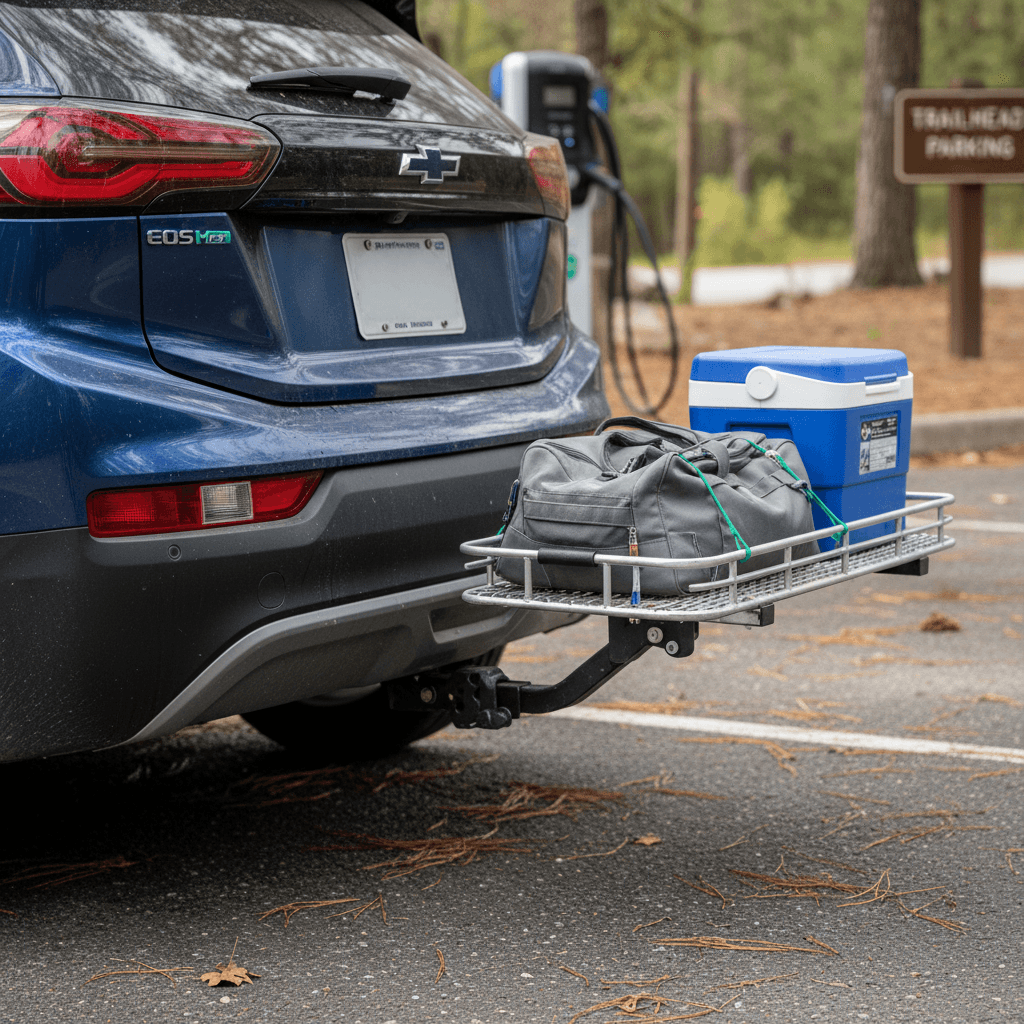
For most Bolt EUV owners, the question isn’t, “Can I tow 1,500 lbs?” It’s, “Can I safely carry bikes, skis, or camping gear without killing my range?” Here the hitch is often more about cargo management than towing, and the trade‑offs look a little different.
Common ways Bolt EUV owners haul extra gear
Pros, cons, and range impact
Hitch‑mounted bike rack
- Uses the 2‑inch receiver; tongue weight is usually modest.
- 2–4 bikes can add 80–160 lbs and turbulently disrupt airflow.
- Expect a 5–15% range hit at highway speeds, more in strong headwinds.
Hitch cargo carrier
- Great for bulky but light items; keep heavy stuff in the trunk.
- Keep total carrier + cargo well under tongue‑weight limits.
- Range loss is usually 10–20%, depending on how tall the load is.
Roof rack or box
- Eats into range more than a clean tail because it sits in undisturbed air.
- Highway range penalties of 15–30% are common for big roof boxes.
- Nice option if you don’t want a hitch, but less efficient overall.
Smarter packing, better range
Protecting battery health when towing or hauling
The Bolt EUV’s 65 kWh pack has shown itself to be robust in normal use, and a Brazilian hyper‑miling test even squeezed more than 500 miles out of a charge at very low speeds. But sustained high load, especially in heat, can stress any battery and power electronics. If you plan to tow regularly, the way you treat the pack matters more than any single trailer weight number.
Battery‑friendly habits when you’re towing or loaded up
1. Avoid repeated DC fast charges at 0–10%
Towing makes it easier to arrive at chargers nearly empty. Try to arrive with <strong>15–20%</strong> in the pack and stop charging around <strong>80–90%</strong> unless you truly need the extra range, which reduces heat and stress.
2. Turn down the charge rate at home in hot weather
If you live somewhere warm and you’re charging immediately after a heavy tow, consider limiting your Level 2 to <strong>24–32 amps</strong> instead of max. Slower charging on a hot, just‑worked battery is easier on long‑term health.
3. Watch battery and motor temperatures
If your Bolt EUV starts limiting power on long climbs or you see warnings, <strong>back off the throttle</strong> and give it a break. Thermal limits are there to protect expensive components.
4. Keep tires inflated appropriately
Extra load increases rolling resistance and heat. Run tire pressures toward the higher end of the door‑jamb spec (but within limits) when towing, and never exceed the tire’s load rating.
5. Don’t tow at maximum speed
Even dropping from 75 mph to 60–65 mph can dramatically lower power draw and heat generation, benefiting both range and battery longevity.
Cold vs hot weather towing
Trip planning and charging with a loaded Bolt EUV
Planning a long trip with a trailer behind a Chevy Bolt EUV is absolutely possible, but you’ll need to think more like a pilot and less like a commuter. Your charging strategy, route choice, and expectations all need to adjust for the extra drag and weight.
- Start with conservative assumptions, plan using the “practical planning range” numbers for your use case from the table above and add a 10–20% safety buffer.
- Prefer routes with more frequent fast chargers, even if they add a few miles. It’s better to have options if headwinds or weather wreck your efficiency.
- Target shorter hops between fast charges, think 60–90 miles when towing something boxy, not 150–180 miles.
- Use apps that let you filter for working CCS chargers and recent check‑ins. With the Bolt’s modest DC speed, a broken station can cost you hours.
- If you’re only carrying bikes or a hitch rack, consider removing them between big trips to restore your full range for daily driving.
Think in time, not just miles
Bolt EUV vs other small EVs for light towing
How does the Bolt EUV stack up against other compact EVs if you want to tow occasionally? The short version: it’s competent for light work, but there are better factory‑rated options if towing is central to how you’ll use your EV.
Chevy Bolt EUV vs other compact EVs for light towing
Rough comparison of towing‑friendliness for popular small EVs available on the used market in the U.S.
| Model | Official U.S. tow rating | Typical owner use | Pros for towing | Trade‑offs |
|---|---|---|---|---|
| Chevy Bolt EUV (2022–2023) | None in North America | Aftermarket hitches up to 2,000–3,000 lbs; many owners tow ~1,000 lbs or less | Affordable, efficient, strong regen, compact size for city use | No factory rating, modest DC fast charging, FWD traction only |
| Chevy Bolt EV (hatch) | None in North America | Similar to EUV; often used for small utility trailers and racks | Slightly more efficient than EUV, same battery and motor | Less rear space; same lack of official tow rating |
| Hyundai Kona Electric | None in U.S.; modest rating in some markets | Aftermarket hitches mostly used for racks; light towing by some owners | Good efficiency, slightly higher ground clearance than Bolt | No official U.S. tow rating; similar DC charging limitations on early years |
| Volkswagen ID.4 (AWD) | Up to ~2,700 lbs in U.S. | Commonly used for camping and utility trailers | Factory tow rating, available AWD, higher mass and wheelbase | Bigger, heavier, more expensive; efficiency drops more under load |
| Ford Mustang Mach‑E | Select trims rated up to ~1,500–2,000 lbs | Used for small campers and utility trailers | More power, available AWD, higher DC fast‑charge rates | Higher purchase price; heavier so baseline consumption is higher |
Towing ratings are for U.S. or closest‑equivalent markets; always confirm exact ratings for your specific model year.
Where the Bolt EUV still shines
Buying a used Bolt EUV if you plan to tow
On the used market, the Chevy Bolt EUV is compelling precisely because it mixes affordability, decent range, and hatchback practicality. If you know you’ll want a hitch or plan to tow at all, there are a few extra checks you should make when you’re evaluating a used example.
Used Bolt EUV checklist for towing and hitch use
1. Look for an existing hitch and wiring
A professionally installed 2‑inch hitch with tidy wiring can save you hundreds of dollars. Check for <strong>rust, damage, or bent metal</strong> around the mounting points that might indicate overloading.
2. Inspect rear suspension and tires
Uneven rear tire wear or sagging suspension can be a sign of heavy tongue weight or overloaded cargo. Budget for <strong>new tires or suspension work</strong> if you see issues.
3. Review charging and range behavior
Take a long test drive that includes highway speeds. Watch average Wh/mi and estimate realistic range. A healthy Bolt EUV should be able to get close to its EPA rating in mild conditions without a trailer.
4. Ask how the previous owner used the car
Occasional light towing is unlikely to hurt longevity, but if the seller used it as a <strong>full‑time workhorse</strong> with heavy trailers, factor that into price and your risk tolerance.
5. Get an independent battery health report
Tools like a <strong>Recharged Score battery health report</strong> can give you objective data on pack capacity and thermal history. That’s especially valuable if you’ll be asking more from the battery by towing.
How Recharged can help
Chevy Bolt EUV towing & range FAQ
Frequently asked questions about Bolt EUV towing capacity and range
The Chevy Bolt EUV was never engineered as a hardcore tow vehicle, but with realistic expectations and a high‑quality hitch, it can handle light trailers, bikes, and extra cargo without drama. The keys are staying well below aftermarket hitch limits, planning for significant range loss at highway speeds, and treating the battery with the same care you’d give any other major asset. If you’re considering a used Bolt EUV for this kind of duty, pairing the car’s inherent efficiency with a verified battery health report, like the Recharged Score each Recharged vehicle comes with, lets you tow and travel with eyes wide open rather than fingers crossed.