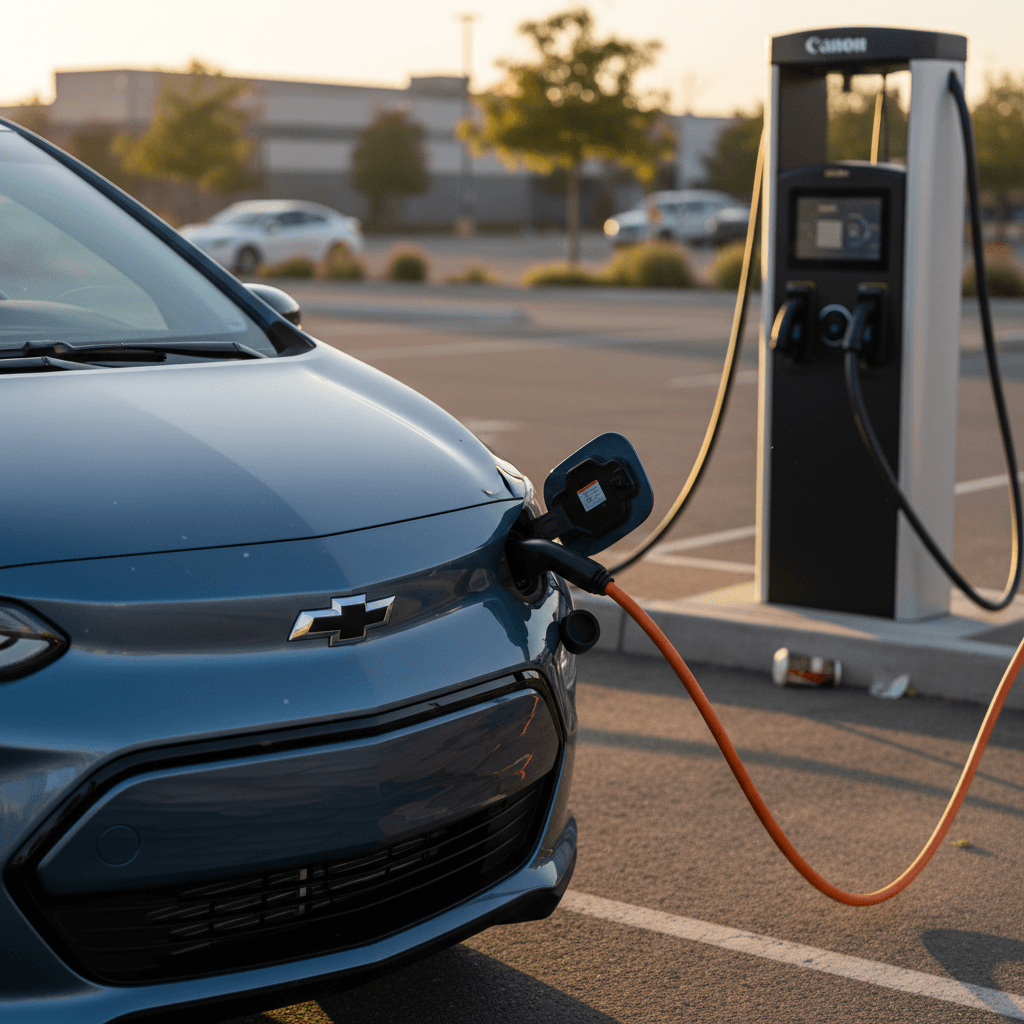
If you’re shopping for a used Chevy Bolt EUV, you’ve probably heard two very different stories about its charging: some owners say it’s "good enough," others complain that DC fast charging is painfully slow. This real-world Chevy Bolt EUV charging speed test walks through what you can actually expect at public fast chargers and at home, so you can decide if it fits your driving and road-trip plans.
Key takeaway up front
Chevy Bolt EUV charging basics at a glance
Bolt EUV charging specs (2022–2023 models)
Chevy gave the Bolt EUV a conservative charging setup on purpose. The 65 kWh pack is paired with roughly 55 kW maximum DC fast charging and up to 11.5 kW on Level 2. On paper that’s slower than many newer EVs that advertise 150–250 kW, but raw peak numbers don’t tell the whole story. What really matters is how long you sit at a charger to add usable miles.
- Battery: 65 kWh lithium-ion pack (NMC chemistry on 2022–2023 models).
- DC fast charging: CCS Combo 1 (up to ~55 kW peak).
- AC charging: J1772 inlet (up to 11.5 kW with 48 A Level 2).
- EPA range: about 247 miles for the Bolt EUV when new.
Don’t compare kW without looking at time
How fast does the Chevy Bolt EUV really charge?
- 10–50%: roughly 25–30 minutes
- 10–80%: roughly 60–75 minutes
- 20–80%: roughly 50–60 minutes
That lines up with Chevrolet’s own guidance that a DC fast charger can add about 95 miles of range in 30 minutes for the Bolt EUV. It’s workable, but you won’t be in and out in 15 minutes the way you might be with a newer 150 kW–plus EV.
Bolt EUV headline charging times (typical conditions)
Approximate times for a 2022–2023 Chevy Bolt EUV on a healthy charger at moderate temperatures, starting near 10% state of charge (SoC).
| Method | Power delivered to car | From 10% to 80% | Miles added (approx.) | |
|---|---|---|---|---|
| DC fast charging (CCS) | 40–55 kW | 60–75 minutes | ~170–190 miles | |
| Public Level 2 (240 V, 32 A) | ~7.7 kW | 8–9 hours (10–100%) | ~230+ miles | |
| Home Level 2 (240 V, 40–48 A) | 9.6–11.5 kW | 6–8 hours (10–100%) | ~230+ miles | |
| Level 1 (120 V wall outlet) | 1–1.4 kW | 40–50+ hours (0–100%) | ~4–5 miles per hour |
Real-world times vary with charger power, temperature, and how busy the site is, but these are realistic ballpark numbers.
Cold weather can cut your speeds dramatically
Our Chevy Bolt EUV DC fast charging speed test
To get a realistic picture of Chevy Bolt EUV charging speed, you want more than a single peak number, you want to see how the car behaves across a full session. Below is a composite of real-world tests from 2022–2023 Bolt EUV owners on 62.5–150 kW CCS chargers, plus published curves from independent tools and reviewers. Think of it as a "typical" charging session on a mild day, not a best-case hero run.
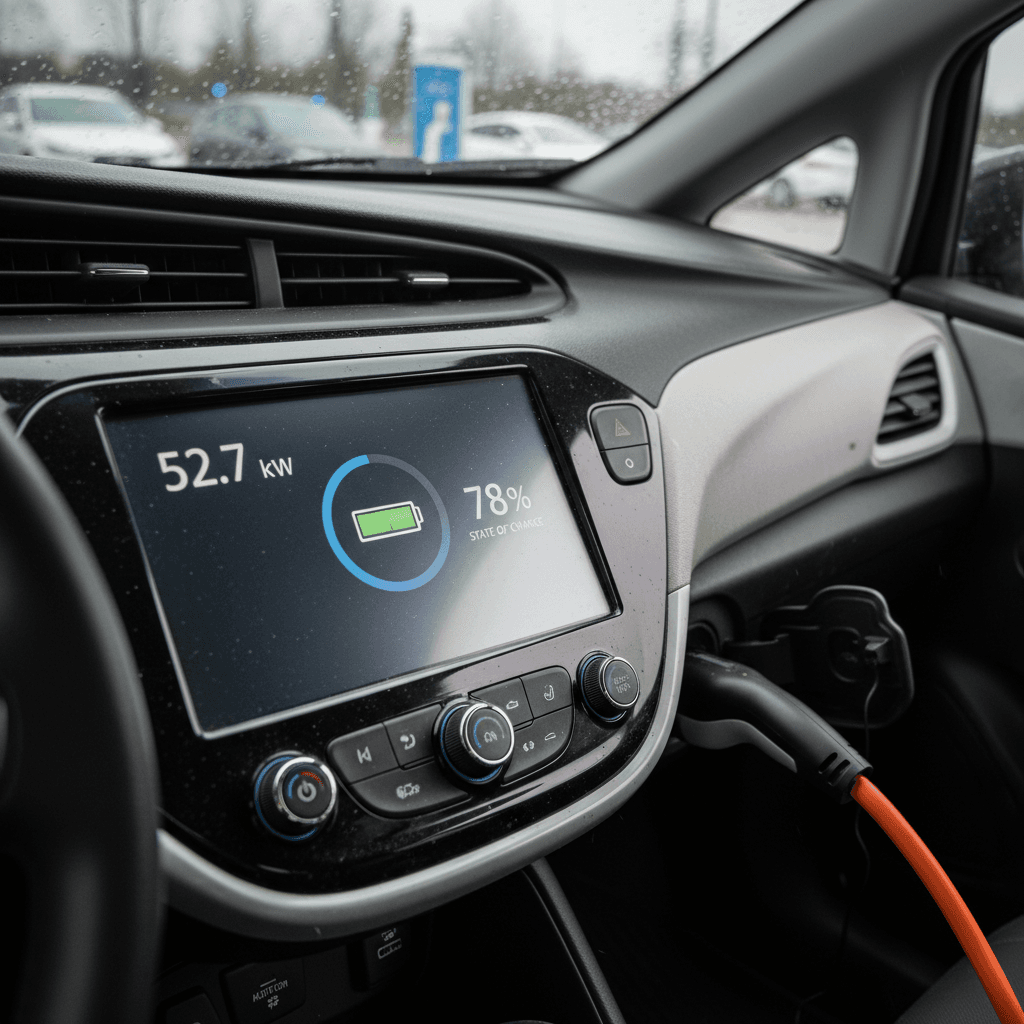
Sample Bolt EUV DC fast charging speed test (10–80%)
Approximate behavior of a 2022–2023 Bolt EUV on a 62.5–150 kW DC fast charger at about 68°F, based on owner logs and published charging curves.
| State of charge (SoC) | Charge power (kW) | Time in band (min) | Energy added in band (kWh) |
|---|---|---|---|
| 10–30% | 50–55 kW | 15–18 | ~14–16 |
| 30–50% | 45–50 kW | 15–18 | ~14–16 |
| 50–70% | 28–35 kW | 18–20 | ~10–12 |
| 70–80% | 18–22 kW | 10–12 | ~3–4 |
Numbers are rounded, but they match what many Bolt EUV drivers actually see on road trips.
From 10% to 50%, the Bolt EUV sits near its advertised peak of about 55 kW, then it begins to back off. By 70–80%, you may only see 18–22 kW. That’s why many experienced owners unplug somewhere between 60% and 75% on road trips, beyond that point you’re waiting a long time for relatively few miles.
Speed test rule of thumb
Understanding the Bolt EUV charging curve after 50%
Why the power drops
All EVs taper charging as the battery fills, but the Bolt EUV’s curve is more conservative than many newer models. Above roughly 50%, the battery’s internal resistance rises and the software limits power to reduce heat and extend battery life. That’s good news for longevity, but it stretches your time at the charger.
What that means for you
- If you arrive at 40–50% SoC, you may never see the full 50+ kW peak.
- If you stay past 70–75%, you’ll often be sitting at 20 kW or less.
- For the shortest stops, try to arrive under 25% and leave around 60–70%.
With a Bolt EUV, planning your stops around this curve is almost as important as the charger’s listed kW rating.
2027 Bolt: very different story
Home and Level 2 charging speed for the Bolt EUV
Most of your charging will happen at home or at slower public Level 2 stations. Here, the Bolt EUV does very well. Later-model Bolts can accept up to 11.5 kW on Level 2 (48 A at 240 V) if your home wiring and charger can supply it, and they ship with a dual-level portable cord that supports lower-power Level 2 around 7.7 kW.
Typical Bolt EUV Level 2 charging setups
Where you plug in matters just as much as what the car can accept.
Home 40–48 A wallbox
Power: 9.6–11.5 kW
Good for: Overnight charging, two-EV households, frequent drivers.
Expect roughly 6–8 hours from low battery to full, or about 25–30 miles of range per hour.
Home 30–32 A outlet
Power: ~7.2–7.7 kW
Good for: Most commuters, renters with 240 V access.
Expect roughly 8–10 hours from low to full, or 20–25 miles of range per hour.
Public Level 2
Power: 6–11 kW depending on station.
Good for: Work, parking garages, destination top-ups.
Plan on several hours for a meaningful boost, great for "set it and forget it" charging while you’re busy.
Home charging can be almost "invisible"
How long to charge in common real-world scenarios
Realistic Bolt EUV charging scenarios
1. Daily commute top‑up at home
You drive 35 miles round-trip each day and plug in to a 7.7 kW Level 2 in your garage. You’ll add those 35 miles back in <strong>roughly 90 minutes</strong>, so even a short evening session brings you back to full by morning.
2. Weekend errands with public Level 2
You arrive at a shopping center with 40% SoC and plug into a 6.6–7.2 kW public Level 2 while you shop for two hours. Expect to leave with <strong>around 30–40 additional miles</strong>, which is usually enough to cover the rest of the weekend.
3. Highway fast charge: 15% to 65%
On a road trip, you pull into a 62.5–150 kW DC fast charger at 15% and unplug at 65%. On a healthy unit, you’ll likely spend <strong>35–40 minutes</strong> there and add roughly 120–140 miles of range, enough for another two to three hours of driving.
4. Deep refill: 5% to 80% on DC
If you stretch a leg too far and arrive nearly empty, going from about 5% to 80% SoC will usually take <strong>70–80 minutes</strong>. You’ll get back most of the pack, but the last 20–30% of that session is where things slow way down.
5. Emergency Level 1 overnight
On a trip to a friend’s house with only a standard 120 V outlet, leaving the Bolt EUV plugged in for 10–12 hours might add <strong>40–60 miles of range</strong>. It’s painfully slow, but enough to get you to the next faster charger.
Road trip strategies for a slower-charging Bolt EUV
Can you road trip in a Bolt EUV? Absolutely, but you plan your stops differently than someone in a 250 kW rocket ship. The goal is to use the "fast" part of the curve as much as possible and avoid sitting at 20 kW for an extra half hour just to top off to 90%.
Make the most of every Bolt EUV fast-charge stop
Think like a road-trip planner, not like a spec sheet reader.
Plan for more, shorter stops
Instead of one massive 10–90% charge, try two 10–60% sessions. You’ll spend more minutes driving and fewer sitting at the charger while the car sips at 20 kW above 70%.
Use apps that show real-time stall status and power ratings so you’re not surprised by a slow or broken unit.
Align stops with natural breaks
Think in 120–150 mile legs. Drive two to three hours, then charge while you use the restroom, grab a meal, or walk the dog. A Bolt EUV fast-charge window naturally fits a relaxed travel style where you’re not racing the clock.
Watch the charger, not just the dash
Ideal Bolt EUV road‑trip pattern
- Arrive between 10–25% SoC.
- Charge to 60–70% on most stops.
- Only push beyond 75–80% if the next leg is unusually long or chargers are sparse.
- Favor reliable networks along major corridors, even if it means a slight detour.
When to consider a different EV
If you regularly do 500–700 mile days and hate stopping, or you need to tow, a Bolt EUV’s conservative charging curve will feel limiting. In that case, a faster-charging EV, or waiting for the 150 kW-capable 2027 Bolt, may better match your expectations.
Charging speed, battery health, and used Bolt EUVs
Slower peak charging isn’t all bad news. The upside of the Bolt EUV’s conservative approach is that it tends to be gentle on the battery. Real-world data shows many high‑mileage Bolts retaining a healthy portion of their original range, especially when owners mainly use Level 2 charging and only fast charge on trips.
Why this matters for used shoppers
At Recharged, every used EV we list comes with a Recharged Score battery health report. That gives you a clear, data‑driven look at remaining capacity and projected longevity, not just a guess based on age and mileage. For a Bolt EUV, that kind of transparency is especially helpful, because two visually identical cars can have very different charging behavior depending on how they were used and charged.
Checklist: evaluating a used Chevy Bolt EUV’s charging health
Ask for recent DC fast charge behavior
If possible, review a recent fast‑charge session: how quickly did it ramp up, and how long did it hold over 40 kW? Sudden throttling at low SoC on a warm day can indicate either battery or station issues that deserve a closer look.
Confirm Level 2 performance
On a 40–48 amp Level 2, the Bolt EUV should settle in near its rated 9.6–11.5 kW. If it’s consistently lower with a known‑good charger, you’ll want to understand why before you buy.
Review battery health data
Use tools like the Recharged Score or an independent scan to verify remaining capacity. Healthy packs maintain range better and tend to track closer to the typical charging curve you see in speed tests.
Inspect the charge port and cable
Look for burns, melted plastic, or loose contacts around the CCS/Level 2 port. Damaged hardware can slow charging, or, in rare cases, prevent a fast‑charge session from starting at all.
FAQ: Chevy Bolt EUV charging speeds
Frequently asked questions about Bolt EUV charging speed tests
Bottom line: Is the Bolt EUV too slow for you?
The Chevy Bolt EUV isn’t a charging-speed champion, and it never pretended to be. In our composite charging speed test, it behaves exactly how the spec sheet suggests: steady but modest DC fast charging with a noticeable taper after 50–60%, and excellent overnight convenience on Level 2 at home. For many drivers, especially those with home charging and a few long trips a year, that tradeoff is a smart one, because it keeps costs low while still delivering practical range.
If you’re trying to decide whether a used Bolt EUV belongs in your driveway, think about how you actually drive. If most days are under 60–80 miles and you can plug in at home, the Bolt’s charging quirks almost disappear. If you live on the interstate and measure days in 500‑mile chunks, it may be worth stretching for a faster‑charging EV or keeping an eye on the 2027 Bolt. Either way, going through this kind of real‑world charging speed test, and pairing it with a clear battery health report like the Recharged Score, will help you choose the EV that fits your life, not just the one that looks best on paper.