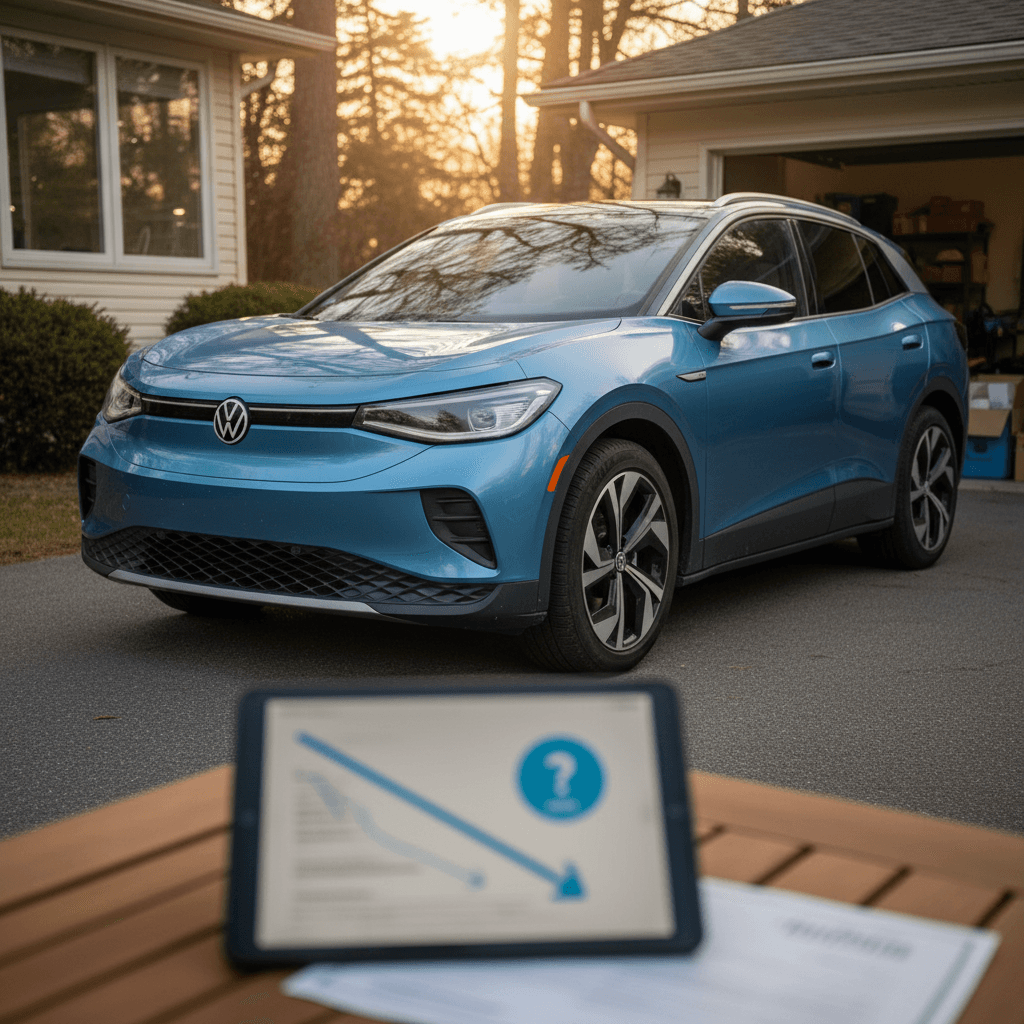
If you’re asking yourself, “What is my Volkswagen ID.4 worth?”, you’re not alone. The ID.4 has been heavily leased, heavily incentivized, and hit by the same used-EV price swings that rattled the market in 2024–2025. The good news: with a little structure, you can get very close to a fair value for your ID.4 today, and understand exactly what’s moving that number up or down.
Quick take
How much is my VW ID.4 worth right now?
VW ID.4 value snapshot in 2026 (big‑picture)
Those are market‑wide numbers. To get from there to your ID.4’s value, you need three quick building blocks:
- Your exact model year and trim (e.g., 2021 Pro S RWD, 2022 AWD Pro S, 2023 Standard).
- Your current mileage and condition (accident history, tire/brake wear, cosmetic issues).
- A realistic view of your battery health and range versus when the car was new.
Rule of thumb
How Volkswagen ID.4 depreciation really works
The VW ID.4 doesn’t behave like an ordinary gas SUV on the used market. Incentives, tax credits, and rapid improvements in newer EVs have pulled values around more sharply than many owners expected.
Why ID.4 values moved so much
Three big forces behind your current number
Stacked incentives
Many first owners combined hefty federal and state EV credits with aggressive lease programs. That pushed effective new costs down, which in turn pulled used prices lower.
Rapid EV tech updates
Newer EVs launched with longer range, faster charging and more tech. That makes earlier ID.4s feel older quicker, even if they still drive well.
Used EV reset
After pandemic highs, the entire used‑EV market corrected in 2024–2025. EVs, on average, began losing a bigger slice of their value in the first five years than comparable gas vehicles.
Zoomed in on the ID.4, that’s translated into roughly 40–45% depreciation in the first 3–4 years for early 2021–2022 models and around 60–62% over five years, putting it near the class average for compact electric SUVs and just a step behind the very best‑resale EVs.
Early‑build reality check
Real‑world price ranges by model year and trim
Every car is unique, but it helps to anchor on realistic bands. Think of these as typical asking‑price lanes you might see on dealer sites and classifieds for clean, accident‑free ID.4s in much of the US, as of spring 2026:
Illustrative VW ID.4 asking‑price bands (spring 2026)
Ranges assume clean history reports and average mileage for the year. High‑mile, damaged, or branded‑title vehicles will sit below these numbers; ultra‑low‑mile or certified vehicles may sit above.
| Model year | Typical trims in this band | Approx. retail asking range | Mileage assumption |
|---|---|---|---|
| 2021 | Pro, Pro S RWD | $14,000 – $19,000 | 40,000–70,000 miles |
| 2022 | Pro, Pro S RWD/AWD | $16,000 – $22,000 | 30,000–60,000 miles |
| 2023 | Standard, Pro, Pro S AWD | $19,000 – $26,000 | 20,000–45,000 miles |
| 2024 | Pro, Pro S AWD (early used) | $24,000 – $30,000+ | Under 25,000 miles |
These are directional ranges, not offers. Local supply, incentives and condition can move your ID.4 thousands of dollars either way.
Retail vs. trade‑in
If you’re getting quotes that seem way outside these lanes, look closely at what’s different about your vehicle: mileage, accident history, options, or simply a very hot or cold local market.
7 factors that move your ID.4 value up or down
Key levers that change what your ID.4 is worth
1. Model year & build
Earlier 2021–2022 imports with lower range and early software are worth less than updated 2023–2024 US‑built ID.4s. Newer model years, especially with range bumps and improved interiors, command more money.
2. Trim level & options
AWD Pro and Pro S trims with larger batteries, better headlights, premium audio and panoramic roofs typically beat base cars on resale. A rare color or loaded spec can help, but not as much as condition and mileage.
3. Odometer mileage
For buyers, mileage is the fastest proxy for wear. Crossing big thresholds, like 30k, 60k or 90k miles, usually knocks value down. All else equal, an ID.4 with 18k miles will be worth more than one with 48k.
4. Battery health & usable range
EV shoppers care as much about <strong>real‑world range</strong> as they do about leather seats. If your ID.4 still delivers range close to its original rating, that supports a stronger number; if it’s sagging badly, buyers will discount.
5. Accident and title history
A clean, verifiable history report is money in your pocket. Structural damage, airbag deployments, or a branded/rebuilt title can easily knock <strong>20–40%</strong> off comparable clean‑title values, sometimes more.
6. Tires, brakes and cosmetic condition
Fresh tires, recent brakes and a clean interior don’t just photograph better, they tell buyers the car was maintained. On a compact SUV like the ID.4, that can swing value <strong>$1,000 or more</strong> between two otherwise similar vehicles.
7. Local supply, incentives and interest rates
If your region is flooded with off‑lease ID.4s and new EV deals, prices soften. In markets with tight supply or strong EV demand, similar vehicles maintain higher asking prices. Financing and incentive programs matter too.
Look beyond a single pricing tool
How battery health affects what your ID.4 is worth
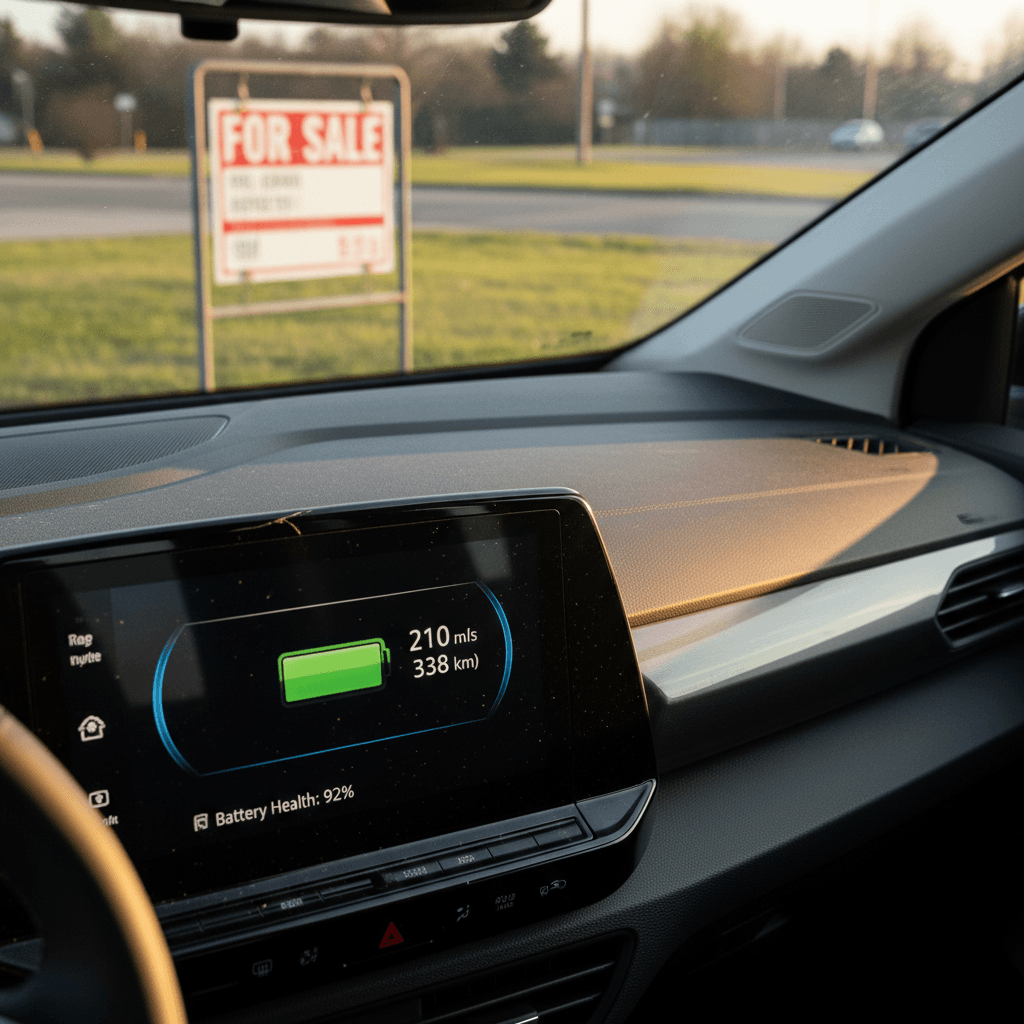
Battery condition is the new engine condition. For most well‑cared‑for ID.4s, real‑world data suggests roughly 1.5–2% capacity loss per year in normal use. That’s modest, but outliers matter, and buyers are learning to ask smart questions.
Why battery health matters so much
- Range confidence: If your ID.4 still gets close to its original EPA range on a full charge, it feels newer to the next owner.
- Warranty runway: Volkswagen’s battery warranty coverage (time and mileage) underpins buyer confidence. More warranty left, more value.
- DC fast‑charging behavior: Packs that charge smoothly and predictably at DC fast chargers are more attractive than ones that taper early or throw faults.
Signals that boost or hurt value
- Helps value: Documented service history, garage parking, balanced charging habits (not constantly at 100% or 0%).
- Hurts value: Frequent DC fast‑charging only, chronic low‑state‑of‑charge storage, or any battery‑related warning messages.
- Biggest booster: A third‑party battery health report that verifies usable capacity and degradation vs. similar ID.4s.
How Recharged uses battery data
Step‑by‑step: how to check your ID.4’s value today
You don’t need dealer tools to get close to market reality. Here’s a practical, evening‑project way to answer “what is my Volkswagen ID.4 worth?” without guessing.
DIY valuation checklist for your VW ID.4
1. Gather your vehicle details
Write down your VIN, model year, exact trim, major options, current mileage, and any recent maintenance (tires, brakes, 12V battery, software updates). Note any accident history or open recalls.
2. Check 2–3 online valuation tools
Plug your details into at least <strong>two</strong> major appraisal tools (trade‑in and private‑party). Use “good” condition unless your ID.4 is truly flawless. Record low, average and high values for each.
3. Scan real‑world listings
Search nationwide listings for ID.4s matching your year, trim and mileage. Ignore unrealistic outliers. Focus on <strong>what similar cars are actually listed for</strong>, not just unsold “dream” prices.
4. Adjust for mileage and condition
If your ID.4 has significantly lower miles than the listings you see, adjust your number up modestly; if it’s higher, ratchet down. Factor in new tires, fresh service, or any obvious cosmetic issues.
5. Account for battery and warranty
If you have documentation or a report showing healthy battery capacity and plenty of warranty left, shade your target price toward the <strong>upper end</strong> of the range. If range feels noticeably reduced, lean lower.
6. Decide on your selling channel
Choose whether you want <strong>maximum convenience</strong> (instant online offer or dealer trade‑in) or <strong>maximum price</strong> (selling retail via a marketplace like Recharged). Expect a spread between those two numbers.
Turn ranges into a real asking price
Selling vs. trading in your ID.4
Knowing what your Volkswagen ID.4 is worth is only half the puzzle. The other half is deciding how to turn it into cash or equity toward your next vehicle.
Trading in or taking an instant offer
- Pros: Fast, simple, one‑stop. You avoid managing showings, test drives and paperwork. Often you can roll equity directly into your next EV.
- Cons: You’re selling at a wholesale‑oriented price. Dealers and instant‑offer buyers build in room for reconditioning, auctions and profit.
- Best for: High‑mileage ID.4s, cars with cosmetic needs, or owners who value time over squeezing out every last dollar.
Selling your ID.4 retail
- Pros: Often brings thousands more than a trade‑in. You control the asking price and can emphasize strengths like battery health and options.
- Cons: More time and effort. You’ll handle marketing photos, inquiries, test drives and closing paperwork.
- Best for: Clean‑title, well‑maintained ID.4s with solid battery health where buyers will pay a premium for the right car.
Watch the used EV tax credit rules
Getting a data‑backed value with Recharged
If you don’t want to live in browser tabs comparing every 2022 Pro S AWD within 500 miles, you can lean on platforms built for used EVs specifically.
How Recharged can help you price and sell your ID.4
EV‑specific data, battery diagnostics and a smoother sale
Recharged Score battery health report
Recharged runs an in‑depth Recharged Score battery and vehicle health diagnostic on every ID.4 it sells. That report turns your pack’s condition, charging history and range into a transparent, shareable score buyers can trust.
Fair market pricing for ID.4s
Because Recharged focuses on used EVs, its pricing models are tuned to real ID.4 transaction data, broader used‑EV trends, and local demand, not just generic SUV averages.
Flexible selling options
You can get an instant offer or consign your Volkswagen ID.4, tap EV‑specialist support, and arrange nationwide delivery to the next owner. If you’re in reach of the Richmond, VA Experience Center, you can see the process in person, too.
Ready to find your next EV?
Browse VehiclesWhether you want a quick exit or to maximize your sale price, bringing a verified battery‑health report and a data‑driven asking price to the table makes negotiations easier. That’s exactly what Recharged is built to deliver for ID.4 owners.
FAQ: VW ID.4 value and resale
Frequently asked questions about what your VW ID.4 is worth
Pricing a Volkswagen ID.4 in 2026 means thinking like both an EV engineer and a used‑car manager. Depreciation has been steeper than many owners expected, but if you understand where your ID.4 sits, its model year, trim, mileage, battery health and warranty, you can anchor on a realistic number and choose the right way to sell. Use multiple pricing tools, sanity‑check them against live listings, and don’t underestimate the power of a clean battery report. If you’d rather let specialists do the heavy lifting, Recharged can help you turn that insight into a transparent, data‑backed offer and a smoother sale.