If you own, or are thinking about buying, a 2021 Tesla Model X, you’ve probably heard there have been “a lot of recalls.” That’s true: 2021 is one of the heaviest recall years for the Model X. In this guide, we’ll walk through the 2021 Tesla Model X recalls list in plain language, explain what each one actually means in day‑to‑day driving, and help you use that information wisely if you’re shopping used.
First things first
Why the 2021 Tesla Model X has so many recalls
On paper, the 2021 Model X shows more recalls than earlier model years. That can look alarming, but it’s partly a function of how Tesla does business. The Model X is software‑heavy, and Tesla uses over‑the‑air (OTA) updates to fix issues that used to require physical repairs. Regulators still classify many of those software fixes as recalls, even when the remedy is simply updating the car overnight while it’s parked.
How 2021 stacks up for Model X recalls
Why count doesn’t equal risk
Quick overview: major 2021 Model X recalls
Below is a plain‑English snapshot of the most significant 2021 Tesla Model X recalls. The exact campaign numbers can vary, but these buckets cover what most 2021‑model‑year owners will see when they run a VIN check with Tesla or NHTSA.
Key 2021 Tesla Model X recall themes
High‑level view of the main safety issues that generated recalls for the 2021 Model X.
| Category | What went wrong | How serious is it? | Typical fix |
|---|---|---|---|
| Front seat belt mounting | Front belts may detach at the outboard anchor in certain crashes or after incorrect service work. | High – belt detachment can increase injury risk in a crash. | Inspect and re‑secure or replace front seat belt assemblies. |
| Electric power steering | Loss of steering assist at low speeds from faulty bolts or components. | Medium–High – steering effort increases suddenly, raising crash risk at parking/low speeds. | Inspect steering components, replace or torque hardware, and update software. |
| Airbags / occupant detection | Passenger airbag or front passenger occupancy detection may not meet all regulatory requirements. | Medium – in specific scenarios, airbag deployment might not be optimal. | Software calibration updates and, in some cases, component replacement. |
| Full Self‑Driving / Autopilot behavior | FSD Beta or Autopilot could roll through stop signs or not obey certain rules reliably. | Medium – primarily software behavior in edge cases. | OTA update to adjust behavior and tighten rules compliance. |
| Instrument panel / warning lights | Warning font sizes or telltales may be too small or not compliant with standards. | Low–Medium – information might be harder to read quickly. | Software update to change display layout and font sizes. |
| Window / power operation | Power windows or powered systems may not behave as required in pinch or obstruction events. | Medium – risk of minor injury if windows don’t auto‑reverse properly. | Software update and, rarely, window system adjustment. |
Use this table as a roadmap, then dive into the detailed list that follows.
Detailed 2021 Tesla Model X recalls list
This section breaks down the main 2021 Tesla Model X recalls list into owner‑friendly language. The exact campaign ID (like "21V‑XXX") will be listed on your NHTSA or Tesla recall page, but the descriptions below will help you understand what each recall is really about.
1. Front seat belt detachment – 2021–2023 Model X
One of the most important safety recalls for the 2021 Model X involves the front seat belts. In a group of 2021–2023 Model X and Model S vehicles, Tesla identified cases where the front belts could detach from the outboard lap pretensioner anchor. In practice, that usually happened after a prior service visit where the belt had been disconnected and not reattached to spec, but regulators still treated it as a safety defect.
- Risk: In a moderate or severe crash, a detached belt can’t restrain the occupant properly, increasing injury risk.
- Symptoms: In many cases, owners didn’t notice a problem under normal driving, the risk appears in a crash or heavy load.
- Remedy: Tesla inspects both front belts, performs a pull‑test, and re‑secures or replaces the assembly so the anchor is fully locked in.
Don’t skip this one
2. Electric power steering assist loss
Another widely discussed campaign for the 2021 Model X addresses loss of electric power steering assist. Owners reported situations where steering suddenly became heavy, especially at lower speeds such as parking or tight turns. The underlying issues vary by campaign, but generally involve steering components or fasteners that can loosen or fail over time.
- Risk: When assist drops out unexpectedly, you still retain steering, but it takes much more effort. That can raise the chance of a low‑speed crash, especially for smaller or older drivers.
- Symptoms: Intermittent steering‑assist warnings, heavier steering feel, or chimes accompanied by steering‑related messages on the display.
- Remedy: Inspection and repair of affected steering hardware, plus software updates to monitor and log steering‑assist issues more effectively.
Test it on your drive
3. Passenger airbag and occupancy detection issues
Multiple recalls touch the front passenger airbag and occupant detection system on late‑model Teslas, including 2021 Model X. In some build ranges, the system that decides when and how to deploy the passenger airbag may not meet every detail of the federal standard across all possible seating positions or occupants.
- Risk: In particular seating scenarios, such as a lightweight occupant or unusual seating position, the airbag may not deploy in the ideal way for crash protection.
- Symptoms: Often none that you can feel. At most, you might see airbag or occupancy warnings after a service visit or software update.
- Remedy: Tesla applies software calibration updates and, in some cases, replaces sensors or airbag components in affected vehicles.
4. Full Self‑Driving (FSD) / Autopilot behavior recalls
Several high‑profile recalls for the 2021 Model X are really about driver‑assist software behavior, especially for vehicles enrolled in Tesla’s Full Self‑Driving (FSD) Beta program. Regulators flagged scenarios where the car could roll through stop signs, mis-handle intersections, or fail to strictly obey certain traffic laws while under driver‑assist control.
- Risk: If you over‑trust FSD or Autopilot and aren’t paying attention, the system may make a poor decision that leads to a crash.
- Symptoms: Behavior at four‑way stops or complex intersections that feels too aggressive or non‑compliant with traffic rules, especially on early FSD beta builds.
- Remedy: Over‑the‑air software updates that adjust stopping behavior, speed control, and lane positioning to meet regulator expectations.
Remember: these are driver‑assist systems
5. Instrument panel and warning light visibility
In 2024 Tesla issued a sweeping recall covering millions of vehicles, including the 2021 Model X, because some warning indicators on the instrument panel used font sizes that were too small under U.S. rules. This is a classic example of a paperwork‑driven safety recall that’s real, but not something most drivers would ever spot.
- Risk: If you can’t quickly read a critical warning, your reaction may be delayed in an emergency.
- Symptoms: None for most owners; the cluster looks normal, and there’s no mechanical defect.
- Remedy: A global software update that adjusts the display layout and font sizes to meet the regulation. No physical parts are replaced.
6. Power window and pinch protection behavior
Another 2021 Model X recall group deals with power window pinch protection. Regulators found that in some situations, the windows might not reverse quickly enough after detecting an obstruction, as required by safety standards.
- Risk: Potential minor injury to fingers or hands if a window doesn’t auto‑reverse promptly when something is in the way.
- Symptoms: Windows that close with a bit more force than expected, or that don’t always reverse when lightly pinched during testing.
- Remedy: Software updates to recalibrate window behavior; in rare cases, adjustment or replacement of window regulators.
Simple DIY check
7. Media control unit / touchscreen reliability (older hardware)
Earlier Model X vehicles had a well‑publicized recall for failing media control units (MCUs), which affected the center touchscreen. By 2021 much of that hardware had been updated, but some 2021‑registered vehicles built with earlier MCUs may still appear on recall lists, especially if they’re late registrations of older build stock or were retrofitted.
- Risk: Loss of the center screen can take down backup camera images, defrost controls, and certain telltales that are legally required.
- Symptoms: Freezing, random reboots, black screen, or persistent touchscreen error messages.
- Remedy: Replacement of the media control unit or specific memory components, plus updated software.
8. Smaller software compliance recalls
Finally, there are a host of smaller, software‑centric recalls that still show up on the 2021 Tesla Model X recalls list, everything from chimes that didn’t always sound correctly to Boombox sounds that could obscure pedestrian‑warning noises. These are genuine compliance issues, but they’re generally low on the risk ladder for used‑vehicle shoppers.
- Seat belt reminder chimes not activating correctly in some conditions.
- Pedestrian warning sound being masked by Boombox speaker use at low speeds.
- Minor indicator logic issues in certain menus and displays.
The common thread: these were almost all fixed via OTA updates, often without owners needing to schedule service. When you check a specific VIN, you’ll see these listed individually, but functionally they’re small software clean‑ups.
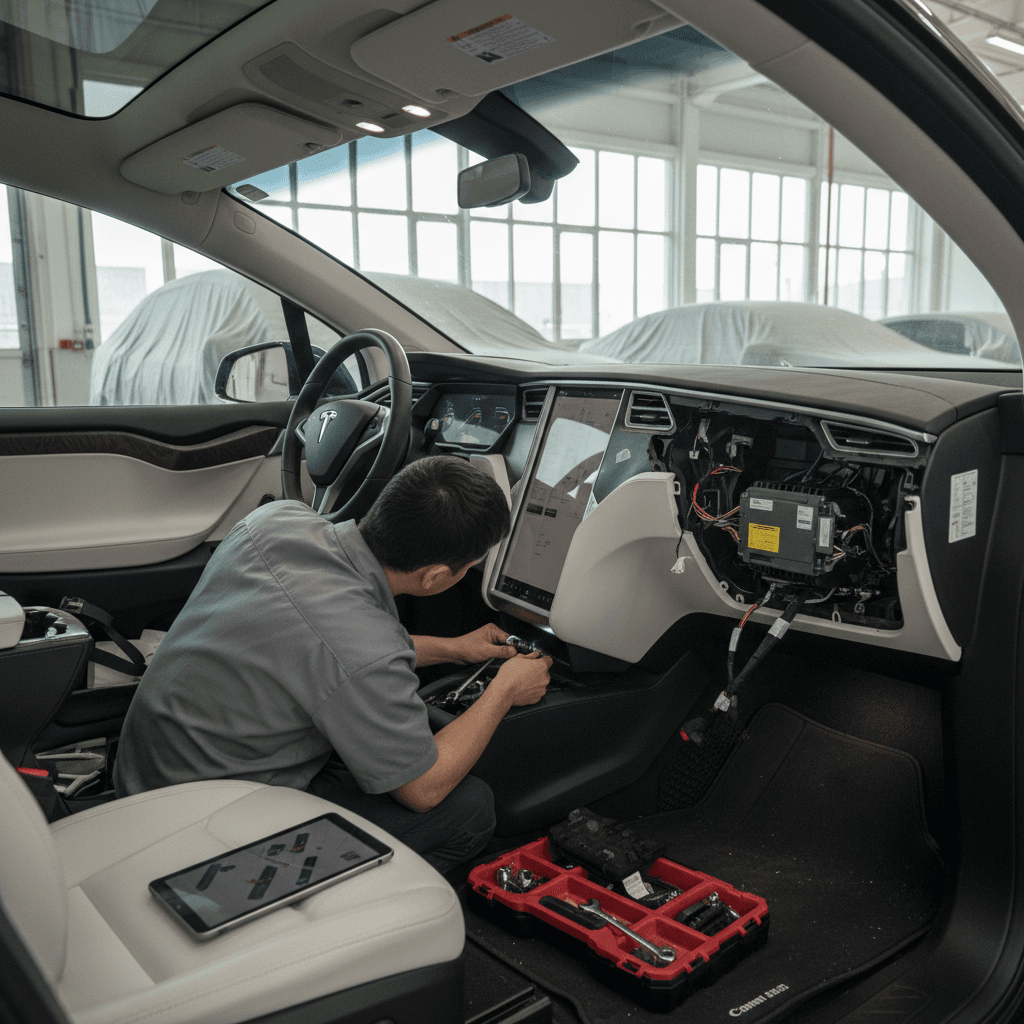
How Tesla handles recalls: over‑the‑air vs. service center
Over‑the‑air (OTA) recall fixes
For many 2021 Model X recalls, Tesla can push a software update directly to the vehicle:
- Happens while the car is parked and connected to Wi‑Fi or LTE.
- You’ll see a notification in the Tesla app or on the screen.
- Installation usually takes 15–30 minutes.
- No visit to a service center, no cost, and no paperwork to file.
Examples: FSD behavior changes, warning‑font size recall, some airbag/occupancy calibration campaigns, Boombox and chime behavior fixes.
Service‑center recall fixes
Hardware‑related recalls still require a physical inspection and repair:
- Seat belt anchor inspection and re‑attachment.
- Steering hardware or fastener replacement.
- Airbag component replacement if required.
- Window regulator adjustments when software alone isn’t enough.
You should see records in the car’s service history, in the Tesla app, or on the Recharged Score Report if you’re shopping on Recharged.
Good news for owners
How to check if your 2021 Model X has open recalls
You don’t have to guess whether a 2021 Tesla Model X has unresolved recalls. Here’s how to check any vehicle, whether it’s already in your driveway or you’re considering a used one from a private seller or dealership.
Step‑by‑step: check recalls on a 2021 Model X
1. Locate the VIN
Find the 17‑digit VIN at the base of the windshield on the driver’s side, on the driver‑door jamb label, or inside the Tesla app under Vehicle details.
2. Check Tesla’s recall page
Go to Tesla’s official recall or support page and enter the VIN. Tesla will show any <strong>open recalls</strong> that still need to be performed.
3. Cross‑check on NHTSA.gov
Visit the NHTSA recall lookup tool, enter the same VIN, and confirm that no open safety recalls are listed. Closed recalls may still show in the history, but they should be marked as completed.
4. Review service history
Ask the seller for Tesla service invoices, or pull up the car’s service history in the Tesla app. Look for line items referencing seat belt, steering, airbag, or safety campaign work in 2022–2025.
5. Ask for proof on critical repairs
For high‑priority recalls, seat belts and steering in particular, request written confirmation that the recall was completed, including the date and mileage.
6. Use a third‑party inspection or Recharged Score
If you’re buying used, a third‑party inspection or a <strong>Recharged Score battery and health report</strong> can validate that the vehicle is in good overall condition beyond just recall status.
Shopping used: what 2021 Model X recalls mean for value
If you’re in the market for a used 2021 Model X, the recall history is one more piece of the value puzzle, alongside battery health, mileage, and options. A long recall list doesn’t automatically make a 2021 a bad bet. In many cases, it’s a sign the manufacturer and regulators have already found and fixed the major issues.
How recalls affect used 2021 Model X value
It’s less about how many recalls, more about how they were handled.
Documented recall completion
When a seller can show that all relevant recalls are completed, it signals responsible ownership. That can support a stronger asking price and easier financing.
Open safety recalls
Open recalls, especially for seat belts or steering, are red flags. They’re still fixable at no cost, but they add hassle and uncertainty you need to price in.
Batteries vs. recalls
Battery health and charging performance usually move the price needle more than small software recalls. That’s why Recharged includes a Recharged Score battery report with every vehicle.
Use recalls as a negotiation tool
Inspection checklist for a used 2021 Model X
Beyond running the VIN for official recall status, you can look for a few real‑world indicators that the big 2021 Model X recall items have been handled properly. Use this list alongside a professional inspection or a Recharged Score report.
On‑the‑ground checks tied to recall items
Seat belt anchors feel solid
Buckle in the driver and front passenger belts, then tug sharply across the lap and shoulder. You shouldn’t feel any looseness at the lower anchor on the outboard side.
Steering feels consistent
On a test drive, do slow‑speed turns, figure‑eights in a parking lot, and highway cruising. Steering effort should stay consistent with no sudden heaviness or steering‑assist warnings.
No persistent airbag lights
Turn the vehicle on and wait for all warning lights to cycle. Any <strong>airbag or restraint system</strong> warnings that stay on deserve immediate investigation.
Windows auto‑reverse properly
Gently obstruct a closing window with a towel or thick cloth. It should stop and reverse smoothly rather than continuing to pinch.
Clean, current software
Check the Software screen for recent update dates. A car that hasn’t updated in a long time may have missed OTA recall fixes and could be neglected in other ways.
Professional inspection or Recharged Score
Have an EV‑savvy technician inspect the car, or shop with a marketplace like <strong>Recharged</strong> that includes a standardized <strong>Recharged Score</strong> report with verified battery health and condition.
Common owner questions about 2021 Model X recalls
2021 Tesla Model X recalls: FAQ
Should 2021 Model X recalls scare you off?
A 2021 Tesla Model X does carry a longer recall list than many SUVs, even among EVs. But in practice, that list is a blend of serious issues, like seat belt anchors and steering assist, and a large number of software and compliance campaigns that were quietly fixed over the air. For current owners, the job is simple: make sure your car is on current software and that Tesla has closed out any open hardware recalls.
If you’re shopping used, recalls can actually be an advantage. A 2021 Model X with documented recall completion, strong battery health, and clean service history may be a better bet than a "quiet" vehicle that hasn’t been scrutinized as closely. On Recharged, every used EV includes a Recharged Score battery health report, fair market pricing, and EV‑specialist support to help you read between the lines of recall history, service records, and software updates.
Do your homework, verify recall status by VIN, and pair that with a solid inspection and battery‑health check. Approach it that way, and a well‑maintained 2021 Model X can still be a compelling choice, combining the space and performance of a luxury SUV with the refinement of a maturing EV platform.