If you live in or around Charlottesville, Virginia and you’re considering an electric vehicle, you’ve probably noticed the incentives picture changing fast. Some federal EV rebates are being phased out, but new local and utility programs are popping up. This guide breaks down the current landscape of EV rebates in Charlottesville as of 2026 so you know what’s still available, what’s gone, and how to stack savings on a new or used EV.
A moving target
Overview: How EV rebates work in Charlottesville
When people search for “EV rebates Charlottesville”, they’re really talking about a stack of different programs that happen to intersect in Central Virginia. You’re not looking at one big Charlottesville-only check; you’re looking at a mix of federal tax credits, evolving state policies, utility incentives from Dominion Energy, and a handful of local grants and technical assistance programs.
Charlottesville-area EV savings snapshot (typical ranges)
Watch the timelines
Federal EV tax credits in 2026: what’s left
Federal incentives are still the largest dollar amounts most Charlottesville drivers will ever see, but 2026 is not the wide‑open landscape it was when the Inflation Reduction Act first launched. A House bill passed in 2025 aims to wind down several EV tax credits by the end of 2026, tightening eligibility and capping how many credits major automakers can claim. At the same time, IRS guidance around binding contracts gives some buyers a way to preserve the old rules if they signed before key 2025 deadlines.
- New EV federal credit (up to $7,500) – Still exists, but model eligibility is narrower and subject to price caps, income caps, and battery sourcing rules. Major brands that blew past earlier 200,000‑unit caps may be more constrained.
- Used EV federal credit (up to $4,000) – Scheduled to end after 2025 under current legislation. If you’re reading this in 2026, you’ll likely only benefit if you signed a binding contract by September 30, 2025 and are taking delivery later under transitional IRS rules.
- Commercial/lease credit – The separate $7,500 commercial EV credit that many leasing companies used to pass savings through to drivers is also under pressure from the 2025 legislation. Expect fewer subsidized lease deals going forward unless manufacturers decide to eat more of the cost.
Ask how your deal is structured
Used EV rebates & savings for Charlottesville buyers
Used EV shoppers in Charlottesville are in a different position. Federal policy is moving away from subsidizing used EVs after 2025, but the used market itself is doing part of the work that rebates used to do. Prices on many 3‑ to 6‑year‑old EVs have fallen as new supply grows, and the key questions are now about value and battery health, not just sticker price.
Why used EVs can still be a deal without big rebates
Rebates are nice, but depreciation and data matter more in 2026.
Faster depreciation than gas cars
Early‑generation EVs typically depreciated faster than comparable gas models. For you as a buyer, that means lower upfront prices, especially on 4–7‑year‑old cars.
Battery health transparency
With tools like the Recharged Score, you can see independent battery health data on a used EV instead of guessing. That helps replace old tax credits with real risk reduction.
Lower running costs
Even if the federal used EV credit is gone, you still save every month on fuel and maintenance. In Virginia, typical EV drivers spending about $1 a day on home charging often beat their old gas bills by a wide margin.
Every vehicle listed on Recharged comes with a Recharged Score Report that includes verified battery health, pricing benchmarks, and expert commentary. That doesn’t replace a tax credit, but in a market where federal support is shrinking, it’s one of the best ways to protect yourself from buying a discounted EV with an expensive battery problem hiding under the hood.
Where Recharged fits in
Ready to find your next EV?
Browse VehiclesVirginia-wide EV incentives that affect Charlottesville drivers
Virginia doesn’t currently offer a big, headline‑grabbing statewide EV rebate like some western states, but there are still policy levers and programs that nudge costs down for Charlottesville drivers.
Time-of-use & peak-time programs
Dominion Energy’s residential customers can enroll in programs that reward shifting EV charging to off‑peak hours. Under the Peak Time Rebates program, for example, you can earn bill credits by dialing back whole‑home usage during high‑demand events. Combine that with EV‑specific programs (covered below) and you can effectively turn smart charging into a small side income.
State tax environment & one‑time rebates
Virginia has focused more on broad taxpayer relief than targeted EV subsidies lately. One‑time state income tax rebates, up to $200 for individuals and $400 for joint filers in 2025, don’t require you to own an EV, but they do free up cash that can go toward a down payment or charger installation. Think of them as indirect EV money if you time your purchase smartly.
HOV lane perk is gone
Local Charlottesville & Albemarle EV incentives
This is where the phrase “EV rebates Charlottesville” starts to make literal sense. While there’s no city‑specific purchase rebate for residents buying an EV, there are local programs that support charging infrastructure and home energy upgrades, and those can meaningfully reduce your total cost of going electric.
Charlottesville & Albemarle-area EV-related incentives
Key local programs that impact EV charging and home electrification costs.
| Program | Who it Helps | What You Can Get | EV Angle |
|---|---|---|---|
| City of Charlottesville EV Charging Grant | Local businesses and property owners in the city | Up to $4,000 per Level 2 charger, up to $10,000 per DC fast charger in installation grants | Offsets hardware and installation costs for public chargers that attract EV‑driving customers. |
| Albemarle County public charging expansion | General public | New Level 2 and DC fast chargers at county office buildings; user fees apply | Increases reliable public charging options near downtown and 5th Street corridor. |
| Energy Resource Hub incentives directory | Homeowners, renters, and businesses in Charlottesville/Albemarle | Curated list of rebates, tax credits, and green loans for appliances, solar, EVs and charging | One‑stop portal to find EV charger rebates, tax credits, and technical support. |
| Charlottesville Residential Retrofit Mini‑Grants | City of Charlottesville homeowners | Up to $2,000 toward energy‑saving home improvements like insulation or heat pumps | Doesn’t directly pay for an EV, but frees up cash and improves efficiency before adding home charging. |
Programs and typical benefits available to Charlottesville and Albemarle County residents or businesses as of early 2026. Always confirm current terms before applying.
Start with the Energy Resource Hub
Dominion Energy programs for EV owners
Most Charlottesville households are served by Dominion Energy Virginia, and that matters because Dominion has quietly become one of the most important EV “rebate” players in the region, especially for home charging.
Key Dominion Energy offerings for Charlottesville EV drivers
Not all are classic rebates, but together they can shave hundreds off your EV ownership costs.
EV Charger Rewards
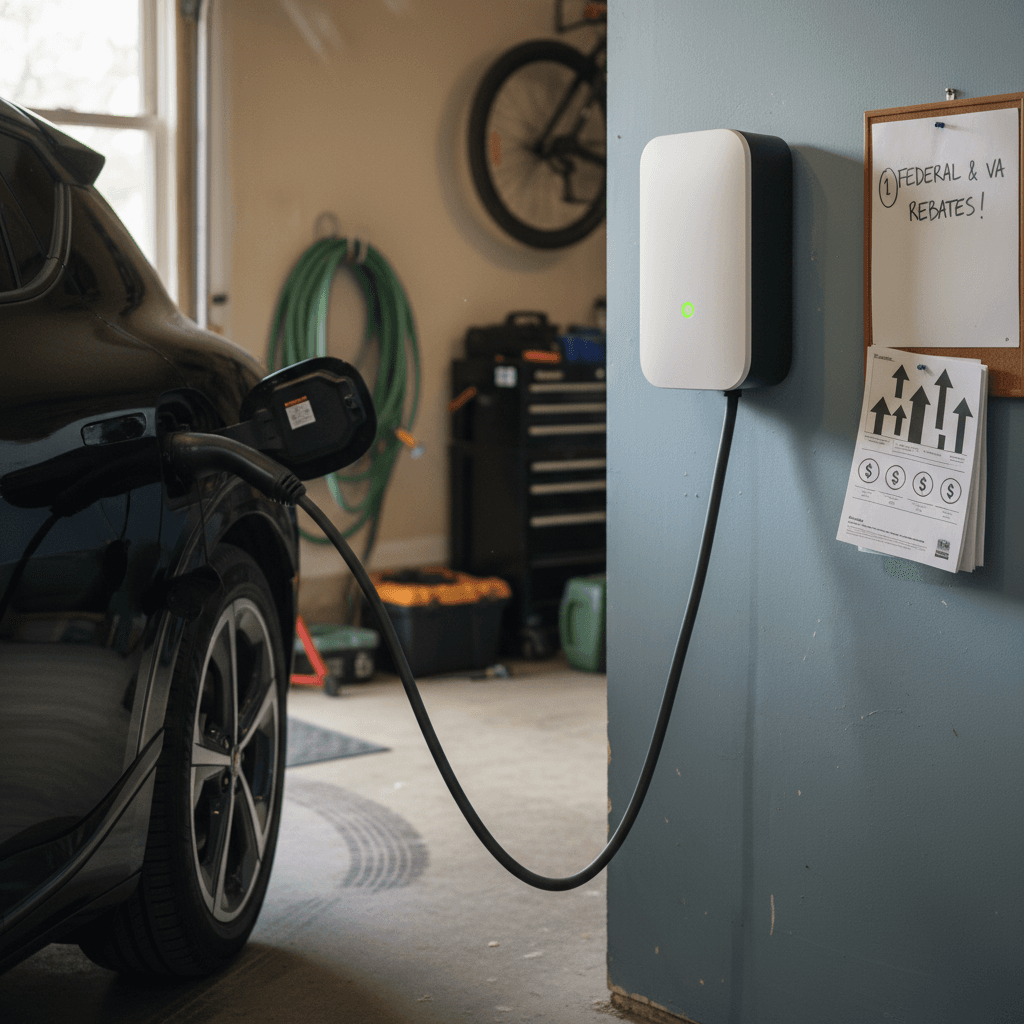
Dominion’s EV Charger Rewards program pays you to let them manage a qualified Level 2 smart charger at home.
- Enrollment incentive of about $125 when you buy and enroll an eligible charger from brands like ChargePoint, Emporia, Evocharge or Wallbox.
- $40 bill credit each year you stay enrolled.
- Charger must be Wi‑Fi connected and in a qualifying single‑family residence.
Residential Charger Program
If the upfront cost of a Level 2 charger is the barrier, Dominion’s Residential Charger Program wraps hardware and installation into a fixed monthly fee, around $40.27 on your bill for five years.
You avoid the big one‑time cost, but still end up with a dedicated home charging solution.
Off-peak & peak-time options
Dominion’s Off‑Peak Plan and Peak Time Rebates encourage you to shift EV charging away from the evening peak.
If you can plug in overnight, you can effectively turn smart charging habits into recurring bill savings, especially helpful once gasoline savings are part of your monthly equation.
Programs have fine print
Rebates for businesses, apartments & fleets
If you run a business, manage a multifamily property, or oversee a fleet in Charlottesville, your EV incentive picture looks different from a retail buyer’s. You’re unlikely to see big checks for the vehicles themselves, but charger infrastructure incentives are real.
- City of Charlottesville EV Charging Grant – Local businesses can apply for grants covering up to roughly $4,000 per Level 2 station and up to $10,000 per DC fast charger. Preference goes to sites near retail or commercial destinations, so drivers can patronize local shops while they charge.
- Dominion Environmental Justice Community (EJC) EV Charging Program – For eligible Environmental Justice communities in Dominion’s territory, the EJC program can provide no‑cost installation and maintenance of Level 2 or DC fast chargers for public, workplace, multifamily, or fleet use, including make‑ready infrastructure.
- Energy Resource Hub commercial incentives – The Hub’s filters include commercial customer types and an “EVs and Charging” attribute, which helps local businesses in Charlottesville and Albemarle identify charger rebates and low‑interest financing options.
Apartments: sell EV readiness, not just parking
How to stack and actually claim these incentives
The biggest frustration I hear from EV shoppers and small businesses is simple: “I know there are programs out there, but I don’t know how they fit together, or whether I personally qualify.” In Charlottesville, the trick is to treat incentives as a sequence, not a scavenger hunt.
Step-by-step: building your Charlottesville EV incentive stack
1. Decide new vs. used, then check federal timelines
If you’re leaning new, ask your dealer or online retailer for a plain‑English rundown on which federal credits, if any, still apply in 2026 and whether they’re already baked into the price. If you’re leaning used, focus instead on total ownership cost and battery health, since the federal used credit is effectively sunsetting.
2. Price in charging before you sign
In Charlottesville, the real local money shows up at the charger. Before signing a purchase agreement, get at least a ballpark quote on installing a Level 2 charger at home or your business, then see how Dominion and city programs can offset that cost.
3. Check the Energy Resource Hub for local programs
Use the Hub’s filters for Charlottesville or Albemarle and the “EVs and Charging” attribute. Note which incentives you qualify for based on income, property type, or business size so you don’t waste time chasing funds you can’t access.
4. Line up utility enrollment early
For Dominion’s EV Charger Rewards or Residential Charger Program, eligibility depends on your service address and existing rate plan. Start the enrollment process as soon as you order a charger so you don’t miss any deadlines for rebates.
5. Keep every invoice and approval email
Many rebates, federal and local, hinge on documentation. Save PDFs of charger invoices, contractor quotes, grant approvals, and your vehicle purchase agreement in one place so tax prep and rebate applications are painless.
6. If you’re buying used, lean on expert tools
With federal support shrinking, tools like the <strong>Recharged Score Report</strong> help you avoid overpaying for a used EV with a weak battery. That’s often worth more than chasing a disappearing $4,000 tax credit on paper.
How Recharged can help Charlottesville buyers
Recharged was built around used EV shoppers who want clarity instead of guesswork. If you’re in Charlottesville, you can shop online for used EVs nationwide, get a Recharged Score Report on each vehicle, and lean on EV‑specialist support to talk through range, charging and incentives before you sign anything.
You can also trade in your current vehicle, explore financing, and schedule delivery to Central Virginia, all digitally, or with in‑person help at Recharged’s Experience Center in Richmond if you’d rather make a day trip down I‑64.
Practical example: a Charlottesville family
Think of a family in Belmont eyeing a used Chevy Bolt. They might:
- Use Recharged to compare two Bolts with different mileage and battery health scores.
- Skip the fading federal used EV credit, but save thousands on depreciation versus new.
- Apply for Dominion’s EV Charger Rewards when they install a smart Level 2 charger in their driveway.
- Check the Energy Resource Hub for any home retrofit mini‑grant that could subsidize panel or wiring upgrades if needed.
The result: federal support isn’t the star of the show anymore, but total savings can still be compelling.
FAQ: EV rebates in Charlottesville, VA
Frequently asked questions about EV rebates in Charlottesville
Bottom line: making EV ownership pencil out
If you’re shopping EV rebates in Charlottesville in 2026, the story has shifted. The easy, one‑size‑fits‑all federal checks are fading, but there’s still real money on the table, especially around charging infrastructure, smart‑charging rewards, and falling used‑EV prices. The most successful buyers I talk to build their plan from the bottom up: start with a realistic look at range and charging needs, layer in Dominion and local programs, and then treat any remaining federal credit as a bonus, not a foundation.
Whether you’re a Charlottesville commuter eyeing your first used EV or a local business thinking about adding chargers out front, the core question is the same: does the math work without assuming yesterday’s subsidies? With the right information, and with tools like the Recharged Score Report and EV‑specialist support, you can still make that answer a clear yes.