If you drive an electric car long enough, the question will find you at 2 a.m. at a lonely DC fast charger: **“Is this fast charging bad for my EV battery?”** The short answer is: used occasionally and intelligently, fast charging is fine. Abused, it *can* shave years and miles off your usable range, especially on some battery chemistries and ultra‑high‑power chargers.
The nuance in one line
Fast charging: friend or foe for your EV battery?
Before we get into why fast charging can be bad for an EV battery, it helps to define our terms. **Level 1 and Level 2 charging** use AC power (typically 120–240V) and are relatively gentle, like a jog. **DC fast charging**, what most people call “fast charging” or “Level 3”, skips the onboard charger and feeds high‑power DC straight into the pack, often at 50–350 kW or more. That power is what lets you go from 10–80% in 20–35 minutes instead of overnight.
How fast charging compares to other charging levels
Same electrons, very different pace and stress level
Level 1 (120V)
- Standard wall outlet
- ~2–4 miles of range per hour
- Very gentle on battery
Level 2 (240V)
- Home or public AC chargers
- ~20–40 miles of range per hour
- Normal, recommended daily charging
DC fast charging
- Highway and commercial stations
- 50–350+ kW, rapid top‑ups
- Most convenient, most stressful on the pack
The concern behind **“why is fast charging bad for EV batteries?”** comes down to physics: stuffing energy into a lithium‑ion pack quickly creates more heat, higher internal stresses, and a greater risk of microscopic damage. Modern EVs are built with smart battery management systems (BMS) and cooling to control that damage, but physics still takes its cut.
What real‑world data shows about fast charging and battery health
The headline risk
What actually happens inside your battery during fast charging
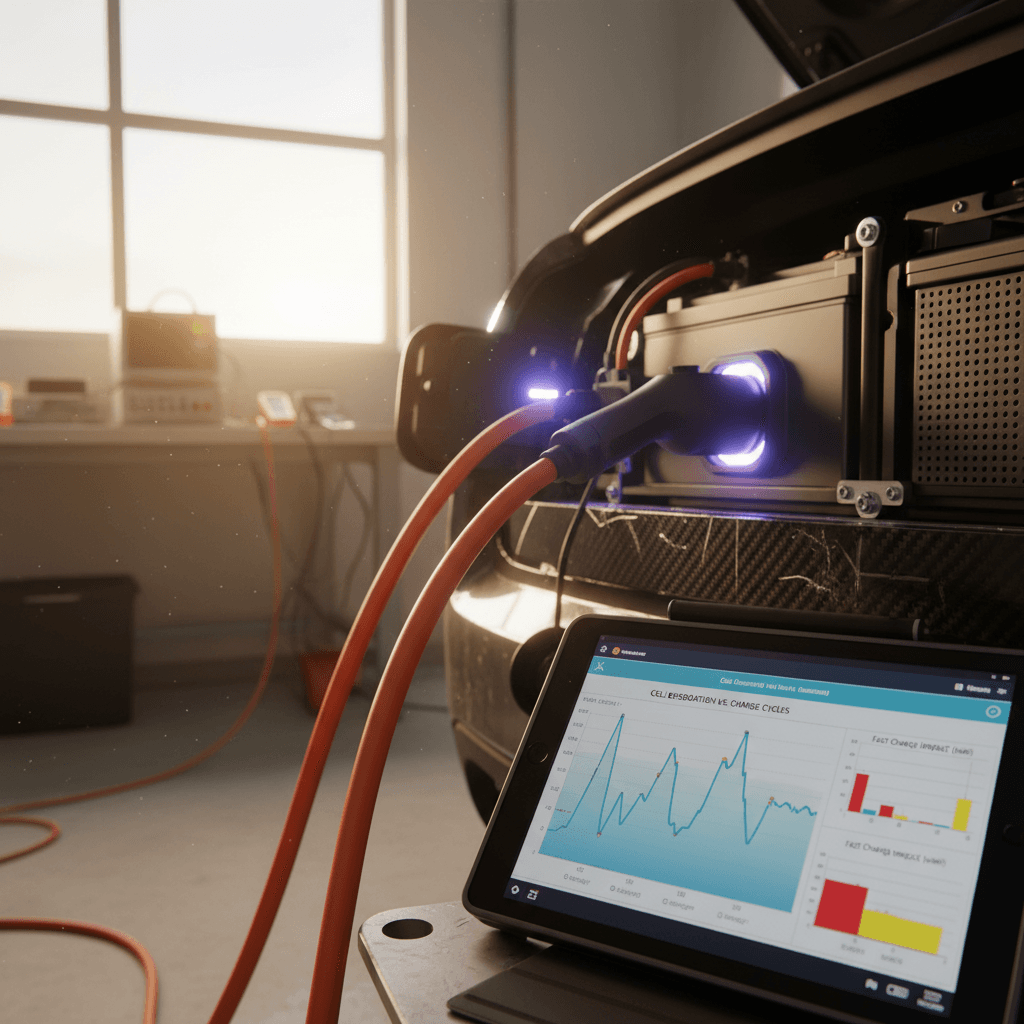
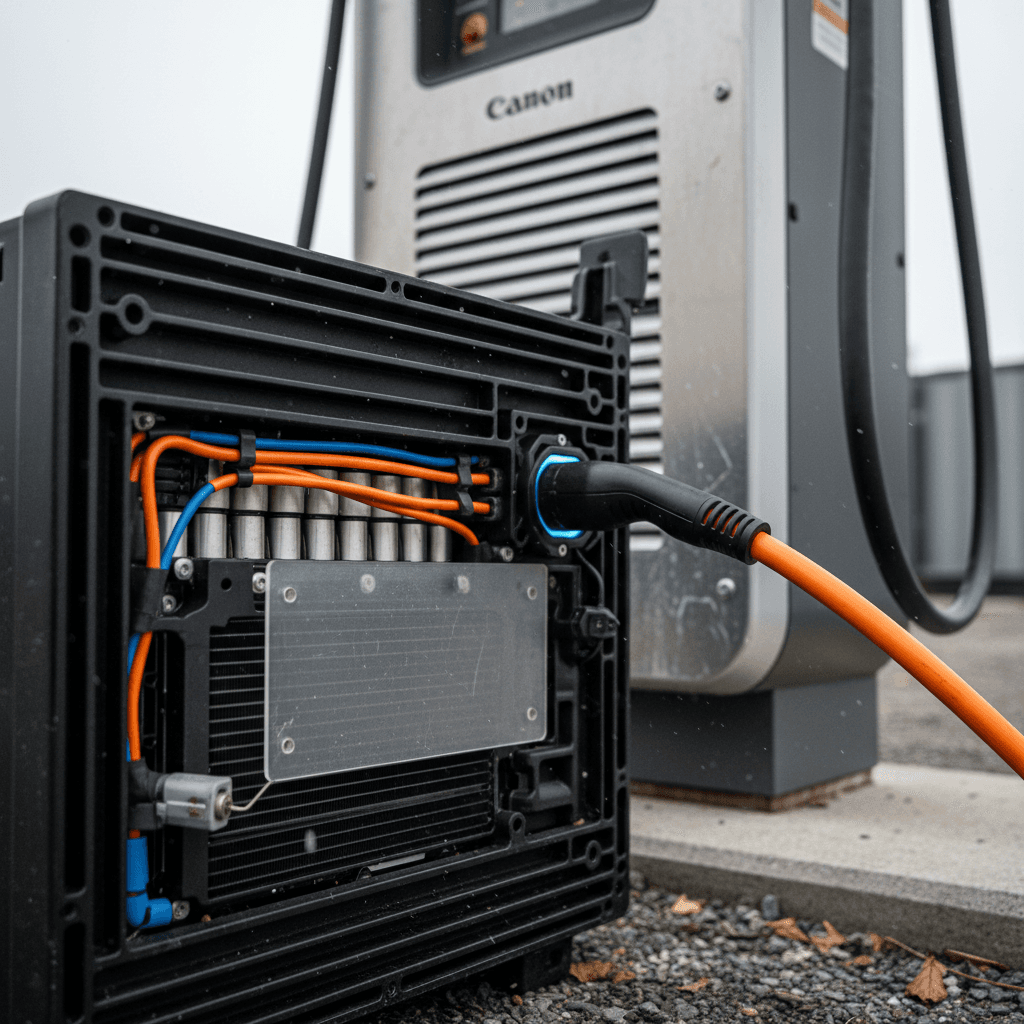
A modern EV battery is a tightly packed sandwich of electrodes, electrolyte, and separators kept in a narrow comfort zone of temperature and voltage. Fast charging pushes that system to its limits. Here’s what’s going on under the floor when you plug into a big DC box marked 150 kW or 350 kW.
- More heat, everywhere. Charging is an exothermic process: shove energy in quickly and the pack heats up. Elevated temperatures accelerate the slow chemical reactions that age the battery and, in extremes, threaten safety.
- Higher mechanical stress. Ions move in and out of the electrode materials as you charge and discharge. When you fast charge, they crowd in more quickly, which can create mechanical strain and micro‑cracks inside the electrodes over many cycles.
- Risk of lithium plating. If the anode can’t absorb lithium ions as fast as they arrive, because it’s cold, already near full, or the current is too high, metallic lithium can plate onto its surface. That permanently removes capacity and, in bad cases, grows needle‑like dendrites that can lead to internal shorts.
- Uneven cell loading. In big packs, some cells naturally charge a bit faster or run a bit hotter than others. High‑power charging exaggerates these differences. The BMS works hard to balance everything, but it can’t make the pack perfectly uniform.
Why your car rarely lets you truly abuse the pack
How much faster does fast charging age an EV battery?
This is the question EV owners really care about: **what’s the price, in battery life, of convenience?** The honest answer is that it depends on chemistry, cooling, how hard you fast charge, and how often. But we can sketch the outlines.
Typical charging patterns vs. long‑term battery wear
Illustrative ranges based on published studies and fleet data; exact numbers vary by model, chemistry, and climate.
| Charging pattern | Use of DC fast charging | Typical annual degradation | Who this looks like |
|---|---|---|---|
| Mostly home/public Level 2 | Occasional DC fast charging on road trips | ~1–2% capacity loss per year | Typical suburban commuter with home charger |
| Mixed AC + DC | 1–2 DC fast charges per week, mostly 50–150 kW | ~2–3% capacity loss per year | High‑mileage driver without reliable home charging |
| Heavy DC fast charging | Most energy from DC, including frequent high‑power sessions | ~3–5%+ capacity loss per year | Ride‑hail or fleet vehicle chasing uptime |
Think of these as ballpark comparisons, not precise predictions for your specific car.
What these numbers really mean for you
Battery chemistry matters: LFP vs NMC vs NCA
Not all batteries react to fast charging the same way. In broad strokes, today’s EV packs use three main families of lithium‑ion chemistry, each with its own charging personality.
How common EV chemistries handle fast charging
Your degradation risk depends in part on what’s inside the pack, not just where you plug in.
LFP (Lithium Iron Phosphate)
- Increasingly common in standard‑range Teslas and many Chinese EVs.
- Very robust to frequent fast charging in tests, even when used heavily.
- Lower energy density means shorter range, so owners tend to fast charge more, but chemistry is forgiving.
NMC (Nickel Manganese Cobalt)
- Used by many non‑Tesla automakers.
- Handles moderate fast charging well but shows faster wear when fast charging dominates.
- Balanced mix of range, cost, and robustness.
NCA (Nickel Cobalt Aluminum)
- Found in many long‑range Teslas and some performance EVs.
- Offers excellent range but can be more sensitive to sustained heavy fast charging.
- Degradation can climb sharply under extreme fast‑charge usage.
Don’t know your chemistry? Ask, or look it up
When fast charging is hardest on your EV battery
Fast charging is a tool, and like any tool it can be misused. Certain combinations of state‑of‑charge (SoC), temperature, and charging power are harder on the pack than others.
High‑stress fast‑charging situations to minimize
1. Fast charging from near‑empty in brutal heat
Running the pack down to a very low SoC, then immediately hammering it with maximum DC power in 100°F+ weather is tough on chemistry and cooling systems alike. Give the car a few minutes to cool and, if available, use battery preconditioning.
2. Fast charging in freezing cold without preconditioning
Cold cells can’t absorb lithium as quickly, which raises the risk of lithium plating at high charge rates. Many EVs automatically precondition the battery if you navigate to a fast charger in the car’s nav, use that feature.
3. Holding 90–100% on DC repeatedly
The top end of the battery’s charge curve is where voltage is highest and the pack is under the most electrochemical stress. That’s why many EVs slow charge dramatically above ~80% on a fast charger. Staying on the plug to chase the last few percent adds more stress than range.
4. Back‑to‑back ultra‑fast sessions
If you’re bouncing between 150–350 kW chargers with little downtime, the pack may not have enough time to cool. This is especially relevant for fleets and ride‑hailing drivers.
Watch the plateau
Smart fast‑charging habits that protect range
You don’t have to choose between convenience and battery health. A few habits will let you use DC fast charging confidently while still preserving range for the long haul.
- Aim to fast charge in the middle of the pack. When possible, arrive with ~10–20% and unplug around 70–80%. That’s where your car charges fastest and where the chemistry is most comfortable.
- Let the car precondition. If your EV supports battery preconditioning, start navigation to the charger in your car’s system, not just on your phone. That lets the pack reach a Goldilocks temperature for fast charging.
- Prefer Level 2 for daily use. Home or workplace Level 2 charging is the EV equivalent of a healthy diet: boring, consistent, effective. Save DC fast charging for road trips, long days, and genuine time pressure.
- Don’t panic over occasional abuse. A handful of “ugly” charging sessions, fast charging to 100% in summer, for example, won’t ruin a healthy pack. It’s the pattern over years that matters.
- Use station power wisely. Just because the pedestal advertises 350 kW doesn’t mean your car needs or can use it. Many EVs max out well below that; chasing the biggest number on the sign doesn’t buy you much.
A simple rule of thumb
Daily driving vs. road‑trip strategy
For daily life
- Rely on home or workplace Level 2 if you can.
- Use a simple target window like 20–80% or 30–90% SoC for most days.
- Reserve fast charging for the rare day when you run unexpectedly low.
- In apartments, try to mix slower public charging with fast charging rather than using DC for every single session.
If you’re charging almost exclusively at DC fast chargers because you have no other option, expect somewhat faster degradation, but not instant doom.
For road trips
- Plan around 10–80% hops: arrive fairly low, leave once the charge rate starts tapering sharply.
- Let the car do the thinking. Built‑in route planners in many EVs already optimize stops to keep the battery in its fast‑charging sweet spot.
- Skip the temptation to “fill to the brim” at every stop. Those last 20% points take the longest and add the most stress for the least payoff.
- It’s fine to break these rules occasionally to reach a charger desert, just don’t make it your default ritual.
Trip‑planning bonus
Used EVs: how much fast charging is “too much”?
If you’re shopping the used market, the question shifts from **“Will fast charging hurt my battery?”** to **“Has fast charging already hurt this battery?”** High‑mileage cars that lived at DC stations, think ride‑hail duty, can show more degradation than garage‑kept commuters that mostly sipped Level 2.
Reading the clues on a used EV’s fast‑charging history
You may not get a neat percentage, but you can triangulate the truth.
1. Current range vs. original
2. Prior use pattern
3. Independent battery health data
How Recharged helps you see past the plug
Fast‑charging myths vs. reality
Common fast‑charging myths, corrected
Separating scary stories from how modern EVs are actually engineered.
| Myth | Reality |
|---|---|
| “A few fast charges will ruin your battery.” | Modern packs are designed for thousands of cycles. Occasional DC fast charging, especially on trips, has a minor impact compared with overall age and mileage. |
| “Using a 350 kW charger is always worse than a 150 kW one.” | Your car decides how much power to take. If it’s limited to 120 kW, both pedestals will feed roughly the same, and the BMS will taper when needed. |
| “You should never charge past 80%.” | 80% is a good general target for routine fast charging, but topping to 90–100% for a long day or vacation is perfectly fine in moderation. |
| “Fast charging voids your warranty.” | Manufacturers expect you to use DC fast charging. Abuse, like constant ultra‑fast charging in extreme conditions, might complicate warranty claims, but normal use is supported. |
| “All EVs hate fast charging equally.” | LFP packs tolerate fast charging better than some NCA designs; thermal management and BMS strategies also vary by model. Chemistry and engineering matter. |
Your EV is smarter and tougher than the internet rumor mill suggests, but it’s not invincible.
Battery life isn’t determined by one or two heroic charging sessions at a lonely highway charger. It’s written in the sum of a thousand small decisions about how you treat the pack day in and day out.
FAQ: Fast charging and EV battery health
Frequently asked questions about fast charging and battery life
The bottom line: fast charging and long battery life can coexist
Fast charging is both the EV’s party trick and its moral panic. Yes, if you live on 350 kW pedestals, especially in brutal weather, running the pack from empty to full over and over, you will pay a toll in battery life. But that’s not how most people actually drive. With a diet built around **Level 2 charging** and fast charging used thoughtfully, your battery can age gracefully while still giving you the freedom to cross states in a day.
So don’t fear the big green “Start” button at a highway charger. Use it wisely. Arrive low, leave around 80%, let the car precondition, and don’t obsess over the occasional imperfect session. And if you’re stepping into the used EV world, lean on transparent battery‑health data, like the Recharged Score, so you know exactly what story that pack has been telling fast chargers all its life.